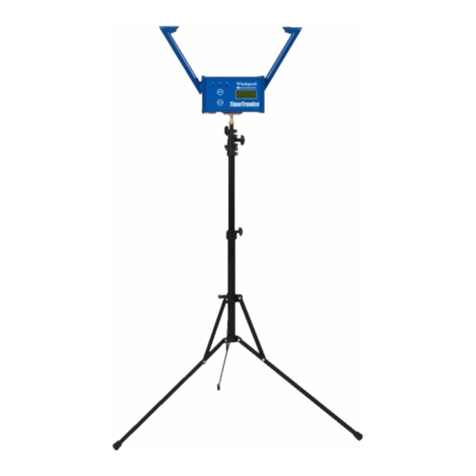
2012v1 Manual FalseStart II
1. Introduction
In T&F races the athletes have become faster and faster and the result of one athlete meticulously approximates to the
result of another. This progress goes hand in hand with the evolution in science and technique. As a consequence, time
measurement in track and field races should be very accurately performed up to one thousandth of a second.
A very significant part of a race (particularly at sprint races is the start. Sometimes, a detection of such a start is still
visually perceived by the human eye. The development of our system, False Start, enables us to electronically detect a
false start.
An athlete causes a FalseStart whenever he or she starts before 100 thousandths of a second after the starting shot (=
current IAAF regulation . The IAAF considers this limit of 100 thousandths as being the fastest human reaction time
possible. This means that a starter in the current system has to judge whether an athlete starts sooner or later than the
100 thousandths of a second, thus causing a FalseStart or not. An athlete can be privileged (e.g. letting him run at a start
after 65 thousandths or handicapped (e.g. shooting back at a start after 105 thousandths . By applying an electronic
detection, these inaccuracies can be avoided.
1.1 Optimization of the audibility of the starting shot
It is possible that:
a The sound of the starting shot does not reach all athletes simultaneously.
b The sound of the starting shot reaches the athletes too late.
At a start of 8 athletes, where all starting blocks are positioned
next to each other, the distance between the athlete in lane 1
and the one in lane 8 amounts to approximately 8.5 meters.
When looking at the time difference with respect to the moment
at which both athletes hear the starting shot, and taking into
account the sonic speed (= 343 m/s , we can conclude that the
athlete in lane 8 hears the starting shot 2.5 hundredths of a
second later than the athlete in lane 1 provided that the starter
is positioned at the far left side from the track (see drawing .
This difference may even become larger at races such as the 400 meters, at which the starting blocks are positioned at
least 7.5 meters from each other. The athlete in lane 8 would hear the starting shot 14.4 hundredths later than the athlete
in lane 1, on condition of course that the starter would take place close to the athlete in lane 1, which would rather be
unfair.
The starter could in fact position himself at an equal distance to each athlete, in other words in the centre of an imaginary
circle which is drawn over the starting blocks. Consequently he will be about 31 meters apart from each athlete so that all
athletes will simultaneously hear the starting shot 9 hundredths of a second too late.
That is why this virtual distance between starter and athlete will have to be reduced. We
bring the sound to each athlete by using a microphone and an amplifier at the central
starter position, and a loudspeaker into EACH starting modules (mounted at the back of
each starting block . All connections are made by means of one single cable, which
connects all starting modules to the FalseStart system.
What we certainly want to emphasize is that the FalseStart detection system remains an
auxiliary TOOL for the starter, to ASSIST him. It still remains the starter’s responsibility
to make the final decision when it comes to defining a false start.
In subsequent parts you will encounter a more elaborate description of our FalseStart
detection system.
3