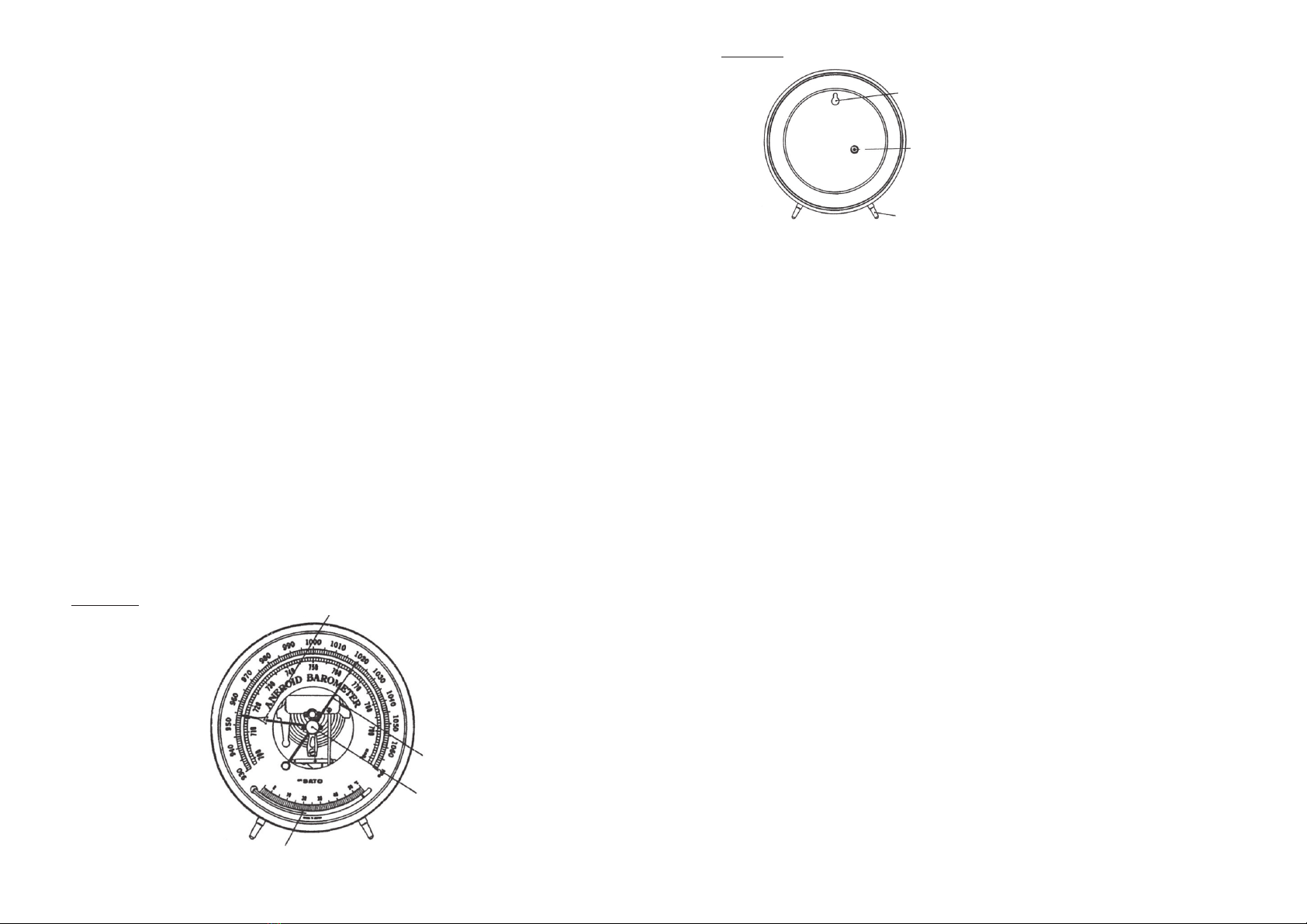
3. Specifications
Cat. No. No. 7610-20
Product Aneroid Barometer with Glass Thermometer
Atmospheric
pressure
Measuring range 930 to 1070 hPa
700 to 800 mmHg
Min. graduation 1 hPa, 1 mmHg
Accuracy ±1 hPa (at 980 to 1020 hPa)
±3 hPa (at other than above)
Sensing element Aneroid bellows
Usable altitude Up to 500 m
Temperature
Measuring range -10 to 50°C
Min. graduation 1°C
Accuracy ±2°C
Sensing element Colored kerosene
Materials Case Brass (buffing)
Window Plate-glass
Dimensions Ø158 × 50 (D)mm
Weight About 690 g
Standard accessories Test result, Instruction manual
4. Sea Level Corrections
When the weather observations (T.V., radio and newspapers) announce the atmospheric
pressure, they are referring to the atmospheric pressure at a height of zero meters above sea
level. The atmospheric pressure changes with the height (meters above sea level). It is
required to check the place where the barometer is being placed before use.
Refer to Fig. 1. As the ground gets higher the air becomes thinner and the atmospheric
pressure decreases. Because of that, the pointer of the barometer will point to the low
atmospheric pressure area of the scale. Upon reaching a height of 100m above sea level,
the reading of the barometer will drop approximately 12 hPa. The higher above sea level
the more the pointer will move left to the low pressure zone.
For example, if the result of the measuring atmospheric pressure at a place of 100m above
sea level is 1001 hPa, the correct atmospheric pressure at the place is 1013 hPa calculated
by adding 12 hPa to 101hPa. This method is referred to as “Correcting to Sea Level”
Chart for Converting the Sea Level Correction (in hPa) from The Altitude (in meters)
When the barometer is used at a place 50 meters above sea level (altitude), the sea level
correction value is approx. 6 hPa. Read the atmospheric pressure of this place by
correcting 6 hPa toward the high atmospheric pressure zone.
If one in advance researches the height (above sea level) of the place where the barometer
is in use and makes the sea level correction according to the above chart then this will be
similar to the method for fixing pressure at zero meter above sea level which the weather
observatories publish. The higher the ground becomes the more the pointer will move to
the left (toward the low pressure zone). Consequently, when correcting to sea level read to
the right (toward the high pressure zone) as much as the pointer has moved left due to the
height of one’s position above sea level.
Fig. 1
Hei
ht above sea level
Sea level correction
3-4, Kanda-kajicho, Chiyoda-ku, Tokyo 101-0045 Japan
URL: http://www.sksato.co.jp/english/
K.07