【2-2 Precautions】
1) Use clean and dry gas with the mass flow Controller / meter. The dryness condition must be a dew
point below –20℃at atmospheric pressure.
2) A 100-micron filter is installed at the gas inlet. However, if the meter is to be used in a line where dust
and mist might be produced, install a filter of about 10-micron in front of the meter to remove them.
3) Install a stop valve for gas stop completely.
A control valve of mass flow controller is “normally close” , but cannot completely shut off it. Please
avoid using it as a substitute of a stop valve.
3. Installation
【3-1 Installation Site】
1) The mass flow meter is designed for indoor use.
Never install the meter in a place where it may be wetted. The meter may fail.
Install the meter in a place that is well ventilated and has little change in humidity.
2) Install the meter in a place free of vibration and impact.
3) Do not install the meter in a place that is under direct sunlight or very hot or humid.
4) Install the meter in a place free of dust.
5) Install the meter in a place free of corrosive gases.
6) Install the meter in a place free of strong electric or magnetic field.
7) Be sure to conduct leak tests of the piping after installation.
8) Always use the special connecting cables.
Note that the use of the meter out of the specifications is a cause of failure.
【3-2 Contamination of the Piping System】
Be sure to use well-cleaned pipes and joints for piping. A standard filter has been installed. However, if
a large amount of dust adheres, the gas flow will be disturbed. In particular, if air from a compressor or
blower fan is used, it is likely that a large amount of oil mist and water may enter the meter. In such a case,
always install an oil filter or water removing filter in front of the meter.
【3-3 Installation Method】
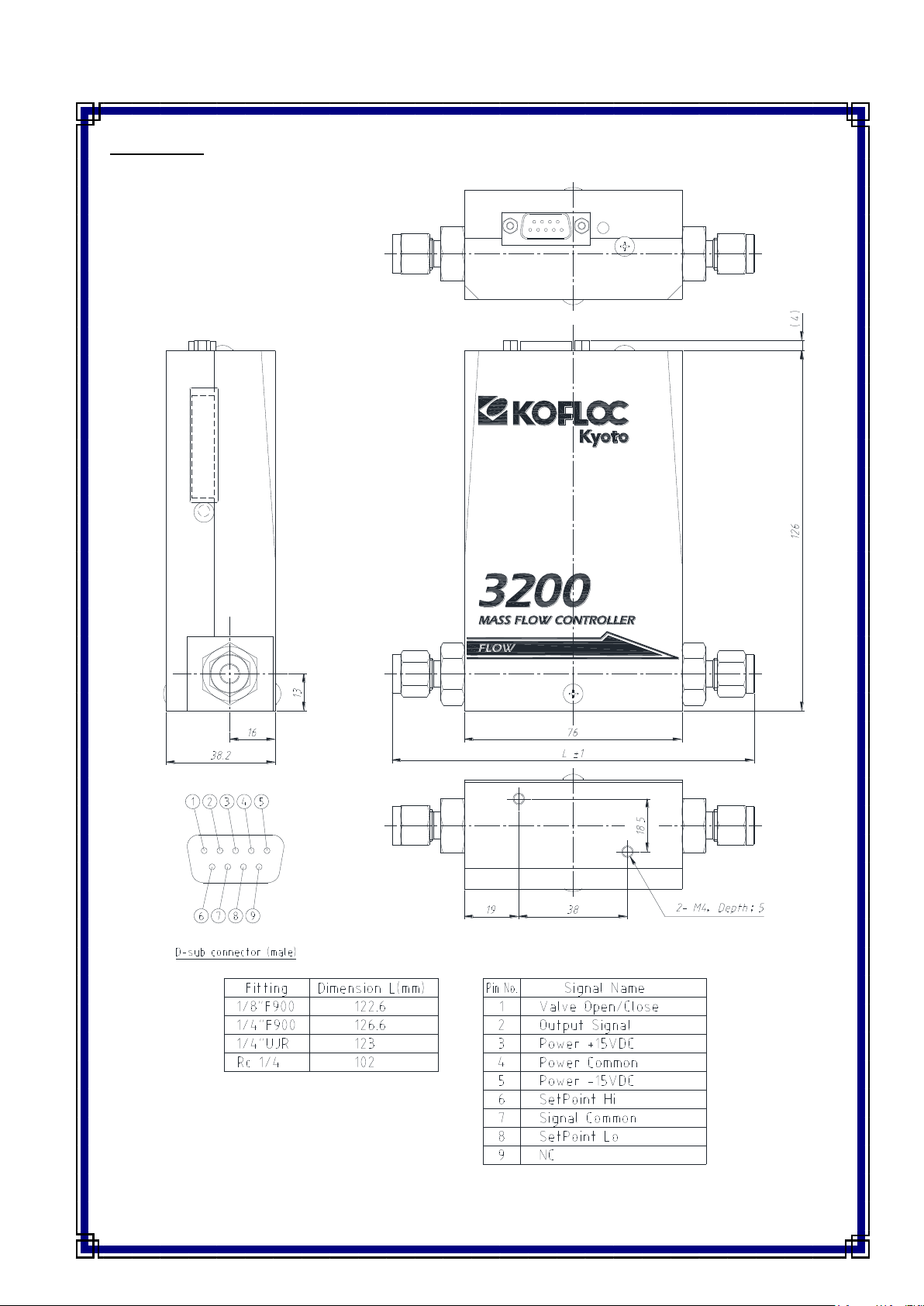
1) For installation, utilize the mounting threaded holes (M4) on the bottom of the meter block.
2) The standard piping connection is 1/4”Swagelok. Use suitable joints and be sure that they will not
leak.