5
Op er at ion : I nt e rn al Ele ct r ode s
The parallel resist ivit y probe m et hod
com plies wit h EOS/ ESD- S11.11. I t is
used t o giv e fast elect r ical resist iv it y
m easurem ents on flat hom ogeneous
m at erials. I t m ay be used on m ult ilay-
ered m at erials, but t his should be not ed
along wit h t he tem perat ure and hum idit y
value on t he dat a repor t. When t he
m easurem ent is t aken bet ween t he
tester’s two mesh rails under the tester, the tester will in-
dicat e t he surface resist ivit y of t he m at er ial being t est ed.
1. Prior t est ing, m ake cert ain t hat surfaces t o be
t est ed are clean and free of cont am inant s.
2. Allow the m et er t o equilibrat e to t he at m osphere
the m et er is to be used in. I t m ay t ake a half hour
for t he m et er t o adj ust t o envir onm ent condit ions.
3. Place the m et er on t he desired surface t o be test ed
and press and hold the red t est button.
4. When using t he built - in electrodes, the meter’s test
values for surface resist ivit y are in ohm s per square
( alt hough t hey ar e displayed in ohm s) .
5. The test value is indicated on t he LED display. A
decade will br ight en t o t he accor ding t est value.
6. Colors signify the test value’s function (see page 3).
Op er at ion : Ex t er na l Ele ct r ode s
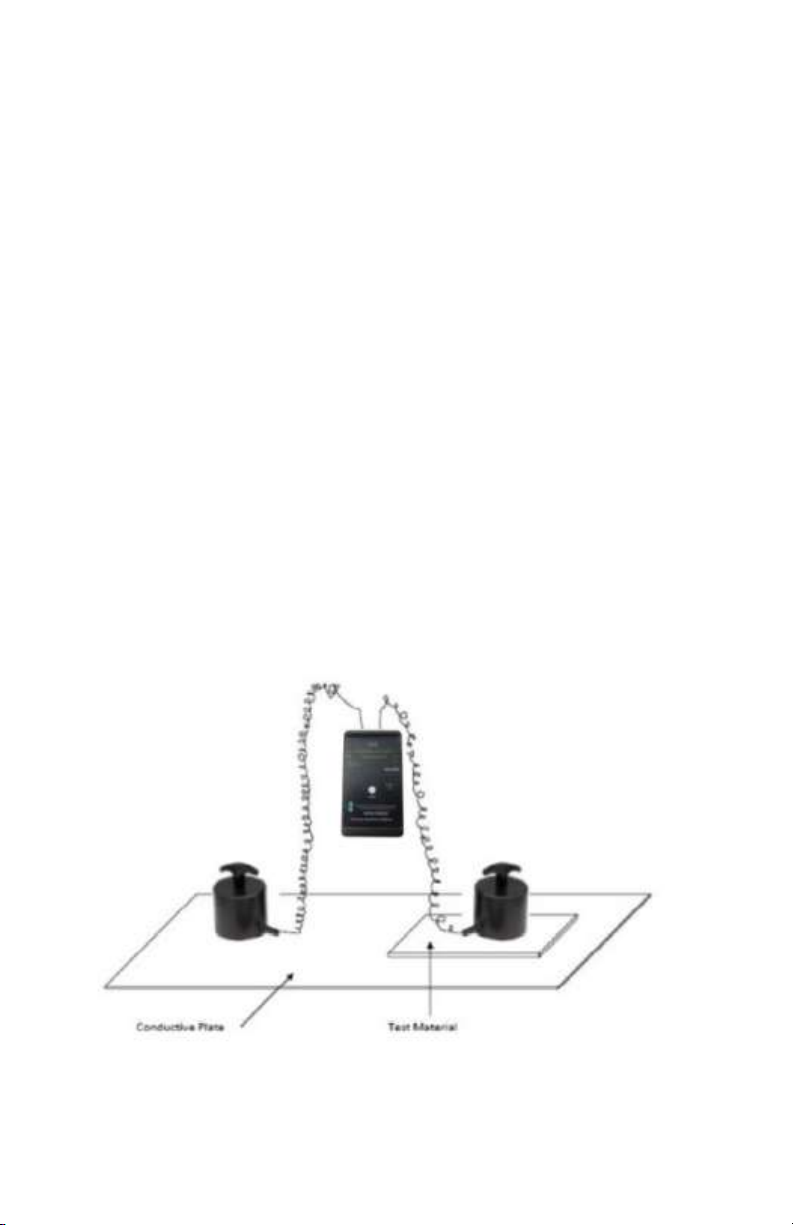
By connect ing t he opt ional surface resis-
tance probes to the SRM320 meter, it’s
possible t o m easure other form s of re-
sist ance su ch as Point t o Point ( RTT) Re-
sist ance, Surface t o Gr ound ( RTG) , and
Volum e Resist ance. Using these probes
will allow com pliancy wit h var ious st an-