FPI 100 Manual 1. Introduction
Page 2
Status: 16.6.01
1Introduction
The FPI 100 is a piezoelectrically scanned confocal Fabry-Perot Interferometer that combines high finesse
(F) and ease of alignment with the flexibility of using it as a stable reference cavity for applications from
the UV toIR range of the optical spectrum. Two different mirror radii are available, 75 mm and 18.75 mm,
which give a free spectral range (FSR) of 1GHz and 4GHZ, respectively.
1.1 Theory of Operation
When illuminated by monochromatic light rays close to the axis, a multiple beam interference pattern is
produced near the center of the interferometer. At precisely the confocal spacing, each mirror images
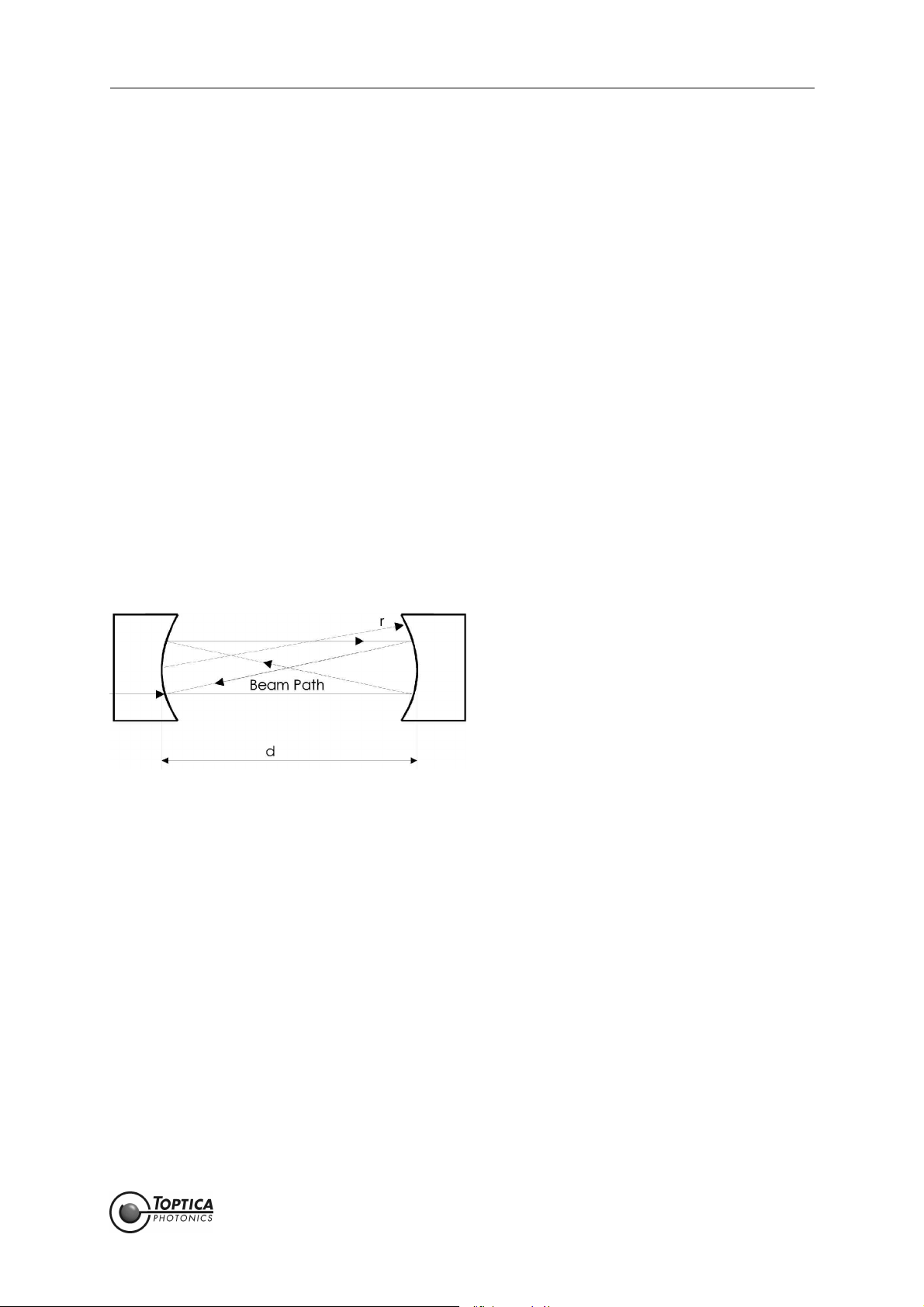
the other back upon itself so that a paraxial ray is re-entrant, i.e. falls back upon itself after four traversals
of the interferometer. This is not strictly true for real rays, where successive traversals of the interferometer
are not perfectly re-entrant but for paths close to the axis multiple reflections will continue to intersect at
the beam waist, creating an interference fringe pattern. Four traversals of the cavity mean that the trans-
mitted spectrum is reproduced with every quarter wavelength (λ /4) change in the mirror separation.
Consequently the free spectral range is given by
where cis the velocity of light, nis the refractive index of the air between the mirrors, and dis the dis-
tance between the mirrors.
Figure 1 Confocal Interferometer Configuration
The etalon makes use of spherical mirrors whose radius of curvature ris equal to the spacing dbetween
the mirrors. Therefore, the FSR of a confocal etalon is fixed by the choice of mirrors. This is a disadvantage
when compared to a plane parallel Fabry-Perot Interferometer, which can be used at any mirror spac-
ing. On the other hand the spherical mirror interferometer is much less sensitive to mirror alignment
because it is not necessary to maintain mirror parallelism. In addition, the focusing effect of curved mir-
rors results in a mode with a small diameter on the mirror surface, minimizing the possible finesse degrada-
tion due to the mirror surface imperfections. Only the mirror separation and alignment with incident light
beam are critical for the performance of a spectrum analyzer, which makes the confocal spectrum ana-
lyzer extremely simple to use.
1.2 Resolution and Finesse
The spectral resolution of any Fabry-Perot interferometer is FSR/F. For a given FSR, the resolution becomes
higher for higher reflectivity mirrors. At high reflectivity the surface quality of the mirrors may also limit the
resolution. (See paragraph 6.4). Therefore, there are practical limits in the quest of arbitrarily high resolu-
tion. One is that the surface quality is bounded by the limitations of mirror polishing. Another is that higher
reflectivity produces lower etalon transmission, as coating absorption and substrate scattering losses
FSRc4nd⁄=