ST STEVAL-LVLP01 User manual

Introduction
The STEVAL-LVLP01 evaluation board is based on the STDRIVE101 three-phase gate driver and the STL8N10F7 power
MOSFETs.
The STEVAL-LVLP01 embeds a power stage and circuitry for driving three-phase brushless DC motors. The board can be
interfaced with different control boards based on STM32 microcontrollers through the MC Connector V2, which is a part of motor
control development platform supporting ZeST and HSO Algorithms.
The STEVAL-LVLP01 can support single-shunt or three-shunt operation. The different connectors for onboard motor positioning
feedback and motor phase sensing network allow implementation of sensor and sensorless algorithms for motion control.
Figure 1. STEVAL-LVLP01 evaluation board
Getting started with the STEVAL-LVLP01 evaluation board
UM3193
User manual
UM3193 - Rev 1 - October 2023
For further information contact your local STMicroelectronics sales office. www.st.com

1 Hardware description and configuration
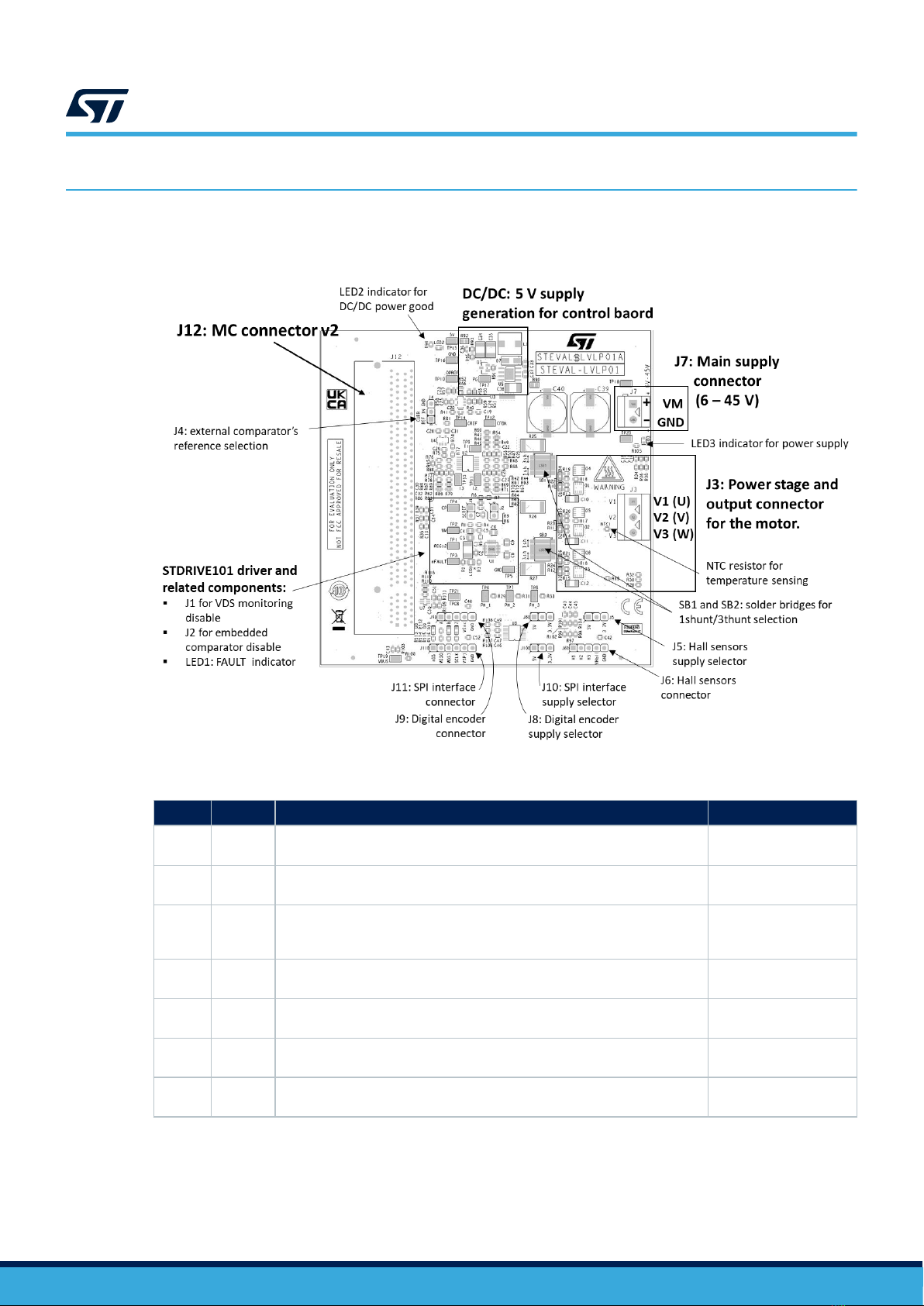
The main components and connectors of the STEVAL-LVLP01 are shown in the figure and tables below.
Figure 2. STEVAL-LVLP01 main components and connectors
Table 1. STEVAL-LVLP01 configuration jumpers
Ref. Label Description Default
J1 SCREF Allows to short the SCREF pin of the STDRIVE101 to 3.3V, thus disabling
the VDS monitoring protection (see VDS monitoring protection).
Open (VDS protection
enabled)
J2 Allows to short the CP pin of the STDRIVE101 to GND, thus disabling the
overcurrent protection (see Overcurrent comparator).
Open (OC protection
enabled)
J4 CURR
REF IN
Allows to select the reference for the current control comparator (see
Comparator for current control). The reference signal can be provided
externally, by removing the jumper or directly from the CURR_REF signal
Jumper on CURR_REF
signal
J5 Selects the supply of the motor’s Hall sensors, whether 5 V or 3.3 V (see
Hall sensor connector)Jumper on 5V selection
J8 Selects the supply of the motor’s encoder, whether 5 V or 3.3 V (see Digital
encoder connector)Jumper on 5V selection
J10 Selects the supply of the Serial Peripheral Interface (SPI), whether 5 V or 3.3
V (see SPI connector)Jumper on 5V selection
SB1 and
SB2
Solder bridges to configure the shunt topology: three-shunt or single shunt
configuration (see Shunt resistor configuration)3-shunt configuration
UM3193
Hardware description and configuration
UM3193 - Rev 1 page 2/33

Table 2. STEVAL-LVLP01 connectors
Ref. Pin Label Description
J3
V1 Phase 1 (U) of the three-phase motor.
V2 Phase 2 (V) of the three-phase motor.
V3 Phase 3 (W) of the three-phase motor.
J7 + (VM) Main power supply of the power MOSFETs and the STDRIVE101. It ranges from 6V to 45V.
- (GND) Reference ground terminal (negative pole) of the main power supply.
J6
H1 Motor’s Hall sensor signal 1 (digital signal).
H2 Motor’s Hall sensor signal 2 (digital signal).
H3 Motor’s Hall sensor signal 3 (digital signal).
VHall Motor’s Hall sensors supply voltage (selectable by J5).
GND GND reference for the motor’s Hall sensors.
J9
A Motor’s encoder out A+ (digital signal).
B Motor’s encoder out B+ (digital signal).
Z Motor’s encoder zero feedback (digital signal).
Venc Motor’s encoder supply voltage (selectable by J8).
GND GND reference for the motor’s encoder.
J11
nSS SPI interface: Chip Select / Slave select (active low).
MISO SPI interface: Master Input Slave Output
MOSI SPI interface: Master Output Slave Input
SCLK SPI interface: Serial clock
VSPI SPI interface supply voltage (selectable by J10).
GND GND reference for the SPI interface.
Table 3. STEVAL-LVLP01 test points
Ref. Label Description
TP1 REG12 Test point connected to the REG12 pin of the STDRIVE101; it is the output of the embedded linear regulator
and the supply of the gate drivers.
TP2 VM Voltage supply of the motor and the STDRIVE101. TP2 is placed next to the STDRIVE101.
TP3 nFAULT Test point connected to the nFAULT pin of the STDRIVE101. This pin indicates a failure condition detected by
the device.
TP4 CP Test point connected to the CP pin of the STDRIVE101. It is the input of the embedded comparator used for
overcurrent protection
TP5 GND Power GND. Close to the power stage.
TP6 PH_1 Voltage of the phase V1 (U) of the motor, rescaled and filtered.
TP7 PH_2 Voltage of the phase V2 (V) of the motor, rescaled and filtered.
TP8 PH_3 Voltage of the phase V3 (W) of the motor, rescaled and filtered.
TP9 I1 Amplified signal related to the current flowing in the phase V1 of the motor.
TP10 OPREF Reference voltage provided to the operational amplifiers.
TP11 I2 Amplified signal related to the current flowing in the phase V2 of the motor.
TP12 CFBK Amplified signal used by the comparator implementing the current control (Comparator for current control).
TP13 I3 Amplified signal related to the current flowing in the phase V3 of the motor.
TP14 CREF Reference signal used to set the current threshold of the current control (Comparator for current control).
UM3193
Hardware description and configuration
UM3193 - Rev 1 page 3/33

Ref. Label Description
TP15 5V 5 V output of the DC/DC Buck converter. 5 V supply is used to supply the control board connected to the MC
connector V2.
TP16 GND Signal ground, reference for the DC/DC and the MC connector V2. The control board is referred to this GND.
TP17 PG Power good indicator of the DC/DC Buck converter.
TP18 VM Voltage supply of the motor and the STDRIVE101. TP2 is placed next to the main power connector J7.
TP19 VBUS Bus voltage VM rescaled and filtered.
TP20 GND Power GND. Close to the main power connector J7.
TP21 TPCB Temperature signal measured by the NTC resistor.
1.1 MC connector V2
The Motor Control connector V2 is used to connect a compatible control board to the STEVAL-LVLP01. The
insertion slot of this 164-pin edge-card connector presents two rows of contacts: the row on the bottom has an
“A”, and the row on top has a “B” (see Figure 3) at the beginning and the end of the pin numbering sequence.
The signal mapping is reported in Table 4, which indicates:
• The category of the pin according to the functional block associated
• The direction of the signal, whether from the power board STEVAL-LVLP01 to the control board (P → C) or
vice-versa (P → C)
• The description of the signal function
The pins of the connector not reported in Table 4 can be associated to other functions or signals present on the
control board, but are unused by the STEVAL-LVLP01.
Figure 3. MC connector V2 footprint and pin numbering (top view)
UM3193
MC connector V2
UM3193 - Rev 1 page 4/33

Table 4. Pin mapping of the MC connector V2
Pin No. Category Direction Signal Name Description
A01
SPI
C → P SPI_nSS nSS signal generated by the SPI peripheral (Master) on the control board.
B01 P → C SPI_MISO MISO signal generated by the slave device connected to J11 on the STEVAL-LVLP01.
A02 C → P SPI_SCK Serial clock signal generated by the SPI peripheral (Master) on the control board.
B02 C → P SPI_MOSI MOSI signal generated by the SPI peripheral (Master) on the control board.
A05
Power
P → C 5V + 5V Supply voltage generated by the DC/DC converter on the STEVAL-LVLP01
B05
A06 C → P VDD +3.3V Supply voltage generated on the control board.
B06 -- VREF+ Reference voltage for the analog circuitry
A07 -- GND Reference GND
B07
A08 Board ID C → P ID ENABLE
Selects the analog signal to be sent on TEMP/ID pin (A28):
Set to 0: board ID
Set to 1: temperature sensor
B08 Power -- GND Reference GND
A12
Motor Feedback P → C nFAULT
STDRIVE101 fault indicator (active low): connection to BKIN input of the timer.
B12 STDRIVE101 fault indicator (active low): connection to BKIN2 input of the timer
(default).
A13
Motor control
C → P INH1 INH1/IN1 control Signal for the half bridge 1 (see Working mode selection).
B13 C → P INL1 INL1/EN1 control Signal for the half bridge 1 (see Working mode selection).
A14 C → P INH2 INH2/IN2 control Signal for the half bridge 2 (see Working mode selection).
B14 C → P INL2 INL2/EN2 control Signal for the half bridge 2 (see Working mode selection).
A15 C → P INH3 INH3/IN3 control Signal for the half bridge 3 (see Working mode selection).
B15 C → P INL3 INL3/EN3 control Signal for the half bridge 3 (see Working mode selection).
B16
Motor Feedback
P → C ENCA A+ signal from the motor digital encoder
A17 P → C ETR ETR signal from the current control comparator (see Comparator for current control).
B17 P → C ENCB B+ signal from the motor digital encoder
A18 P → C H1 Hall sensor 1 digital signal
B18 P → C ENCZ Zero feedback signal from the motor digital encoder
A19 P → C H2 Hall sensor 2 digital signal
B19 P → C H3 Hall sensor 3 digital signal
A20 Power -- GND Reference GND
B20
A21
Motor Feedback
P → C ISNS1P Current sensing signal (positive) related to motor’s phase 1 (U) (see Operational
amplifiers).
B21 P → C ISNS1N Current sensing signal (negative) related to motor’s phase 1 (U) (see Operational
amplifiers).
A22 P → C ISNS2P Current sensing signal (positive) related to motor’s phase 2 (V) (see Operational
amplifiers).
B22 P → C ISNS2N Current sensing signal (negative) related to motor’s phase 2 (V) (see Operational
amplifiers).
A23 P → C ISNS3P Current sensing signal (positive) related to motor’s phase 3 (W) (see Operational
amplifiers).
UM3193
MC connector V2
UM3193 - Rev 1 page 5/33

Pin No. Category Direction Signal Name Description
B23 Motor Feedback P → C ISNS3N Current sensing signal (negative) related to motor’s phase 3 (W) (see Operational
amplifiers).
A24 Power -- GND Reference GND
B24
A25
Motor Feedback
P → C VSNS1 Voltage of the motor’s phase 1 (U) rescaled and filtered.
B25 -- GND Reference GND
A26 P → C VSNS2 Voltage of the motor’s phase 2 (V) rescaled and filtered.
B26 -- GND Reference GND
A27 P → C VSNS3 Voltage of the motor’s phase 3 (W) rescaled and filtered.
B27 -- GND Reference GND
A28 P → C TEMP/ID Analog signal representing the board ID or the temperature (see Temperature sensor
and board ID).
B28 Motor control C → P CURR_REF Reference signal used to set the current control (see Comparator for current control).
A29 Motor Feedback P → C VBUS Power stage bus voltage (VM) rescaled and filtered
A31
Power -- GND Reference GND
B31
A32
B32
A45
B45
A49
B49
A56
B56
A65
B65
UM3193
MC connector V2
UM3193 - Rev 1 page 6/33

1.2 Getting started
Table 5 summarizes the maximum ratings of the STEVAL-LVLP01. To run the motor follows the points below:
Step 1. Plug a compatible control board in the MC Connector V2 (J12), programmed with the target firmware
Step 2. Connect a power supply (voltage between 6V and 45V) to J7, taking care to connect the positive pole
to VM pin and the negative one to GND pin (see Figure 2)
Step 3. Connect the three-phase brushless motor to J3 taking care of the motor phase sequence
Step 4. In case motor sensors are needed (disregard this point if the application does not require them):
Step 4a. Select which supply to use for the Hall sensors using J5 and connect the Hall sensors and
their supply to J6
Step 4b. Select which supply to use for the encoder using J8 and connect the encoder and its supply
to J9
Step 5. Power up the voltage supply connected to J7 and start the application.
Table 5. STEVAL-LVLP01 operative conditions
Parameter Value
Supply voltage Nominal From 6 V to 45 V
Maximum phase current Continuous(1) 5 Arms
Peak (OC protection enabled – J2 open) 20 Amax
1. Actual maximum current could be limited by power dissipation
UM3193
Getting started
UM3193 - Rev 1 page 7/33

2 Hardware and functional blocks description
The STEVAL-LVLP01 is based on the STDRIVE101 three-phase gate driver. The power stage is based on six N-
channel STL8N10F7 power MOSFETs in the 3.3 x 3.3 powerFLAT package. The digital control signals and the
feedback signals are routed on the MC connector V2, which acts as interface for the control board.
The STEVAL-LVLP01 can be configured in single-shunt or three-shunt and it can support FOC, six-step, ZeST,
and HSO algorithms. Each part of the Figure 4 block diagram is described in the following sections.
Figure 4. STEVAL-LVLP01 block diagram
2.1 DC-DC buck converter
The ST1S14 is a DC/DC buck converter present on the STEVAL-LVLP01, which generates a 5 V output, starting
from the motor supply VM provided on J7. The external components are sized in order to guarantee a maximum
current capability of 1.5 A. The 5 V voltage is brought on the MC connector V2, in order to provide the supply the
microcontroller present on the control board. The step down from 5 V to 3.3 V is usually done by a linear
regulator. The 5 V can also supply the motor sensors connected to the STEVAL-LVLP01 (see Motor position
feedback interfaces)
If needed, the extended current capability of the DC/DC allows the user to connect other external loads, in
addition to the other circuitries mentioned above. The 5 V voltage provided by the DC/DC is present on the test
point TP15; a “Power Good” signal present on TP17 indicates whether the 5V is ok or there are some issues in
regulation. Moreover, the “power good” is also indicated by the LED2 (green).
2.2 Current sensing
This section describes how the STEVAL-LVLP01 performs the current sensing, flowing in each phase of the
motor. The current sensing is a critical point because most of the motion control algorithms are based on this
information.
2.2.1 Shunt resistor configuration
The STEVAL-LVLP01 can be used in both three-shunt or single shunt configurations. By default, the board is
configured in three-shunt configuration. Every phase has a shunt resistor of 15 mΩ. It is possible to change from
three-shunt to single shunt, by changing the configuration of the solder bridges SB1 and SB2 as shown in
Figure 5 and Figure 6.
UM3193
Hardware and functional blocks description
UM3193 - Rev 1 page 8/33

Figure 5. Solder bridges configuration for three-shunt operation
Figure 6. Solder bridges configuration for single shunt operation
In case of single shunt operation (Figure 6) the solder bridges redirect the current of the three phases to flow in
the shunt resistor of the phase 2 (R26); the readout of the current must be performed on the ISNS2P and ISNS2N
signal; A22 and B22 pins of the MC connector V2, respectively.
UM3193
Current sensing
UM3193 - Rev 1 page 9/33

2.2.2 Operational amplifiers
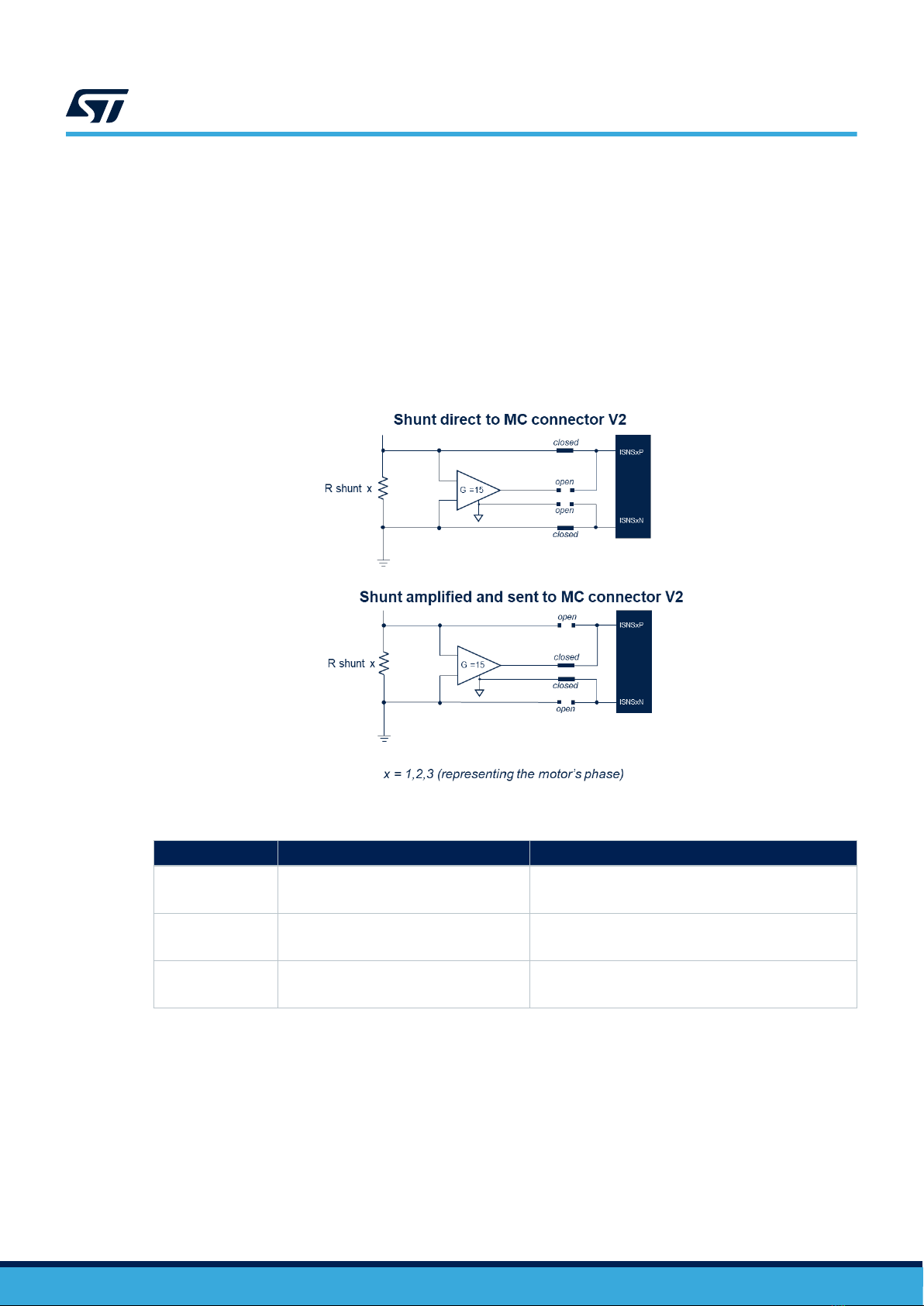
By default, the shunt resistors are directly connected to the MC connector V2: the amplification can be done
exploiting the operational amplifiers embedded in the microcontroller on the control board. However, it is possible
to change this configuration and use the operational amplifiers present on the STEVAL-LVLP01. The signal of
each shunt resistor has a dedicated op-amp, which implements a differential amplifier with a gain of 15. The
topology used enables the rejection of the common mode, resulting in a more accurate output signal. There is the
possibility to add a RC low pass filter at the output of each op-amp; by default, no filter is mounted. The TSV994
mounted on the STEVAL-LVLP01 embeds the three operational amplifiers (one for each shunt), together with a
fourth op-amp used for current control (see Comparator for current control).
By configuring the 0-Ohm resistors/solder bridges as reported in Table 6, the raw signal coming from the shunt
resistor is amplified before sending it the MC connector V2.
Figure 7. Shunt and op-amp connections by solder bridges / 0-ohm resistors
Table 6. Configuration for the shunt resistors amplification
Shunt resistor Direct to MC conn. V2 (default) To op-amp and then to MC connector V2
R25 (Phase 1) R43, R54 mounted/closed
R46, R49 open
R43, R54 open
R46, R49 mounted/closed
R26 (Phase 2) R62, R71 mounted/closed
R65, R69 open
R62, R71 open
R65, R69 mounted/closed
R27 (Phase 3) R79, R88 mounted/closed
R83, R86 open
R79, R88 open
R83, R86 mounted/closed
UM3193
Current sensing
UM3193 - Rev 1 page 10/33
Table of contents
Other ST Motherboard manuals

ST
ST STM8/128-EVAL User manual

ST
ST STM32 Nucleo Installation and operating instructions

ST
ST SPC564A-DISP Installation and operating instructions

ST
ST UM1935 User manual

ST
ST AEKD-AICAR1 User manual

ST
ST STM3220G-EVAL User manual

ST
ST STM32H5 User manual

ST
ST STLink User manual

ST
ST STEVAL-ISF003V1 User manual

ST
ST STFPC311 User manual

ST
ST STM32L5 Nucleo-144 board User manual

ST
ST STEVAL-ILH007V1 User manual

ST
ST STEVAL-ISW001V1 User manual

ST
ST STM3220F-EVAL User manual

ST
ST SPC58XXADPT176S User manual

ST
ST STM32H7 Nucleo-144 User manual

ST
ST STUSB03E User manual

ST
ST STM32429I-EVAL User manual

ST
ST STM32 Nucleo-64 User manual

ST
ST STM32F407 Series User manual