NARDA SRM-3006 User manual

SRM: WHEN SAFETY COUNTS
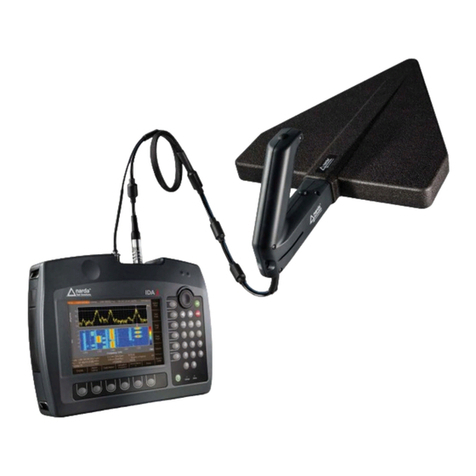
SRM-3006: SELECTIVE RADIATION METER
FOR ELECTROMAGNETIC FIELDS
UP TO 6 GHz

2
SAFETY?
Radio, TV, mobile phones, wireless services: Electromag-
netic fields are the medium wherever such forms of
communication are used. These fields affect everything
around them including the people that are moving
within them. Complete coverage would otherwise be
impossible.
National and international authorities have fixed limit
values for such fields to prevent harmful effects. The
field strengths allowed in the occupational environment
are usually higher than those for the general public,
because people who routinely work in electromagnetic
fields are trained, aware of the potential dangers, and
know what to do or have specific instructions which, for
example, limit exposure time to the field.
AM FM DVB-T DAB

3
CHECK!
Legislators have laid the responsibility for ensuring safety
upon the operators of transmitting equipment and the
relevant authorities. These, in turn, can take advantage
of the measurement services offered by organizations
and independent providers. There is really only one way
to make sure everything is safe:
TETRA GSM UMTS CDMA WIMAX LTE
Photo reproduced by kind permission of
ORS – Österreichische Rundfunksender GmbH & Co KG
Austrian Broadcasting Services, www.ors.at

4
CHECK? HOW?
SRM: WHEN SAFETY COUNTS
Wideband measuring equipment gives blanket coverage
of large frequency ranges, which could range from
the broadcast band to the mobile phone band and
beyond, for example. When fitted with special probes,
such equipment can deliver results that are expressed
automatically in terms of the applicable permitted limit
values. These devices are usually easy to operate.
Selective devices such as spectrum analyzers break the
fields down into their individual frequency components,
allowing detailed analysis. They are more complex to
operate and some specialist knowledge is needed to
evaluate results.
The Selective Radiation Meter SRM-3006 from Narda
Safety Test Solutions combines the analysis features of
a spectrum analyzer with the simple application of a
wideband measuring set. It was developed specifically
to address safety concerns in electromagnetic fields. In
contrast to a “converted” spectrum analyzer, it provides
users with application-oriented operating modes for
measuring separate transmission channels and services
such as analog or digital broadcasts (TV, DVB-T, DAB),
mobile phones (GSM, UMTS, LTE) or wireless (WLAN,
WiMAX). Results are displayed as individual values in
tables and as an overall total value, expressed in units of
field strength, power density, or simply as a percentage
of the permitted limit value. You don’t need to be an
expert in spectrum analysis to use the SRM.

5
The Selective Radiation Meter and its
measuring antennas are matched.
Any antenna and any instrument in the
range can be combined to form a
handy unit. Plug and Play.
The results can be shown in physical units, e.g. electric field strength in
V/m, magnetic field strength in A/m, and power density in W/cm2,
or directly as a percentage of the limit values, for example those
specified by ICNIRP. Important: The SRM can also subsequently
convert results to percentages, physical units or logarithmic
quantities.
V/m A/m W/cm2%

6
DEPENDABLE?
SRM: WHEN SAFETY COUNTS
Legally airtight, trustworthy results depend on many
factors: The measuring equipment must be calibrated.
The measurement must comply with standards, and it
must be made professionally and correctly.
The SRM from Narda Safety Test Solutions is calibrated
– traceable to national and international standards. It
fulfills all the requirements of current human safety
standards. And it makes correct, professional measure-
ments easy, such as time-averaged measurements over
the standard six-minute period or spatial averaging over
several measurement points. When using the isotropic
measuring antennas for the SRM, you don’t need to
worry about the direction of the field either; the instru-
ment doesn’t miss a thing. And you can set up and save
measurement routines in advance, ensuring reproduc-
ible results and eliminating incorrect settings.
The SRM can create measurement reports on-site, so
there’s no possibility of transmission errors creeping
in. The instrument includes the underlying standard in
the result, records the date, time and GPS coordinates,
and also saves written or voice comments, which can
describe e.g. the ambient conditions or any events that
occur during the measurement. All this means that you
always get dependable results.
GPS TIME DATE VOICE

7
Impossible to falsify: Screenshot of a ‘Safety Evaluation’ result.
The calibration certificate
records the traceability
of the calibration of the
instrument and antenna
to recognized standards
– with accreditation if
requested.

8
SRM – WHAT FOR?
SRM: FOR EVERYTHING
Electromagnetic fields always consist of an electrical and
a magnetic field component. Limit values are therefore
specified for both the electric as well as the magnetic
field strength.
The electric and magnetic field strengths at a distance
from the source are in a fixed relationship, so it is suffi-
cient to measure just one of the two components. This
relationship does not apply close to the source, so both
components must be determined separately.
The wavelength of the radiation determines the location
of the near-field and the far-field. The near-field of a
long wave transmitter extends for several kilometers.
The near-field for mobile phone antennas ends within
the space of about one meter.
Narda Safety Test Solutions has developed a thoroughly
researched range of measuring antennas. They make
the SRM into a universal measuring set for electric and
magnetic fields – from long wave up to the latest gene-
ration of mobile phone frequencies.
The isotropic (three-axis)
measuring antenna for electric
fields (E-fields) up to 3 GHz
is the all-round solution for
trouble-free measurements
covering VSW to UMTS.
Inside the isotropic electric
field measuring antenna,
showing three dipoles
arranged at mutual
right angles.

9
ISOTROP – SINGLE AXIS
ALL-PURPOSE MEASURING ANTENNAS
Quick and reliable because they are non-directional:
The isotropic antennas detect the field strengths in
three mutually perpendicular directions, and the SRM
automatically calculates the resulting field strength.
Nevertheless, isotropic measurements are also possible
using the single-axis antennas if you use a tripod and
the antenna holder, which allows you to make suc-
cessive measurements in three mutually perpendicular
positions. The SRM supports this procedure by saving
the result for each of the three positions and then calcu-
lating the resulting field strength – without a PC.
All antennas and antenna cables are interchangeable
without affecting accuracy: The calibration data for
each item is saved in the antenna or cable itself and is
read out and applied automatically by the SRM Basic
Unit. At the same time, the SRM blocks the frequency
ranges for which the antenna has not been calibrated.
This avoids incorrect measurements.
For rapid, non-directional
measurements involving
latest generation wireless
technologies: Three-axis
(isotropic) E-field antenna
for frequencies from
420 MHz to 6 GHz
For rapid, non-directional
measurements, e.g.
covering mobile phone
frequencies: Three-axis
(isotropic) E-field antenna
for frequencies from
27 MHz to 3 GHz
The measuring antennas can be connected to the SRM Basic
Unit directly or via a cable. An auxiliary control cable allows
the Basic Unit to read out the measuring antenna and antenna
cable data automatically.
For precision measure-
ments in the mobile
phone frequency range:
Single-axis E-field
antenna for frequencies
from
27 MHz to 3 GHz
For precision electric
field measurements on
radio / TV transmitters
and industrial equipment:
Single-axis E-field antenna
for frequencies from von
9 kHz to 300 MHz
For precision magnetic field
measurements in the nearfield of
radio / TV transmitters and industrial
equipment: Single-axis H-field
antenna for frequencies fromn
9 kHz to 300 MHz
E-FELD
H-FELD
For rapid, non-directional
magnetic field measure-
ments in the near-field of
radio / TV transmitters and
industrial equipment: Three-
axis H-field antenna for
frequencies from
9 kHz to 250 MHz
The single-axis antennas can be mounted on a tripod and
adjusted to produce isotropic results by making measurements
in three mutually perpendicular positions. Hand-held, they are
also ideal for locating maximum values within a room using the
so-called pendulum method.

10
WHO? WHAT?
SRM FOR DETAILS
Broadcasting, mobile telephony, industrial equipment:
What proportion of the overall field is from which
source? The answer is of interest to the relevant authori-
ties and safety representatives as well as to the opera-
tors themselves. There is often a need to know what
field strength is emanating from which equipment,
which channel or which radio cell. This determines who
must reduce output power in the event that the limit
values are exceeded, for example. On the other hand,
the overall field strength is more important when it
comes to human safety and environmental protection.
The Selective Radiation Meter SRM is perfect for
such investigations, thanks to its application-oriented
operating modes. For example: ‘Safety Evaluation’
with automatic evaluation of individual services such
as analog TV, digital radio (DVB-T, DAB), mobiles (GSM,
UMTS, LTE), and wireless (WLAN, WiMAX), as well as a
summary of the results in the form of an overall value.
Or ‘Level Recorder’ mode, which can even record pulsed
radar signals as numerical values. Or ‘Scope’ mode,
which displays the variation of the field over time.
Even the resolution bandwidths are tailored to the
applications. Using these settings, the SRM can select
out a single narrow GSM channel or capture an entire
broad DVB-T channel.
SPECTRUM ANALYSIS SAFETY EVALUATION UMTS DEMODULATION LTE MODE
Overview with ‘Safety Evaluation’: The
services to be checked are recorded in
editable tables. There’s no complicated
evaluation needed in ‘Safety Evaluation’
mode: The numerical result shows the
individual contributions of the services
as well as the overall level in terms of
the permitted limit value.
Classical spectrum analysis: Result
evaluation using markers and delta
markers. The integration function can
be used to determine the channel
power level, for example. Special
feature: Service identification by
means of pre-recorded service tables.
LEVEL RECORDER SCOPE
Other manuals for SRM-3006
3
Table of contents
Other NARDA Measuring Instrument manuals

NARDA
NARDA SRM-3006 Operating manual

NARDA
NARDA PMM PL-01 User manual

NARDA
NARDA nbm-520 User manual

NARDA
NARDA NRA Series Instruction Manual

NARDA
NARDA L3HARRIS SMARTS II User manual

NARDA
NARDA NIM-511 User manual

NARDA
NARDA AMS-8061 User manual

NARDA
NARDA FieldMan User manual

NARDA
NARDA SRM-3000 User manual

NARDA
NARDA FieldMan User manual