StellarNet, Inc., 2012 1
CAUTION
The RPB can be operated with a laser source. Visible and/or invisible laser radiation
can be emitted from the probe aperture. Appropriate laser safety procedures should
be observed when operating the probe with a laser source, including the use of
protective eyewear. See the laser manufacturer’s manual for precautions.
I. Overview
The RPB is available in different configurations as indicated by the Model Number shown on
the identification label:
RPBXXX
where XXX is the excitation wavelength (in nm). The probes are constructed with a 105 µm
excitation fiber and a 200 µm collection fiber. The default working distance is 7.5 mm;
options for 5.0 and 10 mm are also available, as well as custom focal lengths. The
connectors terminating each fiber optic cable are either FC or SMA. FC connectors have a
notch or key that results in the connectors fitting in the receptacle in one orientation. SMA
connectors can be rotated in the receptacle.
Please note the Model Number prior to use. The serial number is also provided on the
identification label; this number is unique to each probe and should be provided when
corresponding with InPhotonics.
The patented InPhotonics fiber optic Raman probe utilizes micro-optic components for
delivering the laser excitation source to the sample and for collection of scattered light
resulting in a compact probe head that is fiber optically coupled to the laser source and
spectrograph.
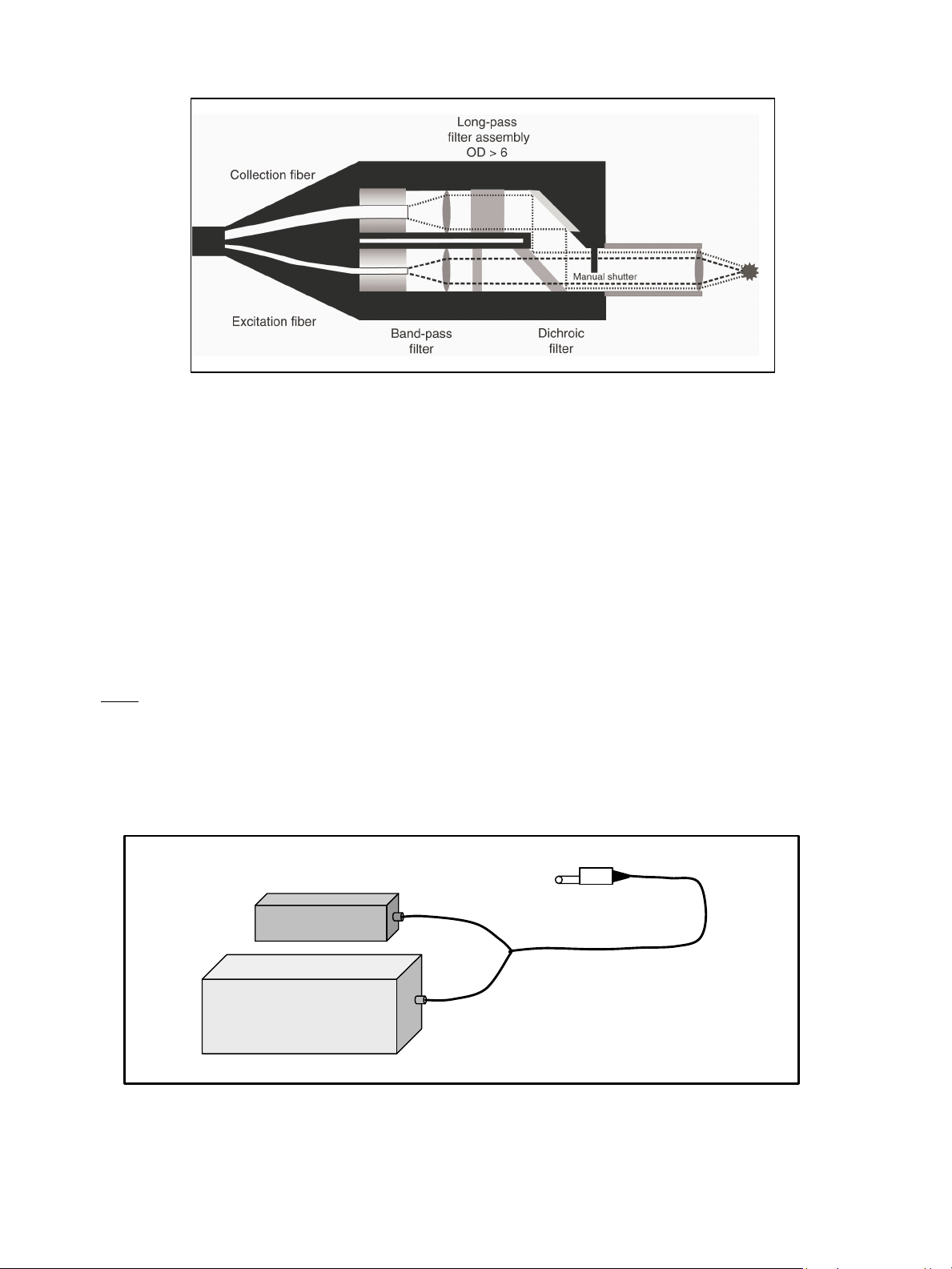
Through the efficient use of bandpass, dichroic and edge filters for separating the excitation
and scattered light, the InPhotonics RPB utilizes a backscattering (θ=180°) sampling
geometry. The backscattering collection geometry allows easy sample alignment and
provides optimum throughput because of the total overlap between the excitation and
collection cones. The spot size of the laser varies with the transmission properties of the
sample under measurement. Using a collection fiber that is twice the size of the excitation
fiber ensures maximum signal collection of transparent as well as opaque materials.
The RPB has a main optical body and an extension tip holding the final focusing lens. A
schematic diagram of the internal optics is shown in Figure I.1. The optical design is patent
protected (U.S. Patent #5,122,127). The InPhotonics RPB also incorporates a manual shutter
with calibration standard (see Section III.A). The shutter is in the “open” position when the
red label is exposed.