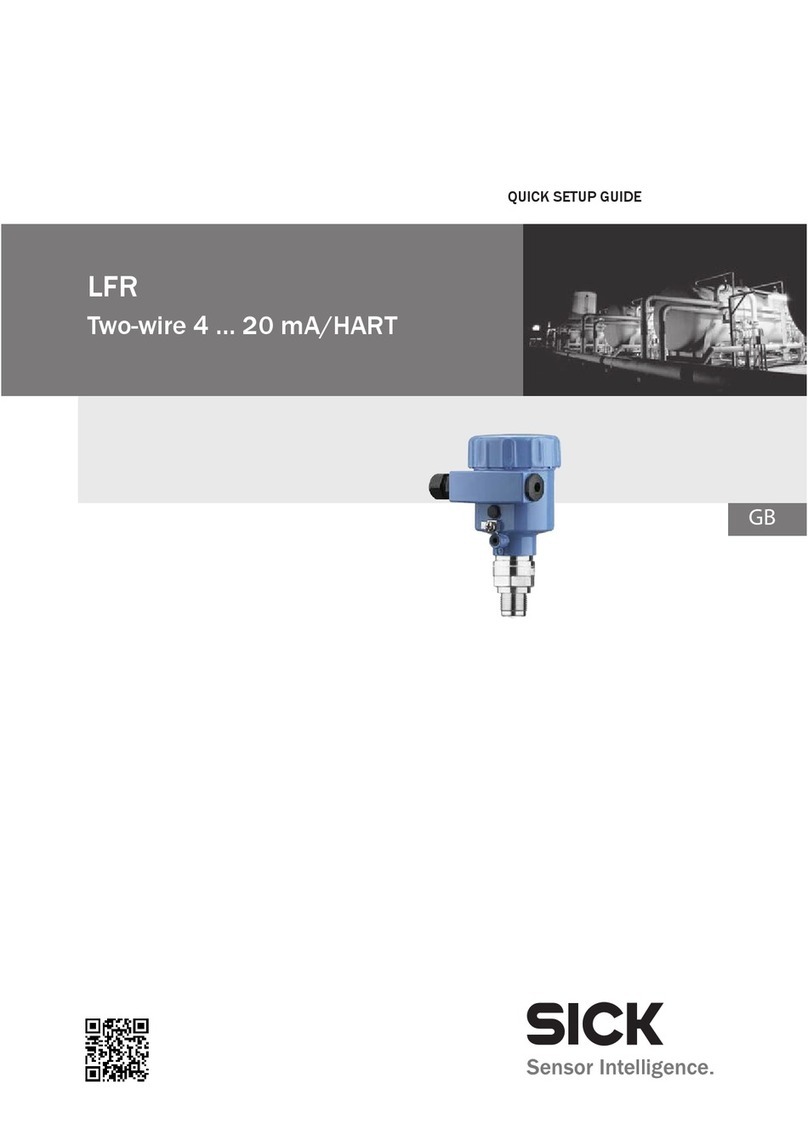
SICK WLA26 00 Series User manual


Described product
W26
WLA26
Manufacturer
SICK AG
Erwin-Sick-Str. 1
79183 Waldkirch
Germany
Legal information
This work is protected by copyright. Any rights derived from the copyright shall be
reserved for SICK AG. Reproduction of this document or parts of this document is
only permissible within the limits of the legal determination of Copyright Law. Any modi‐
fication, abridgment or translation of this document is prohibited without the express
written permission of SICK AG.
The trademarks stated in this document are the property of their respective owner.
© SICK AG. All rights reserved.
Original document
This document is an original document of SICK AG.
2006/42/EC
NO
SAFETY
28020357.19RH / 15.01.2021 | SICK
Subject to change without notice

Contents
1 Safety information............................................................................ 4
1.1 General safety notes................................................................................ 4
1.2 Notes on UL approval............................................................................... 4
2 Intended use...................................................................................... 4
3 Operating and status indicators...................................................... 4
4 Mounting............................................................................................. 5
5 Electrical installation........................................................................ 5
6 Additional functions.......................................................................... 7
7 Commissioning.................................................................................. 8
7.1 Alignment.................................................................................................. 8
7.2 Check the application conditions............................................................ 9
7.3 Sensing range setting............................................................................... 11
7.4 Time function setting................................................................................ 12
7.5 Setting light/dark switching..................................................................... 13
8 Process data structure..................................................................... 13
9 Troubleshooting................................................................................. 13
10 Disassembly and disposal............................................................... 14
11 Maintenance...................................................................................... 14
12 Technical data.................................................................................... 15
12.1 Dimensional drawings.............................................................................. 15
CONTENTS
8020357.19RH / 15.01.2021 | SICK
Subject to change without notice 3

1 Safety information
1.1 General safety notes
■Read the operating instructions before commissioning.
■
Connection, mounting, and configuration may only be performed by trained
specialists.
■
2006/42/EC
NO
SAFETY
Not a safety component in accordance with the EU Machinery Directive.
■
Do not install the sensor at locations that are exposed to direct sunlight
or other weather influences, unless this is expressly permitted in the operating
instructions.
■These operating instructions contain information required during the life cycle of
the sensor.
1.2 Notes on UL approval
The device shall be supplied from an isolating transformer having a secondary overcur‐
rent protective device that complies with UL 248 to be installed in the field rated either:
a) max 5 amps for voltages 0 ~ 20 V (0 ~ 28.3 V peak), or
b) 100 / Vp for voltages of 20 ~ 30 V (28.3 ~ 42.4 V peak).
Alternatively, they can be supplied from a Class 2 power supply.
UL Environmental Rating: Enclosure type 1
2 Intended use
The WLA26 is an opto-electronic photoelectric retro-reflective sensor (referred to as
“sensor” in the following) for the optical, non-contact detection of objects, animals, and
persons. A reflector is required for it to function. If the product is used for any other
purpose or modified in any way, any warranty claim against SICK AG shall become void.
3 Operating and status indicators
WLA26x-xxxxxx00 WLA26x-xxxxxx01 WLA26x-xxxxxx02
1
2
3
1
23
5
1
23
4
1 SAFETY INFORMATION
48020357.19RH / 15.01.2021 | SICK
Subject to change without notice

WLA26x-xxxxxx30 WLA26x-xxxxxx31 WLA26x-xxxxxx32
1
2
3
6
1
23
5
6
1
23
4
6
1BluePilot blue: alignment aid
2LED indicator yellow: status of received light beam
3LED indicator green: supply voltage active
4Press-turn element: time function adjustment
5Teach pushbutton: adjustment of light/dark switching
6Teach-Button: adjusting the sensitivity
4 Mounting
Mount the sensor and the reflector using suitable mounting brackets (see the SICK
range of accessories). Align the sensor and reflector with each other.
Note the sensor’s maximum permissible tightening torque of < 1,3 Nm.
5 Electrical installation
The sensors must be connected in a voltage-free state. The following information must
be observed, depending on the connection type:
– Male connector connection: Note pin assignment
– Cable: wire color
Only supply/switch on the voltage once all electrical connections have been estab‐
lished.
Explanations of the connection diagram (following tables):
Alarm = alarm output
Health = alarm output
MF (pin 2 configuration) = external input, teach-in, switching signal
QL1/C = switching output, IO-Link communication
Test = test input
UB: 10 ... 30 V DC
Table 1: Connections
Wxx26x- x4 xH x5 xI
1 = BN
2 = WH
3 = BU
4 = BK
5= GY
12
4 3
0.14 mm2
AWG26
12
4 3
5
0.14 mm2
AWG26
MOUNTING 4
8020357.19RH / 15.01.2021 | SICK
Subject to change without notice 5

Wxx26x- x9 xB
1 = BN
2 = BU
3 = not connected
4 = BK
5= WH
6 = GY
7 = not connected
3 4
1
2 5
6
IN = 4 A
3
7
2
16
5
4
IN = 6 A
Table 2: DC
WLA26
x-
xxX6XxxxA00 xxX6Xx
xxA01-
A99
Push-
pull
xx161 xx162 xx163 xx165 xx168 xx16A xx16L xx16N xx16x
PNP xx861 xx862 xx863 xx865 xx868 xx86A xx86L xx86N xx86x
1 = BN + (L+)
2 = WH MF
3 = BU - (M)
4 = BK QL1/C
Default:
MF
QQAlarm Alarm Test →
L+
no func‐
tion
Test →
L+
no func‐
tion
www.sic
k.com
80227
09
Default:
QL1/C
QQQQQ Q Q Q www.sic
k.com
80227
09
Table 3: DC
WLA26x- xxXXXxxxZZZ
Push-pull xx111 xx112 xx114 xx116 xx421 xx422 xx721 xx722
PNP xx811 xx812 xx814 xx816 xxB21 xxB22 - -
BN + (L+)
WH QQHealth Health Q QQQ
BU - (M)
BK QQQQQQQQ
GR - - - - Test →
L+
Test →
L+
Test →
M
Test →
M
5 ELECTRICAL INSTALLATION
68020357.19RH / 15.01.2021 | SICK
Subject to change without notice

Table 4: Push-pull, PNP, NPN
Push-pull
PNP
NPN
+ (L+)
Q ≤ 100 mA
‒ (M)
Push-pull
PNP
NPN
+ (L+)
Q ≤ 100 mA
‒ (M)
Push-pull
PNP
NPN
+ (L+)
Q≤ 100 mA
‒ (M)
Push-pull
PNP
NPN
+ (L+)
Q≤ 100 mA
‒ (M)
6 Additional functions
Alarm
Alarm output: The sensor (WLA26) features a pre-failure notification output (“Alarm” in
the connection diagram [see table 2]), which issues a notification if the sensor is only
ready for operation to a limited extent. The LED flashes in this case. Possible causes:
sensor or reflector is contaminated, sensor is out of alignment. In the good state: LOW
(0), if excessively contaminated HIGH (1).
Health
Health output: The sensor (WLA26) features a pre-failure notification output (“Health”
in the connection diagram [see table 2]), which issues a notification if the sensor is
only ready for operation to a limited extent or the cable has been interrupted. Possible
causes: Sensor or reflector is contaminated, sensor is out of alignment, cable is dam‐
aged. In the good state: HIGH (1), if excessively contaminated or in the event of cable
interruption LOW (0). The yellow LED indicator flashes in this case.
ADDITIONAL FUNCTIONS 6
8020357.19RH / 15.01.2021 | SICK
Subject to change without notice 7

Table 5: Alarm
Alarm (≤ 100 mA) Health (≤100 mA)
+ (L+)
Alarm
‒ (M)
+ (L+)
Health
‒ (M)
+ (L+)
Alarm
‒ (M)
+ (L+)
Health
‒ (M)
Test input
Test input: The sensors WLA26 feature a test input (“TI” or “Test” on the connection
diagram [see table 2]), which can be used to switch the sender off and, therefore,
check that the sensor is functioning correctly: If female cable connectors with LED
indicators are used, you have to ensure that the TI is assigned accordingly.
It is important that there is no object between the sensor and reflector; activate the test
input (see the connection diagram [see table 2]).
The send LED is shut down or the detection of an object is simulated. Refer to table 6
to check the function. If the switching output fails to behave in accordance with the
graphic, check the application conditions, see "Troubleshooting", page 13.
Table 6: Test
Test → M Test → L+
+ (L+)
Test
– (M)
+ (L+)
Test
– (M)
+ (L+)
Test
– (M)
+ (L+)
Test
– (M)
7 Commissioning
7.1 Alignment
Align the sensor with a suitable reflector. Select the position so that the red emitted
light beam hits the center of the reflector. The sensor must have a clear view of the
reflector, with no object in the path of the beam [see figure 1]. You must ensure that the
optical openings of the sensor and reflector are completely clear.
6 ADDITIONAL FUNCTIONS
88020357.19RH / 15.01.2021 | SICK
Subject to change without notice

Table: Alignment
Figure 1: Alignment 1 Figure 2: Alignment 2
7.2 Check the application conditions
WLA26 are photoelectric retro-reflective sensors in which the autocollimation principle
has been combined with a multi-receiver element, thereby ensuring the greatest possi‐
ble resistance to depolarizing objects combined with a very high sensing range. This
means the WLA26 has a high operating reserve (insensitivity to dust) and does not
exhibit any switching errors with depolarizing objects.
Adjust the distance between the sensor and the reflector according to the correspond‐
ing diagram [see table 7] (x = sensing range, y = operating reserve).
NOTE TIP:
Should switching errors nevertheless arise due to extremely depolarizing objects, the
WLA26 can also be adapted to these extreme conditions and the switching errors
suppressed by means of a teach-in (via IO-Link or using the Teach-in button on the
housing).
Table 7: Application conditions
0
100
10
1
65
2
1
1,000
4
(13.12)
8
(26.25)
20
(65.62)
16
(52.49)
12
(39.37)
Function reserve
Distance in m (feet)
Sensing range
WLA26P-xxxxx1xx
4
3
Figure 3: Characteristic line 1: Standard
reflector
1Reflector PL20A
2Reflector PL22
Distance in m (feet)
Sensing range Sensing range typ. max.
1
2
3
4
5
6
0 8
(26.25)
12
(39.37)
4
(13.12)
16
(52.49)
20
(65.62)
5.5 70
11.5 16
0
12 17
0
12 18
0
18
10
0
8 10
0
15
Figure 4: Bar graph 1: Standard reflector
1Reflector PL20A
2Reflector PL22
3Reflector PL250
4Reflector PL30A
5Reflector PL40A
6Reflector PL80A, C110A
COMMISSIONING 7
8020357.19RH / 15.01.2021 | SICK
Subject to change without notice 9
This manual suits for next models
7
Table of contents
Languages:
Other SICK Accessories manuals




SICK
SICK MPS-G 1108675 User manual

SICK
SICK WL12G-3P3572S12 User manual

SICK
SICK WebChecker MLG-2 Manual

SICK
SICK GLS611 User manual

SICK
SICK HTB18 User manual

SICK
SICK SureSense HSE18 Series User manual

SICK
SICK SureSense HL18 Series User manual

SICK
SICK TiM3 Series User manual

SICK
SICK PL240DG-H User manual

SICK
SICK GRTE18 24 Series User manual