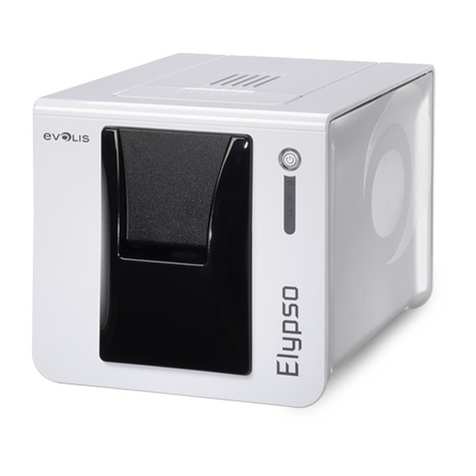
Posligne ODP 1000 User manual

All specifications are subject to change without notice
Receipt Printer User’s Manual
MODEL : ODP 1000


2
3

4
5
1. Parts Identifications
TOP COVER
POWER SWITCH
CONTROL LABEL
Open this cover to
load or replace paper.
Used to turn on/off
power to the printer
Features LED indicators
to indicate printer status
and switches to operate
the printer.
INTERFACE CONNECTOR(SERIAL) INTERFACE CONNECTOR(USB)
PERIPHERAL DRIVE CONNECTOR
POWER CONNECTOR
1. Parts Identications 5
2. Setting up the printer 6
2.1 Unpacking 6
2.2 Connecting the cables 7
2.3 Loading the roll paper 10
3. Control panel and other functions 13
3.1 Control panel 13
3.2 Error Indicating 13
4. Self Test 14
5. Hexadecimal Dump 15
6. Specications 16
6.1. General Specications 16
6.2. Auto Cutter Specications 18
6.3. Interface 18
6.4. Electrical Characteristics 18
6.5. Environmental Requirements 19
6.6. Reliability 19
6.7. Certication 19
7. Command List 20
Table of Contents

6
7
2-2. Connecting the Cables
You can connect up the cables required for printing to the printer.
They all connect to the connector panel on the back of the printer, which is shown below :
Before connecting any of the cables, make sure that both the printer and the computer are turned off.
For connection to a
host computer.
For connection to a
host computer. For connection of
the AC adapter.
Never unplug the
AC adapter while
the printer is on.
Connects to peripheral units
such as cash drawers, etc.
Do not connect this to
a telephone.
INTERFACE CONNECTOR(USB)
PERIPHERAL DRIVE CONNECTOR
POWER CONNECTOR
INTERFACE CONNECTOR(SERIAL)
2-1. Unpacking
Your printer box should include these items. If any items are damaged or missing, please contact your
dealer for assistance.
The Printer User's Manual Roll Paper
Interface Cable(optional) Adaptor(Optional)
2. Setting Up the Printer

8
9
2-2-2. Cash Drawer Connector
The printer can operate two cash drawers with a 6 pin RJ-11 modular connector.
The driver is capable of supplying a maximum current of 0.1A for 510ms or less when not printing.
PIN SIGNAL DESCRIPTION
1 Signal GND -
2 Drawer kick-out drive signal 1 Output
3 Drawer open/close signal Input
4 +24V -
5 Drawer kick-out drive signal 2 Output
6 Signal GND -
2-2-1.Interface Connector
Serial Interface
PIN SIGNAL I/O DESCRIPTION
2 TxD Output Printer transmit data line RS-232C level
3 RxD Input Printer receive data line RS-232C level
4, 20 DTR Output Printer handshake to host line RS-232C level
6 DSR Input Data Send Ready
1, 7 GND - System Ground
USB Interface
PIN SIGNAL I/O DESCRIPTION
1 +5V - +5V
2 DATA- - Printer transmit data line
3 DATA+ - Printer transmit data line
4 GND - System Ground
12
43

10
11
5. Be sure to note the correct direction that the paper comes off the roll.
6. Pull out a small amount of paper, as shown.Then, close the cover.
7. Tear off the paper as shown.
2-3. Loading the Roll Paper
Notes: Be sure to use paper rolls that meet the specifications. Do not use paper rolls that have the
paper glued to the core because the printer cannot detect the paper end correctly.
(Turn off power switch)
1. Make sure that the printer is not receiving data; Otherwise, data may be lost.
2. Open the paper roll cover by pushing down the cover open button.
3. Remove the used paper roll core if there is one inside.
4. Insert new paper roll as shown.

12
13
3-1. Control panel
You can control the basic paper feeding operations of the printer with the button on the control panel.
The indicator lights help you to monitor the printer’sstatus.
Control Panel
Button
The button can be disabled by the ESC c 5 command.
Press the FEED button once to advance paper one line. You can also hold down the FEED button to feed
paper continuously.
3-2. Error indicators
This section explains the different patterns signaled by the three LED indicators located on the top
cover of the printer.
STATUS PAPER ERROR POWER REMARKS
RED RED GREEN
Power off OFF OFF OFF Normal power is not supplied to
the printer
Power on OFF OFF ON Normal power is supplied to the
printer
On line OFF OFF ON Normal error-free mode
Cover open OFF ON ON Close cover
Paper empty OFF ON ON Insert new paper roll
Paper near end ON OFF ON Paper is low
3. Control panel and other functions
♣CAUTION:
When the paper is jammed from cutter, the top cover might be stuck as well. In this case, repeat power
on and off several times.
If the top cover is still stuck, please follow the steps to release the papers from jamming.
1. Make sure the printer is turned off.
2. Plug in the screw driver into the hole next to where it says “JAM” on the cover-open button.

14
15
This feature allows experienced users to see exactly what data is coming to the printer. This can be
useful in finding software problems.
When you turn on the hex dump function, the printer prints all commands and other data in
hexadecimal format along with a guide section to help you find specific commands.
To use the hex dump feature, follow these steps
1. Please run the self test. (While holding down the FEED button, turn on the printer using the
switch on the front of the printer to begin the self-test)
2. Please holding down FEED button more than 2 seconds after print out first page of self test .
3. Now you are in hex dump mode when you will see
“ Hexadecimal printing mode…..” on paper.
Hexadecimal Dump
1B 21 00 1B 26 02 40 40 .!..& . @ @
1B 25 01 1B 63 34 00 1B .%.. c4 ..
41 42 43 44 45 46 47 48 ABCDEFGH
□A period (.) is printed for each code that has no ASCⅡequivalent.
5. Hexadecimal Dump
The self-test lets you know if your printer is operating properly. It checks the control circuits, printer
mechanisms, print quality, ROM version and DIP switch settings.
This test is independent of any other equipment or software.
Running the self test
1. Make sure the printer is turned off and the printer cover is closed properly.
2. While holding down the FEED button, turn on the printer using the switch on the front of
the printer to begin the self-test. The Self Test prints the printer settings and then prints the
following, Cuts the paper, and pauses. (Error LED On)
Self-test printing
Please press the PAPER FEED button.
3. Press the FEED button to continue printing.
The printer prints a pattern using the built-in character set.
4. The self test automatically ends and cuts the paper after printing the following.
*** Completed ***
The printer is ready to receive data as soon as it completes the self-test.
NOTES:
The parameters of the serial port and of the printer can be amended by using a loading utility
on the AURES technical support website:
www.aures-support.fr
4. Self Test

16
17
6. Specifications
6-1. General Specifications
(1) Printing Method Direct line thermal printing.
(2) Print speed 160 mm/sec. (Approx 35.4LPS)
(3) Dot density
180 DPI (Hor / Ver) 180 / 180 (0.141mm / 0.141mm dot)
(4) Printing Width
180 DPI Max 72mm (512 dots)
(5) Number of print columns.
No. of columns
Font “A” Font “B”
180 DPI 42 56
(6) Roll paper Refer to chapter 2 for details on the recommended roll Paper.
Paper width : 79.5mm ±0.5mm
Roll diameter : Max. Ø83mm
(7) Weight 1.4Kg
(8) Overall dimension
164.34
135.85
110.03
Table of contents
Other Posligne Printer manuals