J. Perkins P-47 Thunderbolt User manual

With Retracts and Scale 4-Bladed Prop
ASSEMBLY INSTRUCTIONS
SpecificationS:
Wingspan: 41 in. (1040mm)
Length: 35 in. (890mm)
Wing Area: 258 in². (16.65dm²)
Weight (inc. battery): 27 oz. (760g)

2 P47 Thunderbolt Instruction Manual
Vital safety info
CAUTION! The P-47 Thunderbolt is not a toy.
It can cause injury to persons/animals and/or property
if not used correctly. It is unsuitable for persons under
the age of 14. You should take care and observe the
principles of safety when flying this model. In the UK,
we recommend you observe the British Model Flying
Association (BMFA) safety code at all times, which can
be found at the following address: http://www.bfma.org
In Australasia, please contact your hobby supplier.
YOU ASSUME ALL RISK.
Before beginning construction, please read this
document thoroughly and familiarize yourself with the
construction sequence of the P-47 Thunderolt. If any
information in this manual is unclear, please contact
your supplier for help. After reading this manual store
it in a safe place for future reference. This is a kit
for intermediate and advanced flyers, basic RC flying
knowledge and skills are required.
about the flying area
required
If you are a newcomer to R/C flight and have never flown
a radio control model before; it is vital you seek advice
from an experienced model pilot on where and how to fly.
Only fly in large open spaces that are approved for R/C
model flying and that are away from people, animals,
buildings, power lines, water or trees.
Only fly in bright sunny conditions where wind speed does
not exceed 5mph.
training, crashes & spares
The P-47 Thunderbolt has been designed to be strong and
very easy to repair, however, it is not invulnerable and
most people will break parts during their flying career.
This is quite normal. All parts are available as spares
from your supplier. Crash damage is not covered by
warranty.
important notice
This manual is supplied with all versions of the P-47
Thunderbolt. Please note that any reference in this
manaul to the Transmitter, Receiver, Charger and Power
supply are not applicable to the P-47 Thunderbolt version
supplied without TX/RX, Charger and Power supply.
contents
Vital safety info ............................................................... 2
About the flying area required ...................................... 2
Training, crashes & spares ............................................ 2
Guarantee/warranty ........................................................ 2
History of the P-47 ........................................................... 3
Kit contents ....................................................................... 3
Lithium polymer battery safety ..................................... 4
Lithium polymer flight battery ....................................... 4
Charging the flight battery .......................................... 5
Assembling the P-47 ....................................................... 6
Assembling the propeller ............................................ 10
Switch on the transmitter ............................................ 11
Transmitter layout .......................................................... 12
Mode II transmitter layout ........................................ 12
Mode I transmitter layout ......................................... 12
Pairing the esc and transmitter .................................. 12
Control checks ............................................................... 13
Preflight checks ............................................................. 14
Flying................................................................................ 15
Take-off ........................................................................ 15
Landing ........................................................................ 15
guarantee/warranty
J. Perkins Distribution Ltd and Model Engines (Aust.) Pty. Ltd. guarantee this product to be free of manufacturing and assembly
defects for a period of one year from time of purchase. This does not affect your statutory rights. This warranty is not valid for any
damage or subsequent damage arising as a result of a crash, misuse, modification or for damage or consequential damage arising
as a result of failure to observe the procedures outlined in this manual. Operation of this model is carried out entirely at the risk of
the operator. Please note that, whilst every effort is made to ensure the accuracy of instructions and material included with this
product, mistakes can occur and neither J. Perkins Distribution Ltd/Model Engines (Aust.) Pty. Ltd. nor it’s distributors will be held
liable for any loss or damage arising from the use of this model or for any loss or damage arising from omissions or inaccuracies in
the associated instructions or materials included with this product.
We reserve the right to modify the design of this product, contents and manuals without prior notification.
© 2009 J Perkins Distribution Ltd, Lenham, Kent, UK ME17 2DL. www.jperkinsdistribution.co.uk
Model Engines (Aust.) Pty. Ltd., Noble Park, Victoria 3174, Australia. www.modelengines.com.au.
All rights reserved. E&OE.
weee disposal
Do not dispose of this product with other household
waste. Instead, it is your responsibility to dispose of
your waste equipment by handing it over to a designated
collection point for the recycling of waste electrical
and electronic equipment. The separate collection and
recycling of your waste equipment at the time of disposal
will help to conserve natural resources and ensure that
it is recycled in a manner that protects human health and
the environment. For more information about where you
can drop off your waste equipment for recycling, please
contact your local council, your household waste disposal
service or the shop where you purchased the product.

3P47 Thunderbolt Instruction Manual
history of the p-47
The P-47 was the heaviest US single-engine fighter of WWII and was built in greater quantities than any other. More
than half a million combat sorties were flown in P-47’s between the years of 1943 and the end of the war in 1945. One of
the first true multi-role fighters, the Jug was a fighter, bomber, dive-bomber and ground attack aircraft. The P-47 was
also the first piston-powered fighter to exceed 500 mph.
Kit contents
contentS LiSt
2.4 GHz Transmitter and Receiver (Only included in RTF complete set)
Fuselage
Main Wing w/Carbon Wing Rod
Horizontal Tail
Fin and Rudder
Retractable Landing Gear, Wheels and Gear Doors (pre-installed)
Outrunner Brushless Motor 1050Kv (pre-installed)
25A ESC (pre-installed)
3-Cell 11.1V 1650mAh Li-poly Battery
Li-poly Balance Charger for 2-3 Cells (Only included in RTF complete set)
4-9 gram Servos and 1-18 gram Servo (pre-installed)
Scale 4-Bladed Propeller
Steerable Tail Wheel (pre-installed)
Mains power supply (Only included in RTF complete set)
additionaL itemS RequiRed
8 x AA Transmitter batteries
5-minute Epoxy Glue
Small Phillips screwdriver
Hobby Knife
NB. If purchasing the RTF version excluding TX/RX/Charger/Power supply you will need to purchase these
separately

4 P47 Thunderbolt Instruction Manual
lithium polymer battery safety
BefoRe chaRging Li-po’S
Before charging your battery check for any damage e.g. check if the battery has expanded or swollen in size or
if the battery cells have been punctured. If any of the above is true: DO NOT CHARGE THE BATTERY!
chaRging Li-po’S
Only use a charger designed to charge Lithium polymer batteries. Never use a nicad or other charger as this is
very dangerous.
Never attempt to charge at a rate faster than that recommended in the instructions. Check that the battery cell
count matches the charger cell count switch (if fitted).
Never charge unattended. Always stay with your battery whilst charging in case of overheating or fire.
Charge on a safe surface or container (e.g. old unused microwave oven). Charge only on non-flammable
surfaces, e.g. concrete floor preferably outdoors, or in a pyrex cooking dish with the battery placed on a bed of
sand, or in a fireplace. Never charge inside a car!
Switch off charger if battery gets too hot. If the battery becomes hot to the touch during charging, disconnect
and switch off immediately.
Extinguish fires with sand. If something goes wrong and your battery catches fire, always have sand from a fire
bucket at hand to douse the flames. Do NOT use water!
uSing Li-po’S
Do not modify/change any part of the battery or lead. Do not remove its heat shrink protective covering.
Removal or modification may damage the battery and will invalidate any warranty claim.
Do not place this battery near fires or anything with high temperatures.
Do not charge batteries while you are driving and do not store batteries in any type of motor vehicle.
Do not let the battery get wet or become submerged in any type of liquid.
Do not carry loose batteries in your pocket or bag as they could short-circuit against other items.
If you should get electrolyte from the cells on your skin, wash thoroughly with soap and water. If in your eyes,
rinse thoroughly with water. Seek medical assistance.
lithium polymer flight battery
Charging lead only
The LiPo flight battery is a high power battery designed to give a flight time of approximately 10mins per charge. It is
supplied in a partially charged state.
As well as a red deans style conector lead (for connection to the ESC) the battery is also fitted with a white 3-pin
polarised connector. This is the charge lead. Connect this white plug to the 12V charger. Always leave the battery in a
partially charged state. Never leave it in a discharged state.
The battery should be charged if you notice the model losing power. At this point land and recharge the battery.
Do not be tempted to run the battery past this stage as you will be over-discharging and the battery may be damaged.
WARNING!
We recommend that you use only the supplied EScale charger with this battery.
WARNING!
Over-discharging will shorten the life of the battery or destroy it. Stop flying immediately you notice the model is
losing power and recharge the battery.
WARNING!
Do not short circuit—battery may explode!
IF YOU HAVE NOT DONE SO ALREADY PLEASE READ THE LITHIUM POLYMER BATTERY SAFETY INSTRUCTIONS
ABOVE BEFORE PROCEEDING ANY FURTHER.

5P47 Thunderbolt Instruction Manual
chaRging the fLight BatteRy
Mains power supply
(only included in RTF
complete set)
12V Charger
(Only included in RTF
complete set)
LiPo Battery
The charger is designed to automatically charge the LiPo battery in about an hour from a discharged state. The 12V
DC automatic charger is powered by the mains power supply illustrated above. Alternatively, you can use a 12V
sealed modelling battery to power the DC automatic charger.
1. Connect the charger to the power source.
The power LED will light Red and the charge
LED will light Green.
2. Plug the white 3-pin connector on your Li-po
battery into the 3pin socket in the front of the
charger.
Charging: Charge LED flashes Red.
Fully charged: Charge LED is solid Green.
If the charge LED is solid Red when you plug in the
battery no charge is needed.
3. When the battery is fully charged disconnect the
battery from the charger. Disconnect the 12V
power source from the charger. Your Li-po is
ready for use.

6 P47 Thunderbolt Instruction Manual
assembling the p-47
1. Locate the horizontal tail assembly and the
vertical fin and rudder assembly.
Note: Picture shows the horizontal tail with double-
stick tape for attching to the vertical fin. We
recommend that you remove the double sided tape
and use epoxy to glue the vertical and horizontal
fin together as this will provide a more permanent
fixing.
2. Use the vertical fin to locate the position
of the alignment holes in the horizontal tail.
Using a sharp hobby knife carefully cut away
the double-stick tape in these 2 positions. Dry
fit the vertical fin to confirm a good fit.
3. Peel the backing paper from the double-
stick tape, or use epoxy glue, and press the
vertical fin into position. You will now have a
single unit of horizontal and vertical tail parts
ready to glue to the fuselage.
4. Locate the main fuselage.
7P47 Thunderbolt Instruction Manual
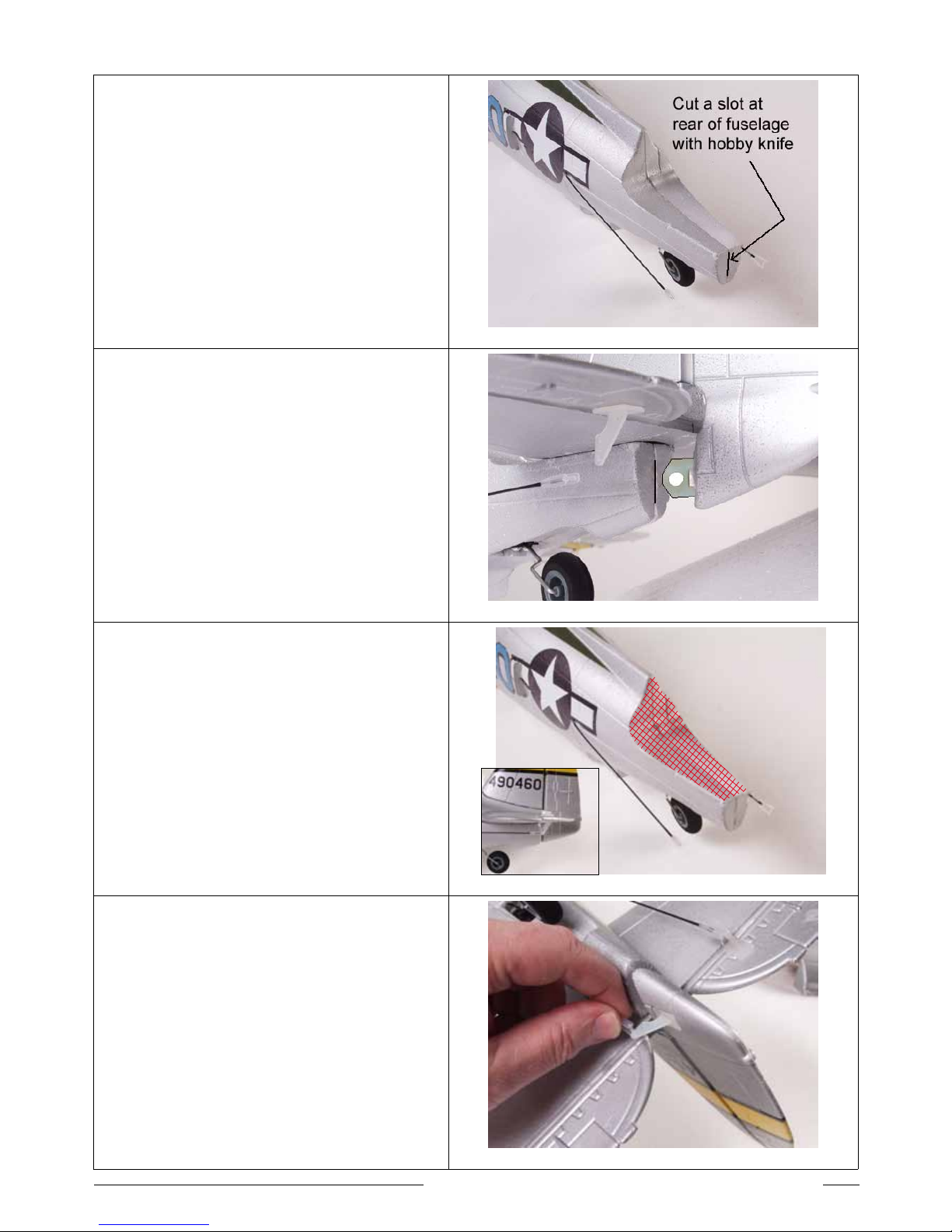
5. In the center of the rear of the fuselage, cut
a vertical slot to accept the hinge that is pre-
attached to the bottom of the rudder. A sharp
hobby knife is best for this operation.
6. Trial fit the tail unit to the fuselage.
7. Epoxy the tail unit to the fuselage.
EPOXY
8. When the epoxy has set, connect the plastic
clevis to the rudder control horn.
9. Connect clevis to the outermost hole in the
control horn.

8 P47 Thunderbolt Instruction Manual
10. In like manner, connect the plastic clevis to
the control horn on the elevator.
11. With the fuselage upside down, place
the leading edge of the main wing on the
fuselage.
12. Locate the single servo extension on the
receiver and plug the retract servo into it.
13. Plug the remaining “Y” connector into the 2
aileron servo extensions. It does not matter
which servo is plugged into which side of the
“Y” connector.
14. Place the wing into the fuselage wing saddle.
Route the main power wires from the ESC to
the bottom side of the wing. You may need
to make a groove in the leading edge of the
wing for these wires. (See Photo)
15. Locate the 2 long metal screws and screw
them in place.

9P47 Thunderbolt Instruction Manual
16. The flight battery slides in place in the hollow
compartment bellow and to the front of the
main wing. Velcro on the bottom of the wing
and on the battery help keep it in place.
17. The lower fuselage under wing filler is held in
position at the front by a tab and at the rear
by strong magnets. No tools are required to
remove for access to the flight batteries.
18. Install the gun units onto the the main wing.
Take care to mount them on the correct side.
Each gun unit is marked L and R to aid with
this.
10 P47 Thunderbolt Instruction Manual
assembling the propeller
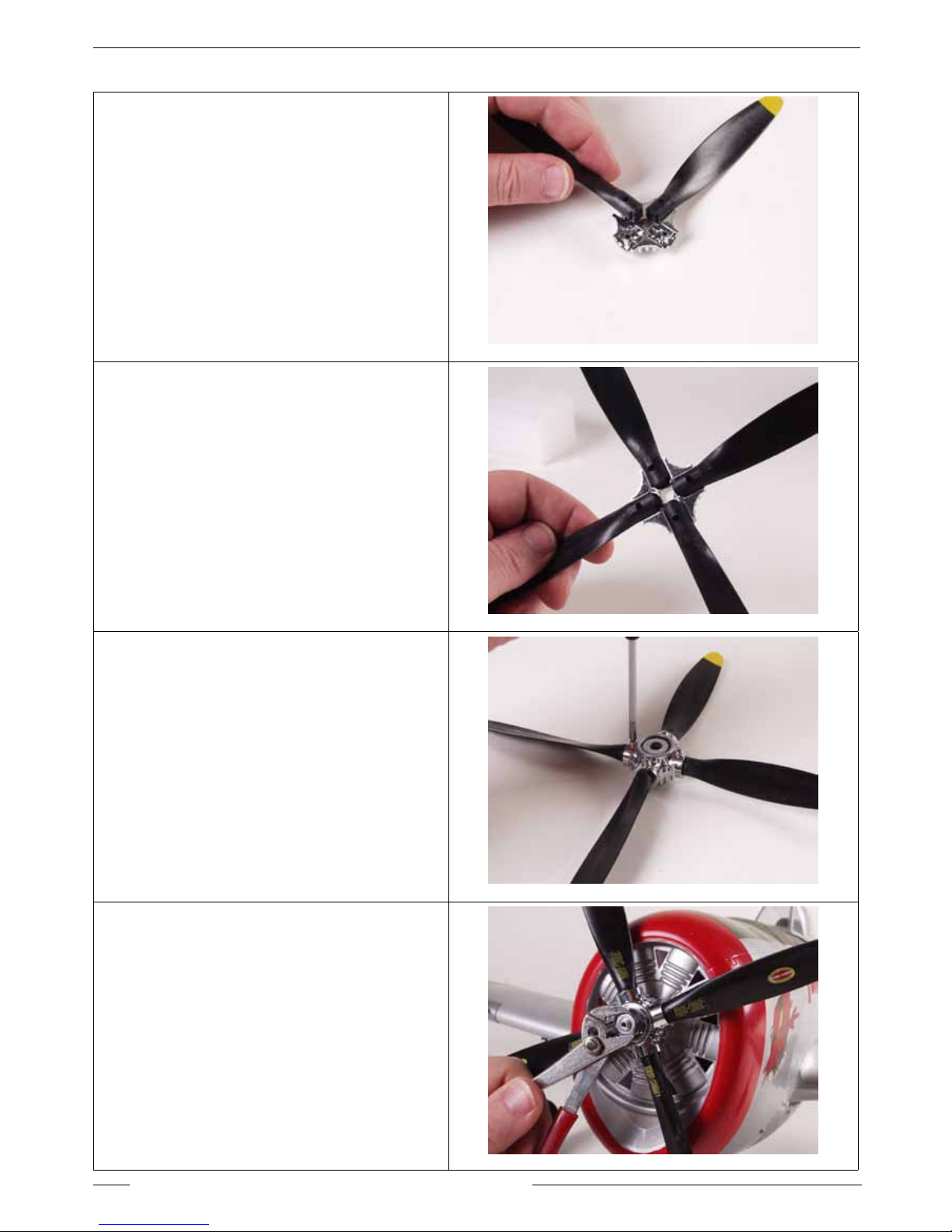
19. Locate the scale propeller parts.
20. Begin by inserting the blades onto the front
prop hub.
21. When all four blades are in position your
propeller should look like the photo at the
right.
22. Snap the rear prop hub in place and insert the
four screws and tighten.
23. Slip the prop onto the motor shaft and install
the washer and nut.
Table of contents
Other J. Perkins Toy manuals

J. Perkins
J. Perkins Twister 3D Storm User manual

J. Perkins
J. Perkins Mini Twister Cam User manual

J. Perkins
J. Perkins TWISTER CP GOLD User manual

J. Perkins
J. Perkins F9F Panther User manual

J. Perkins
J. Perkins Twister Hawk Setup guide

J. Perkins
J. Perkins Panic User manual

J. Perkins
J. Perkins Twister User manual

J. Perkins
J. Perkins Nano Stik User manual

J. Perkins
J. Perkins Panic User manual

J. Perkins
J. Perkins F/A 18E Super Hornet User manual