ECS IEEE 802.11b WLAN Mini USB Adapter User manual
USER’S GUIDE
VERSION 1.2
2004/04/14
Tested To Comply
With FCC Standards
FOR HOME OR OFFICE USE
IEEE 802.11b
WLAN Mini USB Adapter

© All rights reserved.
All trade names are registered trademarks of respective manufacturers listed.
This manual may not be copied in any media or form without the written consent of original maker.

TABLE OF CONTENTS
Welcome .................................................................. 1
Wireless LAN Basics ...................................................... 3
IP ADDRESS ................................................................ 4
Install Driver/Utility ..................................................... 5
Utility Configuration .................................................... 7
Windows XP Configuration .......................................... 8
SiS Advanced Configuration ........................................ 9
Technical Specifications ................................................ 12
Troubleshooting .......................................................... 13
Glossary ................................................................... 14

INFORMATION TO USER
Federal Communication Commission Interference Statement
This equipment has been tested and found to comply with the limits
for a Class B digital device, pursuant to Part 15 of the FCC Rules. These
limits are designed to provide reasonable protection against harmful
interference in a residential installation.
This equipment generates, uses and can radiate radio frequency
energy and, if not installed and used in accordance with the instructions,
may cause harmful interference to radio communications. However, there
is no guarantee that interference will not occur in a particular
installation. If this equipment does cause harmful interference to radio or
television reception, which can be determined by turning the equipment
off and on, the user is encouraged to try to correct the interference by
one of the following measures:
Reorient or relocate the receiving antenna.
Increase the separation between the equipment and receiver.
Connect the equipment into an outlet on a circuit different from
that to which the receiver is connected.
Consult the dealer or an experienced radio/TV technician for help.
This device complies with Part 15 of the FCC Rules. Operation is
subject to the following two conditions: (1) This device may not cause
harmful interference, and (2) this device must accept any interference
received, including interference that may cause undesired operation.
FCC Caution: Any changes or modifications not expressly approved
by the party responsible for compliance could void the user's authority to
operate this equipment.
IMPORTANT NOTE:
FCC Radiation Exposure Statement:
This equipment complies with FCC radiation exposure limits set
forth for an uncontrolled environment. This equipment should be
installed and operated with minimum distance 20cm between the
radiator & your body.
This transmitter must not be co-located or operating in conjunction
with any other antenna or transmitter.

This device is intended only for OEM integrators under the following
conditions:
1 ) The transmitter module may not be co-located with any other trans-
mitter or antenna.
As long as conduction above is met, further transmitter test will not
be required.
However, the OEM integrator is still responsible for testing their
end-product for any additional compliance requirements required with
this module installed (for example, digital device emissions, PC peripheral
requirements, etc.).
IMPORTANT NOTE: In the event that these conditions can not be met (for
example certain laptop configurations or co-location with another
transmitter), then the FCC authorization is no longer considered valid and
the FCC ID can not be used on the final product. In these circumstances,
the OEM integrator will be responsible for re-evaluating the end product
(including the transmitter) and obtaining a separate FCC authorization.
End Product Labeling
The final end product must be labeled in a visible area with the
following: “Contains TX FCC ID: PANWL1207”.
Manual Information That Must be Included
The OEM integrator has to be aware not to provide information to
the end user regarding how to install or remove this RF module in the
users manual of the end product which integrate this module.
The users manual for OEM integrators must include the following
information in a prominent location “ IMPORTANT NOTE: To comply with
FCC RF exposure compliance requirements. The antenna must not be co-
located or operating in conjunction with any other antenna or
transmitter.

REGULATORY INFORMATION
WLAN Mini USB Adapter must be installed and used in strict
accordance with the instructions. This device complies with the
following radio frequency and safety standards.
USA - Federal Communications Commission (FCC)
This device complies with Part 15 of FCC Rules. Operation is
subject to the following two conditions:
1. This device may not cause harmful interference.
2. This device must accept any interference that may cause undes-
ired operation.
Europe - R&TTE Directive
This device complies with the specifications listed below
• ETS 300-826 General EMC requirements for Radio equipment.
• ETS 300-328 Technical requirements for Radio equipment.
• EN60950 Safety Requirements for Radio equipment
The channel identifiers, channel center frequencies, and
regulatory domains of each 22-MHz-wide channel are shown in
following Table.
Channel Center
Identifier Frequency
(MHZ) North
America
12412X X X
22417X X X
32422X X X X
42427X X X X
52432X X X X
62437X X X X
72442X X X X
82447X X X X
92452X X X X
10 2457 X X X X X
11 2462 X X X X X
12 2467 X X X
13 2472 X X X
14 2484 X
Regulatory Domains
Japan ETSI Israel France Mexico

WELCOME
Thank you for your purchase of the WLAN Mini USB Adapter.
Featuring wireless technology, this wireless networking solution has
been designed for both large and small businesses, and it is scalable
so that you can easily add more users and new network features
depending on your business scale.
FEATURES
Support for Microsoft Windows 98SE, Me, 2000 and XP.
Operating distance of up to 300 meters in free space.
1Mbps, 2Mbps, 5.5Mbps, 11Mbps selectable Data Rate.
Support USB 1.1 interface.
64-bit or 128-bit WEP (Wired Equivalent Privacy).
2.400GHz ~ 2.4835GHz unlicensed ISM Frequency Band.
DSSS (Direct Sequence Spread Spectrum).
Modulation Method : DQPSK / DBPSK / CCK.
Easy operation and setting up.
SYSTEM REQUIREMENTS
Windows System : Windows 98SE, Me, 2000 or XP.
PCs must have a device driver installed. It allows you to commu-
nicate with WLAN Mini USB Adapter.
1

2
BEFORE YOU START
1. Confirm Box Contents
CONNECTING YOUR WLAN MINI USB ADAPTER TO PC
Quick Start Guide
Connect your WLAN USB dongle to your
PC.
Install driver.
GETTING TO KNOW WLAN MINI USB ADAPTER
LED
LED turns on when POWER is applied to the WLAN Mini USB Adapter.
LED is blinking when PC is sending data through WLAN Mini USB
Adapter.
WLAN Mini USB Adapter Driver CD
WIRELESS LAN BASICS
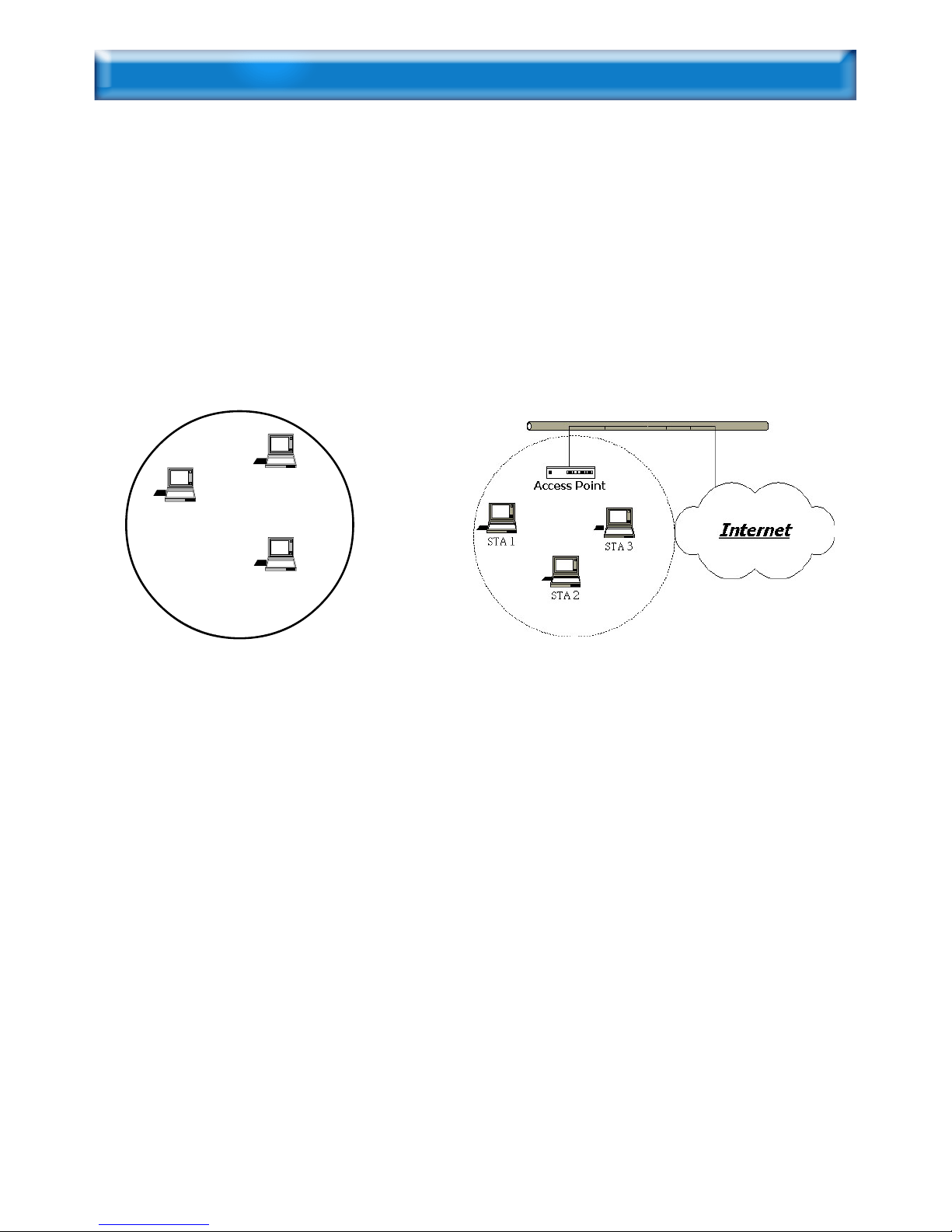
Wireless LAN network defined by IEEE 802.11b standard committee could
be configured as :
Ad Hoc wireless LAN, or
Infrastructure wireless LAN.
Ad Hoc network is a group of PCs installed with wireless LAN cards, this
group of PCs is called a BSS (Basic Service Set). PCs in this group can use
their wireless LAN cards to communicate with each other, but can not
connect to the Internet.
The most obvious difference between Infrastructure wireless network
and Ad Hoc wireless network is that the PCs in Infrastructure wireless
network can access the resource in the Internet through Access Point.
Depending on your requirement, you can easily set up your PC’s
network to be a “Ad Hoc” or “Infrastructure” wireless network. Gener-
ally speaking, if in your network, there is an Access Point in it, we recom-
mend you to set your network as an “Infrastructure”, so it can connect to
the Internet.
3
STA 1
STA 2
STA 3
Ad Hoc Wireless Network Infrastructure Wireless Network

IP ADDRESS
To use the WLAN Mini USB Adapter with a computing device, the WLAN
Mini USB Adapter must be equipped with an USB 1.1 or 2.0 Interface. All
drivers and supporting software for the WLAN Mini USB Adapter must be
installed and configured first.
Ask your system administrator for the following information, which you
may need to provide during driver installation :
Your Wireless Client Name.
Your Wireless SSID.
Your computer’s unique client name and workgroup name.
For your network account, your user name and password.
Your IP address, gateway address, and subnet mask if you’re not
using a DHCP server.
Any computer on a network is identified by a unique network address.
There are two methods to assign a network address to a computer on a
TCP/IP network :
Static IP addressing.
Dynamic IP addressing (DHCP).
In network with static IP addressing, the network administrator manually
assigns an IP address to each computer. Once a static IP address is
assigned, a computer uses the same IP address every time it reboots and
logs on to the network. You may manually change the IP address in the
Network Properties dialog box. Network using static IP address is easy to
set up and do not require additional network management software.
In network with dynamic IP addressing, a DHCP server in the network
dynamically assigns IP addresses to all clients every time they log on to
the network. Network using dynamic IP address requires setting up and
running a DHCP Server.
4
Table of contents
Other ECS Adapter manuals