AEG HHKB64420NB User manual

USER
MANUAL
EN User Manual
Hob
HKB64450NB

CONTENTS
1. SAFETY INFORMATION......................................................................................2
2. SAFETY INSTRUCTIONS.................................................................................... 5
3. INSTALLATION.....................................................................................................8
4. PRODUCT DESCRIPTION.................................................................................14
5. DAILY USE......................................................................................................... 16
6. HINTS AND TIPS................................................................................................18
7. CARE AND CLEANING...................................................................................... 21
8. TROUBLESHOOTING........................................................................................22
9. TECHNICAL DATA............................................................................................. 24
10. ENERGY EFFICIENCY.....................................................................................25
11. ENVIRONMENTAL CONCERNS......................................................................26
FOR PERFECT RESULTS
Thank you for choosing this AEG product. We have created it to give you
impeccable performance for many years, with innovative technologies that help
make life simpler – features you might not find on ordinary appliances. Please
spend a few minutes reading to get the very best from it.
Visit our website to:
Get usage advice, brochures, trouble shooter, service and repair information:
www.aeg.com/support
Register your product for better service:
www.registeraeg.com
Buy Accessories, Consumables and Original spare parts for your appliance:
www.aeg.com/shop
CUSTOMER CARE AND SERVICE
Always use original spare parts.
When contacting our Authorised Service Centre, ensure that you have the
following data available: Model, PNC, Serial Number.
The information can be found on the rating plate.
Warning / Caution-Safety information
General information and tips
Environmental information
Subject to change without notice.
1. SAFETY INFORMATION
Before the installation and use of the appliance, carefully
read the supplied instructions. The manufacturer is not
responsible for any injuries or damage that are the result
of incorrect installation or usage. Always keep the
www.aeg.com2

instructions in a safe and accessible location for future
reference.
1.1 Children and vulnerable people safety
•This appliance can be used by children aged from 8
years and above and persons with reduced physical,
sensory or mental capabilities or lack of experience
and knowledge if they have been given supervision or
instruction concerning the use of the appliance in a
safe way and understand the hazards involved.
•Children between 3 and 8 years of age and persons
with very extensive and complex disabilities shall be
kept away from the appliance unless continuously
supervised.
•Children of less than 3 years of age should be kept
away from the appliance unless continuously
supervised.
•Do not let children play with the appliance.
•Keep all packaging away from children and dispose of
it appropriately.
•WARNING: Keep children and pets away from the
appliance when it operates or when it cools down.
Accessible parts become hot during use.
•If the appliance has a child safety device, it should be
activated.
•Children shall not carry out cleaning and user
maintenance of the appliance without supervision.
1.2 General Safety
•This appliance is for cooking purposes only.
•This appliance is designed for single household
domestic use in an indoor environment.
•This appliance may be used in, offices, hotel guest
rooms, bed & breakfast guest rooms, farm guest
houses and other similar accommodation where such
use does not exceed (average) domestic usage levels.
ENGLISH 3

•WARNING: The appliance and its accessible parts
become hot during use. Care should be taken to avoid
touching heating elements.
•WARNING: Unattended cooking on a hob with fat or
oil can be dangerous and may result in fire.
•Never use water to extinguish the cooking fire. Switch
off the appliance and cover flames with e.g. a fire
blanket or lid.
•WARNING: The appliance must not be supplied
through an external switching device, such as a timer,
or connected to a circuit that is regularly switched on
and off by a utility.
•CAUTION: The cooking process has to be supervised.
A short term cooking process has to be supervised
continuously.
•WARNING: Danger of fire: Do not store items on the
cooking surfaces.
•Metallic objects such as knives, forks, spoons and lids
should not be placed on the hob surface since they
can get hot.
•Do not use the appliance before installing it in the
built-in structure.
•Do not use a steam cleaner to clean the appliance.
•If the glass ceramic surface / glass surface is cracked,
switch off the appliance and unplug it from the mains.
In case the appliance is connected to the mains
directly using junction box, remove the fuse to
disconnect the appliance from power supply. In either
case contact the Authorised Service Centre.
•In case of hotplate glass breakage:
–shut immediately off all burners and any electrical
heating element and isolate the appliance from the
power supply,
–do not touch the appliance surface,
–do not use the appliance.
•If the supply cord is damaged, it must be replaced by
the manufacturer, an authorized Service or similarly
qualified persons in order to avoid a hazard.
www.aeg.com4

•Where the appliance is directly connected to the
power supply, an all-pole isolating switch with a
contact gap is required. Complete disconnection in
compliance with the conditions specified in
overvoltage category III must be guaranteed. The
earth cable is excluded from this.
•When you route the mains cable, make sure that the
cable doesn't come into direct contact (for example
using insulating sleeving) with parts that can reach
temperatures of more than 50°C above room
temperature.
•WARNING: Use only hob guards designed by the
manufacturer of the cooking appliance or indicated by
the manufacturer of the appliance in the instructions
for use as suitable or hob guards incorporated in the
appliance. The use of inappropriate guards can cause
accidents.
2. SAFETY INSTRUCTIONS
This appliance is suitable for the
following markets: GB
2.1 Installation
WARNING!
Only a qualified person must
install this appliance.
WARNING!
Risk of injury or damage to
the appliance.
• Remove all the packaging.
• Do not install or use a damaged
appliance.
• Follow the installation instructions
supplied with the appliance.
• Keep the minimum distance from
other appliances and units.
• Always take care when moving the
appliance as it is heavy. Always use
safety gloves and enclosed footwear.
• Seal the cut surfaces with a sealant to
prevent moisture from causing
swelling.
• Protect the bottom of the appliance
from steam and moisture.
• Do not install the appliance next to a
door or under a window. This
prevents hot cookware from falling
from the appliance when the door or
the window is opened.
• If the appliance is installed above
drawers make sure that the space,
between the bottom of the appliance
and the upper drawer is sufficient for
air circulation.
• The underside of the appliance can
get hot when in use. If an oven has
not been fitted underneath the hob
and underside of the appliance is
accessible and could allow a user or
items stored beneath the hob to come
in direct contact with the underside of
the hob, an intermediate protection
panel must be fitted.
• Plywood or kitchen carcass material is
acceptable for the panel.
• The panel must be removable for
servicing. Screws used to fix the
panel must be accessible after
installation.
ENGLISH 5
2.2 Electrical Connection
WARNING!
Risk of fire and electric
shock.
• All electrical connections should be
made by a qualified electrician.
• The appliance must be earthed.
• Before carrying out any operation
make sure that the appliance is
disconnected from the power supply.
• Make sure that the parameters on the
rating plate are compatible with the
electrical ratings of the mains power
supply.
• Make sure the appliance is installed
correctly. Loose and incorrect
electricity mains cable or plug (if
applicable) can make the terminal
become too hot.
• Use the correct electricity mains
cable.
• Do not let the electricity mains cable
tangle.
• Make sure that a shock protection is
installed.
• Use the strain relief clamp on the
cable.
• Make sure the mains cable or plug (if
applicable) does not touch the hot
appliance or hot cookware, when you
connect the appliance to the near
sockets.
• Do not use multi-plug adapters and
extension cables.
• Make sure not to cause damage to
the mains plug (if applicable) or to the
mains cable. Contact our Authorised
Service Centre or an electrician to
change a damaged mains cable.
• The shock protection of live and
insulated parts must be fastened in
such a way that it cannot be removed
without tools.
• Connect the mains plug to the mains
socket only at the end of the
installation. Make sure that there is
access to the mains plug after the
installation.
• If the mains socket is loose, do not
connect the mains plug.
• Do not pull the mains cable to
disconnect the appliance. Always pull
the mains plug.
• Use only correct isolation devices: line
protecting cut-outs, fuses (screw type
fuses removed from the holder), earth
leakage trips and contactors.
• The electrical installation must have
an isolation device which lets you
disconnect the appliance from the
mains at all poles. The isolation
device must have a contact opening
width of minimum 3 mm.
2.3 Gas connection
CAUTION!
When using a gas cylinder,
always keep it on a flat
horizontal surface (with the
gas valve on top).
• All gas connections must be made by
a qualified person.
• Before installation, make sure that the
local distribution conditions (nature of
the gas and gas pressure) and the
adjustment of the appliance are
compatible.
• Make sure that there is air circulation
around the appliance.
• The information about the gas supply
is on the rating plate.
• This appliance is not connected to a
device, which evacuates the products
of combustion. Make sure to connect
the appliance according to current
installation regulations. Follow the
requirements for adequate ventilation.
2.4 Use
WARNING!
Risk of injury, burns and
electric shock.
www.aeg.com6

CAUTION!
The use of a gas cooking
appliance results in the
production of heat, moisture
and products of combustion
in the room in which it is
installed. Ensure that the
kitchen is well ventilated
especially when the
appliance is in use.
Prolonged intensive use of
the appliance may require
additional ventilation, for
example the increasing of
mechanical ventilation where
present, additional
ventilation to safely remove
the products of combustion
to outside (external) air
whilst also providing room
air changes with additional
ventilation. Consult a
qualified person before
installation of the additional
ventilation.
• Do not change the specification of this
appliance.
• Remove all the packaging, labelling
and protective film (if applicable)
before first use.
• Make sure that the ventilation
openings are not blocked.
• Do not let the appliance stay
unattended during operation.
• Set the cooking zone to “off” after
each use.
• Do not put cutlery or saucepan lids on
the cooking zones. They can become
hot.
• Do not operate the appliance with wet
hands or when it has contact with
water.
• Do not use the appliance as a work
surface or as a storage surface.
• When you place food into hot oil, it
may splash.
WARNING!
Risk of fire and explosion
• Fats and oil when heated can release
flammable vapours. Keep flames or
heated objects away from fats and
oils when you cook with them.
• The vapours that very hot oil releases
can cause spontaneous combustion.
• Used oil, that can contain food
remnants, can cause fire at a lower
temperature than oil used for the first
time.
• Do not put flammable products or
items that are wet with flammable
products in, near or on the appliance.
WARNING!
Risk of damage to the
appliance.
• Do not keep hot cookware on the
control panel.
• Do not let cookware boil dry.
• Be careful not to let objects or
cookware fall on the appliance. The
surface can be damaged.
• Never leave a burner on with empty
cookware or without cookware.
• Do not put aluminium foil on the
appliance.
• Cookware made of cast iron,
aluminium or with a damaged bottom
can cause scratches on the glass /
glass ceramic. Always lift these
objects up when you have to move
them on the cooking surface.
• Use only stable cookware with the
correct shape and diameter larger
than the dimensions of the burners.
• Make sure cookware is centrally
positioned on the burners.
• Do not use large cookware that
overlap the edges of the appliance.
This can cause damage to the
worktop surface.
• Make sure the flame does not go out
when you quickly turn the knob from
the maximum to the minimum
position.
• Use only the accessories supplied
with the appliance.
• Do not install a flame diffuser on the
burner.
• Do not let acid liquids, for example
vinegar, lemon juice or limescale
remover, touch the hob. This can
cause matt patches.
• Discoloration of the enamel or
stainless steel has no effect on the
performance of the appliance.
ENGLISH 7

2.5 Care and cleaning
WARNING!
Do not remove the buttons,
knobs or gaskets from the
control panel. Water may get
inside the appliance and
cause damage.
• Clean the appliance regularly to
prevent the deterioration of the
surface material.
• Switch off the appliance and let it cool
down before cleaning.
• Do not use water spray and steam to
clean the appliance.
• Clean the appliance with a moist soft
cloth. Use only neutral detergents. Do
not use abrasive products, abrasive
cleaning pads, solvents or metal
objects.
• Do not clean the burners in the
dishwasher.
2.6 Service
• To repair the appliance contact the
Authorised Service Centre. Use
original spare parts only.
• Concerning the lamp(s) inside this
product and spare part lamps sold
separately: These lamps are intended
to withstand extreme physical
conditions in household appliances,
such as temperature, vibration,
humidity, or are intended to signal
information about the operational
status of the appliance. They are not
intended to be used in other
applications and are not suitable for
household room illumination.
2.7 Disposal
WARNING!
Risk of injury or suffocation.
• Contact your municipal authority for
information on how to discard the
appliance correctly.
• Disconnect the appliance from the
mains supply.
• Cut off the mains electrical cable
close to the appliance and dispose of
it.
• Flat the external gas pipes.
3. INSTALLATION
WARNING!
Refer to Safety chapters.
3.1 Before the installation
Before you install the hob, write down the
information below from the rating plate.
The rating plate is on the bottom of the
hob.
Model .......................................
PNC .........................................
Serial number ...........................
3.2 Important safety
requirements
This hob must be installed in accordance
with the Gas Safety (Installation and
Use) Regulations (Current Edition) and
the IEE Wiring Regulations (Current
Edition).
Provision for ventilation
Detailed recommendations are contained
in the following British Standards Codes
Of Practice: B.S. 6172/B.S. 5440, Par. 2
and B.S. 6891 Current Editions.
The hob should not be installed in a bed
sitting room with a volume of less than
20 m³. If it is installed in a room of
volume less than 5 m³ an air vent of
effective area of 100 cm² is required. If it
is installed in a room of volume between
5 m³ and 10 m³ an air vent of effective
area of 50 cm² is required, while if the
volume exceeds 11 m³ no air vent is
required.
However, if the room has a door which
opens directly to the outside no air vent
is required even if the volume is between
5 m³ and 11 m³.
If there are other fuel burning appliances
in the same room, B.S. 5440 Part 2
Current Edition, should be consulted to
www.aeg.com8

determine the requisite air vent
requirements.
Location
The hob may be located in a kitchen, a
kitchen/diner or bed sitting room (with a
volume greater than 20 m³), but not in a
bathroom or shower room.
The minimum distance combustible
material can be fitted above the hob in
line with the edges of the hob is 400 mm.
If it is fitted below 400 mm a space of 50
mm must be allowed from the edges of
the hob.
3.3 Gas Connection
WARNING!
Any gas installation must be
carried out by a GAS SAFE
REGISTER installer.
Make sure that, once the hob is installed,
it is easily accessible for the engineer in
the event of a breakdown.
The manufacturer will not accept liability,
should the above instructions or any of
the other safety instructions incorporated
in this instruction booklet be ignored.
On the end of the shaft, which includes
the G 1/2" threaded elbow, adjustment is
fixed so that the washer is fitted between
the components as shown in the
diagram. Screw the parts together
without using excessive force.
1/2
1/2
A B C
A. End of shaft with nut
B. Washer supplied with the appliance
C. Elbow supplied with the appliance
Connection to the gas supply should be
with either rigid or semi-rigid pipe, i.e.
steel or copper.
The connection should be suitable for
connecting to R 1/2 (1/2 BSP male
thread).
When the final connection has been
made, it is essential that a thorough leak
test is carried out on the hob and
installation.
Make sure that the main connection pipe
does not exert any strain on the hob.
If you use flexible metal pipes make sure
that they agree to ISO 10380 and ISO
10807 standards. Be careful they do not
come in touch with mobile parts or they
are not squeezed. Also be careful when
the hob is put together with an oven.
CAUTION!
It is important to install the
elbow correctly, with the
shoulder on the end of the
thread, fitted to the hob
connecting pipe.
CAUTION!
Failure to ensure the correct
assembly will cause leakage
of gas.
CAUTION!
Make sure that the gas
supply pressure of the
appliance obeys the
recommended values.
Rigid connection:
Carry out connection by using metal rigid
pipes (copper with mechanical end).
3.4 Injectors replacement
1. Remove the pan supports.
2. Remove the caps and crowns of the
burner.
3. With a socket spanner 7 remove the
injectors and replace them with the
ones which are necessary for the
type of gas you use (see table in
"Technical Data" chapter).
4. Assemble the parts, follow the same
procedure backwards.
5. Attach the label with the new type of
gas supply near the gas supply pipe.
You can find this label in the package
supplied with the appliance.
If the supply gas pressure is changeable
or different from the necessary pressure,
you must fit an applicable pressure
adjuster on the gas supply pipe.
ENGLISH 9
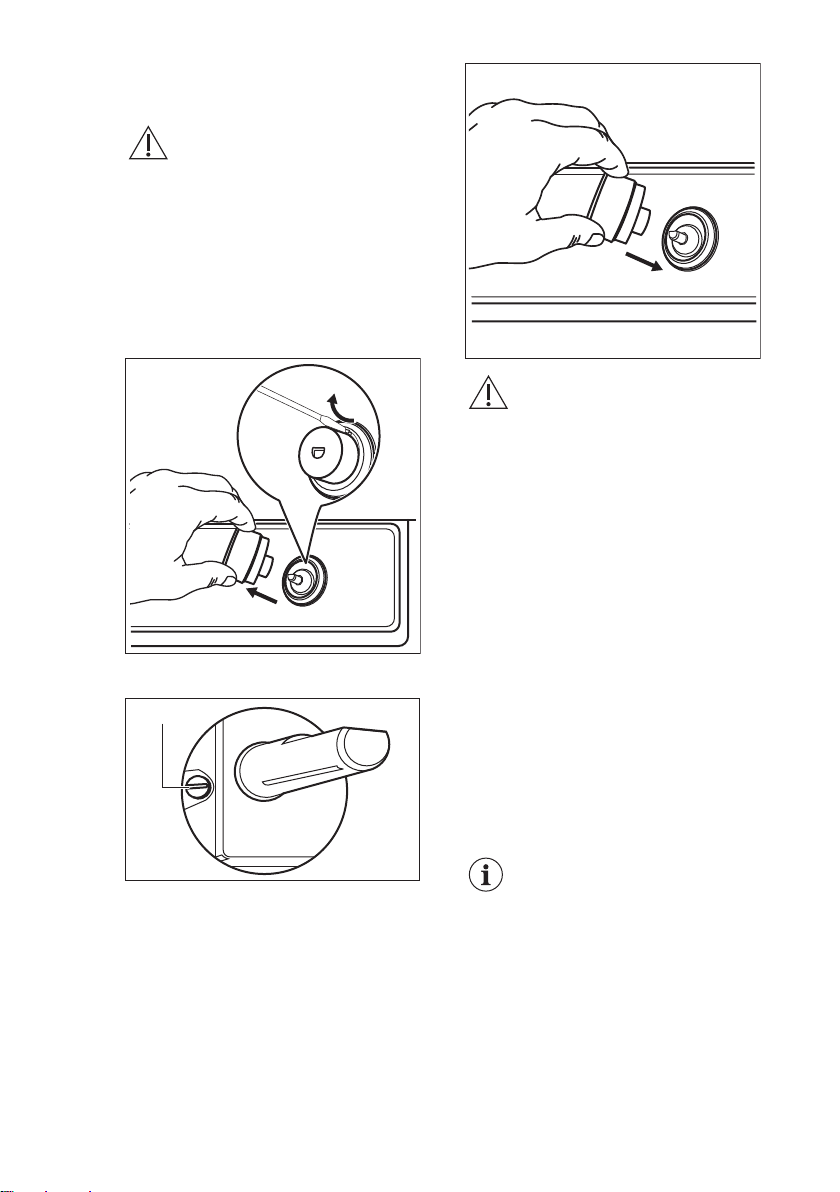
3.5 Adjustment of minimum
level
WARNING!
Information for authorised
installer only.
To adjust the minimum level of the
burners:
1. Light the burner.
2. Turn the knob on the minimum
position.
3. Remove the knob and using thin
screwdriver lift up and remove the
plastic magnet holder.
4. With a thin screwdriver, adjust the
bypass screw position (A).
A
5. If you change:
• from natural gas G20 20 mbar to
liquid gas, fully tighten the bypass
screw in.
• from liquid gas to natural gas G20
20 mbar, undo the bypass screw
approximately 1/4 of a turn (1/2 of
a turn for Multi Crown burner).
6. Reassemble the magnet holder and
the knob.
WARNING!
Make sure the flame does
not go out when you quickly
turn the knob from the
maximum position to the
minimum position.
3.6 Electrical connection
• Do not pull the mains cable to
disconnect the appliance. Always pull
the mains plug (if applicable).
• The appliance must not be connected
with an extension cable, an adapter or
a multiple socket. There is a risk of
fire.
• Do not let the power cable to heat up
to a temperature of more than 90° C.
The cable should be guided by means
of clamps fixed to the side of the
cabinet, in order to avoid any contact
with the appliance beneath the
cooktop.
• Make sure that there is access to the
mains plug after the installation.
If the pilot lights turn on after
connecting the hob to the
mains, turn on and off the
control knob and wait until
the residual heat indicator
goes out.
Electrical Requirements
Permanent electrical installation must
agree with the latest I.E.E. Regulations
and local Electricity Board regulations.
For your own safety the installation must
be done by a qualified electrician (e.g.
your local Electricity Board, or a
www.aeg.com10
Table of contents
Other AEG Hob manuals