Stihl FS 45 User manual

Contents
1 Guide to Using this Manual.........................2
2 Safety Precautions and Working Techni‐
ques............................................................ 2
3 Approved Combinations of Cutting Attach‐
ment, Deflector, Handle and Harness.........9
4 Mounting the Loop Handle..........................9
5 Mounting the Deflector..............................11
6 Mounting the Cutting Attachment..............11
7 Fuel........................................................... 13
8 Fueling...................................................... 14
9 Starting / Stopping the Engine.................. 15
10 Operating Instructions...............................17
11 Cleaning the Air Filter............................... 18
12 Adjusting the Carburetor........................... 18
13 Spark Plug................................................ 19
14 Engine Running Behavior......................... 20
15 Storing the Machine.................................. 20
16 Maintaining the Mowing Head...................20
17 Inspections and Maintenance by Dealer...21
18 Maintenance and Care..............................22
19 Minimize Wear and Avoid Damage...........23
20 Main Parts.................................................23
21 Specifications............................................24
22 Maintenance and Repairs......................... 24
23 Disposal.................................................... 25
24 EC Declaration of Conformity................... 25
Dear Customer,
Thank you for choosing a quality engineered
STIHL product.
It has been built using modern production techni‐
ques and comprehensive quality assurance.
Every effort has been made to ensure your satis‐
faction and trouble-free use of the product.
Please contact your dealer or our sales company
if you have any queries concerning this product.
Your
Dr. Nikolas Stihl
1 Guide to Using this Manual
1.1 Pictograms
The meanings of the pictograms attached to the
machine are explained in this manual.
Depending on the model concerned, the follow‐
ing pictograms may be attached to your
machine.
Fuel tank; fuel mixture of gasoline
and engine oil
Operate decompression valve
Manual fuel pump
Operate manual fuel pump
Tube of grease
Intake air: Summer operation
Intake air: Winter operation
Handle heating
1.2 Symbols in text
WARNING
Warning where there is a risk of an accident or
personal injury or serious damage to property.
NOTICE
Caution where there is a risk of damaging the
machine or its individual components.
1.3 Engineering improvements
STIHL's philosophy is to continually improve all
of its products. For this reason we may modify
the design, engineering and appearance of our
products periodically.
Therefore, some changes, modifications and
improvements may not be covered in this man‐
ual.
2 Safety Precautions and
Working Techniques
Some special safety precautions
must be observed to reduce the risk
of personal injury when operating this
power tool because of the very high
speed of its cutting attachment.
English
2 0458-232-0121-F
© ANDREAS STIHL AG & Co. KG 2021
0458-232-0121-F. VA0.F21.
Printed on chlorine-free paper
Printing inks contain vegetable oils, paper can be recycled.
Original Instruction Manual
0000000049_028_GB

It is important you read and under‐
stand the User Manual before com‐
missioning and keep it in a safe place
for future reference. Non-compliance
with the User Manual may cause seri‐
ous or even fatal injury.
Observe all applicable local safety regulations,
e.g. by trade organizations, social insurance
institutions, labor safety authorities etc.
If you have never used a power tool before:
Have your dealer or other experienced user
show you how to operate your machine – or
attend a special course to learn how to operate
it.
Minors should never be allowed to use the
machine – except for apprentices over the age of
16 when working under supervision.
Children, animals and bystanders must not be
allowed near the machine.
When not using the machine, it must be laid
down in such a way that it does not endanger
anyone. Ensure that the machine cannot be
used without authorization.
The user is responsible for accidents or risks
involving third parties or their property.
Do not lend or rent your power tool without the
User Manual. Be sure that anyone using it under‐
stands the information contained in this manual.
The use of machines that emit noise may be limi‐
ted to certain hours of the day as specified by
national and/or regional or local regulations.
Anyone operating the machine must be well res‐
ted, in good physical health and in good mental
condition.
If you have any condition that might be aggrava‐
ted by strenuous work, check with your doctor
before operating a machine.
If you have a pacemaker: The ignition system of
your machine produces an electromagnetic field
of very low intensity. This field may interfere with
some pacemakers. STIHL recommends that per‐
sons with pacemakers consult their physician
and the pacemaker manufacturer to reduce any
health risk.
Anyone who has consumed alcohol or drugs or
medicines affecting their ability to react must not
operate a power tool.
Depending on the cutting attachment fitted, use
your trimmer only for cutting grass, wild growth
and similar materials.
The power tool must not be used for any other
purpose because of the increased risk of acci‐
dents and damage to the machine. Never
attempt to modify your power tool in any way
since this may result in accidents or damage to
the machine.
Only use cutting attachments and accessories
that are explicitly approved for this power tool
model by STIHL or are technically identical. If
you have any questions in this respect, consult
your dealer. Use only high quality parts and
accessories. in order to avoid the risk of acci‐
dents and damage to the machine.
STIHL recommends the use of original STIHL
tools and accessories. They are specifically
designed to match the product and meet your
performance requirements.
Never attempt to modify your power tool in any
way since this may increase the risk of personal
injury. STIHL excludes all liability for personal
injury and damage to property caused while
using unauthorized attachments.
Do not use a high-pressure washer to clean the
power tool. The solid jet of water may damage
parts of the unit.
The guard provided with your machine may not
protect the operator from all foreign objects
(gravel, glass, wire etc.) ejected by the revolving
cutting attachment. Ejected objects may also ric‐
ochet and strike the operator.
2.1 Clothing and equipment
Wear proper protective clothing and equipment.
Clothing must be sturdy but allow
complete freedom of movement.
Wear close-fitting clothes such as a
boiler suit, not a loose jacket.
Do not wear clothing which could
become trapped in wood, brush or
moving parts of the machine. Do not
wear a scarf, necktie or jewelry. Tie
up and confine long hair above your
shoulders.
Wear sturdy shoes with non-slip
soles.
WARNING
To reduce the risk of eye injuries,
wear close-fitting safety glasses in
accordance with European Standard
EN 166. Make sure the safety
glasses are a snug fit.
2 Safety Precautions and Working Techniques English
0458-232-0121-F 3

Wear face protection and make sure it is a good
fit. Face protection alone is not sufficient to pro‐
tect the eyes.
Wear "personal" sound protection, e.g. ear
defenders.
Wear sturdy protective gloves made
of a resistant material (e. g. leather).
STIHL can supply a comprehensive range of per‐
sonal protective equipment.
2.2 Transporting the machine
234BA001 KN
Always stop the engine.
Carry the unit properly balanced by the shaft or
loop handle.
By vehicle: When transporting in a vehicle, prop‐
erly secure your machine to prevent turnover,
damage and fuel spillage.
2.3 Refueling
Gasoline is an extremely flammable
fuel. Keep clear of naked flames. Do
not spill any fuel – do not smoke.
Always shut off the engine before refueling.
Do not fuel a hot engine – fuel may spill and
cause a fire.
Open the fuel cap carefully to allow any pressure
build-up in the tank to release slowly and avoid
fuel spillage.
Only refuel the machine in a well ventilated
place. If fuel has been spilled, immediately clean
the machine – do not allow your clothes to be
splashed with fuel. If that happens, change your
clothes at once.
After refueling, close the fuel cap as
tightly as possible.
This helps reduce the risk of unit vibrations caus‐
ing an incorrectly tightened fuel cap to loosen or
come off and spill quantities of fuel.
Check for leaks. Do not start the engine if there
is a fuel leak – serious or fatal burns could result!
2.4 Before starting
Check that your power tool is properly assem‐
bled and in good condition – refer to appropriate
chapters in the User Manual:
–Check the fuel system for leaks, especially the
visible parts, e. g., fuel cap, hose connections,
manual fuel pump (only in machines with a
manual fuel pump). In case of leakage and
damage, do not start the engine – risk of fire!
Have the machine serviced by a dealer before
using it
–Use only an approved combination of cutting
attachment, deflector, handle and harness. All
parts must be assembled properly and
securely. To reduce the risk of injury, never
use metal cutting attachments!
–Slide control / stop switch must move easily to
STOP or 0
–Throttle trigger lockout (if installed) and throttle
trigger must move easily – the throttle trigger
must return to the idle position automatically
–Check that the spark plug boot is secure – a
loose boot may cause sparking that could
ignite combustible fumes and cause a fire!
–Check cutting attachment for correct and
secure assembly and good condition
–Check safety devices (e. g., deflector for cut‐
ting attachments) for damage and/or wear.
Always replace damaged parts. Never operate
the unit with a damaged deflector
–Never attempt to modify the controls or safety
devices
–Keep the handles dry and clean – free from oil
and dirt – this is important for safe control of
the machine
–Adjust the harness and handle(s) to suit your
height and reach
To reduce the risk of personal injury, do not
operate your power tool if it is damaged or not
properly assembled!
To prepare for emergencies when using a har‐
ness: Practice setting down the machine quickly.
To avoid damage, do not throw the machine to
the ground when practicing.
English 2 Safety Precautions and Working Techniques
4 0458-232-0121-F

2.5 Starting the engine
Start the engine at least 3 meters from the fuel‐
ing spot, outdoors only.
Place the unit on firm ground in an open area.
Make sure you have good balance and secure
footing. Hold the unit securely. The cutting
attachment must be clear of the ground and all
other obstructions because it may begin to run
when the engine starts.
Your power tool is a one-person unit. To reduce
the risk of injury from ejected objects, do not
allow other persons within a radius of 15 meters
of your own position – even when starting.
Avoid contact with the cutting attach‐
ment – risk of injury!
Do not drop-start the engine – start it as descri‐
bed in the User Manual.
The cutting attachment runs on for a
short while after releasing the throttle
trigger – coasting effect!
Check engine idling: The cutting attachment
must remain at a standstill when the engine idles
– throttle trigger released.
To reduce the risk of fire, keep hot exhaust
gases and hot muffler away from easily combus‐
tible materials (e.g. wood chips, bark, dry grass,
fuel).
2.6 Holding and guiding the
machine
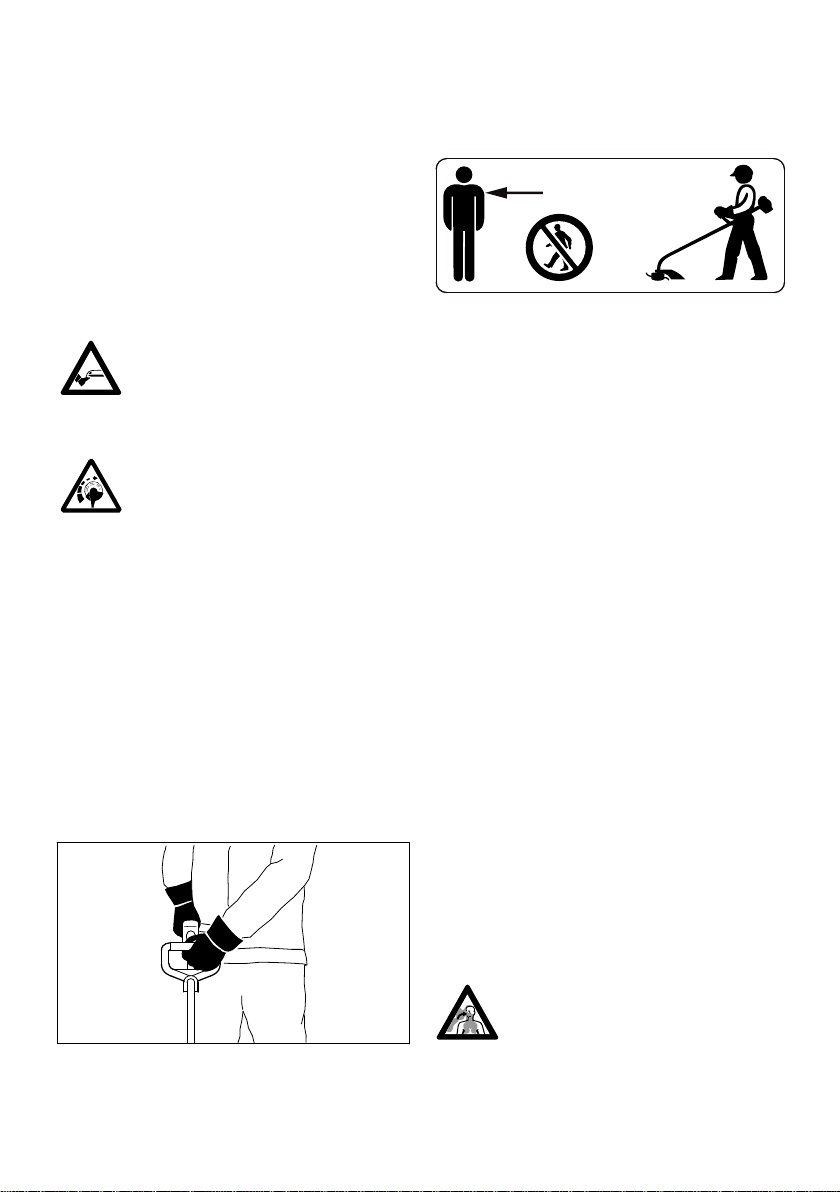
Always hold the unit firmly with both hands on
the handles.
Make sure you always have good balance and
secure footing.
002BA056 KN
Left hand on the loop handle, right hand on the
shaft handle, even if you are left-handed.
2.7 While working
In the event of impending danger or in an emer‐
gency, switch off the engine immediately - move
the slide control/stop switch to STOP or 0.
15m (50ft)
The cutting attachment may catch and eject
objects over a great distance and cause injury -
therefore, do not allow any other persons within
a radius of 15 meters of your own position. This
distance must also be maintained in relation to
objects (vehicles, window panes) – risk of prop‐
erty damage! Even at a distance over 15 m, dan‐
ger cannot be ruled out.
Check that the engine is properly idling so that
the cutting tool will not continue rotating after you
release the throttle trigger.
Check and correct the idle speed setting at regu‐
lar intervals. If the cutting attachment still rotates
at idle speed, have your dealer make proper
adjustments or repairs.
Take special care in slippery conditions – damp,
snow, ice, on slopes or uneven ground.
Watch out for obstacles: tree stumps, roots – risk
of tripping or stumbling!
Make sure you always have good balance and
secure footing.
Only work while standing on the ground, never
on a ladder or mobile elevated work platform.
Be particularly alert and cautious when wearing
hearing protection because your ability to hear
warnings (shouts, alarms, etc.) is restricted.
Take breaks when you start getting tired or feel‐
ing fatigue – risk of accidents!
Work calmly and carefully – in daylight conditions
and only when visibility is good. Proceed with
caution, do not put others in danger.
As soon as the engine is running, the
power machine generates toxic
exhaust gas.As soon as the engine is
running, the power machine gener‐
ates toxic exhaust gas. These gases
may be odorless and invisible and
may contain unburned hydrocarbons
and benzene. Never run the engine
indoors or in poorly ventilated loca‐
2 Safety Precautions and Working Techniques English
0458-232-0121-F 5

tions, even if your model is equipped
with a catalytic converter.
To reduce the risk of serious or fatal injury from
breathing toxic fumes, ensure proper ventilation
when working in trenches, hollows or other con‐
fined locations. This reduces the risk of serious
or fatal injury from breathing toxic fumes.
Stop work immediately if you start suffering from
nausea, headaches, impaired vision (e.g. your
field of vision gets smaller), impaired hearing,
dizziness, or impaired concentration – these
symptoms may possibly be the result of too-high
exhaust gas concentration – Risk of accidents!
Operate your power tool so that it produces a
minimum of noise and emissions – do not run the
engine unnecessarily, accelerate the engine only
when working.
To reduce the risk of fire, do not smoke while
operating or standing near your power tool. Com‐
bustible fuel vapor may escape from the fuel sys‐
tem.
Dusts, mist and fumes emissions during the work
may be hazardous to your health. Wear respira‐
tory protection in case of heavy dust or smoke
emission.
If your power tool is subjected to unusually high
loads for which it was not designed (e.g. heavy
impact or a fall), always check that it is in good
condition before continuing work – see also
"Before Starting".
Check in particular that the fuel system has no
leaks and the safety equipment is fully operative.
Never use a power tool that is no longer safe to
operate. In case of doubt, contact a dealer.
Do not operate your power tool in the starting
throttle position – engine speed cannot be con‐
trolled in this position.
Never work without protection suita‐
ble for the respective machine and
cutting tool – risk of injury by ejected
objects!
Check the work site – rocks, metal
objects etc. may be caught up and
ejected – possibly over a distance of
15 m – risk of injury! – They can also
damage the cutting attachment and
other property (e. g. parking vehicles,
windows).
Be particularly careful when working on difficult,
densely grown terrain.
When mowing in high shrubbery, under shrub‐
bery and hedges: Hold the cutting tool at a work‐
ing height of at least 15 cm – avoid risks to ani‐
mals.
Before you leave the machine: Shut the engine
off.
Check the cutting tool regularly at short intervals,
and immediately if you feel a change in its
behavior:
–Turn off the engine, hold the device securely,
press the cutting attachment against the
ground to stop it
–Check the condition and firm seat, watch out
for fine cracks
–Immediately replace defective cutting tools,
also in case of minor hairline cracks
Clean grass and plant residue off the cutting
attachment mounting at regular intervals –
remove any build up of material from the cutting
attachment and deflector.
To reduce the risk of injury, shut off the engine
before replacing the cutting attachment!
Do not continue using or attempt to repair dam‐
aged or cracked cutting attachments by welding,
straightening or modifying the shape (out of bal‐
ance).
Particles or pieces may come off and hit the
operator or a bystander at a high speed – risk of
most severe injuries!
If a rotating cutting attachment touches a rock or
another hard object, sparks may be generated
which may possibly ignite combustible materials.
Also dried-out plants and brushwood are com‐
bustible, above all in hot and dry weather. If
there is a risk of fire, do not use cutting attach‐
ments in the vicinity of combustible materials,
dried-out plants or brushwood. It is mandatory
that you ask the responsible forestry office about
the current fire hazard.
2.7.1 When using mowing heads
Only use the protection with properly mounted
blade to ensure that the mowing line is restricted
to the permissible length.
Always switch off the engine to adjust the mow‐
ing line for manually adjustable mowing heads –
risk of injury!
Misuse with mowing lines that are too long
reduces the working speed of the engine. The
constant slipping of the clutch causes overheat‐
ing and damage to important components (e. g.
clutch, plastic housing parts) – e. g. due to the
English 2 Safety Precautions and Working Techniques
6 0458-232-0121-F

cutting attachment rotating during idling – risk of
injury!
2.8 Vibrations
Prolonged use of the power tool may result in
vibration-induced circulation problems in the
hands (whitefinger disease).
No general recommendation can be given for the
length of usage because it depends on several
factors.
The period of usage is prolonged by:
–Hand protection (wearing warm gloves)
–Work breaks
The period of usage is shortened by:
–Any personal tendency to suffer from poor cir‐
culation (symptoms: frequently cold fingers,
tingling sensations).
–Low outside temperatures.
–The force with which the handles are held (a
tight grip restricts circulation).
Continual and regular users should monitor
closely the condition of their hands and fingers. If
any of the above symptoms appear (e.g. tingling
sensation in fingers), seek medical advice.
2.9 Maintenance and Repairs
Service the machine regularly. Do not attempt
any maintenance or repair work not described in
the instruction manual. Have all other work per‐
formed by a servicing dealer.
STIHL recommends that you have servicing and
repair work carried out exclusively by an author‐
ized STIHL servicing dealer. STIHL dealers are
regularly given the opportunity to attend training
courses and are supplied with the necessary
technical information.
Only use high-quality replacement parts in order
to avoid the risk of accidents and damage to the
machine. If you have any questions in this
respect, consult a servicing dealer.
STIHL recommends the use of original STIHL
replacement parts. They are specifically
designed to match your model and meet your
performance requirements.
To reduce the risk of injury, always shut off the
engine before carrying out any maintenance or
repairs or cleaning the machine. – Exception:
Carburetor and idle speed adjustments.
Do not turn the engine over on the starter with
the spark plug boot or spark plug removed
unless the slide control / stop switch is on STOP
or 0 since there is otherwise a risk of fire from
uncontained sparking.
To reduce the risk of fire, do not service or store
your machine near open flames.
Check the fuel filler cap for leaks at regular inter‐
vals.
Use only a spark plug of the type approved by
STIHL and make sure it is in good condition –
see "Specifications".
Inspect the ignition lead (insulation in good con‐
dition, secure connection).
Check the condition of the muffler.
To reduce the risk of fire and damage to hearing,
do not operate your machine if the muffler is
damaged or missing. –
Do not touch a hot muffler since burn injury will
result.
2.10 Cutting Attachments and
Deflectors
For safety reasons only the combinations of cut‐
ting attachment, deflector, handle and shoulder
strap approved in the model-specific instruction
manual may be used.
Only mowing heads may be used on trimmers
with a curved drive tube and loop handle.
2.10.1 Symbols on Deflectors
An arrow shows the direction of rotation of the
cutting attachments.
2 Safety Precautions and Working Techniques English
0458-232-0121-F 7

2.11 Mowing Head with Nylon Lines
000BA019 KN
Nylon line achieves a soft cut for edging and
trimming around fence posts, trees, etc. – less
risk of damaging tree bark.
WARNING
To reduce the risk of injury, never use steel wire
in place of the nylon cutting line.
2.12 STIHL PolyCut 6-3 Mowing
Head with Polymer Blades
1
002BA073 KN
2
002BA074 KN
For mowing unobstructed edges of meadows
(without posts, fences, trees or similar obsta‐
cles).
It is important to follow the maintenance instruc‐
tions for the Polycut mowing head.
Check the wear limit marks!
Wear limit marks are integrated in the base of
the PolyCut.
Do not continue using the PolyCut 6-3 if one of
the circular holes (1; arrow) becomes visible or if
the projecting rim (2; arrow) has worn away.
Install a new mowing head.
WARNING
If the wear limit marks are ignored, there is a risk
of the cutting tool shattering and flying parts
injuring the operator or bystanders.
To reduce the risk of accidents from shattered
blades, avoid contact with stones, metal and sim‐
ilar solid objects.
Check PolyCut blades for cracks at regular inter‐
vals. If a crack is found in one of the blades,
always replace all the blades.
English 2 Safety Precautions and Working Techniques
8 0458-232-0121-F

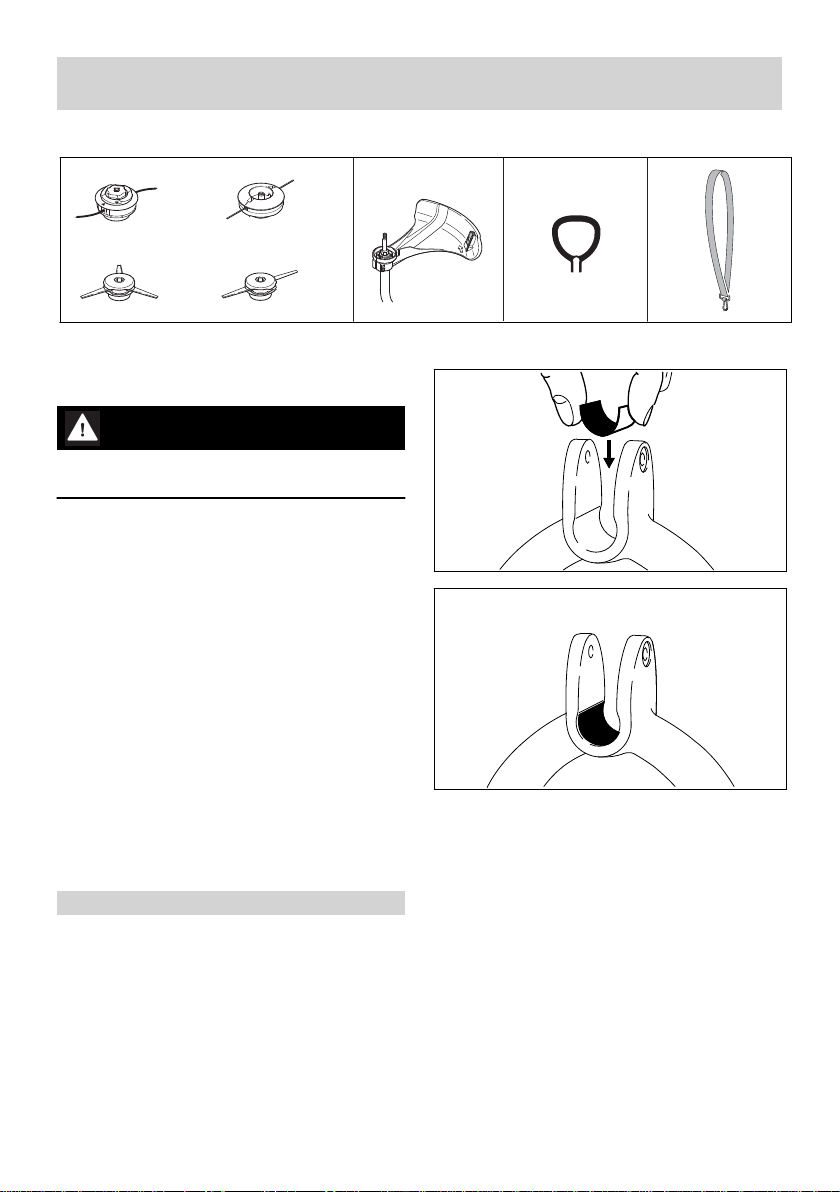
3 Approved Combinations of Cutting Attachment, Deflector, Han‐
dle and Harness
Cutting attachment Deflector Handle Carrying strap
0000-GXX-0401-A4
1
67
5
2
34
3.1 Permissible combinations
Choose the correct combination from the table
depending on the cutting tool!
WARNING
For safety reasons no other combinations are
permitted – risk of accidents!
3.2 Cutting attachments
3.2.1 Mowing heads
1 STIHL AutoCut C 6-2
2 STIHL DuroCut 5-2
3 STIHL PolyCut 7-3
4 STIHL PolyCut 6-2
3.3 Deflector
5 Guard with blade for mowing heads
3.4 Handle
6 Loop handle
3.5 Carrying strap
7 Shoulder strap can be used
4 Mounting the Loop Handle
The loop handle comes in two different versions.
4.1 Version A
223BA017 KN
223BA018 KN
► Place the friction liner in the loop handle.
3 Approved Combinations of Cutting Attachment, Deflector, Handle and Harness English
0458-232-0121-F 9

4
65
232BA027 KN
1
2
3
A
► Fit the loop handle (1) on the drive tube at dis‐
tance (A) of about 20 cm (8 in.) from the con‐
trol handle (2).
► Slide the spacer (3) – if supplied – into the
loop handle as far as stop.
► Insert the screw (4) through the loop handle
and the spacer until the screw head locates in
the loop handle's hexagon recess.
► Fit the washer (5).
► Screw on the star knob (6) and tighten it down
firmly.
Adjusting loop handle to most comfortable posi‐
tion
► Loosen the star knob (6).
► Move the loop handle (1) along the drive tube
as required.
► Tighten down the star knob (6) firmly.
4.2 Version B
Your new power tool comes with the loop handle
mounted on the drive tube, but it must be turned
and lined up to suit your requirements.
Line up the loop handle.
1
239BA008 KN
► Use the combination wrench to loosen the
screw (1).
239BA009 KN
► Turn the handle to the vertical position.
234BA026 KN
A
The loop handle can be adjusted to suit the
height and reach of the operator and the applica‐
tion by changing distance (A).
Recommendation: distance (A): about 15 cm
(6 in)
English 4 Mounting the Loop Handle
10 0458-232-0121-F
Other manuals for FS 45
5
This manual suits for next models
4
Table of contents
Other Stihl Trimmer manuals