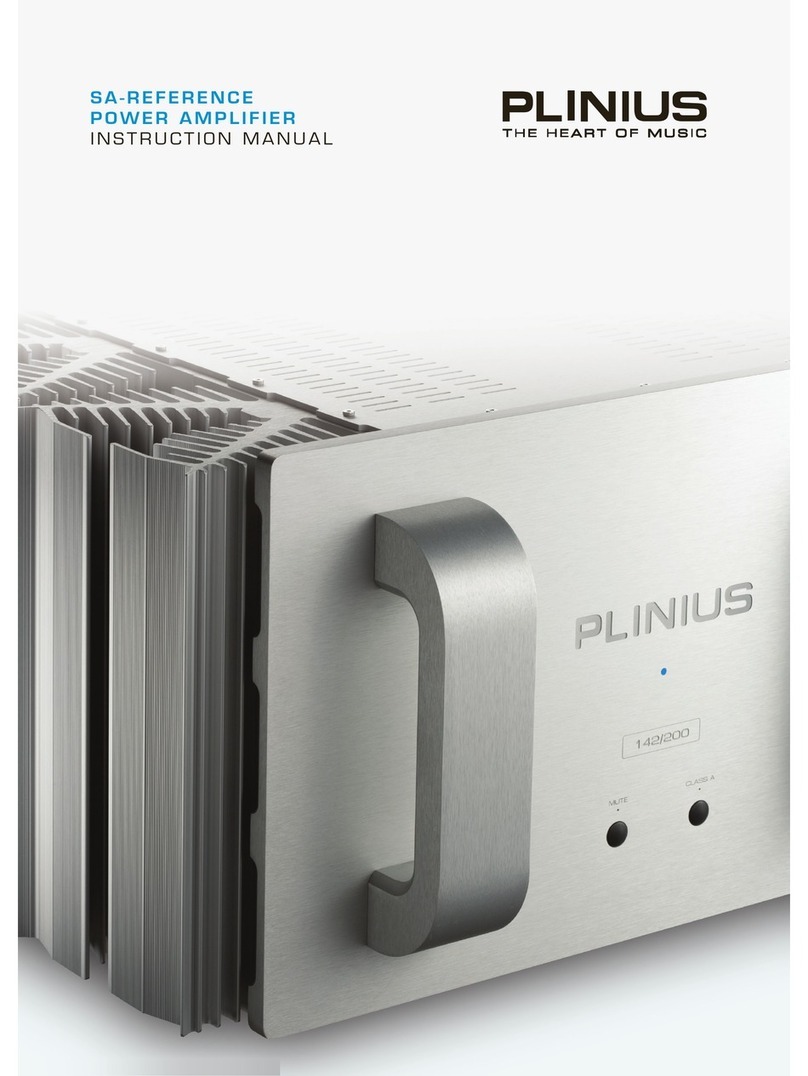
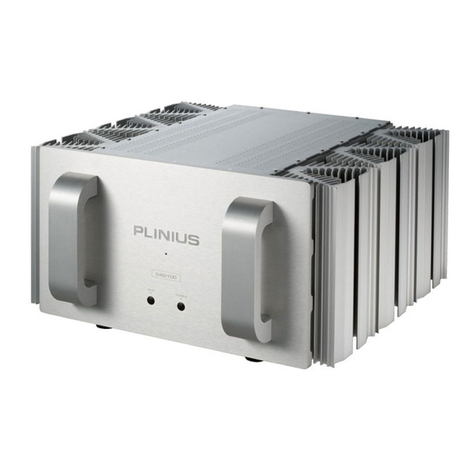
Plinius KAITAKI User manual

The heart of music
www.pliniusaudio.com
KAITAKI
Preamplifier
Instruction Manual


Contents
Introduction ...............................................................................................................2
Design Philosophy ...............................................................................................3
Unpacking ....................................................................................................................4
Placement & Ventilation ....................................................................................4
Care & Maintenance............................................................................................5
Precautions ................................................................................................................6
Front Panel Functions ........................................................................................7
Rear Panel Functions .........................................................................................8
Remote Control Functions .............................................................................11
Installation & Operation ....................................................................................13
Product Features ..................................................................................................16
Troubleshooting .......................................................................................................18
Specifications ..........................................................................................................19
Index ................................................................................................................................20
All operational, technical and descriptive material in this publication
is subject to change at any time without notice. For further product
information or queries, please contact your Plinius dealer.
Plinius products are designed and manufactured by
Plinius Audio Limited, New Zealand.

2
PLINIUS KAITAKI
Introduction
Congratulations on your decision to become the proud owner of this
Plinius Kaitaki Preamplifier.
This manual has been prepared to help you understand the operation of your
preamplifier, and to provide information about its design and the variety of ways it may
be used.
We have designed and manufactured this preamplifier to reproduce your favourite
music faithfully and accurately. With a little care and a full understanding of the
operating recommendations in this manual, your Plinius Kaitaki Preamplifier will
provide years of high-quality, trouble-free performance.
Please take the time to read this manual thoroughly before using your preamplifier.
SERIAL NUMBER
FINAL TEST CERTIFIED BY

3
PREAMPLIFIER
Design Philosophy
From a distance you can see that the design of the Plinius products is more than
an applied styling exercise to the front panel. We have started from the ground up
to produce a casing for our electronics that is unrivalled in its physical strength and
visual simplicity.
Wherever possible we have reduced the number of parts needed and then invested
massively in refining and producing the remaining parts to the highest quality
achievable with state of the art computer controlled machines allied with expert
craftsman. Examples of this approach include the hydraulically formed corners on
the amplifiers giving much greater strength and the one piece housing for the remote
control that looks, feels and genuinely is robust.
As with music that you are not familiar with, truly innovative new designs can take time
to understand and enjoy. How often have you heard music that you were first unsure
of, that over repeated listening, has become a firm favourite?
Our designs are fundamentally different to many other companies, and we hope that
you will take the time to explore their unique character and qualities because we have
not made them different simply to be different. We genuinely believe that their visual
and tactile qualities do improve the experience of listening to music and that is our
design goal!
Ross Stevens
DESIGN DIRECTOR

4
PLINIUS KAITAKI
Unpacking
Open the box from the top and remove the accessories from the foam end caps.
You may now proceed to lift the unit from the box, Once the unit is removed you can
proceed with the removal of the foam end caps. These caps are designed to fit on
the front and back of the unit for maximum protection. Retain the packaging for future
transportation of this unit.
Placement & Ventilation
This Plinius product may operate at a moderately high temperature, especially
during extended listening sessions. With this in mind, we recommend the following
guidelines for placement and ventilation:
• The ideal location is upon a rigid stand, away from direct contact with any
temperature sensitive materials, furniture or deep pile carpets.
• Ventilation through and around the preamplifier should be kept unimpeded.
• Ensure heat vents (slots in the base and lid) are not covered or restricted in any way.
• Equipment racks should be of an open type with no closed side panels and no
closed front or rear panels. Ensure a minimum of 100mm clearance on all sides of
your Plinius unit to other equipment and the shelf above.
• If the unit is in an enclosed cabinet, the clearance should be greater than 400mm
on all sides. Ensure the space between the chassis and shelf below the unit is
unobstructed at all times.
• When stacking separate audio components, ensure a minimum of 400mm
clearance above the top unit is maintained for suitable airflow.
• NOTE: This unit has been designed for use in moderate climates only, not for tropical
conditions.
The design of this Plinius product incorporates a very high level of mechanical
decoupling of the input and output. It can however still be influenced by acoustical
feedback in the operating environment. The use of acoustic cones or a suitably
spiked stand or table may further enhance the performance of this preamplifier.
Consult your Plinius dealer for further advice if required.

5
PREAMPLIFIER
Care & Maintenance
With simple care and maintenance your Plinius product can be kept looking and
operating like new for many years to come.
MAINTAINING THE CONNECTORS
Exposed connectors such as the RCA connectors will be subject to environmental
factors, and over time the surface may degrade. This can be greatly reduced by fitting
readily available ‘RCA caps’ to reduce the effects of environmental elements on the RCA
connectors. These RCA caps or RCA shorting caps can also provide sonic benefits.
Connector cleaning products are also available to clean the RCA and cable connectors
and frequent checks and cleaning will help maintain a good signal connection.
NOTE: DO NOT use RCA shorting caps on output connectors or power amplifier input
connectors. Use RCA shorting caps on unused preamplifier stage input connectors only.
Standard RCA shielding caps can be used on any unused input or output connectors.
MAINTAINING THE SWITCHES
Switches should be maintained by using each various switch setting periodically.
Even if a switch or a switch setting is not used, it is a good idea to toggle small
switches and turn rotary switches though the full range of the switch several times in
succession to keep the contacts active. Performing this simple action will promote
longevity of the switch contacts.
SURFACE CLEANING
From time to time you may wish to clean the surface of your Plinius equipment to
remove dust, or any material build up from the atmosphere or on commonly used
controls. Your Plinius product is made up of parts that have a hard anodised or a
powder coat finish and will clean easily without being damaged.
Cleaning should be carried out using a soft cleaning cloth, dry or with either a small
amount of water or a very mild surface cleaner, while observing the following guidelines:
• As a safety precaution, always switch the equipment off prior to cleaning
• Always use a cloth that is soft and clean
• Never use abrasives or polishing compounds anywhere on the unit
• Never apply liquid directly to the surface of the unit
• Use the cloth dry or with mild surface cleaners of either liquid or foaming type
• Apply only small amounts of cleaner to the cloth
• DO NOT rub the surface but wipe clean only. Excessive rubbing may dull powder
coat or wear the screen printed text.

6
PLINIUS KAITAKI
Precautions
PLEASE TAKE SPECIAL NOTE OF THE FOLLOWING PRECAUTIONS
BEFORE OPERATING YOUR NEW PREAMPLIFIER.
• The Plinius Kaitaki Preamplifier contains electronic circuits that are capable of
generating heat that could have an adverse effect on other electronic equipment,
furniture, etc.
• DO NOT leave flammable material on the preamplifier whilst running, as this could
pose a serious fire risk.
• This preamplifier operates at hazardous voltage levels. There are some alterations
that may be made by you, the owner. However, we recommend that any work
requiring removal of the lid be referred to a suitably qualified and experienced
service technician.
• DO NOT attempt to connect any input of this preamplifier to its own outputs.
• DO NOT earth any output terminal or connect any of these terminals together
without following the instructions in this manual or seeking qualified assistance.
• DO NOT place this preamplifier in any position where liquids, or any foreign
material may accidentally enter it.
• DO NOT connect any voltage source, short circuit, earth/ground or appliance to
the preamplifier output terminals.
• DO NOT expose the unit to dripping or splashing.
• DO NOT place objects filled with liquids on the unit, e.g. vases.
• DO NOT place sources of naked flame on the unit, e.g. candles.

7PREAMPLIFIER
Front Panel Functions
The front of the Plinius Kaitaki Preamplifier incorporates all the facilities you will require
on a daily basis.
1. DISPLAY LED
The blue LED on the front panel indicates the mode of operation. When fi rst switched
on the unit will go into standby and the display LED will vary in brightness. When the unit
is taken out of standby and is ready for use, the LED will remain lit. Whenever mute or a
remote volume button is pressed, the LED will dim.
2. SOURCE SELECTION BUTTONS
The buttons on the front panel allow selection of any of the different inputs available
on the rear panel. This selection is fed to the Pre Out, Line Out and speaker outputs of
the preamplifier.
3. SOURCE DISPLAY LEDS
These small white LEDs communicate the current source selection.
4. HT BYPASS LED
This small white LED is ON when the current source selection is the HT Bypass Input.
This input can be selected using the remote control or activated by the trigger input.
5. PHASE LED
This small white LED is ON when the phase of the input signal is inverted 180°. This
option can be activated using the remote control.
6. VOLUME CONTROL KNOB
The volume control is a motorised unit that will accurately convey the selected source
signal to the line stage of the Plinius Kaitaki Preamplifier. When using the remote
control to alter the volume level, briefly press the button to make small adjustments, or
hold the button down to continuously adjust the volume.
1
4
5
6
2
3

8PLINIUS KAITAKI
Rear Panel Functions
This panel incorporates all terminals for connecting the input signals from your CD or
Network player, tuner, etc, to the outputs to the power amplifi er and the mains supply.
Please remember that your Plinius Kaitaki Preamplifi er is a high quality electronic
instrument capable of an exceptional level of performance. Be sure that you understand
your system’s requirements fully before you make any connection to this preamplifi er.
1. MAINS SWITCH
The heavy-duty rocker switch turns the Mains/Line Power to the preamplifier ON or
OFF. The preamplifier draws a moderately high current when switched on, so it is not
good practice to rapidly turn the Mains switch on and off repeatedly.
2. INPUT TERMINALS
The input terminals for your Plinius Kaitaki Preamplifier are easily accessible along the
bottom of the rear panel, with the right channel (red) inputs along the top. The phono
inputs are suitable only for low level input phono turntables, while the rest are all ‘line
level’ inputs, for use with unbalanced signals from line level source components such
as CD players, tuners, etc. Consult your Plinius dealer for further advice if required.
NOTE: The internal Phono stage is an optional accessory. If your unit is not fitted with
an internal phono stage, an external phono preamplifier can be used, or an additional
line level source can be connected.
3. CD XLR INPUT TERMINALS
The CD input has the option for RCA or XLR ‘line level’ XLR balanced inputs for use
with source components that feature XLR balanced outputs. Balanced signals are
carried via a three way cable.
The XLR pin configuration used in all Plinius product is:
PIN 1 to GND
PIN 2 to +Signal
PIN 3 to -Signal
5 6 7 8 10 1112 9
4
3
1
2 2 22
Table of contents
Other Plinius Amplifier manuals

Plinius
Plinius SA-103 User manual

Plinius
Plinius M8 User manual

Plinius
Plinius P7 User manual

Plinius
Plinius SA-201 User manual

Plinius
Plinius P8 User manual

Plinius
Plinius 9100 User manual

Plinius
Plinius SA-103 User manual

Plinius
Plinius PLINIUS 8200P MKII User manual

Plinius
Plinius SA-100 Series Service manual

Plinius
Plinius SA reference User manual

Plinius
Plinius CD LAD User manual

Plinius
Plinius SA-50 User manual

Plinius
Plinius SA-100 Series User manual

Plinius
Plinius SB-301 User manual

Plinius
Plinius M8 User manual

Plinius
Plinius A-300 User manual

Plinius
Plinius M16 User manual

Plinius
Plinius TAUTORO PREAMPLIFIER User manual

Plinius
Plinius 8150 User manual

Plinius
Plinius SB-300 User manual