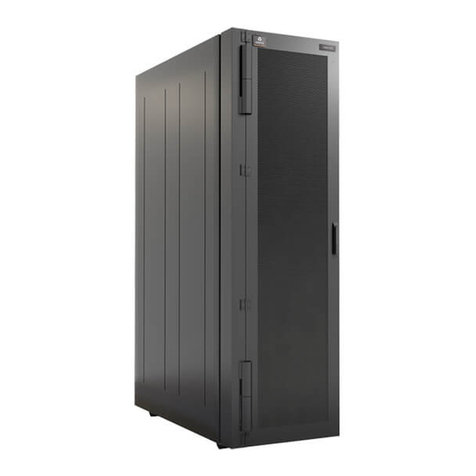
PennBarry ESA Manual

1
ESA
Ecient Silent Array™
OPERATION & MAINTENANCE MANUAL - PN 59705-0
The information contained herein is, to the best of our knowledge, accurate
and applicable for proper operation and installation of the specied
equipment at the time this document entered service. Before proceeding, it
is recommended that you check for a more current version of this Installation
Operation Manual (IOM) on our website at www.pennbarry.com.
Read carefully before attempting to assemble, install, operate or maintain
the product described. Protect yourself and others by observing all safety
information. Failure to comply with instructions could result in personal
injury and/or property damage! Retain instructions for future reference.
IMPORTANT! Read before proceeding!


3www.PennBarry.com
INTRODUCTION
This Installation Manual is provided as a guide for the installation of fans manufactured by PennBarry. It is the responsibility of the
purchaser to provide qualied personnel experienced in the installation, operation, and maintenance of air moving equipment.
Instructions given in this manual are general in nature and apply to a variety of models manufactured by PennBarry. Read this
Installation Manual completely before installing the fan. Additional product and engineering information is available at www.
PennBarry.com. Always follow good safety practices when installing, maintaining and operating air moving equipment.
If fans are located less than 7 feet above the oor, guarding is required in accordance with OSHA (Occupational Safety
and Health Act) requirements.
Disconnect power before servicing or installing.
This fan should be assembled and installed by a qualied technician.
WARNING
CAUTION
RECEIVING AND HANDLING
All PennBarry products are carefully constructed and inspected before shipment to ensure the highest standards of quality and
performance. Compare all components with the bill of lading or packing list to verify that the proper unit was received. Check each
unit for any damage that may have occurred in transit. Any damage should be reported immediately to the carrier, and the necessary
damage report led.
Handling of all air moving equipment should be conducted by trained personnel and be consistent with safe handling practices.
Verify the lift capacity and operating condition of handling equipment. Maintain handling equipment to avoid serious personal injury.
Units shipped completely assembled may be lifted with slings and spreader bars. Lift the fan in a fashion that protects the fan and fan
coating from damage. Never lift a fan by the inlet or discharge ange, shafting, drives, impeller, motor, motor base, or in any other
manner that may bend or distort parts.
LIFTING INSTRUCTIONS
Fans are designed to be lifted and moved as a single module. PennBarry does not recommend lifting connected fan modules unless
the fan modules are supported on a common base.
1. Carefully remove any crate and packing materials.
2. Place the bottom fans onto the mounting structure using the recommended lifting points as shown. Lift each fan individually
into position.
Maximum Fan Weight
Specications Product
Fan Size Max. Total Weight (lbs.)
105 240
122 270
135 300
150 340
165 490
182 476
200 528
222 815
245 1263

4www.PennBarry.com
Preferred lifting method
A Eyebolt with washers and nut
Alternate lifting method
B S-Hook
C Clevis Hook
Lifting Points
– 5/8” diameter holes
INTRODUCTION
A
B
C

5www.PennBarry.com
INSTALLATION, OPERATION & MAINTENANCE
SHORT TERM STORAGE
If fan installation is delayed, store the unit in a protected area. Protect the fan and motor bearings from moisture and vibration (or
shock loading).
LONG TERM STORAGE
If a fan is to be stored for any length of time and the bearings are re-greasable, the motor bearings should immediately be lled with
grease while rotating the fan, and then the bearings should be re-greased and rotated monthly. This will prevent moisture, which
condenses within the bearing, from corroding the raceways.
STORAGE PROCEDURES
Fans should be stored indoors whenever possible where control over temperature, humidity, shock and dust is reasonably maintained.
If units are to be stored outside, they should be covered with a water-resistant material. Stored equipment should be on a clean, dry
oor or blocked up o the ground to prevent unit from sitting directly on the ground.
PERIODIC CHECK
On a monthly interval, the equipment should be checked to ensure that it has remained in an acceptable stored condition. The fan
and motor should be rotated several times by hand. The fan impeller should be repositioned approximately 180 degrees from the
previous month to prevent damaging the motor bearings.
BASES (Foundation and Isolation)
Critical to every fan installation is a strong, level foundation. Structural bases must be sturdy enough to prevent exing and vibration.
PennBarry recommends using a spring isolated inertia base for all Ecient Silent Array™ applications. Design, fabrication, and
installation of the isolation base are the customers responsibility.
After the fan, isolation base, and isolators are installed, the entire assembly must be leveled. Floor mounted fans should be installed
on a at, level, rigid foundation.
Fans mounted to or within a structure should be placed as close as possible to a rigid member such as a wall or column. The structure
must be designed for rotating equipment; static design for strength is not sucient to ensure proper operation. Structural resonance
should be at least 20% above the maximum fan operating speed.
Any ducting should have independent support; do not use the fan to support ducting. Isolating the fan from ductwork with ex
connections eliminates transmission of vibration.

6www.PennBarry.com
When the unit is removed from storage, all grease should be purged and replenished with fresh grease. The following checklist is
recommended to ensure proper operation:
Operation Check List
Verify proper safety precautions have been followed:
• Electrical power must be locked o.
Check fan mechanism components:
• System connections are properly made and tightened.
• Impeller and fan surfaces are clean and free of debris.
• Rotate the impeller by hand to verify it spins freely and has not shifted in transit.
Check fan electrical components:
• Motor is wired for proper supply voltage.
• Motor was properly sized for power.
• Motor is properly grounded.
• All leads are properly insulated.
Trial “bump”:
• Turn on power just long enough to start assembly rotating.
• Check rotation for agreement with rotation arrow.
Perform checklist again until unit is operating properly. Verify fastener tightness. These may have become loose during shipment or instal-
lation.
• Bushing set screw torque.
• Bolts on inlet funnel.
• Motor bolt torque.
• Nuts holding housing frame to base and base to ground (customer specications).
• Bushing fastener torque.
• Prevention of contact between piezo ring tubing and impeller.
UNIT START UP
Bushing Fastener Torque
Bushing Type Screw Size Recommended Torque
JA 10-24 60 in-lbs.
SD/SDS 1/4-20 108 in-lbs.
SK 5/16-18 180 in-lbs.
SF 3/8-16 360 in-lbs.
Bushing Set Screw
Bushing Type Screw Size Recommended Torque
SD/SDS 1/4-20 60 in-lbs.
SK 5/16-18 110 in-lbs.
SF 3/8-16 110 in-lbs.
C
D

7www.PennBarry.com
UNIT START UP
Motor Bolt Torque
NEMA Frame Bolt Size (Grade 5) Washers Size
(Top and Bottom)
Recommended
Torque (ft-lb)
56-145T 5/16 5/16 18
182-215T 3/8 3/8 31
254U-286TS 1/2 1/2 75
324T-365T 9/16 9/16 107
D
C
B
A
D
A
B
C
Hub
Bushing
Bushing Screws
Bushing Set Screw

8www.PennBarry.com
MOTOR AND STRUCTURAL MAINTENANCE
MOTOR MAINTENANCE
The three basic rules of motor maintenance are: keep the motor clean, dry and properly lubricated. Keeping motors and windings
clean is important as trapped dirt and dust may impede air ow and heat convection causing motor windings to overheat possibly
leading to premature failure. Blow dust and dirt out of windings and o the motor periodically. Use low pressure (50 psi) airstream
to prevent winding damage. Keep the areas surrounding the motor clear so the air can circulate through the motor cooling fan.
Motors should be kept dry to avoid electrical short circuits. Motors kept in storage for long periods of time can have moisture
condense on the windings. Be certain the motor is dry before use.
Some smaller motors are permanently lubricated. Motor bearing lubrication, if required, must follow a rigorous schedule. Motors
less than 10 hp running eight hours a day in a clean environment should be lubricated once every ve years. Lubricate 15 to 50
HP motors every 3 years and 50 to 150 HP motors yearly. See motor manufacturer specications for recommended greases. For
motors in a dusty or dirty environment or which run 24 hours a day, divide the service interval by 2. If the environment is very dirty
or high temperatures exist, divide the service interval by 4. Lubrication requirements are normally attached to the motor. Do not
over-lubricate.
The major cause of motor bearing failure is contamination of grease, insucient grease, over lubrication, and incompatibility of
grease.
STRUCTURAL MAINTENANCE
All structural components or devices used to support or attach the fan to the isolation base or other structure should be checked at
regular intervals. Vibration isolators, bolts, foundations, etc, are subject to failure from corrosion, erosion, and other causes. Improper
mounting can lead to poor operation characteristics, fan fatigue, and failure. Check components for corrosion, cracks, or other signs
of stress.

9www.PennBarry.com
Use safety practices when investigating fan or system performance problems. General safe practices and performance
troubleshooting guidelines can be found in AMCA Publication 410: Recommended Safety Practices for Users and Installers of
Industrial and Commercial Fans, and AMCA Publication 202-98 (R2011): Troubleshooting. Fan application and eld measurement
procedures can be found in AMCA Publication 201-02 (R2011): Fans and Systems, and AMCA Publication 203-90 (R2011): Field
Performance Measurement of Fan Systems.
Troubleshooting Performance Problems:
The lists below indicate possible areas to check when air or sound values do not meet expectations. Most fan problems can be
pinpointed to one of these common causes.
Air Capacity Problems:
1. Air resistance of system is not at design rating. If air resistance is lower than expected, airow may be higher, and the associated
horsepower lower. If air resistance is higher than anticipated, air volume will likely be lower.
2. Fan speed is not at design speed.
3. Air density is not at design values. Also, check air performance measurement techniques / procedures.
4. Mechanical air devices (e.g. dampers or lters) are closed or plugged.
5. Impeller is mounted improperly or is rotating in reverse.
6. Parts of system or fan have been damaged or need cleaning.
Noise Problems:
1. Fan is not at design point of operation, or fan is operating in an unstable ow region.
2. Bearings failed. Check bearings.
3. Supply voltage is high, or supply frequency is inconsistent. Variable frequency controllers can generate motor noise.
4. Objects which are installed in a high velocity airstream can generate noise. This includes ow sensors, turning vanes, etc.
5. Fan inlets develop non-uniform conditions.
6. Acoustics or sound measurement procedures are incorrectly administered.
Vibration Problems:
1. Misalignment of drive components.
2. Poor foundations (isolation base) or mounting structure (resonances).
3. Trapped foreign object in rotating components.
4. Damaged rotating components (bearings, shaft, fan, impeller).
5. Broken, loose or missing set screws.
6. Loose bolts.
7. Vibration transmitted by another source.
8. Water accumulating in airfoil blades.
9. Fan operation in stall or unstable ow region.
TROUBLESHOOTING GUIDELINES
NOTE: All fans manufactured by PennBarry are factory balanced prior to shipment. Improper handling and movement of the fan during shipment
may cause the rotating assembly to shift out of alignment. Balance should be checked once the fan is installed. If a nal trim balance is required, it
is the end user’s responsibility to bring the fan back to factory specications. Final trim balancing is not the responsibility of PennBarry.

10 www.PennBarry.com
Intake Side
Bolt bottom Ecient Silent Array™ modules to the isolation base, or other structure, and adjacent modules using the inlet and outlet
mounting anges. The rst row of modules should be securely installed before installing the second row of modules. PennBarry
does not recommend lifting and moving an assembled Ecient Silent Array™, as this may cause bending, distortion, and lead to
component misalignment.
INSTALLATION
EFFICIENT SILENT ARRAY™ ASSEMBLY
Intake Side Supply Side
A
*Intake Side
B *Intake Side
Top, Bottom and Side Connections
*Intake Side Shown
• 1/2-13 x 1.00 Grade 5 Hex Head Cap Screw (or equivalent) 4
required (1 in each corner)
• 1/2 Flat Washer, 8 required (2 in each corner)
• 1/2-13 Hex Nut (or equivalent), 4 required (1 in each corner).
Recommended torque setting of 18 (ft-lb)
• Split Lock Washer (or equivalent), 4 required (1 in each corner)
A
Middle Connections *Intake Side Shown
• Intake Side Panel Connection: A series of .22” diameter holes,
3” on center, are provided to connect the front panel of the
fan assembly to the customer’s equipment. The holes are
sized for 1/4” sheet metal screws.
• All installation hardware supplied by end user.
B
Table of contents
Other PennBarry Fan manuals

PennBarry
PennBarry RAU User manual

PennBarry
PennBarry Zephyrette Manual

PennBarry
PennBarry ZQ105 User manual

PennBarry
PennBarry BX12Q Manual

PennBarry
PennBarry Breezeway BX Installation guide

PennBarry
PennBarry MXI Series Manual

PennBarry
PennBarry Breezeway User manual

PennBarry
PennBarry ZQ2005N User manual

PennBarry
PennBarry Zephyr Z1 Installation guide

PennBarry
PennBarry Fumex User manual


Popular Fan manuals by other brands

ELTA FANS
ELTA FANS H03VV-F installation guide

Hunter
Hunter 20714 Owner's guide and installation manual

Emerson
Emerson CARRERA VERANDA CF542ORB00 owner's manual

Hunter
Hunter Caraway Owner's guide and installation manual

Panasonic
Panasonic FV-15NLFS1 Service manual

Kompernass
Kompernass KH 1150 operating instructions