
Milwaukee MI456 User manual

INSTRUCTION MANUAL
SATISFACTION
GUARANTEED
MI456
Minititrator for Wine Analysis
Titratable Total Acidity

All rights are reserved. Reproduction in whole or in part is prohibited without the written
consent of the copyright owner, Milwaukee Instruments Inc., Rocky Mount, NC 27804 USA.
THANK YOU for choosing Milwaukee Instruments!
This instruction manual will provide you the necessary information for correct use
of the meter.

3
TABLE OF CONTENTS
1. FUNCTIONAL DESCRIPTION......................................................................................................................................4
2. GENERAL DESCRIPTION.............................................................................................................................................6
3. PRINCIPLE OF OPERATION........................................................................................................................................8
4. SPECIFICATIONS.............................................................................................................................................................9
5. STARTUP ...........................................................................................................................................................................10
6. GUIDE TO DISPLAY CODES......................................................................................................................................10
7. GENERAL TIPS FOR AN ACCURATE MEASUREMENT.................................................................................13
8. PUMP CALIBRATION PROCEDURE......................................................................................................................14
9. pH CALIBRATION PROCEDURE.............................................................................................................................15
10. MEASUREMENT PROCEDURE .............................................................................................................................16
11. PUMP TUBE REPLACEMENT.................................................................................................................................. 17
12. FUSE REPLACEMENT................................................................................................................................................18
13. ELECTRODE CONDITIONING & MAITENANCE.............................................................................................19
14. ACCESSORIES...............................................................................................................................................................21
CERTIFICATION..................................................................................................................................................................22
RECOMMENDATION........................................................................................................................................................22
WARRANTY..........................................................................................................................................................................22

4MI456 Minititrator for Wine Analysis
1. FUNCTIONAL DESCRIPTION
Display
A. STABILITY INDICATOR: when reading is unstable or calibration is in progress
B. STIRRER ACTIVE TAGS
C. CALIBRATION MESSAGES
D. PUMP ACTIVE TAGS
E. CALIBRATION MESSAGES
F. “pH” TAG: when a buer is displayed on the secondary display
G. FOUR DIGITS AND HALF SECONDARY DISPLAY
H. “Time” TAG: when the time is displayed on the secondary display
I. FOUR DIGITS AND HALF MAIN DISPLAY
J. “pH” UPPER TAG: when the end point is modified
K. AUTOMATIC TEMPERATURE COMPENSATION: when ATC blinks the temperature probe is
not connected and the temperature is considered to be 25 °C
L. CALIBRATION MODE INDICATOR
Keypad
MI456 Titratable Total Acidity
Mini Titrator
A. PUMP - to start/stop the pump
B. CAL - to enter pump or pH calibration mode
C. pH - to enter pH calibration mode (CAL tag is active) to modify the end point value
D. STIR - to start/stop the stirrer while in measurement or purging mode
E. START STOP - to start/stop titration
FUNCTIONAL DESCRIPTION 5
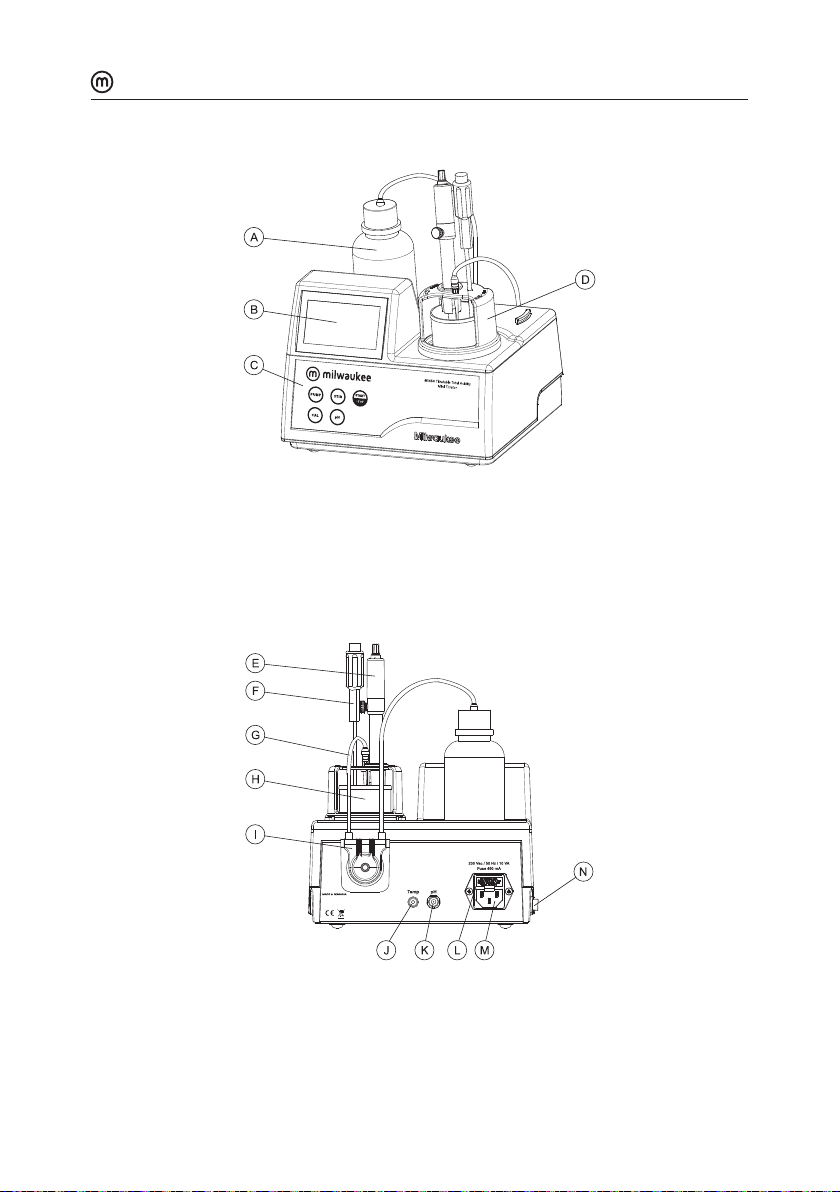
Front Panel
A. TITRANT BOTTLE
B. LIQUID CRYSTAL DISPLAY (LCD)
C. KEYPAD
D. ELECTRODE HOLDER
Rear Panel
E. pH ELECTRODE
F. TEMPERATURE PROBE
G. PERISTALTIC PUMP TUBE
H. BEAKER
I. PERISTALTIC PUMP
J. TEMPERATURE PROBE CONNECTOR
K. BNC ELECTRODE CONNECTOR
L. FUSE
M. POWER CABLE CONNECTOR
N. POWER SWITCH

6MI456 Minititrator for Wine Analysis
2. GENERAL DESCRIPTION
The MI456 is a low-cost, easy to use, microprocessor-based automatic titrator. It has a
simple and reliable peristaltic pump that ensure high dosing repeatability. By performing
pump calibration with the provided Milwaukee standards, the instrument accuracy is
assured. The instrument comes with a preprogrammed analysis method designed for
Total Titratable Acidity measurements on wine.
The MI456 performs automatic analysis, all the necessary calculations and assures to
the user a simple and eective interface.
The instrument has a powerful and eective built-in algorithm to analyze the shape of the
pH electrode response and to determine the reaction completion.
By simply pressing the START STOP button, the instrument will automatically make the
titration up to the end point. The result is immediately displayed in convenient units, then
the instrument is ready for another titration.
Significance of Use
Acids occur naturally during the growing of grapes and as part of the fermentation
process. Wines show lower levels of acid when there are hot growing seasons or when
the grapes come from hotter regions. In the proper proportion, acids are a desirable trait
and give the wine character.
The three predominant acids in wine are tartaric, malic and citric, all of which are
intrinsic to the grape. Tartaric acid is the principal acid in grapes and is a component
that promotes a crisp flavor and graceful aging in wine. A moderate amount of a wine’s
acid comes from malic acid, which contributes to fruitiness, and a small amount comes
from citric acid. Wine also contains trace amounts of other acids. The least desirable
acid in wine is acetic acid, which, when present in more than a nominal amount, gives
wine a sour or vinegary aspect.
Total acidity, also called titratable acidity, is the sum of the fixed and volatile acids. In the
United States the total acidity is usually expressed in terms of tartaric acid, even though
the other acids are measured.
Total Acidity directly eects the color and flavor of wine and, depending on the style of
the wine, is sought in a perfect balance with the sweet and bitter sensations of other
components. Too much acidity makes wine tart and sharp; too little makes wines flat,
flabby and uninteresting.

GENERAL DESCRIPTION 7
Proper acidity in wine is what makes it refreshing and an ideal accompaniment to food.
The proper acid level of a wine varies, with sweeter wines generally requiring somewhat
higher levels to retain the proper balance. For dry table wine the acceptable range is
usually 0.60 to 0.75%; for sweet wine it’s 0.70 to 0.85%.
This meter is supplied with:
yReagent set for titratable total acidity in wine
yOne 2000 µL automatic pipette
yTwo plastic tips for the 2000 µL automatic pipette
yTwo 100 mL beakers
yTubes set with cap
ypH electrode
yTemperature probe
yStir bar
yPower cable
yOne 230 mL bottle of Refill Solution
yOne plastic pipette
yInstruction manual
yWarranty code
Note: Save all packing material until you are sure that the instrument works correctly.
Any defective item must be returned in its original packing.

8MI456 Minititrator for Wine Analysis
3. PRINCIPLE OF OPERATION
The determination of total acids in wine is made according to a neutralization reaction,
that is the reaction between the acids found in wine and a base. This type of reaction
forms the basis of titration methods of analysing acids.
Titratable acidity is measured on a degassed sample at the end-point of 8.20 for Australian
requirements and 7.00 to fulfil the requirements of the European Union. Both results are
expressed as g/L tartaric acid.
For precise results it is very important to know the exact sample volume, titrant volume
and concentration.
The peristaltic pump has a good repeatability but the dosing volume depends on many
factors as the diameter of the tube or the tube streching. To compensate for all this errors,
the pump need to be calibrated. The calibration of the pump is also needed in order to
have high precision of the titrations. It is important to calibrate the pump at the pH value
you want to use as the endpoint of the titrations.
The calibration procedure is in fact the analysis of a known solution. By doing this, the
instrument makes a dierential analysis between the standard and the wine sample. The
pump volumetric debit and the real concentration of the titrant is compensated. Only the
sample volume has to be precisely known.

SPECIFICATIONS 9
4. SPECIFICATIONS
Range 0.0 to 25.0 g/L of tartaric acid
Resolution 0.1 g/L
Accuracy 5% of reading
Method Acid-base titration method
Principle End-point titration
pH Calibration One-point in selected end-point: 7.00 pH or 8.20 pH
Sample volume 2 mL
Temperature Compensation Automatic from 0.0 to 100.0 °C
pH Electrode MA919B/1 (included)
Temperature Probe MA831R (included)
Pump debit 0.5 mL/min
Stirring speed 1500 rpm
Environment 0 to 50 °C (32 to 122 °F) ; max 95% RH non-condensing
Power supply MI456-01: 115 V/60 Hz; 10 VA
MI456-02: 230 V/50 Hz; 10 VA
Dimensions 208 x 214 x 163 mm (8.2 x 8.4 x 6.4") (with beaker)
Weight 2200 g (77,6 oz.)
Required Reagents
Code Description Quantity/test
Mi556-001 Standard 2 mL 2 mL
Mi556-002 Titrant
Mi556-003 Buer pH 7.00 50 mL 50 mL
Mi556-004 Buer pH 8.20 50 mL

10 MI456 Minititrator for Wine Analysis
5. STARTUP
yPlace the instrument on a flat table. Do not place the instrument on direct sun light.
yConnect the titrator to mains socket with ground connection and the correct voltage
and frequency. See the label on the instrument rear for this.
yPlace the peristaltic pump tube on the pump. See the Pump Tube Replacement
section for the procedure.
yRemove the reagent bottle cap and place the bottle cap of the tubes set. Place the
reagent bottle in the appropriate place on the titrator top.
yConnect the tubes with the peristaltic pump (inlet tube is connected with the reagent
bottle, outlet tube is connected with the dosing tip).
yTurn the instrument ON using the power switch from the rear panel of the instrument
and wait until it displays dashes.
6. GUIDE TO DISPLAY CODES
This screen appears for a few seconds each time the instrument
is turned ON.
Main screen display.
Main screen display with stirrer active.
Purging mode message.
Other manuals for MI456
1
Table of contents
Popular Kitchen Utensil manuals by other brands


NEFF
NEFF T4..3.. instruction manual

Schulte-Ufer
Schulte-Ufer De Luxe i Series Using and cleaning instructions

Cook's Companion
Cook's Companion IntelliBag Series quick start guide

Breville
Breville EW30XL Instructions for use

Genius
Genius Nicer Dicer Chef S instruction manual

Swissmar
Swissmar 3-in-1 fondue set How to use