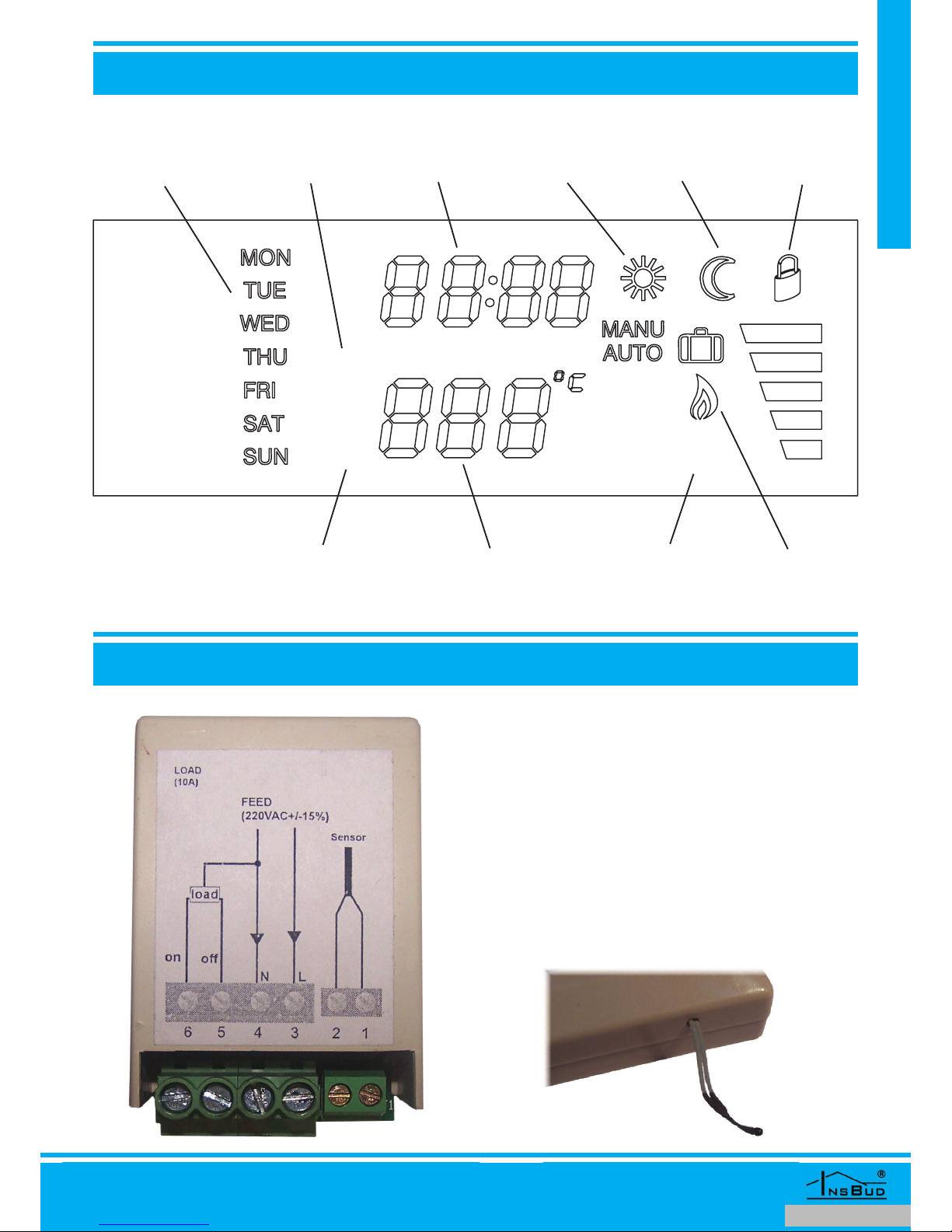
IComplete with controller is NTC thermi-
stor on the 20cm wire. It can function
as a one sensor if there isn’t required an
additional casing of sensor. The second
sensor isn’t supplied with termostat.
IThe sensors can be extended to any
length but we should remember that
extension above 10m may cause a de-
viation of measurement with each me-
ter and falsifying results. Therefore, for
distance above 10m device has to be
calibrated. Sensors have to be extend
of wires:
» to 50 meters 2x 0,75 mm2
» above 50 meters 2x 1,50 mm2
The controller is compatible with NTC
10kΏ sensors having the following
characteristics:
Temperature
[ºC]
Resistance
[Ώ]
-50 687 803
-40 346 405
-30 181 628
-20 99 084
-10 56 140
0 32 960
10 20 000
20 12 510
25 10 000
30 8 047
40 5 310
50 3 588
60 2 476
70 1 743
80 1 249
90 911
100 647
In the controller we have to set three time
values:
Testing break - value in minutes spe-
cifying, at what time do the measuring
test. This value depends on devices,
which ‘receive’ heat or cold and more
precisely depends on how often the
temperature conditions may change
in this device. In the typical size of GHE
(typical family house) this value is most
in the range of 10 ÷ 30 minutes.
Testing periods - value in seconds spe-
cifying, how long device has to work
before reading of sensor reaches the
appropriate level of temperature (star-
ting period, starting delay ). Testing pe-
riod is set separately for each device.
In case of installation of GHE the rst devi-
ce is directly external inlet probe and sensor
has to be placed near to the inlet probe (di-
rect measurement of external temperature).
Testing period of this device should be set
to 0 (there isn’t any delay, the reading is cur-
rent). The second device is GHE. Delay of this
device should be set to optimal value for the
GHE - mostly it’s time to move air through
the GHE (it depends on length and size of
GHE). For the typical size of GHE (for typical
family houses) this delay is in the range of 20
÷ 120 seconds.
Depending on the mode in which the con-
troller operates (heating or cooling), device
chooses warmer or colder device.
The controller is intelligent. It means that it
remembers readings and change the tem-
peratures on the both devices. For example:
when controller during data analysis deter-
mines that there is probability of more favo-
rable temperature conditions on the second
device than currently used device, may be