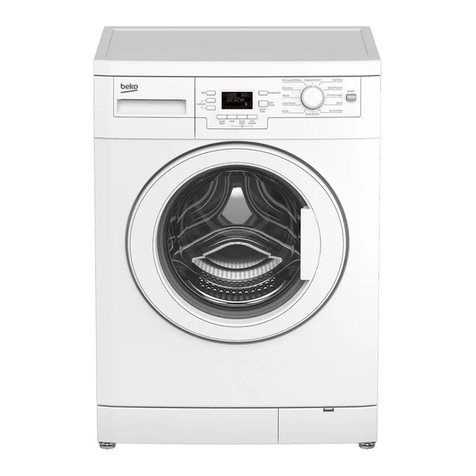
Asko W6324W User manual

Dear Customer,
Thank you for choosing this quality product from ASKO.
We hope it will meet your expectations and fulll your needs for many years to
come. Scandinavian design combines clean lines, everyday functionality, and
high quality. These are key characteristics of all our products and the reason they
are greatly appreciated throughout the world.
To ensure that you get the most out of your new machine, we recommend that
you read the operating instructions before using the machine. The operating
instructions also contain information on how to avoid damaging the environment.
Operating Instructions
Washing Machine
ASKO W6324W

Before using your machine
for the rst time 4
Transport protection 4
Packing material 4
Washer door 4
Checking water hardness 4
Important safety instructions 5
Grounding instructions 5
Installation 6
Overow guard function 6
Transport/Winter storage 6
Disposal 6
Child safety 7
Keep an eye on children! 7
Parts of the washing machine 8
Dispenser 9
Advice and tips before washing 10
Sorting your laundry 10
Clothing 10
Laundry labels 10
Advice and tips before washing 11
Coloured cotton 12
Unbleached linen 12
Wool 12
Rayon bers and synthetic bers 12
Reducing allergic reactions 12
Economy and eciency 12
Detergents 12
Dyeing fabrics 12
Liquid detergents 13
Detergents 13
Recommended powder detergents 13
Detergent Amounts Based on Water
Hardness 13
Amount of detergent to use 13
Operating instructions 15
Sort your laundry. 15
Turn on the main power switch 15
Open the washer door and load
the laundry 15
Add detergent and fabric softener,
as required 15
Select the program 16
Select options 18
Close the washer door and press the
Start/Stop button 18
Once the program has nished 19
You can change the following 19
settings: 19
Door opening 19
Care and maintenance instructions 20
Cleaning the trap and the drain pump 20
Cleaning the detergent compartment 20
Cleaning the outside of the machine 20
Cleaning the inside of the machine
to avoid unpleasant smells 20
Rinse holes under the paddle 21
If you have hard water 21
Troubleshooting 22
The washer door will not open 22
The machine will not start 22
After power failure 22
Wet laundry still in the machine 22
Error messages 23
Technical information 24
Technical data 24
Transport protection 25
Installation 26
Water supply connection 26
Installation 28
Service 29
Limited Warranty – Residential
Appliances 29
Quick guide 32
2Customer Care Center
1-800-898-1879
www.askona.com
Contents

3
Customer Care Center
1-800-898-1879
www.askona.com
Before using your machine for the rst time
Do you need this Use&Care Guide in Spanish? Log on to www.askona.com/customer-care to download.
¿Necesita esta Instrucciones de uso y cuidado en español? Entre en www.askona.com/customer-care
y descárguesela.
WARNING: Read the instructions before using the machine.

4Customer Care Center
1-800-898-1879
www.askona.com
Transport protection
Remove any transport protection devices before
installing the machine. See the "Transport
protection" chapter.
Packing material
Please sort waste materials in accordance with
local guidelines.
Washer door
• The washer door cannot be opened until the
machine is connected to the electricity supply.
• To open the door manually, see "The washer
door will not open" in the "Troubleshooting"
chapter.
• The machine cannot be started when the door
is open.
• To open the washer door while a program
is running, see "Close the door and press
the Start/Stop button" in the "Operating
instructions" chapter.
Checking water hardness
The quantity of detergent needed depends,
among other things, on water hardness. See
the detergent pack for details. Phone your local
water company to check the water hardness in
your area.
NOTE!
Each machine is tested before leaving the
factory.
A small amount of water may remain in the drain
pump, though this does not aect quality or
damage the machine.
Before using your machine for the rst time
See Quick guide on the last page

5
Customer Care Center
1-800-898-1879
www.askona.com
SAVE THESE INSTRUCTIONS FOR
FUTURE REFERENCE
WARNING!
To reduce the risk of re, electric shock, or injury
to persons when using your appliance, follow
basic precautions, including the following:
• Read all instructions before using the
appliance.
• Do not run appliance while you are out of the
home.
• Do not wash or dry articles that have been
previously cleaned in, washed in, soaked in, or
spotted with gasoline, dry-cleaning solvents,
cooking oils, or other ammable or explosive
substances because they give o vapors that
could ignite or explode.
• Do not allow children to play on or in the
appliance. Close supervision of children is
necessary when the appliance is used near
children.
• Before the appliance is removed from service
or discarded, remove the door to the washing
compartment.
• Do not reach into the appliance if the drum is
moving.
• Do not install or store this appliance where it
will be exposed to the weather.
• Do not tamper with controls.
• Do not repair or replace any part of the
appliance or attempt any servicing unless
specically recommended in the user-repair
instructions or in published user-repair
instructions that you understand and have the
skills to carry out.
• Do not add gasoline, dry-cleaning solvents,
or other ammable or explosive substances
to the wash water. These substances give o
vapors that could ignite or explode.
• Under certain conditions, hydrogen gas may
be produced in a hot water system that has not
been used for 2 weeks or more. HYDROGEN
GAS IS EXPLOSIVE. If the hot water system
has not been used for such a period, before
using a washing machine or combination
washer-dryer, turn on all water faucets and let
the water ow from each for several minutes.
This will release any accumulated hydrogen
gas. As the gas is ammable, do not smoke or
use an open ame during this time.
WARNING!
This appliance must be properly grounded.
This manual does not cover every possible
condition and situation that may occur. Use
common sense and caution when installing,
operating, and maintaining any appliance.
Grounding instructions
A) Grounding instructions for a
grounded, cord-connected appliance:
In the event of malfunction or breakdown,
grounding will reduce the risk of electric shock
by providing a path of least resistance for electric
current. This appliance is equipped with a cord
having an equipment-grounding conductor and a
grounding plug. The plug must be plugged into
an appropriate outlet that is properly installed
and grounded in accordance with all local codes
and ordinances.
WARNING!
Improper connection of the equipment-grounding
conductor can result in a risk of electric shock.
Check with a qualied electrician or service
representative or personnel if you are in doubt as
to whether the appliance is properly grounded.
Do not modify the plug provided with the
appliance.
If it will not t the outlet, have a proper outlet
installed by a qualied electrician.
Important safety instructions

6Customer Care Center
1-800-898-1879
www.askona.com
Important safety instructions
B) Grounding instructions for a
permanently connected appliance:
This appliance must be connected to a grounded
metal, permanent wiring system, or an
equipment-grounding conductor must be run
with the circuit conductors and connected to the
equipment-grounding terminal or lead on the
appliance.
NOTE!
This manual does not cover every possible
condition and situation that may occur. Use
common sense and caution when installing,
operating, and maintaining any appliance.
Installation
See the "Installation" chapter.
Overow guard function
If the machine’s water level rises above the
normal level, the overow guard function begins
to pump water out and shuts o the water intake.
If the water level has not dropped within 60
seconds, the program is terminated.
Transport/Winter storage
If the machine is to be transported or stored in
unheated premises where the temperature can
fall below freezing, do as follows:
• Empty the lter and the drain pump. See the
"Care and maintenance instructions" chapter.
• Shut o the water to the washing machine,
loosen the supply hose to the intake valve,
and let the water run out from the valve and
hose.
• After emptying the pump, a small amount of
water may remain in the machine. This does
not aect quality or damage the machine.
Disposal
When the machine has reached the end of its
service life and is to be disposed of, it should
immediately be made unusable by removing the
door to the washing compartment. Contact your
local authorities for information about where your
machine should be disposed of and recycled in
the proper way. The machine is manufactured
and labeled for recycling.
SAVE THESE INSTRUCTIONS FOR FUTURE REFERENCE

7
Customer Care Center
1-800-898-1879
www.askona.com
Keep an eye on children!
WARNING!
• Laundry detergents are corrosive, so always
keep them out of reach of children.
• Should a child swallow detergent, give
plenty to drink immediately, i.e., one or two
glasses of milk or water. Do not try to induce
vomiting. Seek medical advice immediately:
The National Poison center phone number is
1-800-222-1222.
• Always close the door and start the appliance
as soon as you put in the detergent.
• Always turn the power o to the machine
when it is not in use.
• Always keep small children away from the
machine when it is open. There may be some
detergent residue left inside the machine.
• If laundry detergent gets in someone’s eyes,
rinse them with plenty of water for at least 15
minutes.
Activate child safety catch (for
detergent compartment)
On the inside of the detergent compartment is a
child safety catch.
Activated child safety
catch
Inactivated child safety
catch
When the child safety catch is activated, you
must press the release button to pull out the
detergent compartment.
Child safety

8Customer Care Center
1-800-898-1879
www.askona.com
Parts of the washing machine
1. Main power switch
2. Dispenser
3. Program panel
4. Serial number plate (on inside of washer door)
5. Drain pump cover
6. Drain pump (behind cover)
7. Washer door
1
5,6 7
2 3 4

9
Customer Care Center
1-800-898-1879
www.askona.com
Dispenser
14
5
6
2 3
1. Pre Wash
2. Main wash with liquid detergent.
Use the separator (A).
3. Main wash with powder detergent.
Do not use the separator.
4. Fabric softener
5. Release button
6. Child safety catch
The detergent drawer automatically dispenses the detergent and fabric softener at the appropriate times.
Simply pour the measured amounts of detergent and softener into the proper compartments (as
illustrated) and close the drawer.
NOTE!
To avoid oversudsing, do not put detergent in the prewash compartment unless you are using one of the
Heavy wash programs which has a prewash cycle.
A
B
C

10 Customer Care Center
1-800-898-1879
www.askona.com
Advice and tips before washing
Here are some tips that may help you before
washing.
Sorting your laundry
• how soiled they are
• color
• material
Clothing
1. Close zippers and Velcro straps so they won’t
damage fabrics.
2. New colored items may contain excess dye
and should therefore be washed separately
the rst few times.
3. Turn delicate items inside out. This reduces
the risk of burling and fading.
4. Empty pockets and wash them inside out if
possible.
Laundry labels
Look at the item’s laundry label. The table below
shows suitable wash programs for dierent
materials and wash loads.Using modern washing
machines and detergents, such as compact
detergents, you can usually wash at lower
temperatures. It is a good idea to use trial and
error to nd out what produces the best results.
Table of contents
Other Asko Washer manuals
Popular Washer manuals by other brands

Tricity Bendix
Tricity Bendix AW 1000 W Operating & installation instructions

Panasonic
Panasonic NA-F60L5WRB operating instructions

GE
GE WSLP1500 Dimensions and installation information

Electrolux
Electrolux EWF1284EDW Service manual

Bosch
Bosch WAN2829BSN User manual and installation instructions

LG
LG TV2516DV3B owner's manual