Xantrex RC6 Manual

User’s and Installation Guide
RC6
Xantrex
RC6 Remote
On/Off Switch and Monitor

1
11
1
RC6 REMOTE ON/OFF SWITCH AND MONITOR

2
22
2
XANTREX TECHNOLOGY, INC
RC6 User’s and Installation Guide
Notice of Copyright
Xantrex RC6 Remote On/Off Switch and Monitor © October 2002 Xantrex International. All rights reserved.
Xantrex is a registered trademark of Xantrex International.
Disclaimer
UNLESS SPECIFICALLY AGREED TO IN WRITING, XANTREX TECHNOLOGY INC. (“XANTREX”)
(a) MAKES NO WARRANTY AS TO THE ACCURACY, SUFFICIENCY OR SUITABILITY OF ANY
TECHNICAL OR OTHER INFORMATION PROVIDED IN ITS MANUALS OR OTHER DOCUMENTATION.
(b) ASSUMES NO RESPONSIBILITY OR LIABILITY FOR LOSS OR DAMAGE, WHETHER DIRECT,
INDIRECT, CONSEQUENTIAL OR INCIDENTAL, WHICH MIGHT ARISE OUT OF THE USE OF SUCH
INFORMATION. THE USE OF ANY SUCH INFORMATION WILL BE ENTIRELY AT THE USER’S RISK.
Date and Revision
October 2002, Revision 1
Part Number
975-0051-01-01
Contact Information
Web: www.xantrex.com
Email: CustomerService@xantrex.com
Phone: 1 800 670 0707 (toll free) 1 604 422 2777 (direct)
Fax: 1 604 420 2145

3
33
3
Table of Contents
Using the RC6 Remote On/Off and Inverter/Charger
Monitor ............................................................................................. 5
Reading the RC6 Remote Control.................................................................... 5
Power On/Off Switch and LED Indicator................................................................................ 6
Battery Voltage Bar Graph..................................................................................................... 6
Amps DC Bar Graph.............................................................................................................. 7
Error Conditions..................................................................................................................... 7
Bulk Charge and Float Charge Lights.................................................................................... 8
Installation ..................................................................................... 10
Installation Procedure..................................................................................... 10
Warranty......................................................................................... 11
Disclaimer....................................................................................................... 13
Product ................................................................................................................................ 13
Exclusions............................................................................................................................ 13
Warning: Limitations On Use............................................................................................... 13
Return Material Authorization Policy...............................................................14
Return Procedure ........................................................................................... 14

4
44
4

5
55
5
Using the RC6 Remote On/Off and
Inverter/Charger Monitor
This section of the guide is designed to help the user interpret and operate
the RC6 remote when used with Xantrex RV Series Inverter/Chargers.
ost of the time the remote control will only be used to turn the inverter on
and off. However, should you wish, a multitude of information is available
about the state of the inverter/charger and battery system. Without a
remote control, the inverter will work just fine but most of the information the RC6
can show won’t be accessible to you. In this case, the indicator light and legend on the
front of the inverter will be your guide to what the inverter is doing.
Let’s look at some of the features of the Xantrex RC6 Remote Control.
Reading the RC6 Remote Control
The RC6 remote control is capable of turning the inverter on and off, as well as
showing the following:
•Battery Bank Voltage
•Current flowing into or out of the battery bank during charging or
inverting
•Error conditions the inverter may encounter (High Battery, Over
Temperature, Over Load, and Low Battery conditions)
•The charge state the inverter is currently in (Bulk Charge, Absorption, or
Float Charge)
•Whether the inverter is on or off
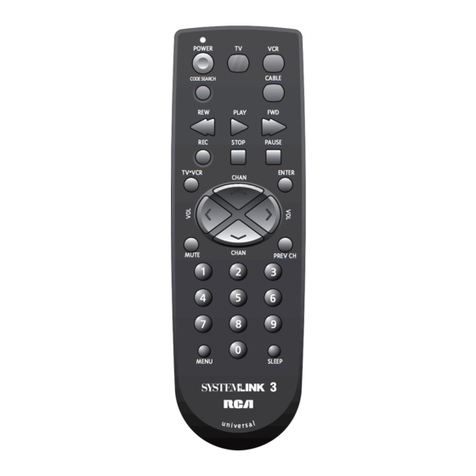
The following picture shows the front of the RC6. Notice the two bar graph scales
that run vertically. The left scale displays the voltage of the battery bank while the right
scale displays the DC (direct current) amperage flowing into (charging) or out of
Section
1
M

6
66
6
(inverting) the battery bank. The lower portion of the Amps DC scale also
displays the four Error conditions. In the upper right portion of the RC6 are
two lights marked Bulk Charge and Float Charge. These lights indicate
the stage the battery charger is in. When the inverter is inverting, they are
not lit.
Let’s take a more detailed look at each of the items pointed out in the picture above.
Power On/Off Switch and LED Indicator
The power on/off switch on the lower front right of the remote is a momentary type
switch and alternately turns the inverter on or off when pressed. The green light in the
middle of it will be lit steadily when the inverter is working, and if the inverter is in the
load search sense mode it will blink on and off rapidly. In charger mode the light will
blink slow green.
Battery Voltage Bar Graph
This bar graph contains a light that will move up and down the bar as the battery
voltage changes. The corresponding battery voltage is read to the left of the light. Red
lights mean out of tolerance, yellow lights marginally within tolerances, and green lights
show that everything is in a normal operating range. It is perfectly normal for battery
voltage to drop a bit when operating heavy loads. The inverter constantly monitors the
battery bank and will not allow it to be over discharged or over charged.
Note: A completely dead battery will read about 11.6 volts or less in an
“at rest” condition. “At rest” means the battery has been sitting dormant
for several hours with no load on it, and is not being recharged. When
the battery drops below a certain pre-set point, the inverter will shut
down, and if AC power is available to the inverter, it will recharge the
batteries.
!
Voltage is
electrical
pressure. It is
equivalent to
water pressure in
a hose.
!
Current or
Amps is the
volume of
electrical flow,
just like gallons
per hour through
a garden hose.
Battery current
(into or out of battery bank)
Charge
lights
Battery
voltage
Error legend
On/Off button

7
77
7
Amps DC Bar Graph
The Amps DC bar graph functions just like the voltage bar graph, except now you
have a choice of two scales to read from. This meter tells you the volume of electricity
that is being taken out of or put back into the battery. If the unit is in inverter mode, as
indicated by an absence of Bulk or Float charge lights on the RC6, then read the scale
on the left side of the Amps DC meter. If the unit is in charger mode then the scale on
the right will indicate the volume of electricity in amps that is being put back into the
battery. All the lights on the Amps DC scale are red in color, so don’t be alarmed
when you see red lights.
Error Conditions
The RV and Truck series inverters are very well protected against a multitude of
potentially bad situations, and in normal usage it will be rare to see any error other than
possibly an occasional low battery condition (if you have small batteries or high usage).
If the inverter/charger encounters a situation it can’t handle then it will shut down and
protect itself, the battery bank, and your appliances. The following four situations are
monitored, protected against, and displayed on the RC6:
•High Battery - The battery voltage has risen above 15.0 volts DC
and the inverter will shut down until acceptable battery voltage has
been restored.
•Over Temperature - The internal temperature of the inverter has
risen above acceptable limits. The inverter will shut down until it
has cooled off enough to operate properly. This error may be
caused by loads too great for the inverter to operate continuously,
or it may be caused by lack of ventilation to the inverter. During
this type of error you should attempt to reduce the number of
electrical loads that you are operating, this will avoid a repeat over-
temp shutdown if the cause was too many loads for the ambient
conditions.
"
Error
conditions
indicated on the
RC6 may also be
viewed on the
front panel of
the inverter
itself.

8
88
8
Note: If your inverter routinely shuts down due to an over-
temperature condition, then call your installer and describe the
problem. Routine over-temp shutdowns are indicative of a larger
problem, most likely poor ventilation in the inverter
compartment.
•Over Load - Too much electrical load is present for the inverter to
power it. This would be like you trying to pick up 500 pounds
when 150 pounds is your limit. The inverter will shut down until
the amount of load has been reduced to a level it can handle. You
simply need to turn a few electrical appliances off until the inverter
can handle the loads that are present. In a properly designed system
this error is infrequent.
•Low Battery - The battery bank voltage has dropped to a level too
low to sustain full AC power output. To avoid damage to the
battery bank and AC loads due to low voltage “brown out”
conditions, the inverter will shut down. If an AC source is then
applied to the inverter (start the generator or plug into
shorepower), the inverter will go into charge mode and recharge
the batteries. The AC loads will then resume operation from the
pass through power, thus running from the external AC source.
The bottom four lights of the Amps DC meter show the error condition represented
by the adjacent Error box legend. During an error condition the appropriate error
light will flash. The inverter will attempt to automatically restart itself every few
seconds until the condition is remedied.
Bulk Charge and Float Charge Lights
Any time the inverter/charger has an alternating current source present it will use a
portion of that power to charge the battery bank—this is regardless of the position of
the on/off switch on the inverter or remote control.
In order to allow you to monitor the inverter’s charging cycle, two lights—Bulk
Charge and Float Charge— have been placed in the upper right corner of the RC6.
Xantrex chargers use a three-stage charging process which consists of three distinct
phases:
1. Bulk Charge Stage
2. Absorption Charge Stage, and
3. Float or Maintenance Charge Stage
"
During an
overload condition
help the inverter
out by reducing the
number of
electrical loads it
must run.
"
When a low
battery condition
occurs, provide the
inverter/charger
with AC power by
starting the
generator or
plugging in to
shorepower. It will
then charge the
batteries.

9
99
9
The purpose behind the three-stage charge process is to provide complete
recharging of the batteries without damage due to overcharging at too high a
current or voltage.
The bulk charging stage provides the battery with controlled constant current
charging and is the first step in the process. When the charger is in this stage the
Bulk Charge light on the RC6 will remain on solid.
During the Absorption Charge stage the Bulk Charge light will blink slowly.
This stage “tops off” the battery.
The float or maintenance charge stage trickle charges the battery while keeping it in
fully charged ready to go state. This stage is indicated on the RC6 by the Float Charge
light slowly flashing.
During the charge process the battery voltage and current being fed into the battery
may be monitored on the RC6 voltage and amp meters as discussed previously.
"
The float
charge light
means the
battery is fully
charged and
ready for use.
This manual suits for next models
1
Table of contents
Other Xantrex Remote Control manuals