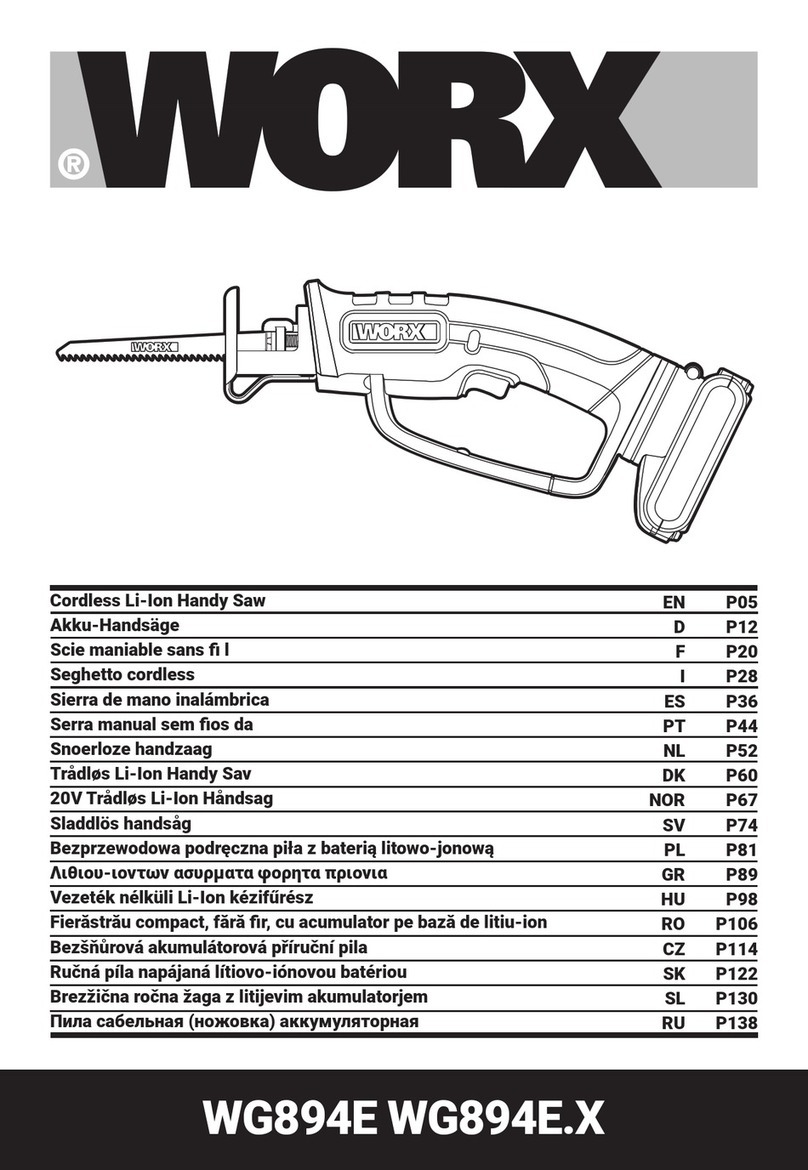
Worx WX550 User manual

WX550 WX550.1 WX550.4 WX550.9
P07
P12
P17
P23
P28
P33
P38
P44
P49
P54
P59
P64
P69
P74
EN
D
F
I
ES
NL
PL
HU
RO
CZ
SK
PT
SV
SL
20V Li-Ion multi-purpose saw
20V Li-Ion-Mehrzwecksäge
Scie multifonction 20V Li-Ion
Seghetto multi funzione a batteria agli ioni di litio da 20V
Sierra multifunción de ion-litio de 20V
Zaag voor algemeen gebruik op 20V Li-Ionbatterij
Pilarka wielofunkcyjna litowo-jonowa 20V
20V-os Li-Ion akkumulátoros multifunkciós fűrész
Ferăstrău multifuncţional cu acumulator Li-Ion de 20V
20V Li-Ion víceúčelová pila
20V Viacúčelová píla napájaná lítiovo-iónovou batériou
Serra multi-usos com bateria de 20V de iões de lítio
20V Li-jon Universalsåg
20V večnamenska žaga z litijevim akumulatorjem

Original instructions EN
Originalbetriebsanleitung D
Notice originale F
Istruzioni originali I
Manual original ES
Oorspronkelijke gebruiksaanwijzing NL
Instrukcja oryginalna PL
Eredeti használati utasítás HU
Instrucţiuni originale RO
Původní návod k používání CZ
Pôvodný návod na použitie SK
Manual original PT
Bruksanvisning i original SV
Izvirna navodila SL

12345
14
13
11
12
9
10
6
7
1
2
Position I
Position II
1
2
3000/min0
8
1
2
1
2
WA3860
WA3880
C1
B2
C2
A4A3
A2A1
B1
D2
C3 C4
D1
F1
D3 E
G1
F2
H
G2
G3

1
2
Position I
Position II
1
2
3000/min0
8
1
2
1
2
WA3860
WA3880
C1
B2
C2
A4A3
A2A1
B1
D2
C3 C4
D1
F1
D3 E
G1
F2
H
G2
G3

1
2
Position I
Position II
1
2
3000/min0
8
1
2
1
2
WA3860
WA3880
C1
B2
C2
A4A3
A2A1
B1
D2
C3 C4
D1
F1
D3 E
G1
F2
H
G2
G3

1
2
Position I
Position II
1
2
3000/min0
8
1
2
1
2
WA3860
WA3880
C1
B2
C2
A4A3
A2A1
B1
D2
C3 C4
D1
F1
D3 E
G1
F2
H
G2
G3

20V Li-Ion multi-purpose saw EN
7
GENERAL POWER TOOL
SAFETY WARNINGS
WARNING: Read all safety warnings
and all instructions. Failure to follow the
warnings and instructions may result in electric
shock, fire and/or serious injury.
Save all warnings and instructions for future
reference.
The term “power tool” in the warnings refers to your
mains-operated (corded) power tool or battery-
operated (cordless) power tool.
1. WORK AREA SAFETY
a) Keep work area clean and well lit. Cluttered
or dark areas invite accidents.
b) Do not operate power tools in explosive
atmospheres, such as in the presence of
flammable liquids, gases or dust. Power
tools create sparks which may ignite the dust or
fumes.
c) Keep children and bystanders away while
operating a power tool. Distractions can
cause you to lose control.
2. ELECTRICAL SAFETY
a) Power tool plugs must match the outlet.
Never modify the plug in any way. Do
not use any adapter plugs with earthed
(grounded) power tools. Unmodified plugs
and matching outlets will reduce risk of electric
shock.
b) Avoid body contact with earthed or
grounded surfaces, such as pipes,
radiators, ranges and refrigerators. There is
an increased risk of electric shock if your body is
earthed or grounded.
c) Do not expose power tools to rain or wet
conditions. Water entering a power tool will
increase the risk of electric shock.
d) Do not abuse the cord. Never use the cord
for carrying, pulling or unplugging the
power tool. Keep cord away from heat,
oil, sharp edges or moving parts. Damaged
or entangled cords increase the risk of electric
shock.
e) When operating a power tool outdoors,
use an extension cord suitable for outdoor
use. Use of a cord suitable for outdoor use
reduces the risk of electric shock.
f) If operating a power tool in a damp
location is unavoidable, use a residual
current device (RCD) protected supply. Use
of an RCD reduces the risk of electric shock.
3. PERSONAL SAFETY
a) Stay alert, watch what you are doing and
use common sense when operating a
power tool. Do not use a power tool while
you are tired or under the influence of
drugs, alcohol or medication. A moment of
inattention while operating power tools may
result in serious personal injury.
b) Use personal protective equipment.
Always wear eye protection. Protective
equipment such as dust mask, non-skid safety
shoes, hard hat, or hearing protection used for
appropriate conditions will reduce personal
injuries.
c) Prevent unintentional starting. Ensure
the switch is in the off-position before
connecting to power source and/or battery
pack, picking up or carrying the tool.
Carrying power tools with your finger on the
switch or energising power tools that have the
switch on invites accidents.
d) Remove any adjusting key or wrench
before turning the power tool on. A wrench
or a key left attached to a rotating part of the
power tool may result in personal injury.
e) Do not overreach. Keep proper footing
and balance at all times. This enables
better control of the power tool in unexpected
situations.
f) Dress properly. Do not wear loose clothing
or jewellery. Keep your hair, clothing and
gloves away from moving parts. Loose
clothes, jewellery or long hair can be caught in
moving parts.
g) If devices are provided for the connection
of dust extraction and collection facilities,
ensure these are connected and properly
used. Use of dust collection can reduce dust-
related hazards.
4. POWER TOOL USE AND CARE
a) Do not force the power tool. Use the
correct power tool for your application.
The correct power tool will do the job better and
safer at the rate for which it was designed.
b) Do not use the power tool if the switch
does not turn it on and off. Any power tool
that cannot be controlled with the switch is
dangerous and must be repaired.
c) Disconnect the plug from the power
source and/or the battery pack from
the power tool before making any
adjustments, changing accessories, or
storing power tools. Such preventive safety
measures reduce the risk of starting the power
tool accidentally.
d) Store idle power tools out of the reach
of children and do not allow persons
unfamiliar with the power tool or these
instructions to operate the power tool.
Power tools are dangerous in the hands of
untrained users.
e) Maintain power tools. Check for
misalignment or binding of moving parts,
breakage of parts and any other condition
that may affect the power tool’s operation.
If damaged, have the power tool repaired
before use. Many accidents are caused by
poorly maintained power tools.

20V Li-Ion multi-purpose saw EN
8
f) Keep cutting tools sharp and clean.
Properly maintained cutting tools with sharp
cutting edges are less likely to bind and are
easier to control.
g) Use the power tool, accessories and
tool bits etc. in accordance with these
instructions, taking into account the
working conditions and the work to
be performed. Use of the power tool for
operations different from those intended could
result in a hazardous situation.
5. BATTERY TOOL USE AND CARE
a) Recharge only with the charger specified
by the manufacturer. A charger that is
suitable for one type of battery pack may create
a risk of fire when used with another battery
pack.
b) Use power tools only with specifically
designated battery packs. Use of any other
battery packs may create a risk of injury and fire.
c) When battery pack is not in use, keep it
away from other metal objects, like paper
clips, coins, keys, nails, screws or other
small metal objects, that can make a
connection from one terminal to another.
Shorting the battery terminals together may
cause burns or a fire.
d) Under abusive conditions, liquid may be
ejected from the battery; avoid contact.
If contact accidentally occurs, flush with
water. If liquid contacts eyes, additionally
seek medical help. Liquid ejected from the
battery may cause irritation or burns.
6. SERVICE
a) Have your power tool serviced by a
qualified repair person using only identical
replacement parts. This will ensure that the
safety of the power tool is maintained.
RECIPROCATING SAW
SAFETY WARNINGS
1. Hold reciprocating saw by insulated
gripping surfaces, when performing an
operation where the cutting accessory
may contact hidden wiring. Cutting
accessory contacting a “live” wire may make
exposed metal parts of the power tool “live”
and could give the operator an electric shock.
ADDITIONAL
SAFETY RULES FOR
RECIPROCATING SAW
1. Always wear a dust mask.
SAFETY WARNINGS FOR
BATTERY PACK
a) Do not dismantle, open or shred cells or
battery pack.
b) Do not short-circuit a battery pack. Do
not store battery packs haphazardly in
a box or drawer where they may short-
circuit each other or be short-circuited
by conductive materials.When battery
pack is not in use, keep it away from other
metal objects, like paper clips, coins, keys,
nails, screws or other small metal objects, that
can make a connection from one terminal to
another. Shorting the battery terminals together
may cause burns or a fire.
c) Do not expose battery pack to heat or
fire. Avoid storage in direct sunlight.
d) Do not subject battery pack to mechanical
shock.
e) In the event of battery leaking, do not
allow the liquid to come into contact
with the skin or eyes. If contact has
been made, wash the affected area with
copious amounts of water and seek
medical advice.
f) Seek medical advice immediately if a cell
or battery pack has been swallowed.
g) Keep battery pack clean and dry.
h) Wipe the battery pack terminals with a
clean dry cloth if they become dirty.
i) Battery pack needs to be charged before
use. Always refer to this instruction and
use the correct charging procedure.
j) Do not maintain battery pack on charge
when not in use.
k) After extended periods of storage, it may
be necessary to charge and discharge
the battery pack several times to obtain
maximum performance.
l) Battery pack gives its best performance
when it is operated at normal room
temperature (20°C ± 5°C).
m) When disposing of battery packs, keep
battery packs of different electrochemical
systems separate from each other.
n) Recharge only with the charger specified
by WORX. Do not use any charger other
than that specifically provided for use
with the equipment. A charger that is
suitable for one type of battery pack may create
a risk of fire when used with another battery
pack.
o) Do not use any battery pack which is not
designed for use with the equipment.
p) Keep battery pack out of the reach of
children.
q) Retain the original product literature for
future reference.
r) Remove the battery from the equipment
when not in use.
s) Dispose of properly.

20V Li-Ion multi-purpose saw EN
9
SYMBOLS
To reduce the risk of injury, user
must read instruction manual
Warning
Wear ear protection
Wear eye protection
Wear dust mask
Li-I on
Do not dispose of batteries.
Return exhausted batteries
to your local collection or
recycling point
Do not burn
Do not expose to rain or water
Waste electrical products
must not be disposed of with
household waste. Please recycle
where facilities exist. Check with
your local authorities or retailer
for recycling advice.
Make sure the battery is
removed prior to changing
accessories
Wear protective gloves
Wood
Metal
Aluminium
Plastic
Incorrect
Correct
Saw with moderate pressure
in order to achieve optimal and
precise cutting results
Lock
Unlock
Pinch points

20V Li-Ion multi-purpose saw EN
10
*Not all the accessories illustrated or
described are included in standard delivery.
TECHNICAL DATA
Type WX550 WX550.1 WX550.4 WX550.9
(5-designation of machinery, representative of
Saw)
WX550
WX550.1
WX550.4 WX550.9
Rated voltage 20V Max**
Charger voltage
100-240V~50/60Hz
/
No load speed 0-3000/min
Stroke length 20mm
Cutting capacity
Jigsaw
mode
Wood 50mm
PVC pipe 50mm
Steel plate 4mm
Rep saw
mode
Wood 100mm
PVC pipe 127mm
Steel
pipe 76mm
Machine weight 1.9kg 1.5kg
**Voltage measured without workload. Initial
battery voltage reaches maximum of 20 volts.
Nominal voltage is 18 volts.
NOISE INFORMATION
A weighted sound pressure LpA= 79,7dB(A)
A weighted sound power LwA= 90,7dB(A)
KpA&KwA 3dB(A)
Wear ear protection
VIBRATION INFORMATION
Vibration total values (triax vector sum) deter-
mined according to EN 60745:
Cutting sheet
metal
Vibration emission value
ah,M= 4,805m/s2
Uncertainty K = 1,5m/s²
Cutting boards
Vibration emission value
ah,B = 5,495m/s2
Uncertainty K = 1.5m/s²
Cutting wooden
beams
Vibration emission value
ah,WB = 5,535m/s2
Uncertainty K = 1.5m/s²
The declared vibration total value may be used for
comparing one tool with another, and may also be
used in a preliminary assessment of exposure.
WARNING:The vibration emission value
during actual use of the power tool can differ
from the declared value depending on the ways in
which the tool is used dependant on the following
examples and other variations on how the tool is
used:
How the tool is used and the materials being cut.
The tool being in good condition and well
maintained.
The use of the correct accessory for the tool and
ensuring it is sharp and in good condition.
The tightness of the grip on the handles and if any
anti vibration accessories are used.
And the tool is being used as intended by its design
and these instructions.
This tool may cause hand-arm vibration
syndrome if its use is not adequately
managed.
WARNING:To be accurate, an estimation
of exposure level in the actual conditions
of use should also take account of all parts of the
operating cycle such as the times when the tool
is switched off and when it is running idle but not
actually doing the job.This may significantly reduce
the exposure level over the total working period.
1. ON/OFF SWITCH
2. LOCK-OFF BUTTON
3. HAND GRIP AREAS
4. PIVOT RELEASE BUTTON
5. MOTOR COVER
6. PENDULUM FUNCTION CONTROL
7. PROTECTION FINGER
8. LED WORK LIGHT (SEE FIG. H)
9. BLADE HOLDER
10. FOOT PLATE
11. BOTTOM PLATE
12. BASE PLATE
13. BATTERY PACK *
14. BATTERY PACK RELEASE BUTTON*
Other manuals for WX550
5
This manual suits for next models
3
Table of contents
Languages:
Other Worx Cordless Saw manuals

Worx
Worx WT520.X User manual

Worx
Worx WG384E User manual

Worx
Worx WX523 WorxSaw User manual

Worx
Worx WX530.X Series Installation manual

Worx
Worx WX500L User manual

Worx
Worx WX530 Installation manual

Worx
Worx WX529 User manual

Worx
Worx WX529L User manual

Worx
Worx WX516 Series Operation instructions

Worx
Worx WG894E User manual

Worx
Worx WX527 Operation instructions

Worx
Worx WG324E Installation manual

Worx
Worx WX523 WorxSaw Installation manual

Worx
Worx WX530 User manual

Worx
Worx WG894E User manual

Worx
Worx WX508L User manual

Worx
Worx WORXSAW WX527.1 User manual

Worx
Worx WG891E User manual

Worx
Worx WG324E User manual

Worx
Worx WX530L User manual