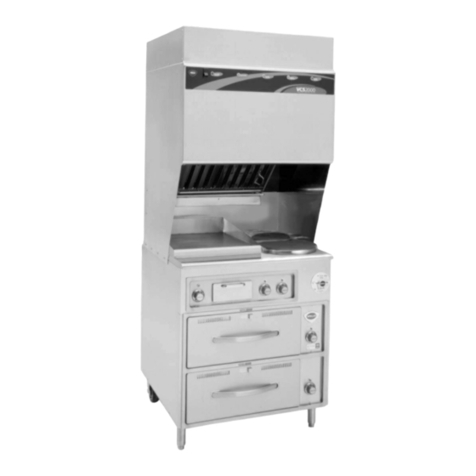
Whale 1247-5100 User manual

GOURMET COOK-TOP
OWNER’S MANUAL
Installation - Operation - Maintenance
CAUTION: READ INSTRUCTIONS BEFORE OPERATING APPLIANCE.
75566 Rev. A
MODELS: "G" GOURMET
1247-5100, 2247-5100, 3247-5100(120v)
1247-5400, 2247-5400, 3247-5400(208v)
1247-5200, 2247-5200, 3247-5200(240v)
SERIAL NUMBER _________________________________________
IMPORTANT:
Save the Owners Manual / Installation instructions for local inspector’s use.
Installer: Provide this manual to the vehicle owner. Vehicle Owner: Keep this manual for future reference


1
IMPORTANT INSTRUCTIONS
Save the owner’s manual / instructions for local Electrical Inspector’s use.
CAUTION!
To eliminate the risk of burns or re by reaching over heated surface units, cabinet storage space
located above the surface units should be avoided. If the cabinet storage is to be provided, the rest can
be reduced by installing a range hood that projects horizontally a minimum of 5 in. (127mm) beyond
the bottom of the cabinets. The diagrams on page 6 illustrate range hood minimum vertical clearances.
The minimum clearance between the top of the cooking surface and the bottom of the unprotected
combustible surfaces must be no less than 30" (762mm). A=24" (609.6mm) minimum is permitted
when the bottom of the wood or metal cabinet is protected by not less than 1/4" (6.35mm) thick ame
retardant mill-board covered with no less than No. 28 MSG sheet steel, 0.015-inch-thick stainless steel,
0.024-inch-thick aluminum or 0.020-inch-thick copper.
IMPORTANT INSTRUCTIONS ALL MODELS
PROPER INSTALLATION:
Be sure your appliance is properly installed and grounded by a qualied technician.
NEVER USE YOUR APPLIANCE FOR WARMING OR HEATING
THE ROOM
DO NOT LEAVE YOUR CHILDREN ALONE: Children should not be left alone or unattended in an area
where appliance is in use. They should never be allowed to sit or stand on any part of the appliance.
Children should be supervised to ensure they do not play with the appliance.
This appliance is not intended for use by persons (including children) with reduced physical,
sensory or mental capabilities, or lack of experience and knowledge, unless they have been
given supervision or instruction concerning use of the appliance by a person responsible for
their safety.
WEAR PROPER APPAREL: Loose-tting or hanging garments should never be worn while using the
appliance.
USER SERVICING: Do not repair or replace any part of the appliance unless specically recommended
in the manual. All other servicing should be referred to a qualied technician.
STORAGE IN OR ON APPLIANCE: Flammable materials should not be stored in an oven or near
surface units.
DO NOT USE WATER ON GREASE FIRES: Smother re or ame, or use dry chemical or foam-type
extinguisher.
USE ONLY DRY POTHOLDERS: Moist or damp potholders on hot surfaces may result in burns from
steam. Do not let potholders touch hot elements. Do not use a towel or other bulky cloths.
USE PROPER PAN SIZE: This appliance is equipped with one or more surface units of different sizes.
Select utensils having at bottoms large enough to cover the surface unit heating element. The use
of undersized utensils will expose a portion of the heating element to direct contact and may result in
ignition of clothing. Proper relationship of utensil to burner will also improve efciency.

2
NEVER LEAVE SURFACE UNITS UNATTENDED AT HIGH HEAT SETTING: Boil over causes
smoking and greasy spillovers that may ignite.
GLAZED COOKING UTENSILS: Only certain types of glass, glass/ceramic, ceramic, earthenware
or other glazed utensils are suitable for range-top service without breaking due to sudden change in
temperature.
UTENSILS SHOULD BE TURNED INWARD AND NOT EXTEND OVER ADJACENT SURFACE
UNITS: To reduce the risk of burns, ignition of ammable materials and spillage due to unintentional
contact with the utensil, the handle of a utensil should be positioned so that it is turned inward, and
does not extend over adjacent surface units.
CAUTION
Do not store items of interest to children in cabinets above stovetop or on the background of a stovetop.
Children climbing on the stovetop, to reach items could be seriously injured.
Do not touch the surface or areas near the stove as they may be hot.
Surface units may be hot, even though they are dark in color. Areas near the stove may become hot
enough to cause burns. During and after use, do not touch, or let clothing or other ammable materials
contact stove or areas near stove, until it has had sufcient time to cool. Other surfaces of the appliance
may become hot enough to cause burns, among these surfaces are:
1. Surfaces surrounding the stovetop.
2. The potholder support.
3. The potholders.
* Note: Surface may still be hot to touch. "HOT LIGHT" will remain on for a period of time after unit is
turned off.
ELECTRICAL INSTALLATION
ELECTRICAL REQUIREMENTS
The branch circuit requirement is as follows:
MODEL VOLTAGE RATING
(KW)
BREAKER SIZE
(AMPS)
MINIMUM*
WIRE SIZE
(AWG)
1247-5100 120 1.2 15 14
1247-5200 240 1.2 10 (DUAL POLE) 14
1247-5400 208 1.2 10 (DUAL POLE) 14
2247-5100 120 2.4 25 12
2247-5200 240 2.4 15 (DUAL POLE) 14
2247-5400 208 2.4 15 (DUAL POLE) 14
3247-5100 120 3.6 35 10
3247-5200 240 3.6 20 (DUAL POLE) 12
3247-5400 208 3.6 20 (DUAL POLE) 12
Mentioned in title 33 Code of Federal Regulations, Part 183, Subpart I, Section 183.435.b

COOKING VESSEL SELECTION
The physical characteristics of pots and pans inuence the performance of cooking. Heat is transferred
through the glass top to the cooking vessel. Proper contact of the cooking vessel the stovetop will
assure heat is readily absorbed. Vessels with the following characteristics will work well.
Flat Bottom: Use pans with bottoms that become at when heated. In the cold state, the pan bottom
must be slightly concave, i.e. must have small center bow; the size of the bow depends on the material,
the thickness, and the diameter of the pan bottom. The entire bottom should touch the heating area in
order to allow for even heat distribution. This will help eliminate “hot spots” which may scorch or burn
food. One way to check the concavity of the pan bottom is to place a straightedge ruler parallel to the
bottom of the pan.
If your cookware spins on the cooking surface, it means that a small bow has formed toward the
stovetop during heating. Do not use this cookware.
Corrected Diameter: The diameter of the vessel should be the same as the diameter of the glowing
heat zone.
Good Balance: Your pan should always be level on the cooking surface, with or without food in it. It
will make good contact with the heating area for uniform heat distribution.
Thick Bottom: Pans with thick bottoms are also effective in eliminating hot spots by providing good
heat distribution. In general, you should not use a vessel with a bottom less than 1/16”.
3

4
THE MATERIAL OF THE VESSEL ALSO INFLUENCES
COOKING PERFORMANCE
Stainless Steel:
Used for sauces, soups, vegetables and egg cookery. It responds relatively slowly
to temperature changes. The best stainless steel utensils have thick “sandwich”
bottoms where a layer of aluminum or copper lies between layers of stainless
steel.
Enamelware:
Ideal for cooking large amounts of liquids. It is stain resistant. The thickness of the
bottom should be at least 3/32 (2.381mm) of an inch thick.
Aluminum:
Best suited for frying, braising and pot-roasting. The pan bottom should not be to
thin, at least 3/32 (2.381mm) to 3/16 (4.762mm) of an inch.
Copper with Tin Lining:
Excellent for gourmet cooking, wine sauce and egg cookery. Remember that tin
lining will wear thin with continued use. It must be re-tinned to avoid toxic reactions
between copper and food.
Ceramic Glass/Ceramic:
Good for long, slow low-heat cooking with liquids such as simmering.
CAUTION
Only certain types of glass, glass ceramic, ceramic, earth ware or other glazed vessels are suitable for
stovetop service without breakage due to sudden change in temperature.
DO NOT USE ALUMINUM FOIL
This material will damage the stovetop surface if it melts. Do not use it under any circumstances.
GLASS/CERAMIC COOKING SURFACES
DO NOT COOK ON BROKEN STOVETOP: If stovetop should break, cleaning solutions and spillovers
may penetrate the broken stovetop and create a risk of electrical shock. Contact a qualied technician
immediately.
WARNING
If the glass surface of the cooktop is cracked switch off the appliance to avoid electrical shock
and contact a qualied technician for repair immediately.

5
GLASS COOKTOP CLEANING
WARNING
CLEAN COOKTOP WITH CAUTION:
If a wet sponge or cloth is used to wipe spills on a hot cooking area, be careful to avoid steam
burn. Some cleaners can produce noxious fumes if applied to a hot surface.
Some cleaning material recommended by manufactures for glass may contain an ingredient, which can
damage your glass stovetop.
Generally, wipe up food spills and splatters before they burn onto the surface. This should be done
immediately after the spills occur. But do not get burned by touching a hot area.
We recommend the use of HOPE’S STOVETOP CLEANING CREAM for care and maintenance of
these glass surfaces. For more information about this product, contact The Hope Company, Inc 1-800-
325-4026 for a dealer near you.
CAUTION
1. Avoid using abrasive plastic, nylon and cloth pad. They can scratch the stovetops surface.
2. Avoid using metal pads. They can metalmark and scratch.
3. Avoid using heavy duty cleansing powders. The pressure you apply and the powder’s abrasiveness
can cause scratching.
4. Avoid using chemical oven cleaners. They are caustic and etch the stovetop surface.
5. Avoid using rust-stain removers containing hydrouoric acid.
6. Avoid using chlorine bleach or ammonia.
7. Do not use a sponge or dishcloth. They may leave a lm of detergent on the stovetop, which
may cause brown discoloration the next time the stovetop is heated. If this occurs, remove the
discoloration with a recommended cleaner.
8. Never mix cleaning products. They may interact with damaging or hazardous results.
9. Never use a steam cleaner to clean the glass surface of the appliance.

6
COOKTOP INSTALLATION
1. Locate cooktop according to the diagram below.
2. Cut-out countertop to the dimensions shown.
3. Peel off tape and secure stove to the countertop.
4. Connect exible conduit and wiring to junction box by a qualied electrician.
5. Means for disconnection must be incorporated in the xed wiring in accordance with the wiring
rules. Means to allow disconnection of the appliance from the supply after installation is required.
The disconnection may be achieved by incorporating a switch in the xed wiring in accordance to
the wiring rules.
CUT-OUT DIMENSIONS
W D
1247 12 3/8" (314.3mm) 12 3/8" (314.3mm)
2247 21 3/8" (542.9mm) 12 3/8" (314.3mm)
3247 21 3/8" (542.9mm) 19 3/8" (492.1mm)
*See page 1 for minimum height
**Distance between cut-out and wall to be no less than 3" (76.2mm)
3.000" **
(76.2mm)

7
8
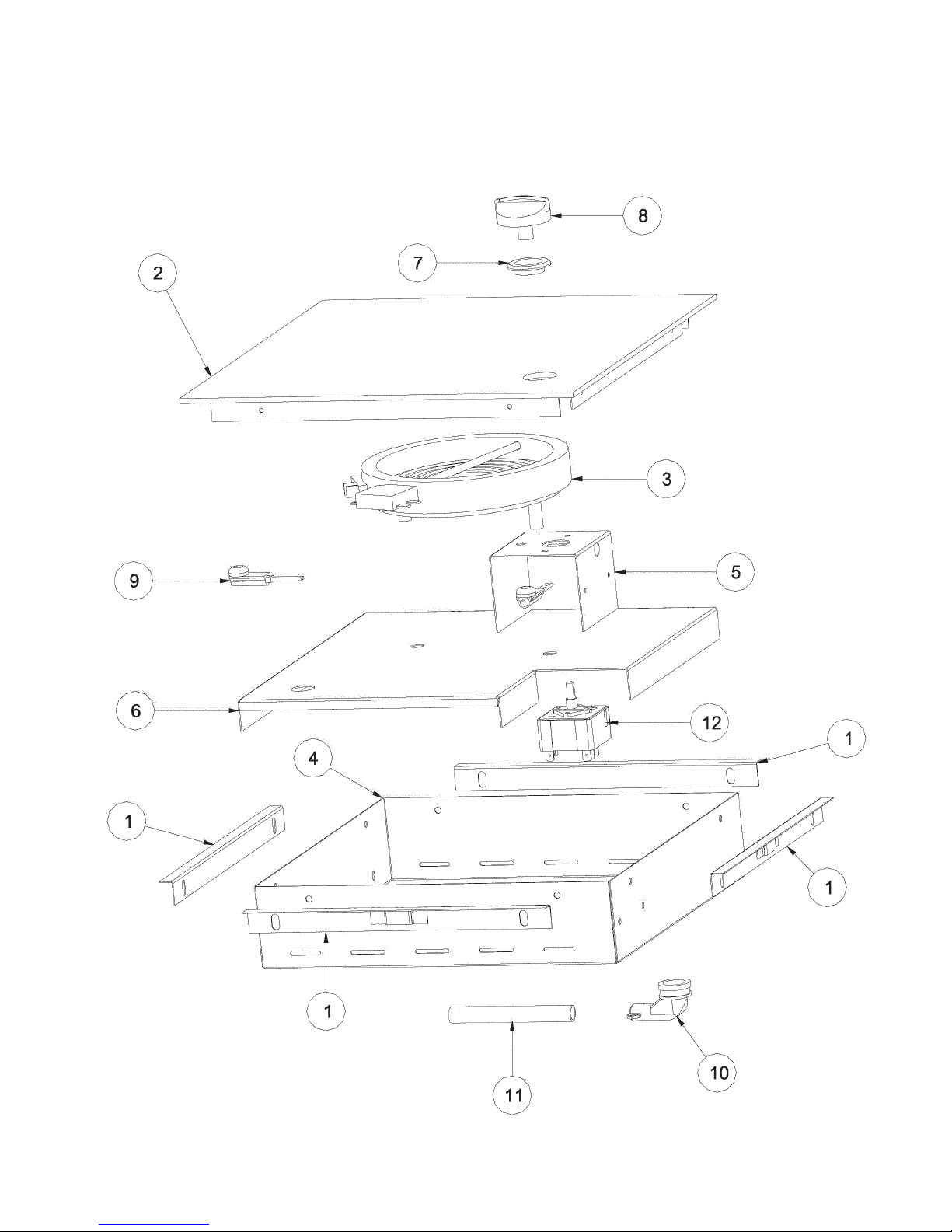
1247 Cook-Top
This manual suits for next models
8
Table of contents
Other Whale Cooktop manuals