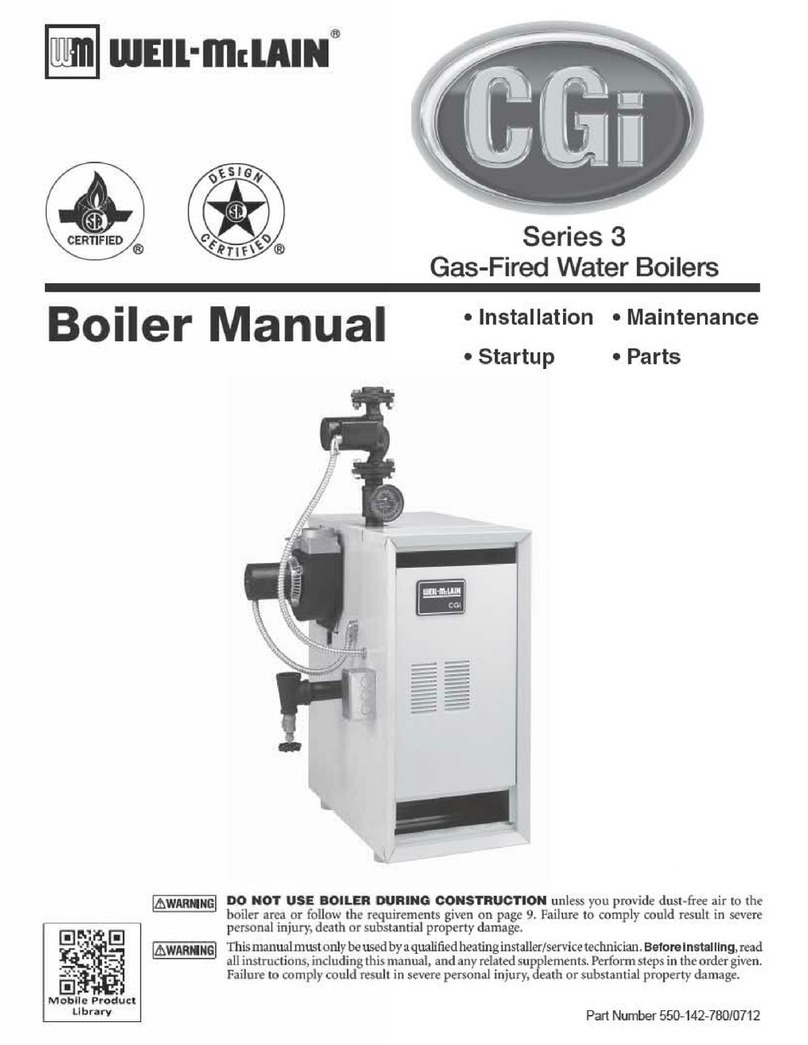
CG
i
GAS-FIRED
wATER
BOILER-
sERIEs
a-
Boiler
Manual
lc
I&
WA
RNING
!
tr
jHJUijj;l
8
Prepare boiler location -vent system
Failure to follow all instructionscan result
in
flue gas spillage
and
carbon
mon
oxide emissions, causing severe
personal inj
ur
y or death.
Inspectexistingchimneybeforeinstalling boiler. Failuretoclean
or
rep
la
ceperforated pipe
or
tile lining willcause
severe
pe
rson
al
injury
or
dea
th.
Direct
exhaust
venting(Category
Ill)
-
DO
NOTCOMMONvent the CGi
in
a directexhaustsystem
(Ci
te
gory
Ill
).
COJ
mecting more than
one
ap
pliance
to
a direct exhaust system will cause flue
gas
spillage or appliance
malfunction, resulting in possible severe personal injury,death
or
substantial propertyda
ma
ge.
When removing
boiler
from
an
existing common
vent
system:
At the
time
of
removal
of
an existing boiler, the following
stepsshallbefollowedwith each applianceremainingcon-
nectedtothe commonventingsystem placedinoperation,
while
the
other
appliances remaining connected to
the
comm
on
ve
ntin
g
syste
m
are
not
in
operatio
n.
a.
Seal
any
unused
openings
in
the
co
mm
on
ve
nting
system.
b. VIsually
Inspect
the
venting
system
for propersize
and
horizontal pitch
and
determinethere
is
no blockage
or restrictio
n,
leakage, co
rr
osion
or
other de
fi
ciencies
which cou
ld
cause
an
unsafe condition.
c.
Test
vent
system
- Insofar
as
is
(>
Tactical,
dose
all
building
doo
rs
and
windows
and
all
doors
between
thespacein wh
ic
h theappliances remainingconnected
to the co
mm
on ventingsystem are located
and
other
spaces
of
the building.
Turn
on
clothes dryers
and
any
appl
ia
ncen
ot
connectedto
the
common
ve
ntingsystem.
Turn
on any exhau
st
funs,
such
as
range hoods
and
bathroom exhausts,so they will operate at maxi
mum
speed.
Do
not operate a stmmt
er
exhaust
fun.
Close
firep
lace
dampers.
d.
Place
In
operation
the
appliance
being
inspected.
Follow
the
operating instructions.
Adj
u
st
the
m1
ostat
so
app
lian
ce
will oper
ate
continu
ous
l
y.
e.
Test
for
spillage
at
draft
hood
re
li
ef
opening after 5
minutes
of
main
burneroperation.
Us
e the flame
of
a
match or candle.
f.
After
it
has been determined
that
each
appliance
re
mai
n
in
g
con
nected
to
the common ven
ting
syste
m
properly vents when tested as outlin
ed
above, r
et
urn
doors,windows, exhaustfuns, firepla
ce
dampers,
and
anyothergas-burning appliance
to
theirpreviouscon-
ditions
of
use.
Anyimproperoperation
of
comm
on
ve
ntingsystem
sho
uld
beco
rr
ected
so
th
e installationconfomtswith the National
Fuel Gas Code, ANSI Z22
3.
1 - latest edition. Correct by
resizing
to
approach the minimum size as determined
using the appropriate tables
in
Part I I
of
that code.
Ca
-
nadian installations
must
complywith BI49.1 or BI49
.2
Installation Code.
Chimney
or
vent
requirements
1.
Venting must
be
installed according to Part 7,
Venting
of
Equipment, of National
FU
el Gas
Code, ANSI Z223.1 - latest e
dition
and
ap
-
plicab
le
building codes. Canadian installations
must
complywith BI49.1
or
BI49.2 Installation
Codes.
2.
See
Ratings table
on
pa
ge
66for minintwnchim-
ney
or
ventsizes. A chi
mn
ey or vent without a
listed
cap
sho
u
ld
extend
at
least
3 feet
above
the
highest
pointwhere
it
passesthrough a r
oof
of
a building
and
at
least
2 teet
higher
than
any
portion
of
a building within a
ho
rizontal
distance
of
10
teet.Achimneyor vent
mu
st
not
extendless than the distancesstatedabove.
3. A lined chi
mney
is preferred
and
must
be
used
when requir
ed
by local, state, pr
ov
incial
and
national codes, laws,regulations
and
ordinances.
Vitreous tile linings
with
joints
that
prevent
retention
of
moistureand
Ji
ni
ngs
m
ade
of
non-
corrosi
ve
materialsare best.Adviceforfluecon-
nections
and
chi
mn
ey linings can
be
obta
in
ed
fro
m local gas utility. Type Bdouble-wall metal
ve
nt pipe or
si
ngle-wall
ve
nt pipe may be used
as
a lin
er.
4. Cold masonry c
himn
eys,also known as outside
chimneys, typically have one
or
more walls ex-
posedtooutsideair.When anyatmosphericgas-
fired boilerwithautomaticventdamp
er
isvented
t
hrough
this
type
of
chimney, the potential
exists
fo
rcondensationtooccur.Condensation
can damage a masonrychim
ney.
Weil
-Mclain
recommends the following to prevent possible
damage.
a.
Line
c
himn
ey
wi
th
co
rr
osi
on
-
resistant
m
eta
l
li
ner
suc
h as AL29-4CS single-wall
stainless steelorB-vent.Size liner per
National Fuel Gas Code
ANS
I
Z223.1
-
latest edition.
b. Provide drain
trap
toremove anyconden-
sate.
Part Number 550-142-780/0712