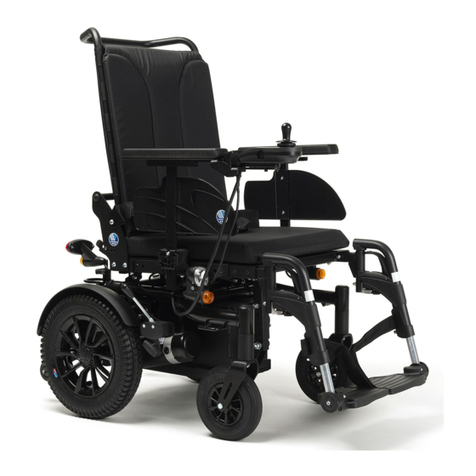
WARDRAY PREMISE XRT4500 User manual

XRT4500
Folding Portering Chair
OPERATORS MANUAL
GEN.S.19/237
OCTOBER 2019

2
Introduction
Thank you for purchasing this X-ray product. Manufactured and tested to the highest standards.
Our products are manufactured by Wardray Premise Ltd at our UK based factory to BS EN ISO
13485:2016 and are CE marked.
To ensure that you obtain maximum benefit from your product, please take a few minutes to read
the enclosed information regarding operation, service and maintenance.
If you have any problems in the meantime or would like any advice about this or any other X-ray
products from the Wardray Premise range, please contact us at the following address:
Wardray Premise Limited
Hampton Court Estate
Summer Road
Thames Ditton
Surrey
KT7 0SP
UK
Tel: +44 (0) 20 8398 9911
Fax: +44 (0) 20 8398 8032
E-mail: sales@wardray-premise.com
Website: www.wardray-premise.com
Kindly note:
If you modify a Wardray Premise product you will invalidate your warranty.
Unless you have our express written permission to modify a product, we transfer all liabilities for
modified products to you.
EU Authorised Representative:
Advena Ltd
Tower Business Centre
2nd Floor, Tower Street
Swatar
BKR 4013
Malta

3
Specification
The XRT4500 folding portering chair is designed to be used in an X-ray environment, and is
manufactured and tested to the highest standards.
The XRT4500 is constructed from 2 main materials, these being aluminium, and 316 stainless
steel.
The main frame is manufactured from aluminium which is lightweight, this aids the easy
movement of the chair.
The armrests are manufactured from 316 stainless steel which give added strength.
It is advisable that this product is inspected and serviced every 12 months by a Wardray Premise
trained technician.
A Service contract package is available, and details are available upon request from our Service
Department on +44 (0)20 8398 9911.
For international customers please contact your local Wardray Premise representative for
assistance.
Maximum patient weight 31Stone / 200Kg
Important Information
The XRT4500 is an adult manual mechanical wheelchair intended to provide mobility to a
person limited to the sitting position as a transport chair within a healthcare facility.
Seat size
mm
475 x 410
Max length
mm
1091
Max width
mm
653
Low height
mm
N/A
Seat height
mm
498
Max load
Kg
200

4
XRT4500 Portering chair parts reference
Footrests
Castor
Adjustable armrest
Front Brake
Rear Brake
Rear Wheel
Plungers
Seat
Backrest
In folded position
Push handles
Threaded Lobe Knob
Serial No.
located
on upright

5
Operating Instructions
Armrest
Armrests have been fitted to both sides of the chair these are to aide comfort whilst the
patient is sat in the chair.
The armrests should be in the lowered position when the patient is getting in and out of the
portering chair.
The armrests can also be lowered to allow a patient access from the side as the armrests
lower to a position below the seat level. This can easily be achieved by pulling the plunger, to
disengage, then lower the armrest.
To raise the armrest, simply pull the armrest upwards. It will click as the plunger engages into
position. Ensure the plunger has engaged in the locator and the armrest locked into position.
Plunger (Fig 1) - Pull black plunger to disengage (Fig 2)
Each armrest has 1 plunger.
Plunger Disengaged
Fig 2
Plunger
Plunger
Engaged Fig 1
IMPORTANT NOTE: Armrests have
not been designed to be weight
bearing. They are for the comfort of
patient transport only.

6
Operating Instructions
Footrests
Designed for patient comfort and ease of use the footrests can be removed completely (Fig 3) if
not required.
To remove the footrests, loosen the threaded lobe knob on the front side of the chair (Fig 4) by
unscrewing in a counter clockwise direction. (You do not need to fully remove the knob.
Loosening it will allow removal of the footrests.) Pull the footrest away from the chair in a
horizontal motion removing the footrest and the supporting arms.
To refit the footrest, simply align the two supporting arms and push the footrest back into place.
Once in place, rotate the threaded lobe knob in a clockwise direction to tighten and secure.
For easier access for the patient the footrests can be rotated upwards (Fig 5).
IMPORTANT NOTE:
DO NOT allow patients to stand
on the footrests when getting in or
out of the chair, as the chair will be
unstable.
In addition, footrests have not been
designed to be weight bearing.
Fig 3
Fig 4
Fig 5

7
Fig 4
Fig 3
Fig 1 Fig 2
Operating Instructions
Braking System
The folding portering chair is fitted with two 150mm diameter, individually braked castors on the
front of the chair (Fig 1) and a rear brake is also fitted to the right hand wheel (Fig 3) .
To engage the brakes on the front castors place your foot on the front part of the brake lever
(Fig 1) and push down firmly, the brake will lock in place and stop the castor from moving.
To release the brake place your foot on the rear part of the brake lever (Fig 2) and press down
firmly, this will release the brake.
Press down
firmly to release
Press down
firmly to lock
To engage the brake on the rear wheel pull the brake lever up firmly (Fig 3), the brake will lock in
place and stop the wheel from moving.
To release the brake push the brake lever downwards (Fig 4)
IMPORTANT NOTE:
Ensure all 3 brakes are
applied before patients
sit / alight from the chair.

8
Operating Instructions
Folded Position
To place the chair into the folded position rotate the footrests into an upright position (Fig 1) and
simply lift the seat. The chair will assume the folded position (Fig 2). There is no locking
mechanism, the weight of the chair keeps it in the folded position.
To open the chair, from its folded position, stand behind the chair and widen the push handles
apart. The chair will open easily on its own.
The armrests can be in their up or down position for folding.
Fig 2Fig 1

9
The chair should be serviced regularly, but only by Wardray Premise trained engineers, as
they will carry the correct spares to guarantee the continued safety of the chair. Failure to
comply with this will invalidate your warranty.
Recommendations
Always refer to and comply with your organisations patient movement policy.
We recommend that all staff using the chair receive appropriate manual handling training and
that appropriate risk assessments are completed.
Additional patient handling equipment such as slings / rota stands / stand aids should be
considered as part of your risk assessment.
It is important that the portering chair is pushed at all times and not pulled. Pulling the chair
whilst occupied could result in the patient being ‘tipped out’.

10
Do’s and Don’ts
Do ensure the following are observed:
Patients / users should not be transported in vehicles of any kind whilst seated in a
portering chair. There are no known types of approved tie down systems for safe
transportation of a user in a portering chair, in a moving vehicle of any type.
The XRT4500 portering chair is intended for the assisted movement of a non ambulatory
patient.
The portering chair is intended for internal use within the hospital / facility over the normal
range of surfaces encountered.
The portering chair should always be used by properly trained staff at all times.
The portering chair must only be used for the purpose for which it is designed.
Always refer to and comply with your organisation’s patient movement policy.
Ensure that patient does not weigh more than 200Kgs / 440lbs / 31 Stone.
Make sure chair is fully open before it is used by a patient.
Ensure that all 3 brakes are on before it is used by a patient.
Make sure that footrests are up / folded out of way whilst patient is getting on or off the
chair ( Page 6, Fig 5).
Ensure relevant armrest is down if patient is being slid onto the portering chair from side.
Ensure that the patient’s feet are safely on the footrests before disengaging the brakes and
transporting the patient.
Ensure that both armrests are in the upper locked position before moving patient.
Table of contents
Other WARDRAY PREMISE Wheelchair manuals