Vittorazi Motors Easy100 User manual

Vittorazi Motors
Passion lives here
Passion lives herePassion lives here
Passion lives here
Owner’s manual
Last update, October 2007
Model: Vittorazi
Easy100
Model: Vittorazi
ly100evo
All the indications writes in the charts of this manual will be underlined with the green color for
the model Easy100 and with the red color for the Fly100evo.
Address: street Roma, 182. Montecosaro 62010 (MC). Italia
Tel/Fax: +39733 866585
Commercial e-mail : info vittorazi.com
Technical support e-mail: matteo vittorazi.com
Skype: vittorazi.motors
Web-site: www.vittorazi.com

2
Index
1.0 Introduction
2.0 Warning
3.0 Installation engine components
3.1 Exhaust pipe
3.2 Rubber mountings
3.3 Air-box
3.4 Ignition coil and spark-plug
3.5 Electric installation
3.6 Gasoline tank and pipe
3.7 Throttle controller
3.8 Pull starter Easy100/ ly100evo
3.9 Choice of propeller
3.10 Accessories
4.0 Get ready for the use
4.1 Propeller mounting
4.2 uel
4.3 Starting and turning off
4.4 Warm-up
4.5 Carburetor adjustment
4.6 Break-in
5.0 Normal operation
5.1 Discovering new horizons
6.0 Specifications and technical data
7.0 Maintenance
7.1 Ignition coil and spark-plug
7.2 Check and cleaning carburetor
7.3 Reed valve
7.4 Gaskets
7.5 Exhaust silencer
7.6 Rubber mountings
7.7 Pull starter ly100evo
7.8 Pull starter Easy100
7.9 Electric starter
7.10 Reduction drive Easy100
7.11 Reduction drive ly100evo
7.12 Piston, cylinder, head
7.13 Crankshaft, crankcase and bearings
7.14 lywheel and ignition timing
8.0 Charts of maintenance
9.0 Tightening torque and special tools
10.0 Spare parts
11.0 requent asked questions - AQ
12.0 Warranty
12.1 Registration of the warranty
12.2 Limited warranty
12.3 Warranty coverage
12.4 Warranty coupon
13.0 Contacts

3
1.0 Introduction
Congratulations for having chosen a fine engine product Vittorazi.
Before passing to the installation of the motor, read this manual carefully.
With this manual we will try to give our knowledge to your service, teaching how to use
motor, providing you the necessary information for installation and maintenance, besides
we will indicate you the situations of danger, with our due suggestions to be able to
avoid them. When you will receive the motor, it will already have overcome a test of 15
minutes in the factory, verifying the operation of all the components and the operation
to every speed. All the engines Vittorazi are tested before the delivery.
If just one parts of the manual won’t be completely understood or in the case which the
manual won't be clear or exhaustive, for uncertainties, questions, to analyze or to
resolve a problem with our help, we invites you to directly contact the authorized dealer
or directly the Vittorazi.
You include in the claim the serial number XXXX of the motor that you find under the
system carburetor, some photos if you think will be necessary.
You find the direct contacts of the factory in the first and in the last page of this manual.
The Vittorazi reserves the right to change in any moment without warning, sketches,
specifications, component, details of the motor, in relationship to the model in
production without incurring in some obligation.
The reliability, the performances and the duration of your motor will also depend from
your knowledge and the way of using it.
During this manual will be underlined: in the red panel the situations that can lead you
to a serious danger; in the blue panel, suggestions or advice that have not to be
underestimated.
Attention, danger, risk
Advice, suggestion, notice
In the present photos/picture of this manual:
the arrows of green color will have generic indications specified in the inherent
paragraphs
the arrows of blue color will indicate to add lock tight medium strength
the arrows of brown color will indicate to add some grease
the arrows of black color will indicate to add sealing paste, resistant to high
temperatures (up to 500-600°C).

4
2.0 Warning
•It needs to be conscious that the motor can stop, have a breakup or to go off in any
moment. This could lead a crash to the ground or a landing in hostile areas with
possible damages/death of the pilot or other people. The ultralight moved by this
motor must fly in permitted spaces to it, not to fly above a crowd of people,
inhabited centers, zones that have difficult or void landings, not to fly above zones
of water or where is possible to drown. It always needs to have in mind that the
motor can go off or breakup, therefore to consider a possible landing of emergency
for every situation.
•This manual describes the motor. or its installation, use and control, you compare
also the attached user manual of the ultralight: Paramotor, Mosquito or Trike...
If used in other applications, cannot be guaranteed the correct operation.
•This motor is not certified. It is not a motor with guarantees or aeronautical
certifications. Its construction is destined to experimental and not certified
aircrafts.
•Some zones for particular atmospheric conditions as pressure, temperature, damp
can bring to a different operation of your motor. Before beginning every flight, you
test on the groud the motor and verify that it doesn't have an anomalous behavior.
•Start the engine in a plain surface, free from stones, sand or small parts that could
be aspirated by the propeller. Be sure that the flow of air pushed by the propeller
not lead damage to anybody. In any moment the motor is running (testing on the
ground, take-off, landing) watch out that nobody draws near to the propeller in
rotation. A good safety distance is 50 meters for all directions of projection of the
propeller and 20 meters for the others directions.
•Not use the motor that has not followed a correct maintenance or not correctly
been used in the time or if you know that is not under perfect conditions.
•The use of not original spare-part and not recognized by the Vittorazi, can make
the motor dangerous and immediately hands term to the validity of the warranty.
Vittorazi doesn't assume any warranty for that motor that are used with not
original parts or not recognized, modified or that have had an improper use.
•Changes not authorized to the motor, to the reduction, to the propellers can reduce
safety and reliability of the aircraft. In the case you have to intervene on the motor
we invite you to compare this manual with the help of your dealer Vittorazi and
follow it as reference.
•Before every use or test, check the conditions of the propeller and the tightening of
bolts of the propeller. If the propeller has received a hit and is damaged you avoid
to use or to turn on the motor. This can lead to an explosion of the propeller in
rotation or to strong vibrations that will revert in the motor with possible
consequent breakups, loss of tightening of the bolts or strong usuries of
components.
•
Do never use the motor without propeller or without reduction drive group. This
motor has been projected for a determined and contained number of turns.
Without propeller or reduction drive, the motor reaches a number of turns for
which has not been calculated. In few second there is risk of explosion of the
motor.
5
3.0 Installation engine components
The chapter or paragraph is reserved to the manufacture, dealer or center assistance
Vittorazi. If you are our collaborators, we invite you to write to our e-mail address and
get the integral version of the manual.
4.0 Get ready for the use
4.1 Propeller mounting
Be sure to possess a suitable and guaranteed propeller by Vittorazi for your motor.
Attention: the propeller can be mounted in two opposite position in comparison to the
reduction drive, which only one is correct. Ask to the authorized dealer or to the
instructor, if you are not certain for the assemblage of the propeller.
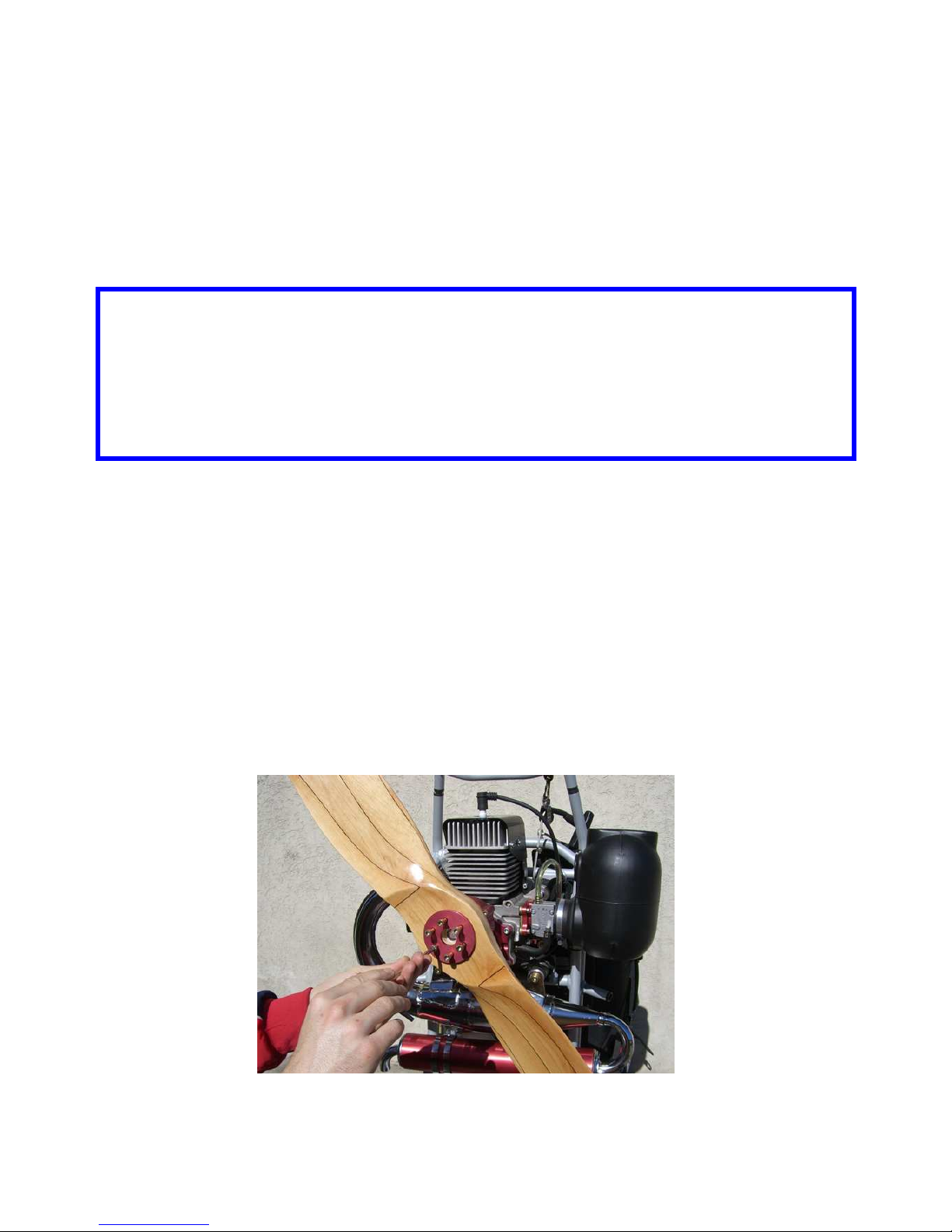
Model Easy100: rotation propeller clockwise, considering the back view
(same view of the picture 4.1).
Model Fly100evo: rotation propeller counterclockwise, considering the back view.
Push the propeller against the reduction drive, untill to insert it completely. Now gently
screw the bolts up to the end. Be sure that the bolt are proper for the propeller,
therefore the threads of the bolts are inserted at least 10mm in the hub. Now to tighten
the bolts of the propeller trying to get the same pressure on every point, picture 4.1.
Not do exaggerate with the pressure on the bolts, there is a risk to crush the propeller, if
in wood.
Have a maximum pressure of 4 -5 Nm, if the propeller is in composite carbon.
Propeller in wood: once tightened the propeller, it is opportune to check that the pich of
the two blades is identical. If there is a considerable variation among the two blades,
this difference can be compensated through the pressure of the bolts.
If you don’t know this method of balancing, ask to an authorized instructor or dealer.
Check the tightening of the wood propeller every 3 hours of flight and repeat the
balancing.
4. / tightening propeller bolts
In the case of a broken propeller, we invite you to purchase from a Vittorazi dealer, the
same propeller for measure and profile, guaranteed from the factory.

6
It will be enough to remember measure, material of the propeller and model of the
motor.
The use of a not conform propeller or the use of a propeller Vittorazi united to a wrong
reduction ratio, brings immediately end of the warranty, see paragraph 12.3

7
4.2 uel
The motor that you are going to use is a two strokes engine. It requires for the
lubrication an established percentage of oil/gasoline. When at the gas pump, always
choose gasoline unleaded 95 octanes.
The percentages will be pointed out in the following paragraphs, "break-in" 4.5 and
"normal operation" chapter 5.
The gasoline is an extremely inflammable and explosive substance. When you prepare
or in every moment you are close to the fuel (gasoline and oil), not smoke, not
provoke sparks or flames. Never fill the tank of your aircraft when the motor is
running. Position the tank of the fuel before starting the motor at least 10 meters.
During the operation of decanting, mixing, filling, choose an open place, ventilated, clean
and away from dusts, sand, grass and everythings that can obstruct the passage of the
gasoline. If possible while filling the tank of the aircraft, filter the mixture. Be sure that
the tank for the transport gasoline, filter and funnel, is perfectly always clean.
We advise only oil of good quality certified and full synthetic (no oil semi-synthetic, no
mineral oil).
We recommend the use of the following types of oil, already tested with success on our
motors: Motul 600, Castrol TTS, Valvoline Racing 2T.
Avoid mixtures prepared by the gas pump. A mixture had been prepared from 2-4 weeks
and left in a tank could separate (oil and gasoline), loosing the characteristics of
lubrication even if shaked before the use. Avoid to prepare a big quantity of mixture,
when you are already conscious to use only a part of it. Avoid use plastic tanks and
consider it as containers to transport, not left to deposit the mixture for days in the
plastic tanks. We dissuade the addition of liquids that increase the number of octanes.
Problems to the motor owed to a lack of oil in the gasoline or for a wrong mix of oil or
for lack of cleaning of the gasoline, are not recognized in warranty. See paragraph 12.3.

8
4.3 Starting and turning off
In the first starting of the engine and every time the gasoline piper remains without fuel
(tank, pipe, primer bulb and carburetor), will need to fill the circuit before starting the
motor. To do that, it is necessary make pressure on the primer bulb of the gasoline and
at the same time, with care on the valve of the carburetor (indicated with the number 6
in the following picture 4.5) up to the filling of the pipeline. It will be easy to see through
a transparent pipeline the gasoline that enters into the carburetor. For a good starting of
the engine when the circuit is empty or the motor is cold, need to enter just a few of
gasoline in the carburetor. This small quantity of gasoline, will work as starter/choke to
the motor. Attention if the quantity of gasoline that you push with the pomp to the
carburetor is excessive, there is the risks to flood the motor, even then to damage the
pull starting.
The best starting of the motor Vittorazi is gotten without throttle or with a minimum of
throttle. If the circuit of fuel is on pressure and the motor is warm, it won't be necessary
to make pressure on the primer bulb and valve.
Always watch out for the propeller during the starting and for whom could be
nearby. Many accidents happen before going to flight. On every test or warm-up,
we suggest to always wear the paramotor on your shoulder, to fast the harness,
then to turn on the engine with the pull or electric starter, ready however with
the killing button to stop the motor in every moment.
Important: often verify that the killing button is working. Sometimes the killing
buttons can get jammed or during the time can stop working.
4.4 Warm-up
You softly get throttle in the first 30 seconds allowing to stabilize the carburetor and the
motor. Now you increase the number of turns (thin to 1/4 around of throttle) and let
warm-up the motor for 2-3 minutes to this constant speed. Finally get the motor for
some second (15-20 seconds) at full throttle. Now your motor is ready to the flight.
These 3 minutes of warm-up also have to be dedicated, thanks to your attention, to
understand if the motor has some anomalous behaviors, if there are unexpected
vibrations or noises not desired.

9
4.5 Carburetor adjustment
4.5.1 A simple and fast control
Don't have any experience or affinity with the motors?
Don’t worry, you follow step by step what we tell you in this paragraph.
From years our ambition is to furnish a simple product and accessible to everybody,
trying to get simple and effective solutions for who doesn't have experience of
adjustement of motor.
When you receive the motor, it has already pass a test of 15 minutes in the thrust-bench
of the factory, verifying the operation, the assemblage and the optimal carburetor
setting.
Chart 4.5
Carburetor setting
Vittorazi Easy 00 Vittorazi Fly 00evo
Screw L from 1/4 to 1/3 of turn from 1/4 to 1/3 of turn
Screw H from 1+1/8 to 1+1/4 of turn from 1+1/8 to 1+1/4 of turn
Idle RPM 2.500-2.700 RPM 2.000-2.200 RPM
In the chart 4.5 are suitable the regulations L and H of the motor in the standard
positions. These regulations guarantee the modularity of the motor, the operating
temperature and the correct lubrication of all the organs of the motor.
4.5 / carburetor
1. Screw L or Low speed
2. Screw H or High speed
3. Screw of the throttle, open the butterfly
4. Pressure plug
5. Lever of butterfly
6. Valve for the first filling of the carburetor

10
If you choose to verify the carburetor setting proceed in this way: close completely the
screw L and H and then exactly open them with the standard setting. Remember: a
strong pressure (tightening) on these screws can irremediably damage the carburetor.
A simple verification of the carburation can be effected, following these indications.
After having started the motor in safety and warmed-up for some minutes (see
paragraph for starting and warm-up) can be done in the ground a control of the
carburation.
- The motor has to maintain a constant idle and not to have the tendency to go off or to
flood.
- When you pull the throttle fastly from the idle rpm, the motor has to immediately
answer without going off or a lack of power.
- Simulating a cruise flight (about 1/4 or 1/3 of throttle), the motor will have to answer
with a regular thrust, smooth and not with hiccups or jumps of power.
- With max speed or max number of rpm (full throttle), the thrust has to be constant.
Attention: if the carburation of the motor (the quantity of gasoline that arrive to the
motor) is poor, therefore the opening of the screw is lower in comparison to the
indications of the chart, will probably occur breakups as seizures, overheatings,
fusions of the piston, precocious usury of the components.
Problems to the motor owed to a lack of oil in the gasoline or a wrong mix oil-
gasoline, impurity in the fuel or a not correct carburation, are not recognized by the
warranty. See paragraph warranty 12.3.
A check of the carburation can be made, analysing the color of the electrode of the
spark. A first control can be done, at the end of the of break-in period, in the following
way:
- If the electrode is brown the carburation it is correct.
- If the electrode is grey or clear the carburation is poor and you have to immediately
seek the cause, with the help of an authorized dealer/instructor.
- If the electrode is dark brown color or black the carburization is rich.
Watch out for the regulation of the screw H, because if this is too closed in comparison
to suitable values, you could have damages to the motor. Any damage will occur if the
carburation of the screw H is too opened (rich). In the doubt, therefore, is everytimes
better to have a carburation rich for the screw H.
Other manuals for Easy100
1
This manual suits for next models
1
Other Vittorazi Motors Engine manuals

Vittorazi Motors
Vittorazi Motors COSMOS 300 User manual

Vittorazi Motors
Vittorazi Motors Moster 185 Factory R User manual

Vittorazi Motors
Vittorazi Motors MOSTER 185 EFI User manual

Vittorazi Motors
Vittorazi Motors Moster 185 Classic User manual

Vittorazi Motors
Vittorazi Motors Moster 185 Plus User manual

Vittorazi Motors
Vittorazi Motors Easy100 User manual