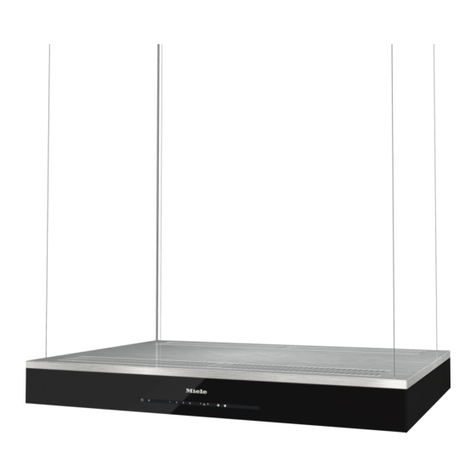
V-ZUG DF-SG5 User manual

Operating instructions
DFSG5/DFSG6/DFSG8/DFSG9
Range hood

Thank you for choosing to buy one of our products. Your appliance is made to
high standards and is easy to use. Nevertheless, please take the time to read
these operating instructions in order to familiarise yourself with the appliance
and get the best use out of it.
Please follow the safety precautions.
Modifications
Text, diagrams and data correspond to the technical standard of the appliance
at the time these operating instructions went to press. The right to make tech-
nical modifications for the purpose of the further development of the appliance
is reserved.
Validity
The product family (model number) corresponds to the first alphanumerics on
the identification plate. These operating instructions apply to:
Type Product family Size system
DFSG5 61017 55
DFSG6 61018 60
DFSG8 61019 82.5
DFSG9 61020 90
Variations depending on the model are noted in the text.
© V-ZUG Ltd, CH-6301 Zug, 2016
2

Contents
1 Safety precautions 4
1.1 Symbols used .............................................................................................4
1.2 General safety precautions ......................................................................5
1.3 Before using for the first time ..................................................................6
1.4 Correct use..................................................................................................6
1.5 Children in the home .................................................................................6
1.6 Note on use.................................................................................................7
2 Disposal 9
3 Your appliance 10
3.1 Appliance description............................................................................. 10
3.2 Extraction model...................................................................................... 10
3.3 Recirculation model ................................................................................ 10
3.4 Equipment................................................................................................. 11
3.5 Construction ............................................................................................. 11
3.6 Operating elements ................................................................................ 12
4 Operating the appliance 13
4.1 Switching the appliance on ................................................................... 13
4.2 Switching the extractor fan on/off ........................................................ 13
4.3 Switching the illumination on/off .......................................................... 14
4.4 Switching the appliance off ................................................................... 14
5 Care and maintenance 15
5.1 Cleaning the housing ............................................................................. 15
5.2 Metal grease filter with integrated long-life activated charcoal filter ....
16
5.3 Replacing the light bulb......................................................................... 18
6 Trouble-shooting 19
6.1 What to do if ............................................................................................ 19
7 Accessories and spare parts 20
8 Technical data 21
9 Index 22
10 Notes 24
11 Service & Support 27
3

1 Safety precautions
1.1 Symbols used
Denotes important safety precautions.
Failure to observe said precautions can result in injury or in dam-
age to the appliance or fittings!
Information and precautions that should be observed.
Information on disposal
Information about the operating instructions
▸ Indicates step-by-step instructions.
–Describes how the appliance reacts to the steps taken.
▪Indicates a list.
4

1 Safety precautions
1.2 General safety precautions
▪Read the operating instructions before using the appliance for
the first time!
▪This appliance can be used by children aged 8 and above
and by persons with reduced physical, sensory or mental cap-
abilities, or lack of experience and/or knowledge, provided
they are supervised or have been instructed on the safe use
of the appliance and have understood the hazards involved.
Children shall not play with the appliance. Cleaning and user
maintenance shall not be undertaken by children without su-
pervision.
▪If an appliance is not equipped with a mains cable and a plug
or other means for disconnecting from the mains with a con-
tact opening on each pole complying with the conditions of
overvoltage category III for full isolation, an isolating device
must be incorporated into the permanently installed electrical
installation in accordance with the installation regulations.
▪If the mains cable of this appliance is damaged, it must be re-
placed by the manufacturer or its Customer Services or a sim-
ilarly qualified person in order to avoid hazard.
5

1 Safety precautions
1.3 Before using for the first time
▪The appliance must be installed and connected to the electricity supply in
accordance with the separate installation instructions. Have a qualified fitter/
electrician carry out the necessary work.
▪Dispose of the packaging material in accordance with local regulations.
1.4 Correct use
▪The appliance is designed for use in the home for extracting cooking
odours from above a cooking area.
▪Any repairs, modifications or manipulations to the appliance, especially any
electrically live parts, may only be carried out by the manufacturer, its Cus-
tomer Services or a similarly qualified person. Repairs if carried out incor-
rectly could cause serious injury or damage to the appliance and fittings as
well as affect the functioning of the appliance. If the appliance is not work-
ing properly or in case of a repair order, follow the instructions given in the
'Service & Support' section. If necessary, please contact our Customer Ser-
vices.
▪Use original spare parts only.
▪Retain these operating instructions for future reference. If you sell the appli-
ance or pass it on to a third party, please ensure these operating instruc-
tions accompany the appliance, together with the instructions on installation.
In this way, the new owner can inform themselves about how to use the ap-
pliance correctly and read the pertinent safety precautions.
1.5 Children in the home
▪Packaging material, e.g. plastic film and polystyrene, can be dangerous for
children. Danger of suffocation! Keep packaging material away from chil-
dren.
▪The appliance is designed for use by adults who are familiar with these op-
erating instructions. Children are often unable to recognize the danger of
electrical appliances. Ensure proper supervision and do not allow children
to play with the appliance – there is a danger that children could hurt them-
selves.
6

1 Safety precautions
1.6 Note on use
▪If the appliance is visibly damaged, do not use it. Contact our Customer
Services.
▪If the appliance is not functioning properly, disconnect it from the power
supply immediately.
▪If the mains cable of the appliance is damaged, it must be replaced by Cus-
tomer Services in order to avoid hazard.
▪Caution: Accessible parts may become hot when used with cooking appli-
ances.
▪Do not flambé food underneath the appliance. Metal grease filters if laden
with grease could catch fire.
▪When frying on the cooking surface, do not leave the appliance unattended.
The cooking oil in the frying appliance could overheat and catch fire. Con-
stantly monitor the temperature of the cooking oil, keeping it below the tem-
perature at which it can catch fire. Change the cooking oil regularly – dirty
oil catches fire more easily than clean oil.
▪Observe the cleaning intervals. Failure to do so can increase the fire hazard
due to the build-up of grease in the metal grease filters.
▪Do not operate the individual cooking zones of the cooking surface without
a pan on them or with an empty pan on them so as to avoid damaging the
appliance or the kitchen fittings through a build-up of heat. Avoid open fires
with oil, gas, wood and coal fired cookers.
▪Ensure there is adequate ventilation when the extractor fan is on so as to
avoid creating a disturbing underpressure in the kitchen and to achieve op-
timal air extraction.
▪Avoid a cross-current of air, which could blow the cooking vapours over the
cooking area.
▪If other appliances – fuelled by gas or other fuels – are being used at the
same time, ensure that there is a sufficient supply of fresh air. This does not
apply to air recirculation appliances.
▪If other firing systems are being used at the same time (e.g. wood, gas, oil
or coal fired heating appliances), safe operation is only possible providing a
room negative pressure of 4Pa (0.04mbar) is not exceeded at the location
of the appliance. Risk of toxic fumes! An adequate flow of fresh air must be
guaranteed e.g. via non-closable openings in doors or windows and in com-
bination with an air-intake/exhaust-air wall box or by other technical means.
7

1 Safety precautions
▪When carrying out maintenance work on the appliance, including replacing
the light bulb, cut off the electricity supply to the appliance: remove the
screw fuse from the holder or switch the circuit breaker off, or disconnect
from the mains supply.
▪When cleaning the appliance make sure no water gets inside the appliance.
Use a moderately damp cloth. Do not spray the inside or outside of the ap-
pliance with water. Do not use a steam cleaner. If water gets inside the ap-
pliance, it can cause damage.
8

2 Disposal
Packaging
▪All packaging materials (cardboard, plastic film (PE) and polystyrene (EPS))
are marked and should, if possible, be collected for recycling and disposed
of in an environmentally friendly way.
Disconnection
▪Disconnect the appliance from the mains. With a fixed appliance, this is to
be carried out by a qualified electrician!
Safety
▪Disable the appliance to prevent accidents caused by improper use, espe-
cially through children playing.
▪Pull the plug out of the mains socket or have the appliance disconnected
from the mains by an electrician. Then cut the mains cable off flush with the
appliance.
Disposal
▪The old appliance should not be discarded as worthless rubbish. If dis-
posed of correctly, the raw materials can be recovered for recycling.
▪The symbol on the identification plate warns that the appliance may not
be disposed of in normal household waste.
▪The appliance must be disposed of in accordance with local regulations on
waste disposal. For more information on the handling, disposal and recyc-
ling of the product, please contact the local authorities, the local recycling
facilities for household waste or the retailer from whom you purchased the
appliance.
9

3 Your appliance
3.1 Appliance description
The appliance is for ventilating a cooking area and is typically built into the
wall unit. This particular model can be used in the extraction mode as well as
in the recirculation mode.
3.2 Extraction model
The integrated fan extracts cooking fumes and smells from above the cooking
surface. The air is cleaned through the grease filter and then fed through the
exhaust air conduit to the outside.
When the appliance is in use, ensure there is a sufficient supply of fresh
air to replace the air that is being extracted.
3.3 Recirculation model
Using an activated charcoal filter in the appliance
After being filtered through the grease filter, the cooking fumes and smells
above the cooking surface are passed through an activated charcoal filter. The
cleaned air is then circulated through the grille – at the top of the appliance –
and back into the room.
Using an air recycling cartridge (LRC)
The appliance extracts the cooking fumes and smells from above the cooking
surface through the grease filter, which removes the grease particles. The air
is then blown via a duct through the air recycling cassette. An activated char-
coal filter in the air recycling cassette removes the cooking fumes and smells.
The cleaned air is then circulated through the outlet grille back into the room.
The activated charcoal filter is more effective at the lower power levels.
10
Other manuals for DF-SG5
2
This manual suits for next models
3
Table of contents
Other V-ZUG Ventilation Hood manuals

V-ZUG
V-ZUG DIE9 User manual

V-ZUG
V-ZUG DWPQ9 User manual

V-ZUG
V-ZUG DIPQG10 User manual

V-ZUG
V-ZUG DI-SMC12 User manual

V-ZUG
V-ZUG DFL5 User manual

V-ZUG
V-ZUG DF-S5 User manual

V-ZUG
V-ZUG AiroClearCabinet V6000 User manual

V-ZUG
V-ZUG DWE9 User manual

V-ZUG
V-ZUG DF-SG5 User manual

V-ZUG
V-ZUG AiroClearWall V4000 User manual

V-ZUG
V-ZUG DI-SMC12 User manual

V-ZUG
V-ZUG DWVMR9 User manual

V-ZUG
V-ZUG DSTS9 User manual

V-ZUG
V-ZUG DW-N9 User manual

V-ZUG
V-ZUG DF5 User manual

V-ZUG
V-ZUG DFPQ5 User manual

V-ZUG
V-ZUG AiroClearCabinet V400 User manual

V-ZUG
V-ZUG GK17TIYSZ User manual

V-ZUG
V-ZUG DSDSR User manual

V-ZUG
V-ZUG DI-SL10 User manual