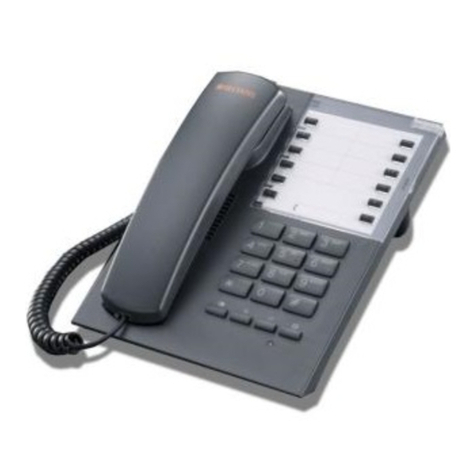
TIPTEL Ergophone C User manual

tiptel
User manual
Ergonomic telephones
Ergophone C
Ergophone CR
(en)

Overview of the operation elements

1
Table of contents
Making telephone calls comfortable.................................... 3
Safety information ................................................................. 4
Operation elements ............................................................... 7
Keys and their functions ..............................................................................7
Slide switches for volume adjustments ........................................................8
Symbols in the display .................................................................................8
Illumination of key pad and display ..............................................................9
Making telephone calls ....................................................... 10
Manual dialling ...........................................................................................10
Dialling with off-line call preparation ..........................................................10
Dialling via speed dialling keys .................................................................. 11
Dialling a number in the phone book .........................................................12
Sending an emergency call .......................................................................12
Manual interruption of an emergency call ..................................................14
Sending an emergency call via pendant ....................................................15
Manual interruption of a distress radio call ................................................16
On-Hook-Dialling .......................................................................................16
Redialling ...................................................................................................16
Automatic redialling ...................................................................................17
Abbreviated dialling ...................................................................................18
Call number chaining (call-by-call function) ...............................................19
Dialling the last telephone number transmitted ........................................19
Ringing signal volume ...............................................................................20
Handset volume .........................................................................................20
Loudspeaker volume .................................................................................21
Listening-in ................................................................................................21

2
Table of contents
Hands-free operation .................................................................................22
Switching between handset and hands-free operation ..............................23
Extended telephone functions ........................................... 24
Dialling via direct call .................................................................................24
Recording of call passages .......................................................................24
Recording of call passages via speed dialling key 5 .................................25
Do-not-disturb function ..............................................................................26
List of released numbers for ringing signals ..............................................26
List of restricted numbers for ringing signals .............................................26
Ringing melody ..........................................................................................27
Incoming call indication by ashlight .........................................................27
Display lightness adjustment .....................................................................27
Call restriction ............................................................................................27
Support for hearing aid users ....................................................................28
Operation with headset ..............................................................................28
Display language .......................................................................................28
Room monitoring .......................................................................................29
Vital sign function ......................................................................................30
Special features by the telephone network provider ..................................30
Appendix .............................................................................. 31
Short operating instructions .......................................................................31
Error messages .........................................................................................33
Cleaning the device ...................................................................................34
Index ..................................................................................... 35

3
Making telephone calls comfortable
Making telephone calls comfortable
This telephone was designed to allow the user a relaxed, comfortable and
easy way to make phone calls.
Clear structure
The large keys, slide switches and display are clearly arranged. Thanks
to the built-in movement detector, the illumination of the key pad and the
display is automatically switched on when e. g. your hand approaches the
device.
Simple operation
The volume of the loudspeaker, ringing signal and handset can be easily
adjusted via slide switches. The function keys are clearly marked.
Safe handling
The handset can easily be replaced and stays on its non-slip rest. You can
make outgoing telephone calls even in the case of a power failure. If re-
quired, an emergency call function can be programmed.
Modern technology
The „call number transfer for incoming calls“ is just one of the outstanding
modern functions provided by this telephone. Quality made in Germany.

4
Safety information
Safety information
Please follow the safety information in the programming instructions on page 5.
Intended use
This telephone is suited to be connected to analogue line interfaces of public
switched telephone networks.
DANGER
- Never try to unscrew the screws and open the device. You
could get in contact with current-carrying parts.
- Never touch the connector contacts with pointed or metallic
objects.
WARNING
The telephone was produced for standard use conditions.
Please do not install the device
- close to heat sources (air-conditioning, heater, exposure to
direct sunlight),
- in humid rooms (no exposure to splashing water or chemi-
cals),
- nearby devices emitting strong magnetic elds (electrical
appliances, uorescent tubes, computers, TV sets),
- in dusty rooms,
- in rooms where the device is exposed to vibrations or extre-
me variations in temperature.
CAUTION
- Never carry the telephone at the handset or the connection
cables.

5
Safety information
- Only plug the connecting cables into the designated recep-
tacles.
- Make sure that the connecting cables are laid in a way that
accidents are prevented.
- If necessary, install additional sockets.
Some furniture lacquers or furniture cleaning products may attack the rubber
at the feet of the telephone and thus cause patches. In such cases, please
use a non-slip pad under the device.
Batteries
DANGER
The batteries are to be used strictly. Batteries should be
replaced as soon as the battery symbol is displayed. For
safety reasons, we recommend to exchange the batteries
once per year as discharged batteries may be subject to
leakage and thus could damage the device. Please dispose
of discharged batteries environmentally (no domestic rub-
bish).
AC adapter
DANGER
Only use the AC adapter from the scope of supply. Make sure
that during operation, the AC adapter is plugged and connec-
ted to the power supply system.
Headset
You may only use and connect headsets that meet the safety requirements
of IEC 60950 item 6.2. (connection to TNV 3 circuits). For more information,
please contact your specialist dealer or headset manufacturer.

6
Safety information
Emergency call function
DANGER
In rare cases, the function of sending out an emergency call
cannot be guaranteed. This might be the case if e. g. the
telephone network fails or if the radio transmission from the
transmitter to the telephone is subject to interference. If the
device is used for people who are in a critical or life-threate-
ning health condition, you should not refrain from additional
safety means.
Wireless pendant (variant with radio emergency function only):
DANGER
If the wireless pendant is worn around the neck by means of
the cord, please consider the following:
• The wireless pendant should only be worn in front of the
upper part of the body and above the clothing. It then
can easily be accessed at any time.
• The cord has been developed and designed to break when
exposed to extra ordinary high mechanical load. Despite of
this, a risk of injury cannot be completely excluded. It is
recommended to wear the wireless pendant around the
wrist when helping laid up persons.
• Only use an original cord to replace a faulty one. Do not try
to repair the cord on your own (e. g. by making a knot).
Wireless pendant and cord should be kept out of reach of
small children.
Take the telephone out of operation
Unplug the AC adapter and the telephone line. Afterwards, take the batteries
out of the battery compartment!

7
Operation elements
Operation elements
Keys and their functions
Loudspeaker key:
- “hands-free operation”: seize line, disconnect line.
- “listen-in function”: activation / deactivation during a call.
- switching between handset and hands-free operation.
Redial key: A call is established to the subscriber number
dialled last.
Programming key: Used to initiate programming steps,
i. e. start and complete the programming.
Recall key e. g. for call transfers if the device is connected
to a telephone system.
Triangular key: Depending on the basic settings, the
handset volume for the current call can be either raised
or lowered.
SOS (emergency call) key (key on the very top): direct
dialling of emergency numbers - if programmed.
# Interrupt emergency call.
Speed dialling key: direct dialling of a stored telephone
number.
. Automatic redialling: If the target subscriber number is
busy, press the keys consecutively and replace the
handset .
Dialling the transferred telephone number of the last
incoming call: press the keys consecutively and pick
up the handset .

8
Operation elements
Dialling a number in the phone book. Press P key and
enter the rst letter of the name. If there are more entries:
Select the desired entry by the arrow keys.
(After pressing the P key, your are able to scroll through all
entries of the phone book).
Recording of call passages: press the P-key. Afterwards
press the triangular key and keep it pressed. Play-back:
press the keys consecutively while the handset is on-hook.
Slide switches for volume adjustments
Ringing signal volume.
Loudspeaker volume.
Handset volume. Please note the section “Handset
volume” on page 20.
Symbols in the display
Automatic redialling active.
Select phone book entry.
R There is an unanswered call. The transferred telephone
number can be displayed.
A programming step is executed.
Listening-in or hands-free mode is active.
Incoming call indication by ashlight is activated.
Other manuals for Ergophone C
1
This manual suits for next models
1
Table of contents
Other TIPTEL Telephone manuals


TIPTEL
TIPTEL 218 User manual

TIPTEL
TIPTEL 85 System S0 User manual

TIPTEL
TIPTEL 83 system User manual

TIPTEL
TIPTEL 114 User manual

TIPTEL
TIPTEL 31xx series User manual

TIPTEL
TIPTEL 3110 User manual

TIPTEL
TIPTEL 172 User manual

TIPTEL
TIPTEL 275 User manual

TIPTEL
TIPTEL Ergophone 1300 User manual

TIPTEL
TIPTEL VP 28 User manual