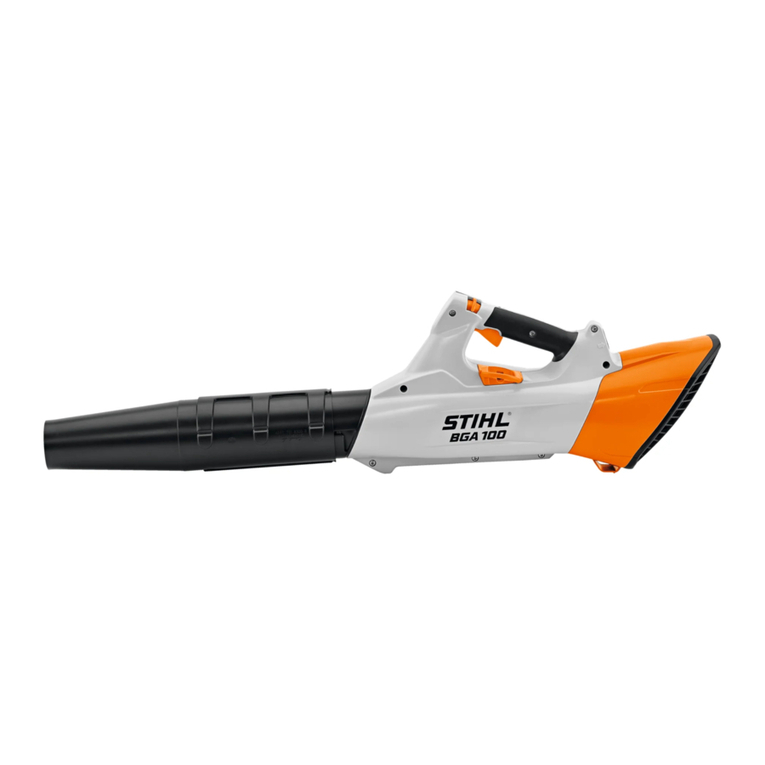
Stihl BGA 85 User manual

STIH)
STIHL BGA 85 2010-11

1BGA 85
q
© ANDREAS STIHL AG & Co. KG, 2011
RA_286_00_01_01
1. Introduction 2
2. Safety Precautions 3
3. Specifications 5
3.1 Motor 5
3.2 Maximum air flow rate 5
3.3 Air velocity 5
3.4 Dimensions 5
3.5 Weight 5
3.6 Tightening Torques 6
4. Troubleshooting 7
4.1 Flowchart 7
4.2 Battery 9
4.3 Machine 10
5. Testing the Battery 11
5.1 Acceptance 11
5.2 Testing with ADG 1
Battery Analyzer 11
6. Blower Housing, 12
6.1 Intake Screen 12
6.2 Blower Housing 12
7. Handle Housing /
Cover 13
7.1 Removing the Handle
Housing 13
7.2 Cover 13
7.3 Locking Levers 14
7.4 Spring 15
7.5 Handle Housing 16
7.6 Trigger Switch
Lockout 17
7.7 Trigger 17
7.8 Retaining Latch 18
8. Blower 19
8.1 Blower Tube 19
8.2 Removing and
Installation
the Blower 19
8.3 Disassembling and
Reassembling
the Blower 20
8.3.1 Disassembling 20
8.3.2 Assembling
the Blower 21
9. Electrical
Components 23
9.1 Testing with ADG 2
Digital Analyzer 23
9.2 Switch 23
9.3 Motor 24
9.4 Electronic Module 24
9.5 Wiring Harness 25
10. Special
Servicing Tools 27

2BGA 85
1. Introduction
This service manual contains
detailed descriptions of all the repair
and servicing procedures specific to
this power tool.
You should make use of the
illustrated parts lists while carrying
out repair work. They show the
installed positions of the individual
components and assemblies.
Refer to the latest edition of the
relevant parts list to check the part
numbers of any replacement parts.
A fault on the machine may have
several causes. To help locate the
fault, consult the chapter on
"Troubleshooting" and the
"STIHL Service Training System"
for all assemblies.
Refer to the “Technical Information”
bulletins for engineering changes
which have been introduced since
publication of this service manual.
Technical information bulletins also
supplement the parts list until a
revised edition is issued.
The special tools mentioned in the
descriptions are listed in the chapter
on "Special Servicing Tools" in this
manual. Use the part numbers to
identify the tools in the
"STIHL Special Tools" manual. The
manual lists all special servicing
tools currently available from
STIHL.
Symbols are included in the text and
pictures for greater clarity.
The meanings are as follows:
In the descriptions:
:= Action to be taken that is
shown in the illustration
(above the text)
– = Action to be taken that is
not shown in the illustration
(above the text)
In the illustrations:
APointer
aDirection of movement
@4.2 = Reference to another
chapter, i.e. chapter 4.2
in this example.
Service manuals and all technical
information bulletins are intended
exclusively for the use of properly
equipped repair shops. They must
not be passed to third parties.
Always use original STIHL
replacement parts.
They can be identified by the STIHL
part number,
the {logo and the
STIHL parts symbol K
This symbol may appear alone on
small parts.
Preparations for servicing
Always switch off the
machine, remove the
battery (2) and set the
retaining latch (1) to ƒ
before carrying out any
repairs or transporting
the machine.
9927RA000 GM
1
2

3BGA 85
2. Safety Precautions
If the power tool is started up in the
course of repairs or maintenance
work, observe all local and country-
specific safety regulations as well
as the safety precautions and
warnings in the instruction manual.
Improper handling may result in
burns or other serious injuries.
Battery
– Use only original STIHL
rechargeable batteries.
– Use STIHL batteries only with
STIHL power tools and recharge
them only with STIHL chargers.
– Charge the battery before use.
– Never use or charge a defective,
damaged or deformed battery.
Do not open or repair, damage or
drop the battery.
– Store the battery out of the reach
of children.
Protect from rain
– do not immerse it in
fluids.
Protect from direct
sunlight, heat and fire –
never throw into a fire
– risk of explosion.
Operate and store the
battery only in a
temperature range
from - 10°C to max.
+ 50°C.
– Never expose the battery to
microwaves or high pressures.
– Never insert objects into the
battery's cooling slots.
– Never bridge the battery
terminals with metallic objects
(short circuit). The battery may be
damaged by a short circuit. Keep
a battery that is not in use away
from metal objects (e.g. nails,
coins, jewelry). Do not use metal
containers for transportation –
risk of explosion and fire.
– Fluid may leak from the battery if
it is damaged or not used
properly – avoid contact with the
skin! Leaking battery fluid can
cause skin irritation and chemical
burns. In the event of accidental
contact, wash affected areas of
skin thoroughly with soap and
water. If fluid gets into your
eye(s), do not rub your eye(s)
and rinse water over the open
eye(s) for 15 minutes at least.
Also seek medical attention.
Charger and battery analyzer
– Use only original STIHL chargers
and STIHL battery analyzer.
– Only use for charging matching
STIHL batteries of type AP with a
maximum capacity of 10 Ah and
a maximum voltage of 42 V.
– Never charge or test defective or
deformed batteries.
– Connect the charger only to a
power supply with the voltage
and frequency specified on the
rating plate.
– Never use a charger with a
damaged housing or damaged
power supply cord.
– Do not open or repair.
– Store out of the reach of children.
Protect from
dampness.
Use and store only
indoors in dry rooms.

4BGA 85
– Operate at ambient temperatures
between + 5°C and + 40°C.
– Do not cover the charger – to
ensure it can cool down normally.
– Never bridge the charger's
contacts with metallic objects
(e.g. nails, coins, jewelry). The
charger may be damaged by a
short circuit.
– In the event of smoke or fire in the
charger, disconnect it from the
wall outlet immediately.
–To reduce the risk of electric
shock or short circuit, do not
insert any objects in the charger's
cooling slots.
– Do not operate the charger on an
easily combustible surface (e.g.
paper, textiles) or in an easily
combustible environment – risk
of fire.
– Do not operate in a hazardous
location, i.e. in a location where
there are combustible liquids
(fumes), vapors or dusts. The
chargers can produce sparks,
which may ignite the dust or
vapors – risk of explosion.
– Never jerk the power supply cord
to disconnect it from the wall
outlet. To unplug, grasp the plug,
not the cord. Have a damaged
power supply cord repaired by an
experienced electrician
– Do not use the power supply cord
for any other purpose, e.g. for
carrying or hanging up the
charger.
– Check the power supply cord and
plug for damage. Never use
damaged cords and plugs or
power supply cords that do not
comply with regulations.
– Position and mark the power
supply cord so that it cannot be
damaged or endanger others
– this helps reduce the risk of
stumbling.
To reduce the risk of electric
shock:
– Always connect the charger to a
properly installed wall outlet.
– Make sure the insulation of the
power supply cord and plug is in
good condition.
Unplug the charger from the wall
outlet when it is not in use.
Check the charger's
power supply cord
regularly for damage. If
the power supply cord
is damaged,
immediately
disconnect the plug
from the power supply
to avoid the risk of
electrocution.
Transporting the cordless blower
Always switch off the machine, set
the retaining latch to ƒand remove
the battery.
Remove the battery
from the machine. This
avoids the risk of the
motor starting
unintentionally.

5BGA 85
3. Specifications
3.1 Motor
BGA 85
Rated current: 16,7 A
Current limit: 70 A
Rated voltage: 36 V
Enclosure EN 60 529: IP 20
Insulation: III
Rated speed: 8,100 rpm
3.2 Maximum air flow rate
with round nozzle: 650 m3/h
with fan nozzle: 715 m3/h
without nozzle: 845 m3/h
3.3 Air velocity
with round nozzle: 46 m/s
with fan nozzle: 45 m/s
3.4 Dimensions
Length: 987 mm
Height: 285 mm
Depth: 167 mm
3.5 Weight
without battery: 3.2 kg

6BGA 85
3.6 Tightening Torques
DG and P (Plastoform) screws are used in polymer and light metal components. These screws form a
permanent thread when they are installed for the first time. They can be removed and installed as often as
necessary without impairing the strength of the screwed assembly, providing the specified tightening torque is
observed.
For this reason it is essential to use a torque wrench.
Fastener Thread size For component Torque
Nm
Remarks
Screw P 5x18 Blower housing, left / right 3,0
Screw P 5x18 Left handle molding / right handle molding 3,0
Screw M 5x10 Ball bearing / motor shaft 6,0 1)
1) Binding head, micro-encapsulated
Use the following procedure when refitting a DG or P screw in an existing thread:
Place the screw in the hole and rotate it counterclockwise until it drops down slightly.
Tighten the screw clockwise to the specified torque.
This procedure ensures that the screw engages properly in the existing thread and does not form a new thread
and weaken the assembly.
Power screwdriver setting for polymer: DG and P screws max. 500 rpm
Do not use an impact wrench for releasing or tightening screws.

7BGA 85
4. Troubleshooting
4.1 Flowchart
Machine does not run or only hums
Check battery for state of charge,
correct installation and external
damage (housing, seal, contacts)
no
yes
Battery
- Charged?
- Properly installed?
- Good condition?
Check light emitting diodes (LEDs)
on the battery
Charge / install
properly / replace.
Machine
runs?
yes
no
LEDs glow or
flash red?
Fault in power
tool, check power
tool
Fault in battery,
check
with ADG 1 and
replace if
necessary
Power tool too hot
– allow power tool
to cool down
Battery too hot /
too cold, allow it
to cool down /
warm up
3 LEDs flash
Machine
runs?
no
yes 4 LEDs flash 3 LEDs glow 1 LED glows
23
yes
no
1

8BGA 85
2 3
1
no
Inspect machine for external damage:
- Blower housing,
- Blower tube
- Controls
- Housing
Machine
damaged?
Use ADG 2 to check electrical
components for
damage and correct operation
and replace if necessary.
yes Replace
damaged
parts
Machine
runs?
yes
no
Machine
runs?
yes
no
Machine in order

9BGA 85
4.2 Battery
Test the battery with the ADG 1 battery analyzer, b5.2.
Condition Cause Remedy
Battery cannot be pushed fully
home
Battery inserted wrong way round,
guide lugs on cover broken
Fit new cover and check contacts.
Battery does not engage when
pushed into the machine
Locking levers defective Fit new locking levers, check
torsion springs and replace if
necessary.
Contacts bent Check contacts, replace wiring
harness or battery as necessary.
Battery remains in same position
after it is unlocked
– battery is not ejected
Spring is bent or broken Check the spring, straighten or
replace if necessary.
Guides / contacts very dirty, battery
jammed
Clean the guides / contacts.
Other manuals for BGA 85
8
Table of contents
Other Stihl Blower manuals