– 7 –
Split Inverter Air-to-Water Heat Pump
Water System
Water System Design
Each SIS Heat Pump has a recommended ow that should be
maintained during all times of operation. For the SIS-060, the
recommendedowis12GPM atwhichthehead lossis 25ftW.C,
11PSI or 73kPa. This head loss value is based upon pure water,
see appendix for multipliers to correct for various concentrations of
anti-freeze solution.
Note:thesearetherecommendedowvalues.Shouldtheowdrop
signicantly below this value, the heat pump will shut down and
showa owerrorcode onthe display.This isnotanindicationof
a fault in the heat pump, but rather points to insufcient pump or
plumbing capacity, or air trapped within the system.
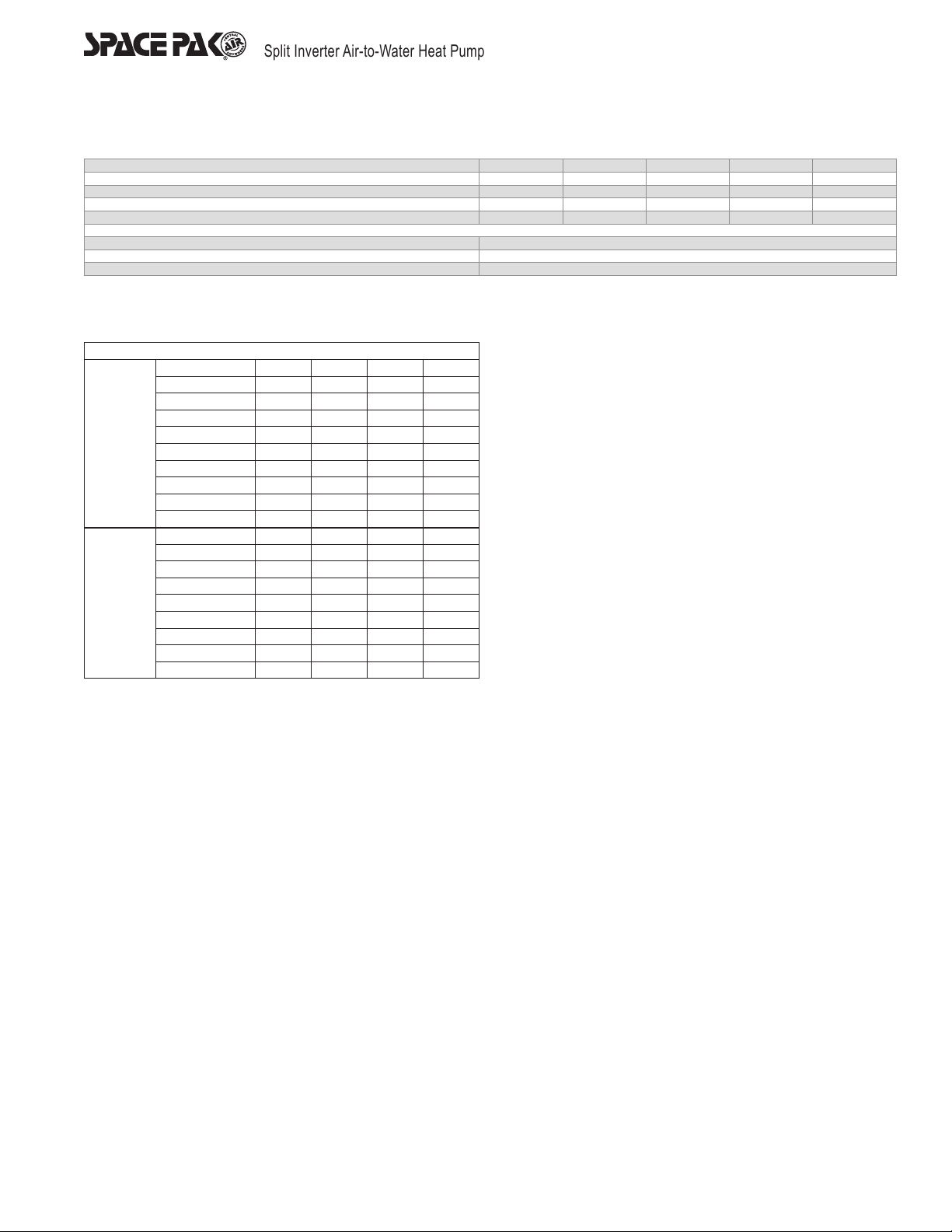
Piping Pressure Losses*
Pressure Drop, Ft H2O/100ft*
Pex
Pipe
Flow Rate GPM 1" 1-1/4" 1-1/2" 2"
6 5.5 1.7 - -
7 7.2 2.5 1.5 -
8 9.1 3.4 1.8 -
9 11.1 4.3 2.1 0.5
10 13.4 5.2 2.4 0.6
11 15.9 6.2 2.8 0.7
12 18.5 7.2 3.2 0.9
14 - 9.4 4.2 1.2
16 - 11.8 5.4 1.6
Copper
Pipe
(Type L)
6 1.0 - - -
7 1.4 0.5 - -
8 1.8 0.7 - -
9 2.2 0.8 0.3 -
10 2.7 1.0 0.4 -
11 3.2 1.2 0.5 0.1
12 3.8 1.4 0.6 0.1
14 - 1.8 0.8 0.2
16 - - 1.0 0.3
*RemembertochecktheCVratingofyourttingsandvalvesto
makesureyou'regettingtherequiredowthroughtheequipment.
Table 2
Table 1 SIS Glycol Concentrations (10% Minimum, 35% Maximum)
PropyleneGlycol(concentrationbyvolume) 10% 20% 25% 30% 35%
Min. temp of burst protection 22°F/-5.6°C 11°F/-11.7°C -1°F/-18.3°C -18°F/-27.8°C -46°F/-43.3°C
Capacity Multiplier 0.99 0.98 0.97 0.96 0.94
PressureDropMultiplier(Cooling) 1.1 1.2 1.27 1.34 1.42
PressureDropMultiplier(Heating) 1.1 1.2 1.27 1.34 1.4
Minimum Expansion Volume/System Volume
Heating and Cooling 1 gallon expansion per 15 gallons system volume
Heatingonly,HPOnly 1 gallon expansion per 20 gallons system volume
Heating Only, with Boiler 1 gallon expansion per 15 gallons system volume
System Volume and Expansion Volume
To ensure smooth temperature control and minimize cycling of
refrigeration system, all installations must have total circulating
volumes equal to or greater than 7.5 gallons per nominal ton of
the unit performance at minimum capacity (The greater of either
heatingorcoolingproduced).Inotherwords,inthecaseofaveton
heat pump with 3 to 1 turndown (0.33x rated capacity) the minimum
total system volume is 5x0.33x7.5=12.5 gal. Multiple heat pump
installationsthatareoperatinginastagedcongurationfollowthe
same rule, so that only a single heat pump tonnage needs to be
considered. Additionally, the system requires an expansion volume
(air) to compensate for the change in volume of the glycol mixture
as it heats and cools, see Table 1 for expansion volume.
A typical multiple heat pump installation may actually have a volume
far greater than the minimum required, and it is this entire volume
thatmustbeconsideredwhensizingtheexpansiontank.
Notethatthenominalexpansiontankvolumeisnotthesameasthe
expansion volume. If the actual air volume is not published, consider
it to be no more than half the nominal volume.
As an example,avetonnominalheatpumpoperatingdown
to 33% capacity, used for both heating and cooling, requires
a minimum of 12.5 gallons of circulated system volume. A 13
gallonbuffertankisselectedforbestoperation.
When the system installation is complete, the total volume
including the heat pump, buffer tank, and all plumbing is 18
gallons.(Note:theexpansiontank,nomatterhowlarge,isnot
considered circulated volume).
According to the chart above, the minimum acceptance volume
oftheexpansiontankmustbeatleast18/15,or1.2gallons.
Iftheacceptancevolumeisnotspecied,assumeitisnogreater
than50%ofthetotaltankvolume.
Therefore in the case of this example, the system would require
aminimumtanksizeof2.4gallons.Asitisunlikelytondthis
specicsize.
Alwaysbesuretoroundup,soatankof3gallonstotalvolume,
or larger, would be appropriate.
Air Separator and Relief Valve
Locateatleastonehighefciencyairseparatorasshowninthe
piping to remove any air from the system. Install appropriately
rated pressure relief valve common to the hydronic system.