
Sony MDR-RF415RK User manual

ES
Wireless Stereo
Headphone System
3-228-914-14(1)
Sony Corporation © 2001 Printed in Korea
MDR-RF415RK
Operating Instructions
Manual de instrucciones
Istruzioni per l’uso
Manual de instruções
IT
PT
GB

2GB
WARNING
To prevent fire or shock hazard, do not
expose the unit to rain or moisture.
To avoid electrical shock, do not open the
cabinet. Refer servicing to qualified
personnel only.
This equipment complies with the essential
requirements of the Directive 1999/5/EC Radio
and Telecommunications Terminal Equipment
Directive.
This product is intended to be used in the
following country:
Italy
Welcome!
Thank you for purchasing the Sony
MDR-RF415RK Wireless Stereo Headphone
System. Before operating the unit, please read
this manual thoroughly and retain it for future
reference.
Some features are:
•Wireless system that allows you to listen to a
program free from the restriction of a cord
•High fidelity sound reproduction
•Acompact transmitter with an AC power
adaptor (supplied) enables simple charging of
the headphone battery. Just by placing the
headphones on the transmitter, headphone
battery can be charged.
•Comfortable Supra-aural headphones with self
adjusting head band
•Automatic ON/OFF function on headphones
to preserve battery power

3GB
Notes on receiving
performance
The system for this equipment utilizes very high
frequency signals in the 400 MHz band so the
receiving performance may deteriorate due to the
surroundings. The following examples illustrate
conditions that may reduce the possible receiving
range or cause interference with reception.
•Inside a building with walls containing steel
beams.
•Area with many steel file cabinets, etc.
•Area with many electrical appliances capable
of generating electromagnetic noise.
•Transmitter is placed on a metal instrument.
•Area facing a roadway.
•Noise or interfering signals exist in the
surroundings due to radio transceivers in
trucks, etc.
•Noise or interfering signals exist in the
surroundings owing to wireless
communication systems installed along
roadways.
Table of contents
Getting started
Unpacking ............................................... 4
Setting up the transmitter ..................... 4
Charging the headphone battery ......... 6
Operating the system
Listening to a program .......................... 7
The effective areas of the transmitter .. 9
Replacing the ear pads .......................... 9
Additional information
Precautions ............................................ 10
Troubleshooting ................................... 10
Specifications ........................................ 11
GB

4GB
DC IN 9V
OFF ON
FILTERNOISE
123
CHANNEL
RBAL
AUDIO IN
NGetting started
Unpacking
Check that you have the following items:
• The headphones
• The transmitter
•AC power adaptor
•Unimatch plug adaptor (stereo mini jack y
stereo phone plug)
• Connecting cord (phono plugs ystereo mini
plug), 1 m
Setting up the
transmitter
1Connect the transmitter to audio/video
equipment. Select one of the hookups
below depending on the jack type:
ATo connect to a headphones jack
Transmitter
Left channel
(white)
Right channel
(red)
Unimatch plug
adaptor
(supplied)
CD Walkman,
MD Walkman,
WALKMAN*,
VCR, etc.
to headphones
jack (stereo
mini jack)
Connecting cord
(supplied)
to AUDIO IN
A jacks
to headphones
jack (stereo
phone jack)
*WALKMAN is a registered trademark of Sony
Corporation.
5GB
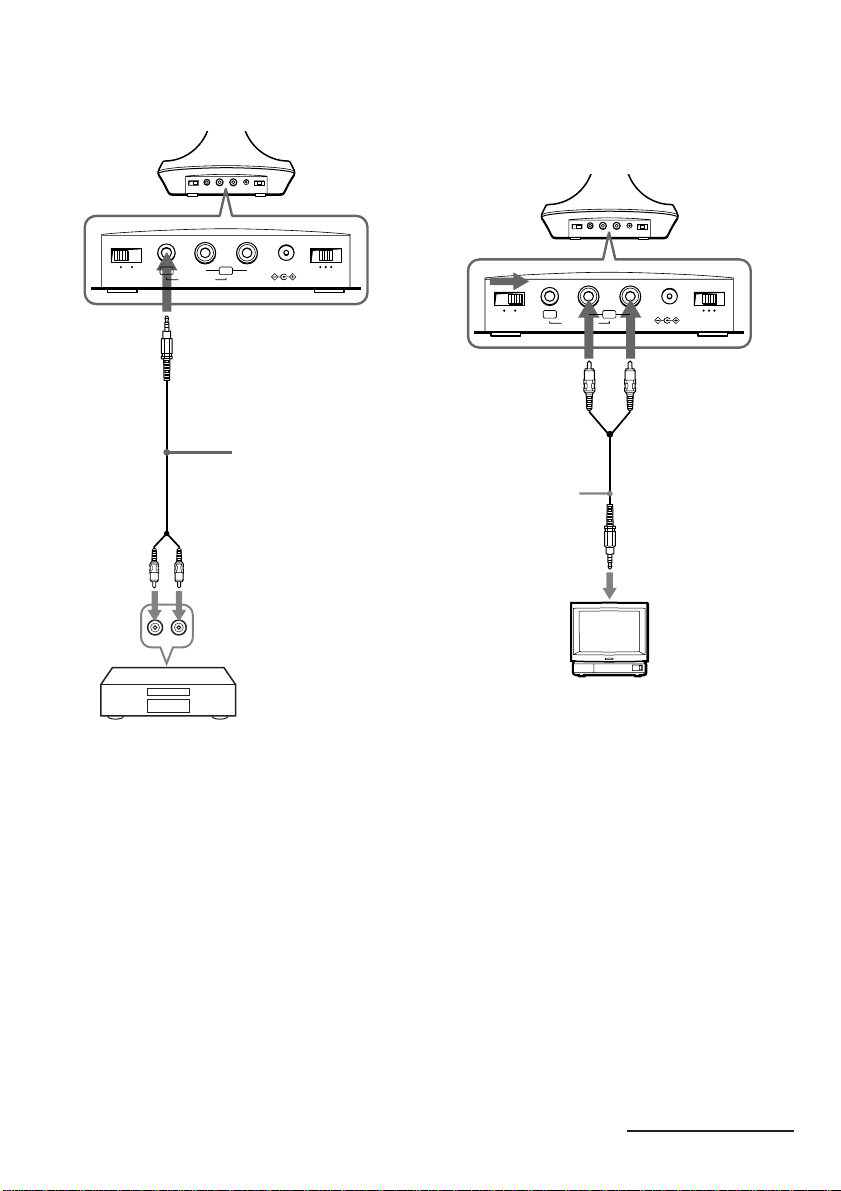
CTo connect to TV, etc.
If noise occurs when the transmitter is
connected to your TV or VCR, set the
NOISE FILTER switch to ON.
Notes
•If you connect the transmitter to LINE OUT or
REC OUT jack of an audio reproducer such as an
MD player or CD player, do not set the NOISE
FILTER switch to ON. Otherwise, the volume will
be limited.
•The NOISE FILTER switch is active only in the
case of the connection shown in diagram Aon
page 4 and C. In diagram B, the switch has no
effect.
•When the transmitter is placed on or near a TV, it
may pick up a noise.
In such case, place the transmitter away from the
TV.
DC IN 9V
OFF ON
FILTERNOISE
123
CHANNEL
RBAL
AUDIO IN
BTo connect to LINE OUT or REC OUT
jacks
Transmitter
to AUDIO IN
B jack
Connecting cord
(supplied)
Right channel
(red)
Left channel
(white)
to LINE OUT or REC
OUT jacks
Stereo system, VCR,
etc.
DC IN 9V
OFF ON
FILTERNOISE
123
CHANNEL
RBAL
AUDIO IN
TV, etc.
to stereo mini jack
to AUDIO IN
A jacks
Right channel
(red) Left channel
(white)
Connecting cord
(supplied)
continue to next page
Transmitter

6GB
Charging the
headphone battery
Using the headphones for the first time
When you use the headphones for the first time,
charge the battery in the following manner.
1Connect the transmitter to a power
source.
Place the headphone on the transmitter such that
the charging pins on the transmitter engage the
charging contacts on the bottom of the right-hand
housing.
The charge indicator on the transmitter will light
in green to indicate that the battery is being
charged.
2Connect the transmitter to an AC outlet
using the supplied AC power adaptor.
Notes
•Use only the supplied AC power adaptor. Do not use
any other AC power adaptor.
Polarity of the plug
•Keep the AC power adaptor cord as far away from the
transmitter as possible. If the cord is positioned near
the transmitter, noise may occur.
•When you connect the transmitter directly to a
monaural earphone jack, the audio signal will not be
output through the right channel. In such a case, use
the separately sold PC-236HG plug adaptor.
•If the connected equipment has the AVLS (Automatic
Volume Limiter System) function, be sure to turn the
function off when using the transmitter. Otherwise,
you will have to turn up the volume of the
headphones, and that may cause noise.
to an AC outlet
To DC IN
9 V jack
AC power adaptor
(supplied)
Transmitter
Continued

7GB
NOperating the system
Listening to a program
1First turn on the audio/video
equipment and start playing.
2Remove the headphones from the
transmitter.
The transmitter’s power indicator will
light in red.
3Select the radio frequency with the
CHANNEL selector switch.
123
CHANNEL
To recharge the headphone battery after
use
Since little electric current is used for charging,
there is no need to worry about overcharging.
Charging and using hours
*at 1 kHz, 1 mW + 1 mW output
** The hours required to fully charge empty batteries
Approx. charging
hours
1
24**
Approx. using time*
55 minutes
23 hours
continue to next page

8GB
4When you put on the headphones the
headphone power turns on
automatically.
5Turn up the volume to a moderate level
with the VOL control, then tune the
headphones in to the frequency of the
transmitter with the TUNING control
until you can hear the audio signal
loud and clear.
Try the above steps 3 and 5 until the
receiving performance becomes better.
TUNING
control
VOL control
Sending RF signals from the Transmitter
The transmitter starts sending the RF signals
automatically, when it detects audio signals from
the equipment connected.
If it does not detect an audio signal for more than
approximately four minutes, the transmitter will
stop sending RF signals, and the power indicator
turns off.
When the transmitter receives an audio signal
again, it starts sending the RF signals, and the
power indicator will light in red again.
If the audio signal is very weak, the transmitter
does not send RF signals. If the transmitter is
connected to a headphone jack, make sure the
volume of the equipment connected is set to 5 – 6
or higher.
You may not hear the beginning of the sound
from the headphones until the transmitter starts
sending the RF signals after detecting an audio
signal.
Auto power on/off function
When you remove the headphones from your
head, the power turns off automatically. Do not
allow the self adjusting band to be pulled up,
otherwise the headphones will be switched on.
The power turns on.
Note
If a hissing noise is heard, move closer to the
transmitter.
Continued

9GB
Replacing the ear pads
When the ear pads become dirty or damaged,
you can get replacements from your Sony dealer.
Replace them as illustrated below.
1Remove the old ear pad by pulling it
out of the groove on the housing.
2Place the new ear pad on the driver
unit and insert the edge of the pad into
the groove as illustrated.
Make sure that the entire edge of the ear pad is
securely inserted into the groove.
The effective areas of
the transmitter
The optimum distance is up to approximately
100 m without the system picking up some
interference. However, the distance may vary
according to the surroundings and environment.
If the system picks up some noise while using it
within the above mentioned distance, reduce the
distance between the transmitter unit and the
headphones, or select the other channel.
Notes
•When you use the headphones inside the effective
areas of the transmitter, the transmitter can be placed
in any direction from the listener.
• Even within the signal reception area, there are some
spots (dead spot) where the RF signal can not be
received. This characteristics is inherent to RF signals,
and does not indicate malfunction. By slightly moving
the transmitter, location of the dead spot can be
changed.

10GB
NAdditional information
Precautions
•When the transmitter is not to be used for a
long period of time, disconnect the AC power
adaptor from the AC outlet holding the plug.
Do not pull on the cord.
•Do not leave the wireless stereo headphone
system in a location subject to direct sunlight,
heat or moisture.
Notes on headphones
Preventing hearing damage
Avoid using headphones at high volume.
Hearing experts advise against continuous, loud
and extended play. If you experience a ringing in
your ears, reduce the volume or discontinue use.
Caring for others
Keep the volume at a moderate level. This will
allow you to hear outside sounds and to be
considerate to the people around you.
If you have any questions or problems
concerning the system that are not covered in this
manual, please consult the nearest Sony dealer.
Be sure to bring the headphones and the
transmitter to the Sony dealer when requiring
repair work.
Disposing of the headphones
Be sure to remove the built-in rechargeable
batteries from the headphones before you
dispose of the headphones.
First remove the left headphone’s ear pad.
You will see six screws. Remove the six
screws and open the housing.
Problem
No sound/
Muffled
sound
Solution
Check the connection of the audio/
video equipment or the AC power
adaptor.
Check that the audio/video
equipment is turned on.
Turn up the volume on the connected
audio/video equipment, if the
transmitter is connected to the
headphones jack.
Change the radio frequency with the
CHANNEL selector on the
transmitter, then tune the headphones
with the TUNING control.
The mute function is activated.
Use the headphones near the
transmitter.
The headphones’ POWER indicator
light is weak or turned off.
•Charge the built-in rechargeable
battery or if the POWER indicator is
still off after charging the built-
in rechargeable battery, take the
headphones to a Sony dealer for
replacement of the rechargeable
battery.
If you connect the transmitter to the
LINE OUT or REC OUT jack of an
audio reproducer, make sure that the
NOISE FILTER switch is set to OFF.
Make sure that the NOISE FILTER
switch is set to either ON or OFF (If
the switch gets stuck between ON and
OFF, the sound will be cut off).
Troubleshooting
Table of contents
Languages:
Other Sony Headphones manuals

Sony
Sony MDR-NC8 User manual

Sony
Sony MDR-EX51LP User manual

Sony
Sony MDR-IF0140 User manual

Sony
Sony Giiq MDR-PQ2/GRN User manual

Sony
Sony WH-1000XM3 Instruction Manual

Sony
Sony MDR-7510 User manual

Sony
Sony MDR-AS200 User manual

Sony
Sony MDR-NC32NX User manual

Sony
Sony MDR-IF230RK User manual

Sony
Sony DR-EX14VP Installation instructions manual

Sony
Sony MDR-EX85LP User manual

Sony
Sony XBA-BT75 Operating instructions

Sony
Sony MDR-EX70LP User manual

Sony
Sony MDR-EX310LP User manual

Sony
Sony MDR-EX1000 User manual

Sony
Sony Street Style MDR-G75LW User manual

Sony
Sony MDR-ED12LP User manual

Sony
Sony MDR-EX38iP User manual

Sony
Sony MDR-E9LP User manual

Sony
Sony DR BT22iK - Headphones - Semi-open User manual


