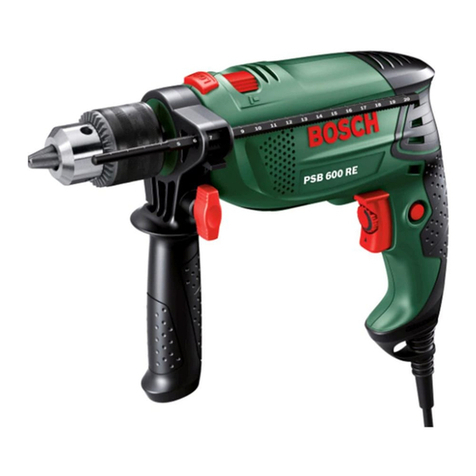
Skil 6355 User manual

SKIL Europe BV - Konijnenberg 60 09/04 2609000168
4825 BD Breda - The Netherlands
HAMMER DRILL
6355 (F0156355 . . )
6365 (F0156365 . . )
6380 (F0156380 . . )
6382 (F0156382 . . )
6385 (F0156385 . . )
6390 (F0156390 . . )
www.skileurope.com
www.skileurope.com
INSTRUCTIONS page 7
INSTRUCTIONS page 9
HINWEISE Seite 11
INSTRUCTIES bladz. 13
INSTRUKTIONER sida 16
INSTRUKTION side 18
ANVISNING side 20
OHJEET sivu 22
INSTRUCCIONES pág. 24
INSTRUÇÕES pág. 27
ISTRUZIONI pag. 29
LEÍRÁS oldal 31
POKYNY strana 34
KILAVUZ sayfa 36
INSTRUKCJA strona 38
ИНСТРУКЦИИ страница 41
ІНСТРУКЦІЯ страница 43
O∆ΗΓΙΕΣ σελιδα 46
INSTRUCØIUNI pagina 49
YKA3AНИЕ страница 51
POKYNY strana 54
UPUTE stranica 56
UPUTSTVA stranica 58
NAVODILA stran 60
KASUTUSJUHEND lehekülg 63
INSTRUKCJIA lappuse 65
INSTRUKCJIA puslapis 67
GB
F
D
NL
S
DK
N
FIN
E
P
I
H
CZ
TR
PL
RU
UA
GR
RO
BG
SK
HR
SCG
SLO
EST
LV
LT
ME77

2
6355 6365 6380 6382 6385 6390
500W 500W 550W 550W 580W 600W
1,5 kg 1,5 kg 1,5 kg 1,5 kg 1,6 kg 1,6 kg
3000
1
0-3000
0-3000
0-3000
0-3000
A
B
C
D
E
(6365/6380)
(6380)
2
DF
E
A
B
C
3
6355/6365/6380 6385
48000
p/min
0-48000
p/min
0-48000
p/min
0-48000
p/min
0-48000
p/min
0-3000
0-48000
p/min

3
D
E
A
B
C
4
6382
6
8
7
9
6365/6380/6382/6385/6390 6365/6380/6382/6385/6390
D
E
G
A
B
C
H
5
6390

4
!@
$
#
6355/6365/6380 6385 6382/6390
6380/6382/6385/6390
0
6365/6380/6382/6385/6390

5
%
^
6380/6382/6385/6390 6355/6365

6
* (
TEN NIS
) ¡
(HSS) ø5, 6, 8 mm ø5, 6, 8 mm ø5, 6, 8 mm
In Deutschland
nicht lieferbar
2610389146
2610073400
2610389145
Magnetic
ACCESSORIES PHILLIPS Nr 1, 2
POZIDRIV Nr 1, 2
M4, M5
+
++
&PHILLIPS
POZIDRIV
SLOTTED
HSS

Hammer drill
6355/6365/6380/6382/6385/6390
INTRODUCTION
●This tool is intended for hammer drilling in brick,
concrete and stone as well as for drilling in wood, metal,
ceramic and plastic; tools with electronic speed control
and left/right rotation are also suitable for screwdriving
and thread cutting
TECHNICAL SPECIFICATIONS 1
OPERATING CONTROLS 2345
ASwitch for on/off and speed control
BButton for switch locking
CSwitch for changing direction of rotation
DSwitch for selecting drilling function
EAuxiliary handle
FClic-system for changing bits
GSpot light
HSensor for spotlight
SAFETY
GENERAL SAFETY INSTRUCTIONS
WARNING! Read all instructions. Failure to follow all
instructions listed below may result in electric shock, fire
and/or serious injury. The term "power tool" in all of the
warnings listed below refers to your mains operated
(corded) power tool.
1) WORK AREA
a) Keep work area clean and well lit. Cluttered and dark
areas invite accidents.
b) Do not operate power tools in explosive
atmospheres, such as in the presence of flammable
liquids, gases or dust. Power tools create sparks
which may ignite the dust or fumes.
c) Keep children and bystanders away while operating
a power tool. Distractions can cause you to lose
control.
2) ELECTRICAL SAFETY
a) Power tool plugs must match the outlet. Never
modify the plug in any way. Do not use any adapter
plugs with earthed (grounded) power tools.
Unmodified plugs and matching outlets will reduce risk
of electric shock.
b) Avoid body contact with earthed or grounded
surfaces such as pipes, radiators, ranges and
refrigerators. There is an increased risk of electric
shock if your body is earthed or grounded.
c) Do not expose power tools to rain or wet conditions.
Water entering a power tool will increase the risk of
electric shock.
d) Do not abuse the cord. Never use the cord for
carrying, pulling or unplugging the power tool. Keep
cord away from heat, oil, sharp edges or moving
parts. Damaged or entangled cords increase the risk of
electric shock.
e) When operating a power tool outdoors, use an
extension cord suitable for outdoor use. Use of a
cord suitable for outdoor use reduces the risk of electric
shock.
3) PERSONAL SAFETY
a) Stay alert, watch what you are doing and use
common sense when operating a power tool. Do not
use a power tool while you are tired or under the
influence of drugs, alcohol or medication. A moment
of inattention while operating power tools may result in
serious personal injury.
b) Use safety equipment. Always wear eye protection.
Safety equipment such as dust mask, non-skid safety
shoes, hard hat, or hearing protection used for
appropriate conditions will reduce personal injuries.
c) Avoid accidental starting. Ensure the switch is in the
off position before plugging in. Carrying power tools
with your finger on the switch or plugging in power tools
that have the switch on invites accidents.
d) Remove any adjusting key or wrench before turning
the power tool on. A wrench or a key left attached to a
rotating part of the power tool may result in personal
injury.
e) Do not overreach. Keep proper footing and balance
at all times. This enables better control of the power
tool in unexpected situations.
f) Dress properly. Do not wear loose clothing or
jewellery. Keep your hair, clothing and gloves away
from moving parts. Loose clothes, jewellery or long
hair can be caught in moving parts.
g) If devices are provided for the connection of dust
extraction and collection facilities, ensure these are
connected and properly used. Use of these devices
can reduce dust related hazards.
4) POWER TOOL USE AND CARE
a) Do not force the power tool. Use the correct power
tool for your application. The correct power tool will do
the job better and safer at the rate for which it was
designed.
b) Do not use the power tool if the switch does not turn
it on and off. Any power tool that cannot be controlled
with the switch is dangerous and must be repaired.
c) Disconnect the plug from the power source before
making any adjustments, changing accessories, or
storing power tools. Such preventive safety measures
reduce the risk of starting the power tool accidentally.
d) Store idle power tools out of the reach of children
and do not allow persons unfamiliar with the power
tool or these instructions to operate the power tool.
Power tools are dangerous in the hands of untrained
users.
GB
7

e) Maintain power tools. Check for misalignment or
binding of moving parts, breakage of parts and any
other condition that may affect the power tools
operation. If damaged, have the power tool repaired
before use. Many accidents are caused by poorly
maintained power tools.
f) Keep cutting tools sharp and clean. Properly
maintained cutting tools with sharp cutting edges are
less likely to bind and are easier to control.
g) Use the power tool, accessories and tool bits etc., in
accordance with these instructions and in the
manner intended for the particular type of power
tool, taking into account the working conditions and
the work to be performed. Use of the power tool for
operations different from those intended could result in a
hazardous situation.
5) SERVICE
a) Have your power tool serviced by a qualified repair
person using only identical replacement parts. This
will ensure that the safety of the power tool is
maintained.
SAFETY INSTRUCTIONS FOR HAMMER DRILLS
●Wear ear protectors with hammer drills (exposure to
noise can cause hearing loss)
●Use auxiliary handles supplied with the tool (loss of
control can cause personal injury)
●Read and save this instruction manual
●Avoid damage that can be caused by screws, nails and
other elements in your workpiece; remove them before
you start working
●Always keep the cord away from moving parts of the tool
●When you put away the tool, switch off the motor and
ensure that all moving parts have come to a complete
standstill
●Use completely unrolled and safe extension cords with a
capacity of 16 Amps (UK 13 Amps)
●In case of electrical or mechanical malfunction,
immediately switch off the tool and disconnect the plug
●SKIL can assure flawless functioning of the tool only
when original accessories are used
●Use only accessories with an allowable speed matching
at least the highest no-load speed of the tool
●This tool should not be used by people under the age of
16 years
●Be careful not to drill or drive into areas where electrical
wires may be contacted
●If the cord is damaged or cut through while working, do
not touch the cord, but immediately disconnect the plug
●Never use tool when cord is damaged; have it replaced
by a qualified person
●Always check that the supply voltage is the same as the
voltage indicated on the nameplate of the tool (tools with
a rating of 230V or 240V can also be connected to a
220V supply)
●If the drill bit becomes unexpectedly jammed (causing a
sudden, dangerous reaction), immediately switch off the
tool
●Be aware of the forces that occur as a result of jamming
(especially when drilling metals); always hold the tool
firmly with both hands and take a secure stance
●Always disconnect plug from power source before
making any adjustment or changing any accessory
WHEN CONNECTING NEW 3-PIN PLUG (U.K. ONLY):
●Do not connect the blue (= neutral) or brown (= live) wire
in the cord of this tool to the earth terminal of the plug
●If for any reason the old plug is cut off the cord of this
tool, it must be disposed of safely and not left
unattended
USE
●On/Off 6
●Switch locking for continuous use 7
●Speed control for smooth starting 8
●Changing direction of rotation 9
-when not properly set in left/right position, switch A
cannot be activated
!change direction of rotation only when tool is at a
complete standstill
●Normal drilling/screwdriving versus hammer drilling 0
!select drilling function only when tool is switched
off
●Changing bits !@#
-insert the bit as deep as possible in the chuck
!do not use bits with a damaged shank
●Adjusting drilling depth $
●Spot light G (6390) %
●Holding and guiding the tool ^
!always use auxiliary handle (can be adjusted as
illustrated)
-keep the ventilation slots uncovered
-do not apply too much pressure on the tool; let the
tool do the work for you
APPLICATION ADVICE
●Use the appropriate bits &
!only use sharp bits
●For drilling in concrete or stone a steady pressure on the
drill is required
●When drilling ferrous metals
-pre-drill a smaller hole, when a large hole is required
-lubricate drill bit occasionally with oil
●When turning in a screw at/near the cross cut end or an
edge of wood, pre-drill a hole in order to avoid cracking
of the wood
●Splinterfree drilling in wood *
●Dustfree drilling in walls (
●Dustfree drilling in ceilings )
●Drilling in tiles without skidding ¡
●For more tips see www.skileurope.com
GUARANTEE / ENVIRONMENT
●Always keep tool and cord clean (especially the
ventilation slots)
!disconnect the plug before cleaning
8

●This SKIL product is guaranteed in accordance with
statutory/country-specific regulations; damage due to
normal wear and tear, overload or improper handling will
be excluded from the guarantee (spotlight G (6390) is
also excluded from the guarantee)
●In case of a complaint, send the tool undismantled
together with proof of purchase to your dealer or the
nearest SKIL service station (addresses as well as the
service diagram of the tool are listed on
www.skileurope.com)
●Dispose of the tool by sorting tool, accessories and
packaging for environment-friendly recycling (the plastic
components are labeled for categorized recycling)
Perceuse à percussion
6355/6365/6380/6382/6385/6390
INTRODUCTION
●L’outil est conçu pour les travaux de perçage en frappe
dans la brique, le béton et dans la pierre naturelle ainsi
que le perçage dans le bois, le métal, la céramique et
les matières plastiques; les outils avec réglage
électronique de la vitesse et rotation à droite/à gauche
sont également appropiés pour le vissage et le filetage
SPECIFICATIONS TECHNIQUES 1
ELEMENTS DE SERVICE 2345
AInterrupteur pour mise en marche/arrêt et réglage de la
vitesse
BBouton de blocage de l’interrupteur
CCommutateur pour inverser le sens de rotation
DCommutateur pour sélectionner la fonction de perçage
EPoignée auxiliaire
FSystème-Clic pour changer des forets
GEclairage
HCapteur pour éclairage
SECURITE
INSTRUCTIONS GENERALES DE SECURITE
ATTENTION! Lisez toutes les instructions. Le non-
respect des instructions indiquées ci-après peut entraîner
un choc électrique, un incendie et/ou de graves blessures
sur les personnes. La notion d’«outil électroportatif»
mentionnée par la suite se rapporte à des outils électriques
raccordés au secteur (avec câble de raccordement).
1) PLACE DE TRAVAIL
a) Maintenez l’endroit de travail propre et bien éclairé.
Un lieu de travail en désordre ou mal éclairé augmente
le risque d’accidents.
b) N’utilisez pas l’appareil dans un environnement
présentant des risques d’explosion et où se
trouvent des liquides, des gaz ou poussières
inflammables. Les outils électroportatifs génèrent des
étincelles risquant d’enflammer les poussières ou les
vapeurs.
c) Tenez les enfants et autres personnes éloignés
durant l’utilisation de l’outil électroportatif. En cas
d’inattention vous risquez de perdre le contrôle sur
l’appareil.
2) SECURITE RELATIVE AU SYSTEME ELECTRIQUE
a) La fiche de secteur de l’outil électroportatif doit être
appropriée à la prise de courant. Ne modifiez en
aucun cas la fiche. N’utilisez pas de fiches
d’adaptateur avec des appareils avec mise à la terre.
Les fiches non modifiées et les prises de courant
appropriées réduisent le risque de choc électrique.
b) Evitez le contact physique avec des surfaces mises
à la terre tels que tuyaux, radiateurs, fours et
réfrigérateurs. Il y a un risque élevé de choc électrique
au cas où votre corps serait relié à la terre.
c) N’exposez pas l’outil électroportatif à la pluie ou à
l’humidité. La pénétration d’eau dans un outil
électroportatif augmente le risque d’un choc électrique.
d) N’utilisez pas le câble à d’autres fins que celles
prévues, n’utilisez pas le câble pour porter l’appareil
ou pour l’accrocher ou encore pour le débrancher
de la prise de courant. Maintenez le câble éloigné
des sources de chaleur, des parties grasses, des
bords tranchants ou des parties de l’appareil en
rotation. Un câble endommagé ou torsadé augmente le
risque d’un choc électrique.
e) Au cas où vous utiliseriez l’outil électroportatif à
l’extérieur, utilisez une rallonge autorisée
homologuée pour les applications extérieures.
L’utilisation d’une rallonge électrique homologuée pour
les applications extérieures réduit le risque d’un choc
électrique.
3) SECURITE DES PERSONNES
a) Restez vigilant, surveillez ce que vous faites. Faites
preuve de bon en utilisant l’outil électroportatif.
N’utilisez pas l’appareil lorsque vous êtes fatigué ou
après avoir consommé de l’alcool, des drogues ou
avoir pris des médicaments. Un moment d’inattention
lors de l’utilisation de l’appareil peut entraîner de graves
blessures sur les personnes.
b) Portez des équipements de protection. Portez
toujours des lunettes de protection. Le fait de porter
des équipements de protection personnels tels que
masque anti-poussières, chaussures de sécurité
antidérapantes, casque de protection ou protection
acoustique suivant le travail à effectuer, réduit le risque
de blessures.
c) Evitez une mise en service par mégarde. Assurez-
vous que l’interrupteur est effectivement en position
d’arrêt avant de retirer la fiche de la prise de
courant. Le fait de porter l’appareil avec le doigt sur
l’interrupteur ou de brancher l’appareil sur la source de
courant lorsque l’interrupteur est en position de
fonctionnement, peut entraîner des accidents.
F
9

d) Enlevez tout outil de réglage ou toute clé avant de
mettre l’appareil en fonctionnement. Une clé ou un
outil se trouvant sur une partie en rotation peut causer
des blessures.
e) Ne surestimez pas vos capacités. Veillez à garder
toujours une position stable et équilibrée. Ceci vous
permet de mieux contrôler l’appareil dans des situations
inattendues.
f) Portez des vêtements appropriés. Ne portez pas de
vêtements amples ni de bijoux. Maintenez cheveux,
vêtements et gants éloignés des parties de l’appareil
en rotation. Des vêtements amples, des bijoux ou des
cheveux longs peuvent être happés par des pièces en
mouvement.
g) Si des dispositifs servant à aspirer ou à recueillir les
poussières doivent être utilisés, vérifiez que ceux-ci
soient effectivement raccordés et qu’ils sont
correctement utilisés. L’utilisation de tels dispositifs
réduit les dangers dus aux poussières.
4) UTILISATION ET EMPLOI SOIGNEUX DE L’OUTIL
ELECTROPORTATIF
a) Ne surchargez pas l’appareil. Utilisez l’outil
électroportatif approprié au travail à effectuer. Avec
l’outil électroportatif approprié, vous travaillerez mieux et
avec plus de sécurité à la vitesse pour laquelle il est
prévu.
b) N’utilisez pas un outil électroportatif dont
l’interrupteur est défectueux. Un outil électroportatif
qui ne peut plus être mis en ou hors fonctionnement est
dangereux et doit être réparé.
c) Retirez la fiche de la prise de courant avant
d’effectuer des réglages sur l’appareil, de changer
les accessoires, ou de ranger l’appareil. Cette
mesure de précaution empêche une mise en
fonctionnement par mégarde.
d) Gardez les outils électroportatifs non utilisés hors
de portée des enfants. Ne permettez pas l’utilisation
de l’appareil à des personnes qui ne se sont pas
familiarisées avec celui-ci ou qui n’ont pas lu ces
instructions. Les outils électroportatifs sont dangereux
lorsqu’ils sont utilisés par des personnes non initiées.
e) Prenez soin des outils électroportatifs. Vérifiez que
les parties en mouvement fonctionnent
correctement et qu’elles ne soient pas coincées, et
contrôlez si des parties sont cassées ou
endommagées de telle sorte que le bon
fonctionnement de l’appareil s’en trouve entravé.
Faites réparer les parties endommagées avant
d’utiliser l’appareil. De nombreux accidents sont dus à
des outils électroportatifs mal entretenus.
f) Maintenez les outils de coupe aiguisés et propres.
Des outils soigneusement entretenus avec des bords
tranchants bien aiguisés se coincent moins souvent et
peuvent être guidés plus facilement.
g) Utilisez les outils électroportatifs, les accessoires, les
outils à monter etc. conformément à ces instructions
et aux prescriptions en vigueur pour ce type
d’appareil. Tenez compte également des conditions
de travail et du travail à effectuer. L’utilisation des outils
électroportatifs à d’autres fins que celles prévues peut
entraîner des situations dangereuses.
5) SERVICE
a) Ne faites réparer votre outil électroportatif que par
un personnel qualifié et seulement avec des pièces
de rechange d’origine. Ceci permet d’assurer la
sécurité de l’appareil.
INSTRUCTIONS DE SECURITE POUR PERCEUSES
A PERCUSSION
●Munissez-vous de casques anti-bruit en utilisant des
perceuses à percussion (l'exposition au bruit peut
entraîner la perte d'audition)
●Utilisez les poignées auxiliaires livrées avec l'outil
(la perte de contrôle peut entraîner des blessures)
●Lisez et conservez ce manuel d'instruction
●Faites attention aux vis, clous ou autres éléments qui
pourraient se trouver dans la pièce à travailler et qui
risqueraient d’endommager très fortement votre outil;
d'abord les enlever puis travailler
●Gardez toujours le câble éloigné des parties mobiles de
votre outil
●Lorsque vous rangez votre outil, le moteur doit être
coupé et les pièces mobiles complètement arrêtées
●Utilisez un câble de prolongement complètement
déroulé et de bonne qualité d'une capacité de 16 A
●En cas d’anomalie électrique ou mécanique, coupez
immédiatement l’outil et débranchez la prise
●SKIL ne peut se porter garant du bon fonctionnement de
cet outil que s’il a été utilisé avec les accessoires
d’origine
●La vitesse admissible des accessoires utilisées doit être
au moins aussi élevée que la vitesse à vide maximale
de l’outil
●Cet outil ne doit pas être utilisé par des personnes en
dessous de 16 ans
●Veillez à ne pas percer ni visser dans des endroits où
vous risqueriez de toucher des fils électriques
●Si le câble est endommagé ou rompu pendant le travail,
ne pas y touchez, mais immédiatement débranchez la
prise
●N'utilisez jamais d'outil avec un câble endommagé;
faites-le remplacer par un technicien qualifié
●Toujours contrôlez si la tension secteur correspond à la
tension indiquée sur la plaquette signalétique de l’outil
(les outils conçus pour une tension de 230V ou 240V
peuvent également être branchés sur 220V)
●En cas de blocage de la mèche (générant une
contre-réaction violente et dangereuse), éteignez
immédiatement l’outil
●Assurez-vous des forces en jeu consécutives au
blocage (spécialement durant le perçage des métaux);
toujours tenez l'outil fermement dans les deux mains et
adoptez une position de travail stable et sûre
●Toujours débranchez l’outil avec tout réglage ou
changement d’accessoire
UTILISATION
●Marche/arrêt 6
●Blocage de l’interrupteur pour marche continue 7
●Réglage de la vitesse pour démarrage doux 8
10

This manual suits for next models
5
Table of contents
Languages:
Other Skil Drill manuals