9
Installation
Your battery can be installed in any orientation, including on its side. If installing
in a vehicle, then it is crucial that the battery is securely fixed down so it cannot
slide while the vehicle is moving. It must also be accessible so it can be removed
or disconnected in an emergency. We recommend having tools readily available
including cable cutters and a socket wrench of the correct size.
You should install the battery in a way that avoids exposing it to extreme hot or cold
temperatures and facilitates an even temperature distribution across the whole
battery pack. If installing the battery on the floor of a vehicle, you should fit insulation
and/or an air gap between it and the floor’s surface as this will prevent cold bridging
from the metal sub-floor.
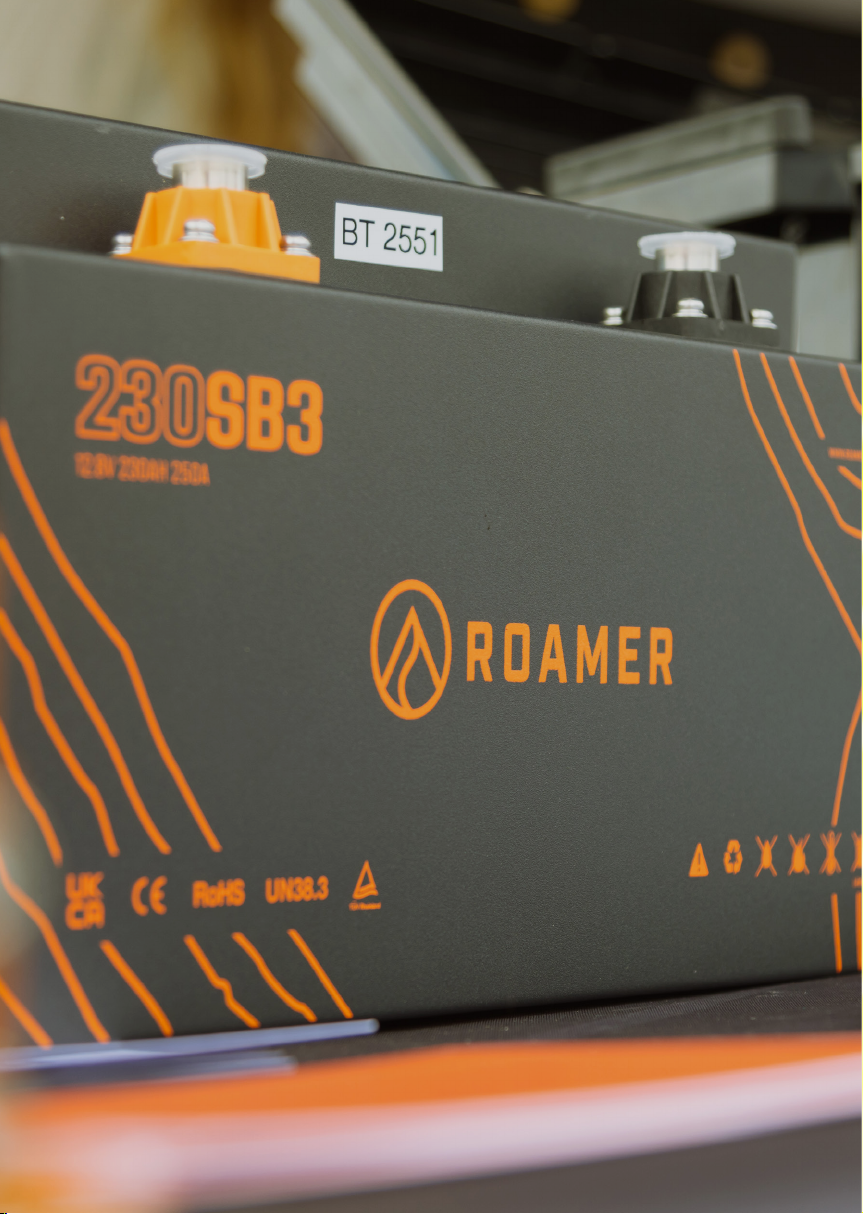
Your battery comes supplied with M8 bolts, flat washers, and spring washers. You
should therefore terminate your battery cables with copper tube ring terminals with
an 8mm hole. The cable terminal should be placed flat, directly onto the battery
terminal. Next place the flat washer, then the spring washer, then feed the bolt
through this stack. The bolts should be tightened to a torque setting of 10Nm. Loose
connections can introduce contact resistance which will cause the termination to heat
up during high current flow. This is a serious fire risk and must be done correctly. If
you are upgrading from a lead acid battery with clamp posts, we recommend re-
terminating your cables as described above, instead of fitting screw-in battery posts.
These are not appropriate for the high current flow possible with your Roamer battery.
You should only have one main cable connected to each battery terminal bolt. If
you have multiple chargers and other components to connect, then you should use
busbars or a distribution system. Too many cable connections on one bolt adds
excessive resistance, which under high current flow can become extremely hot. You
should ensure that this risk is minimised by only installing one ring terminal on a
single stud or terminal. Shifting any complex connection points away from the battery
reduce the risk of starting a battery fire.
Be very careful not to short-circuit the positive and negative terminals. The resulting
current surge could cause damage to the battery and any external components it
flows through. Double check the polarity of the battery and any equipment before
connecting them. Connecting a battery the wrong way around can cause irreparable
damage to the battery and any components connected to it.