JOKER 6
2.2 STARTING TO USE YOUR WHEELCHAIR
Finding the centre of gravity - the point at which the wheelchair will tip back
Your ability to control and safely tip the wheelchair depends mainly on your
seating position and the location of the centre of gravity in respect to the rear
wheels.
The model JOKER allows you to adjust its setting (see chapter 6.5 “Setting
adjustment”)
Remember that every adjustment of the seat affects the wheelchair's
stability and could therefore increase the possibility of overbalancing.
The correct positioning of the seat depends on many factors, among
them: the occupant's weight, type of disability and ability to manoeuvre
the wheelchair.
The manufacturer will supply the wheelchair with the rear wheels
positioned according to instructions given on the original order form.
Finding the point at which the chair will safely tip back requires
the presence of an attendant who must be standing behind the
wheelchair ready to prevent it from overbalancing.
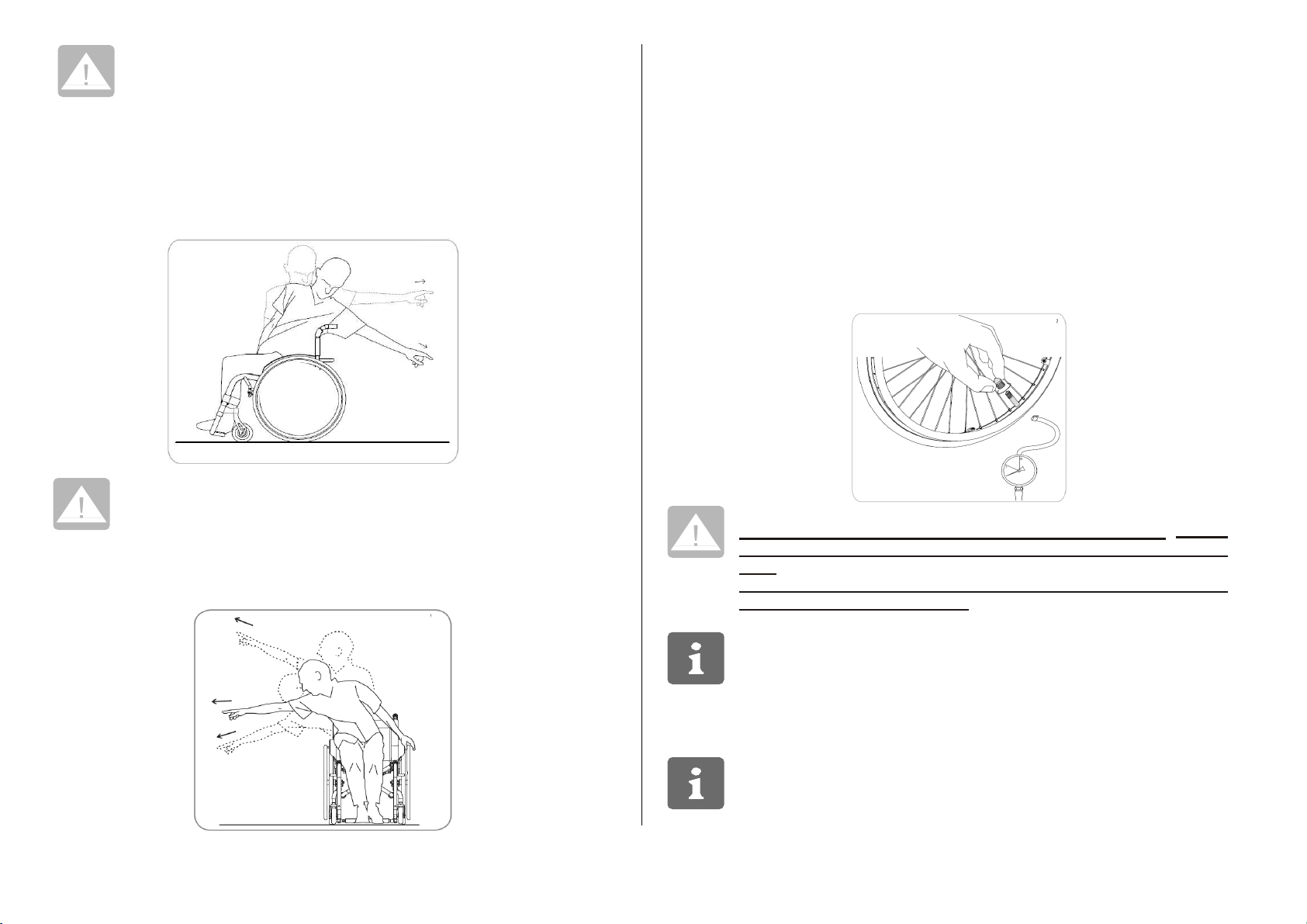
In order to find the point at which the chair will tip back easily and
consequently to find the range within which it is safe to manoeuvre it, proceed
in the following manner (see fig. 3):
While seated in your chair, hold the hand rims on the rear wheels firmly.
Then, move the hand rims slightly backwards and while moving your
weight backwards, push the hand rims forward with a jerk and the front of
the chair will raise.
At this point, by moving your body gently backwards and forwards while
moving the rear wheel backwards and forwards using the hand rims, it will
be possible to find the centre of gravity and the point at which the chair will
safely be controlled.
IN ORDER TO PREVENT THE WHEELCHAIR FROM
OVERBALANCING DURING NORMAL USE WE RECOMMEND
MOUNTING ANTI TIPPER WHEELS WHICH ARE SUPPLIED AS
AN ACCESSORY TO THIS MODEL. (see chapter 7.3 “Anti-tip
wheels”)
2.3 DEALING WITH OBSTACLES: STAIRS AND STEPS
While getting over obstacles such as stairs and steps, approach the
obstacle at a moderate speed
Never attempt to go over steps or other obstacles that are over
20cm (6 inches) height.
If particularly difficult obstacles are encountered an attendant
should always be present at the back of the wheelchair in order to
ensure complete safety.
Going over obstacles alone
Before attempting to go down a step or over any kind of general
obstacle alone (without the presence of an attendant), you will need to
have control over your wheelchair and know how to tip it while
maintaining your balance over the rear wheels (see chapter 2.2
“Starting to use your wheelchair”).
Going down steps on your own
(see fig. 4)
Bring the wheelchair right up to the leading edge of the obstacle .
Raise the front wheels by tilting the wheelchair while maintaining balance.
Move the rear wheels carefully down to the obstacle; during this phase
hold the handrails to control the descent.
Fig. 3
Fig. 4