IMPORTANT:
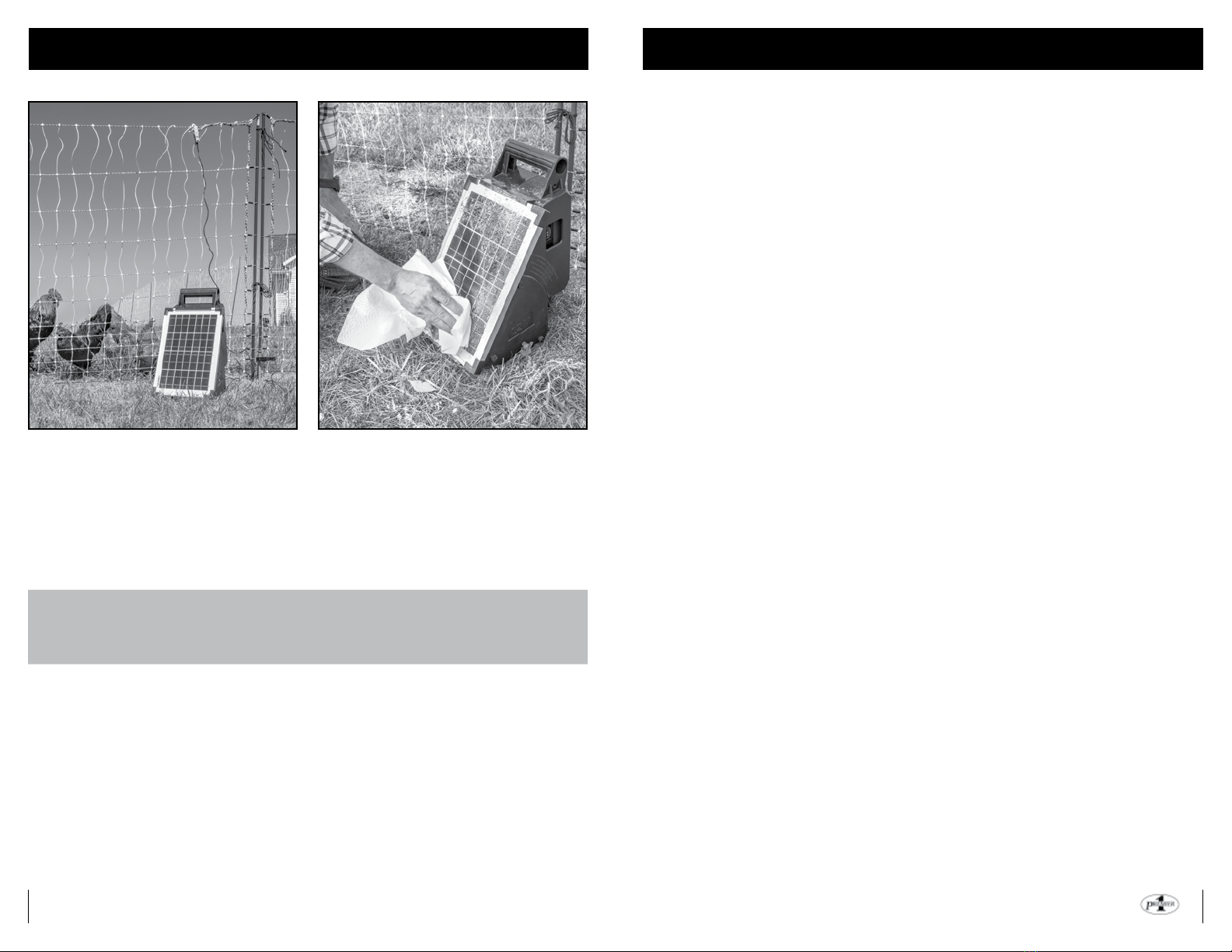
Make sure the battery is measuring 12.6—13.4 volts. If it’s not, recharge the battery (see p. 7). Placing the
energizer in shade will not keep the battery fully charged. Make sure the panel faces south in full sun.
Read Annex BB. 1 of the International Safely Standard IEC 60335-2-76 + EN 60335-2-76 (below).
ANNEX BB. 1:
Electric animal fences and their ancillary equipment shall be installed, operated and maintained in a manner
that minimizes danger to persons, animals or their surroundings.
WARNING: Do not touch the fence with head, mouth, neck or torso. Do not climb over, through or under
a multi-wire electric fence. Use a gate or a specially designed crossing point. Electric animal fence
constructions that are likely to lead to the entanglement of animals or persons shall be avoided.
An electric animal fence shall not be supplied from two separate energizers or from independent fence
circuits of the same energizer.
For any two separate electric animal fences, each supplied from a separate energizer independently timed,
the distance between the wires of the two electric animal fences shall be at least 8.3 ft. If this gap is to be
closed, this shall be effected by means of electrically non conductive material or an isolated metal barrier.
Barbed wire or razor wire shall not be electried by an energizer.
A non-electried fence incorporating barbed wire or razor wire may be used to support one or more off-set
electried wires of an electric animal fence. The supporting devices for the electried wires shall be
constructed so as to ensure that these wires are positioned at a minimum distance of 6" from the vertical plane
of the non-electried wires. The barbed wire and razor wire shall be grounded at regular intervals.
Follow the energizer manufacturer's recommendations regarding earthing.
A distance of at least 33 ft should be maintained between the energizer earth electrode and any other
with the grounding system connected parts such as the power supply system protective ground or the
telecommunication system ground.
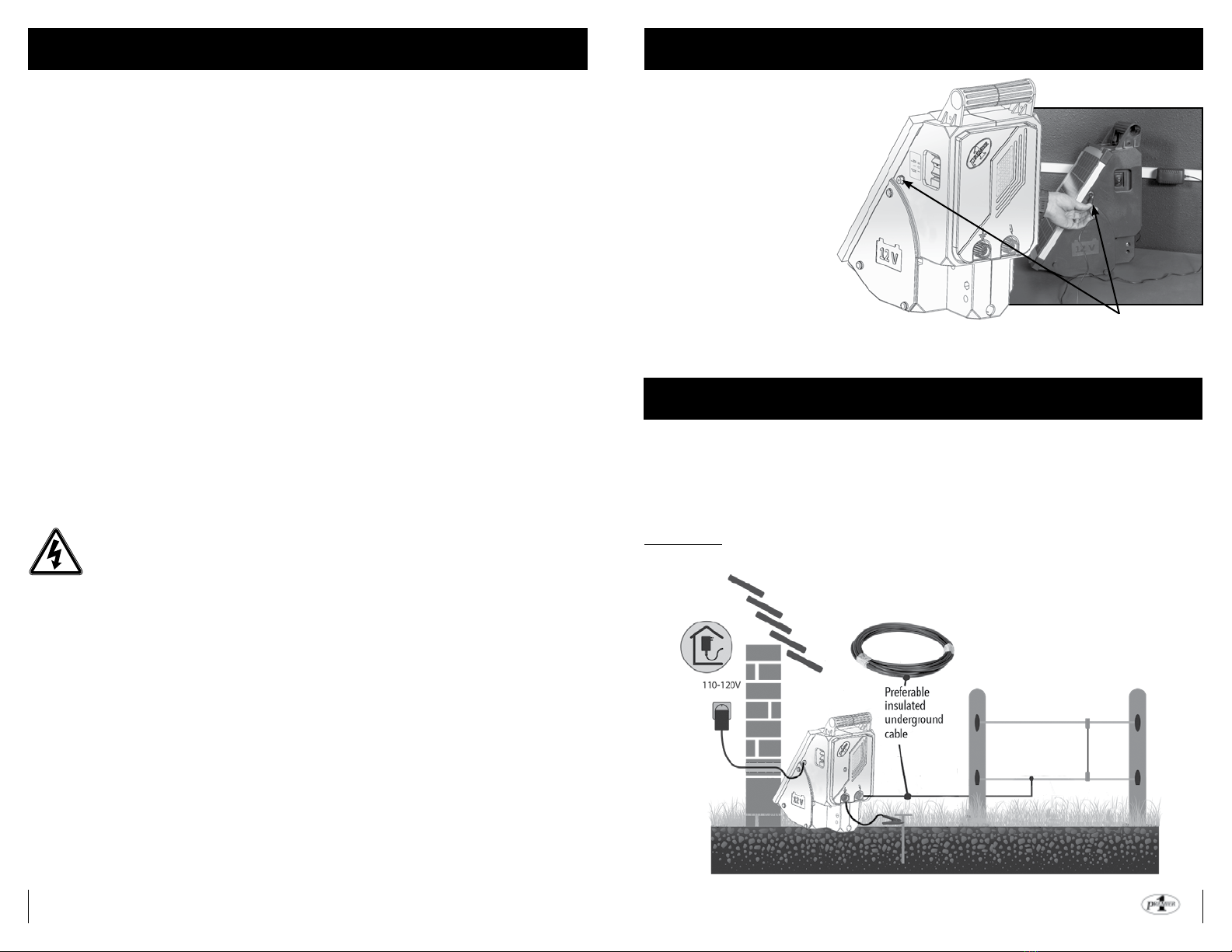
• Connecting leads that are run inside buildings shall be effectively insulated from the grounded
structural parts of the building. This may be achieved by using insulated high voltage cable. Use this
lead-out cable in buildings and where soil could corrode exposed galvanized wire. Never use household
electrical cable: it is made for a maximum of 600 volts and will leak electricity.
• Connecting leads that are run underground shall be run in conduit of insulating material or else
insulated high voltage cable shall be used. Care must be taken to avoid damage to the connecting leads
due to the effects of animal hooves or tractor wheels sinking into the ground.
• Connecting leads shall not be installed in the same conduit as the mains supply wiring,
communication cables or data cables.
• Connecting leads and electric animal fence wires shall not cross above overhead power or
communication lines. Crossings with overhead power lines shall be avoided wherever possible. If such a
crossing cannot be avoided it shall be made underneath the power line and as nearly as possible at right
angles to it. If connecting leads and electric animal fence wires are installed near an overhead power line,
the clearances shall not be less than those shown in Table BB1.
POWER LINE VOLTAGE (V) CLEARANCE
< 1,000V 10 ft
> 1,000V and < 33,000V 13 ft
> 33,000V 27 ft
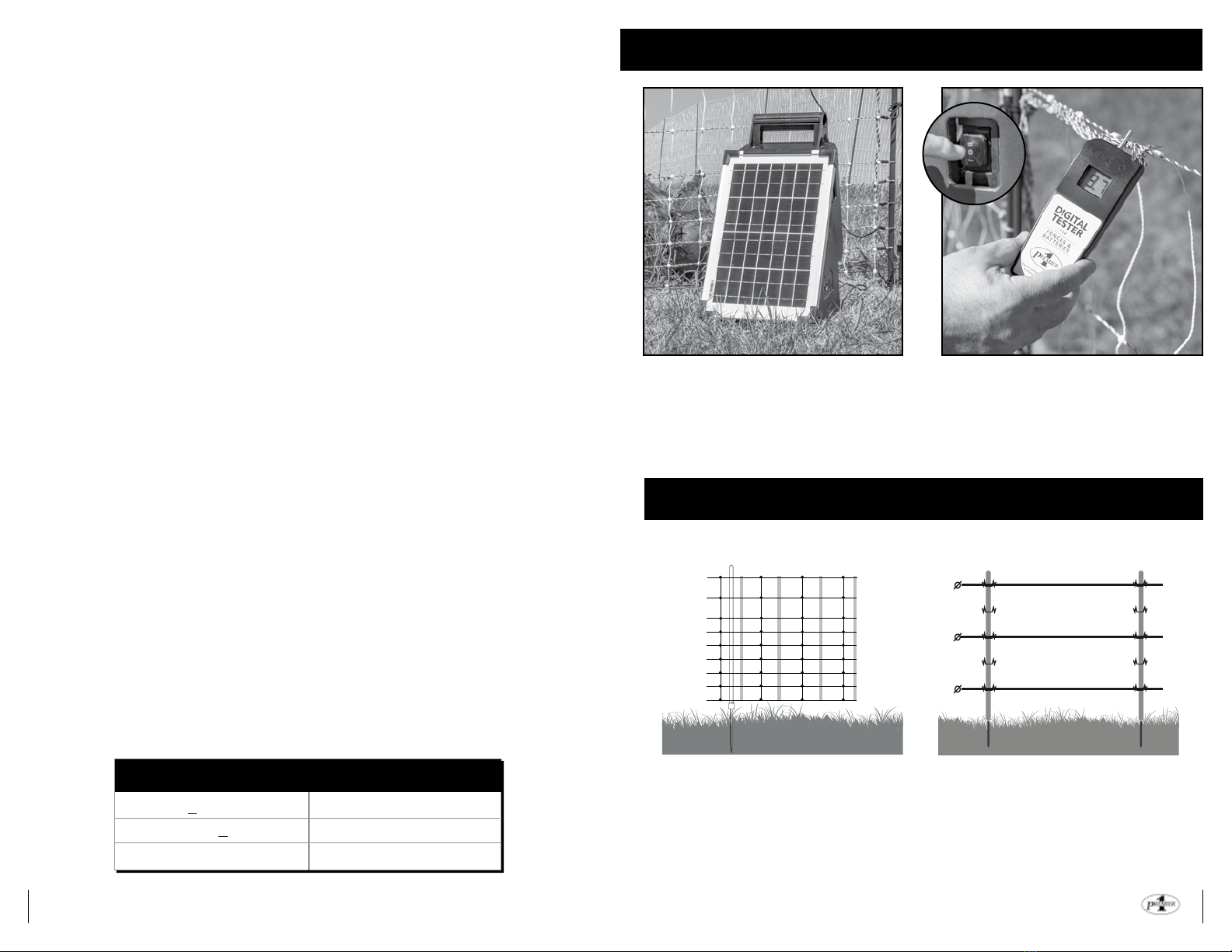
D. Position energizer so that the solar panel faces south
in full sun.
12 5
Table BB 1
Minimum clearances from power line for electrical animal fences
14 15
SAFETY GUIDELINES ELECTRIC ANIMAL FENCES
- To Reduce Risk and Liability ...
REMEMBER:
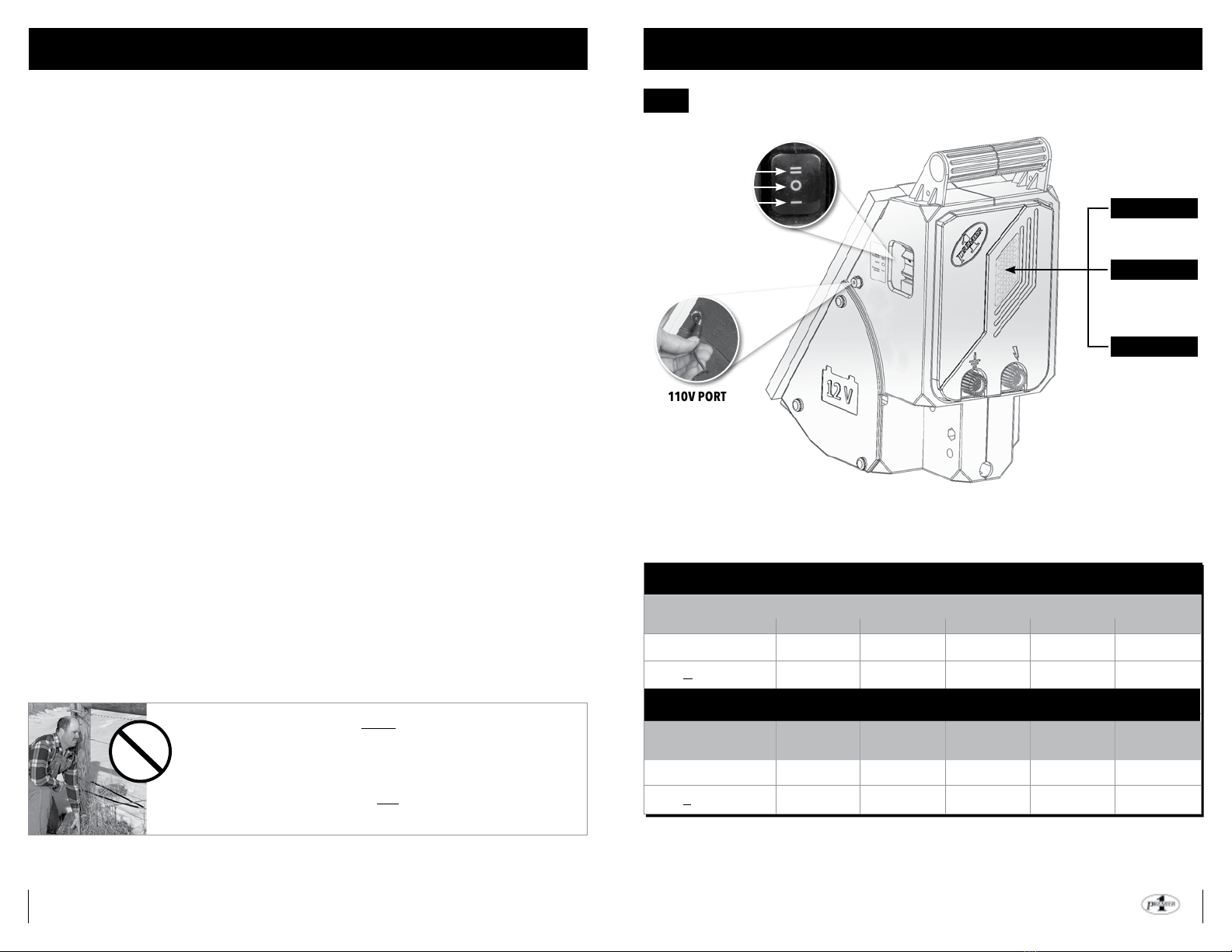
Never touch an electric fence wire with your head or upper
torso (see photo at right).
Never allow anyone else to do so. Instruct all visitors and
children to never do so.
Risk and Liability Reduction Methods
1. For reasons not fully understood, contact with the spi-
nal & head area is much worse than contact with hands,
arms or legs.
2. Most experts agree that smaller energizers are safer
than large ones (as long as animaI control is not put at
risk). So use smaller energizers on fences near children
and untrained adults. To do so, change the fence design
or management to reduce the weed to wire contact.
3. Never connect two energizers to one wire at the same
time.
4. Never energize barbed wire.
5. With high joule energizers reduce the available energy
on wires near children or untrained adults with a 500
ohm resistor. (Not illustrated here.)
6. Hang warning signs on the fence at critical areas where
children or untrained adults will encounter them (inset at
right).
7. Where practical do not energize wires less than 12 in.
above the soil. Why? To allow humans that might con-
tact a wire enough space to fall (by gravity) away from
any energized wires.
8. Ensure that all energized wires are on the inside of
your boundary fence (ensuring that anyone who tou-
ches them without your permission is a trespasser). For
boundary fences achieve this with internal energized
offset wires.
9. The shock from electric fences can panic animals who
may in turn crash into fences (or people) resulting in in-
jury to one or both. Horses have been known to rear and
throw their rider-resulting in injuries to both.
To reduce this risk:
a. Build only non-electric fences along horse trails, around
livestock corrals and surrounding lots.
b. Reduce the available volts and joules on fences that
enclose very small areas (e.g. night enclosures) thus re-
ducing panic and stress.
Never allow your head to get near an
electrified wire. This photo was taken
to illustrate what not to do.
Accidental head/neck contact can
occur when pushing a voltage probe
into the soil when checking voltage.
Be very careful when you do so to
avoid head to wire contact.
A fence that is exposed to untrained
adults or children should never be
without warning signs. Without them
your liability may well be higher.
Solar
IntelliShock 30
15 - 29
mA/hr
0.3
joules
max.
10000 v ~ 10300 v ~ 3300 v ~ 2500 v ~ 1800 v
Solar
IntelliShock 60
20 - 58
mA/hr
0.6
joules
max.
11500 v ~ 11600 v ~3900 v ~ 4000 v ~ 2400 v
Solar
IntelliShock 120
28 - 104
mA/hr
1.2
joules
max.
12700 v ~ 13700 v ~4300 v ~ 6000 v ~ 3700 v
Solar
IntelliShock 180
24 - 140
mA/hr
1.8
joules
max.
11000 v ~ 13100 v ~5000 v ~ 9000 v ~ 4700 v
TECHNICAL DATA
SUBJECT TO TECHNICAL ALTERATIONS !
5km
5 k Ω
5km
500 Ω
0 m 250 m
1 M Ω
250m
500 Ω
MAX. FENCE LINE LENGTH
Solar IntelliShock 30 ≥ 9"
Solar IntelliShock 60 ≥ 18"
Solar IntelliShock 120 ≥ 36" or 3’
12v DC
draw Input
Solar IntelliShock 30 = 1-2 Rolls
Solar IntelliShock 60 = 3-5 Rolls
Solar IntelliShock 120 = 6-10 Rolls
Solar IntelliShock 180 = 9-15 Rolls
Solar IntelliShock 30 = ½ mile
Solar IntelliShock 60 = 1 mile
Solar IntelliShock 120 = 2 mile
Solar IntelliShock 180 = 3 mile
Required
Ground
RED Fence
Terminal
Orange Clip
to fence.
Output
MAXIMUM FENCE LINE LENGTH
14 15
SAFETY GUIDELINES ELECTRIC ANIMAL FENCES
- To Reduce Risk and Liability ...
REMEMBER:
Never touch an electric fence wire with your head or upper
torso (see photo at right).
Never allow anyone else to do so. Instruct all visitors and
children to never do so.
Risk and Liability Reduction Methods
1. For reasons not fully understood, contact with the spi-
nal & head area is much worse than contact with hands,
arms or legs.
2. Most experts agree that smaller energizers are safer
than large ones (as long as animaI control is not put at
risk). So use smaller energizers on fences near children
and untrained adults. To do so, change the fence design
or management to reduce the weed to wire contact.
3. Never connect two energizers to one wire at the same
time.
4. Never energize barbed wire.
5. With high joule energizers reduce the available energy
on wires near children or untrained adults with a 500
ohm resistor. (Not illustrated here.)
6. Hang warning signs on the fence at critical areas where
children or untrained adults will encounter them (inset at
right).
7. Where practical do not energize wires less than 12 in.
above the soil. Why? To allow humans that might con-
tact a wire enough space to fall (by gravity) away from
any energized wires.
8. Ensure that all energized wires are on the inside of
your boundary fence (ensuring that anyone who tou-
ches them without your permission is a trespasser). For
boundary fences achieve this with internal energized
offset wires.
9. The shock from electric fences can panic animals who
may in turn crash into fences (or people) resulting in in-
jury to one or both. Horses have been known to rear and
throw their rider-resulting in injuries to both.
To reduce this risk:
a. Build only non-electric fences along horse trails, around
livestock corrals and surrounding lots.
b. Reduce the available volts and joules on fences that
enclose very small areas (e.g. night enclosures) thus re-
ducing panic and stress.
Never allow your head to get near an
electrified wire. This photo was taken
to illustrate what not to do.
Accidental head/neck contact can
occur when pushing a voltage probe
into the soil when checking voltage.
Be very careful when you do so to
avoid head to wire contact.
A fence that is exposed to untrained
adults or children should never be
without warning signs. Without them
your liability may well be higher.
Solar
IntelliShock 30
15 - 29
mA/hr
0.3
joules
max.
10000 v ~ 10300 v ~ 3300 v ~ 2500 v ~ 1800 v
Solar
IntelliShock 60
20 - 58
mA/hr
0.6
joules
max.
11500 v ~ 11600 v ~3900 v ~ 4000 v ~ 2400 v
Solar
IntelliShock 120
28 - 104
mA/hr
1.2
joules
max.
12700 v ~ 13700 v ~4300 v ~ 6000 v ~ 3700 v
Solar
IntelliShock 180
24 - 140
mA/hr
1.8
joules
max.
11000 v ~ 13100 v ~5000 v ~ 9000 v ~ 4700 v
TECHNICAL DATA
SUBJECT TO TECHNICAL ALTERATIONS !
5km
5 k Ω
5km
500 Ω
0 m 250 m
1 M Ω
250m
500 Ω
MAX. FENCE LINE LENGTH
Solar IntelliShock 30 ≥ 9"
Solar IntelliShock 60 ≥ 18"
Solar IntelliShock 120 ≥ 36" or 3’
12v DC
draw Input
Solar IntelliShock 30 = 1-2 Rolls
Solar IntelliShock 60 = 3-5 Rolls
Solar IntelliShock 120 = 6-10 Rolls
Solar IntelliShock 180 = 9-15 Rolls
Solar IntelliShock 30 = ½ mile
Solar IntelliShock 60 = 1 mile
Solar IntelliShock 120 = 2 mile
Solar IntelliShock 180 = 3 mile
Required
Ground
RED Fence
Terminal
Orange Clip
to fence.
Output
3–6 rolls
Depending on soil conditions and vegetation
Netting Strand Fence
Cattle: 1-1/2 miles of 3 strand fence
Sheep: 1/2 mile of 5–7 strand fence
E. Turn on energizer and check the voltage at the end
of the fence with a fence tester to ensure the fence is
properly electried before introducing it to animals.
Minimum of 3000V at the end of the fence.