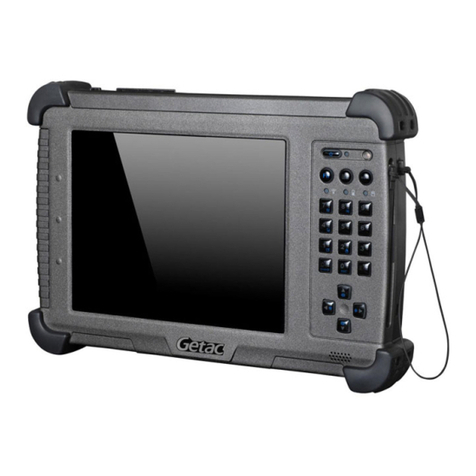
Pokini Tab M10 User manual

Pokini Tab G10/M10
Quick Start Guide
English

Deutsch
2
Contents
1. Introduction...............................................................................................................................
2. Device Layout ..........................................................................................................................
(Front, Side, Top, Bottom view)
3. Managing Device Power ........................................................................................................
(Netzteil, Akku)
4. Using optional features ..........................................................................................................
(RFID, NFC, CAC, Fingerprint, Barcode Reader, GPS, Digitizer)
5. eController-App and its Applications ..................................................................................
(RFID, NFC, CAC, Fingerprint, Barcode Reader, GPS)
6. Product Care ............................................................................................................................
(Temperature, Humidity)
7. Safety ........................................................................................................................................
8. Troubleshooting ......................................................................................................................
9. Technical Specications.........................................................................................................
03
04-06
07-09
10-13
14-16
17
17-18
19-20
21

3
1. Introduction
Welcome to your G10/M10 Tablet PC.
To ensure the optimal performance of this product, please take the time to read this manual carefully.
G10/M10 is a rugged tablet intended for medical/commercial uses.
Explanation of Advisements
In this manual we use three (3) levels of Advisements as follows:
The Note symbol is used for notifying the user of something important or of something that needs special
attention.
The Cautionsymbol is used to inform of something that could cause harm to, or malfunction of the equipment.
The Warning symbol is used to inform of something in which the reisaconceivable risk of harm to the user if the
Warning is ignored.
Symbols and Markings
This section provides information about the symbols that are used on the G10, its accessories, or packaging.
Symbol or Markings Description
Power On/Off Indicator
Dispose of in accordance with your country’s requirements.
CE is the abbreviation of the European Communities and this mark tells customs
ocials in the European Union that the product complies with one or more of the EC
Directives.
This is a certication mark employed on electronic products manufactured or sold in the
United States which certies that the electromagnetic interference from the device is
under limits approved by the Federal Communications Commission.
Consult User´s Manual
UL Marking
The product meet UL’s requirements for Canada and the United States.
Conforms to relevant Australian EMC requirements

Deutsch
4
2. Device Layout
Front View
1Finger Print Reader Provides Fingerprint Authentication and Security for your device (if equipped).
2MIC Audio Recording Device
3Ambient Light
Sensor Provides Automatic Adjustment of Screen Brightness for Various Lighting Conditions
4Front Camera Record Still and Video Images – 8 MP
5NFC/RFID Reader Near Field Communication/Radio-Frequency ID Device
6Power LED Indicator Green – Power On
7Charge LED Indicator
White light Blink – Battery Charging
Solid Green – Charge Complete
Red Blink– Low Battery (Battery Below 10%)
8Function Key 1 Programmable – Can be used for common special functions
9Function Key 2 Programmable – Can be used for common special functions
10 Windows Key Opens or closes the Start menu.
11 Volume + Button Increases the audio volume.
12 Volume - Button Decreases the audio volume.
13 Power Button Turn power On/Off – Hold 10s to Reset

5
Top View
Left-Side View
Bottom view
14 Barcode Reader
(Optional) Optically Scans 1D or 2D Barcodes, if Equipped
15 Audio Connect headphones, speakers, or another external audio device.
16 USB 3.0 Connect any external USB device or storage volume.
17 HDMI Connect a secondary display via HDMI.
18 Barcode Reader Button Press to activate Barcode Reader Scanning Device (button will be deactivated if
tablet not equipped with barcode reader).
19 Stylus Tether Hole The stylus can be tethered through this hole.
20 Docking Connector Connects the tablet with the Tablet Docking Station

Deutsch
6
Rear View
Right-Side View
21 CAC Card Reader For reading Common Access Card for ID authentication.
22 IO Cover Lock Cover the IO port for waterproof.
23 DC in Direct current (DC) power for charging/using the tablet.
24 RJ45 Port 10/100/1000 MB network port
25 Speaker Sends out sound and voice.
26 Stylus Tether Hole Stylus can be tethered to this hole.
27 LED Flash light, controlled by P1&P2 button, Press P1 to turn on the Flash light and P2 to
turn off.
28 Stylus pen Serves as the input device by tapping on the touchscreen to make selections and enter
information.
29 Rear Camera Allows you to use the camera function.
30 Hot Swappable Battery
Lock To lock/unlock the hot swappable battery
31 Hot Swappable Battery Supplies power to your Tablet PC when external power is not connected.
32 SIM Slot Insert SIM card to enable 4G LTE service (optional)
33 MicroSD Slot Accepts MicroSD Memory Cards

7
3. Managing Device Power
AC Adapter
The AC adapter accepts 100-240VAC Input.
A standard US polarized, grounded three-pin plug adapter is included.
International plug AC adapters are available for certain regions.
Use only the AC adapter included with your Tablet PC. Using other AC adapters may damage the device.

Deutsch
8
Battery Pack
The G10/M10 device has one small, permanent, internal battery and one hot-swappable battery. When hot swappable
battery has low voltage and needs to be replaced, the built-in battery will power the tablet for up to 30 minutes.
To charge the Battery Pack:
1. Connect the power cable to the charging port on the device.
2. Connect the power adapter to an electrical outlet and charge the tablet until the battery is fully charged.
3. After your device is fully charged, disconnect the charger from both the device and the electrical outlet.
4. Additional hot-swappable batteries can be charged independently of the Tablet PC by placing the battery
into a docking station with a battery charging bay (available separately).
NOTE: To prevent damage to batteries, please see Section 8: Safety
Battery life naturally degrades over time. Failure to follow instructions for recommended operating
temperatures, charge and discharge rates, and other instructions may accelerate battery decay rates. If your
tablet battery will not accept or hold a satisfactory charge, it may need to be replaced.
For battery storage and charging temperatures, see Section 8: Safety
Checking the Battery Level
To check the battery charge level of the G10/M10, you may use the battery monitor within Windows operating system
or by the voltage gauge of hot swappable battery pack.
When the hot swappable battery pack is not installed in the Tablet PC and you want to know the battery level, press
the Battery Test (1) button. The gauge will display the battery level.
Any battery level indication is an estimated result. The actual operating time can be different from the
estimated time, depending on how you are using the Tablet PC.
1
Storage of the battery
Please note that the battery loses 2% of its charge every three days if it remains in the switched-off tablet.
This can lead to deep discharge if stored for too long. Therefore, remove the battery from the device before
storing it.

9
Hot Swapping the Battery Pack
The G10/M10 Tablet PC battery can be replaced without shutting down the tablet or interrupting your work, by use of
the built-in battery. The built-in battery can sustain power for up to 30 minutes, during which period the swappable
battery must be changed to prevent loss of function.
To swap the battery, lay the tablet on a at surface, and pull the two tabs indicated towards the edges of the tablet.
The battery will pop loose and a replacement can be slid into place.
The appropriate temperature range for hot swapping the battery pack is between -10 °C (14 °F) and
50 °C (122 °F).
Check the Bridge Battery Indicator after unlocking the battery latch. Replace the battery pack only when the
indicator lights in green. A red light means the bridge battery level is too low for you to safely hot swap
the battery pack.
When the battery latch is unlocked, the display brightness level will be xed at a low level and cannot
be adjusted
If the hot swappable battery pack is not inserted within 30 minutes, the Tablet PC enters Hibernation
mode or may switch off entirely.
Internal Battery
The internal battery is not user-replaceable and is not visible to the operating system. It never functions as the power
source as long as the hot swappable battery pack is installed, It enables the hot-swapping function, since it provides
power only when the battery pack is being removed. The internal battery should not be used to power the tablet
during regular operation.
By default, the internal battery is charged by external AC power (if connected) or the main battery pack if it is not fully
charged. To preserve battery life, it is possible to set the internal battery to charge only when connected to an AC
Power Source.

Deutsch
10
4. Using optional features
Due to the overlap features of NFC, RFID and CAC card readers, they are designed in the same location of the
tablet, so the three modules cannot be installed in the same tablet, only one module can be selected.
Using the RFID Reader
This device may include an internal RFID reader module. The RFID system involves a tag and a reader, used for
inventory management, asset tracking and so on. As it is shown in product layout in chapter 2 (Position 5). For more
details, see Technical Specications in Appendix A.
To use an RFID Device:
• Scan a smart card or RFID tag near the RFID reader, please follow the instructions in the specic software
for your application and use RFID function properly.
The RFID tag/card must be within the range of an RFID reader. An audible beep will indicate a successful scan.
If you experience errors while attempting to read an RFID tag with the scanner, please try a different tag.
If the error persists, contact your dealer for assistance.
• If you want to check whether the RFID reader hardware is working properly, you may use eController app to test.
See Chapter 6: eController App and its Applications.
Using the NFC Reader
This device may include an optional internal NFC (Near Field Communication) module for different applications, such
as checking security tags, or communicating with smartphones. You can view the location of the NFC Module in the
product layout in Chapter 2 (Position 5). For more details, see Technical Specications in Appendix A.
To use an NFC Device:
• Users can scan a card or device near the NFC sensor area. Please follow the instructions in the specic software for
your application and use NFC function properly. Below it is example for mobile payment application using NFC.
This manual suits for next models
1
Table of contents
Other Pokini Tablet manuals

Pokini
Pokini Tab A10B User manual

Pokini
Pokini Tab G10 User manual

Pokini
Pokini Tab E11 User manual

Pokini
Pokini Tab K11 User manual

Pokini
Pokini FT 7M User manual

Pokini
Pokini Tab K11B User manual

Pokini
Pokini Tab A6 User manual

Pokini
Pokini Tab K10 User manual

Pokini
Pokini Tab A8 User manual

Pokini
Pokini Tab K10B User manual


Popular Tablet manuals by other brands

Laser
Laser MID-1060 Quick operation guide

MUNBYN
MUNBYN IRT09J Easy setup guide

Motorola
Motorola MC3090R - Win CE 5.0 Professional 520 MHz quick start guide

Dell
Dell Latitude ST Setup and features information

Lenovo
Lenovo IdeaTab S6000L Hardware Maintenance Manual

Venturer
Venturer WT9L11 quick start guide