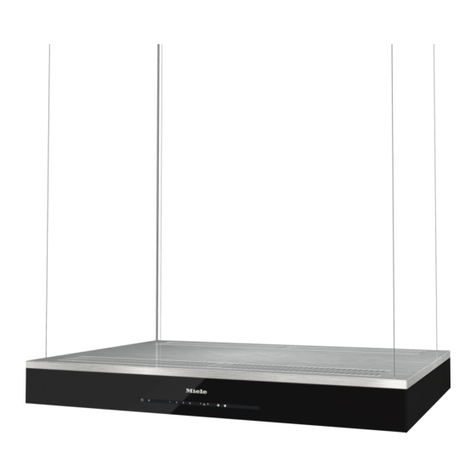
NEFF D8985N0GB Operating instructions

How to use and look after your
built-in cooker hoods
D8985
NEFF (UK) Ltd

2
mind.
650 mind.
550
Abb. 1
ELECTR.
Fig. 1
GAZ

3
Appliance description
Instructions for use:
Operating modes
Operating modes
Exhaust-air mode:
❑The extractor-hood fan extracts the
kitchen vapours and conveys them
through the grease filter into the
atmosphere.
❑The grease filter absorbs the solid
particles in the kitchen vapours.
❑The kitchen is kept almost free of grease
and odours.
DWhen the extractor hood is operated
in exhaust-air mode simultaneously with
a different burner which also makes use
of the same chimney (such as gas, oil or
coal-fired heaters, continuous-flow heaters,
hot-water boilers) care must be taken to
ensure that there is an adequate supply
of fresh air which will be needed by the
burner for combustion.
Safe operation is possible provided that the
underpressure in the room where the
burner is installed does not exceed 4 Pa
(0.04 mbar).
This can be achieved if combustion air can
flow through non-lockable openings, e.g. in
doors, windows and via the air-
intake/exhaust-air wall box or by other
technical measures, such as reciprocal
interlocking, etc.
If the air intake is inadequate, there is a
risk of poisoning from combustion gases
which are drawn back into the room.
An air-intake/exhaust-air wall box by itself is
no guarantee that the limiting value will not
be exceeded.
Note: When assessing the overall
requirement, the combined ventilation
system for the entire household must be
taken into consideration. This rule does not
apply to the use of cooking appliances,
such as hobs and ovens.
Unrestricted operation is possible if the
extractor hood is used in recirculating mode
– with activated carbon filter.
Circulating-air mode:
❑An activated carbon filter must be fitted
for this operating mode (see Filters and
maintenance).
The complete installation set and
replacement filters can be obtained from
specialist outlets.
The corresponding accessory numbers
can be found at the end of these
operating instructions.
❑The extractor-hood fan extracts the
kitchen vapours which are purified in the
grease filter and activated carbon filter
and then conveyed back into the
kitchen.
❑The grease filter absorbs the grease
particles in the kitchen vapours.
❑The activated carbon filter binds the
odorous substances.
Light / fan
switches
Filter grille
Chimney
panelling
Lighting

4
Before using for the first time
Important notes:
❑The Instructions for Use apply to several
versions of this appliance. Accordingly,
you may find descriptions of individual
features that do not apply to your
specific appliance.
❑This extractor hood complies with all
relevant safety regulations.
Repairs should only be carried out by
qualified specialists.
Improperly executed repairs can give
rise to significant hazards for the user.
Do not flambé food directly under the
extractor hood.
Risk of grease filter catching fire due
!to flames.
Restrictions apply to the use of the
extractor hood over a solid-fuel burner
(coal, wood, etc.). (See Installation
instructions).
Gas hobs / gas cookers
Always use gas hobs in a proper and
safe manner.
Important:
The flames from the gas hob must always
be covered by pots or pans.
The intense heat generated by the gas
flames could cause damage to the
!extractor hood.
❑Before using your new appliance, please
read these Instructions for Use carefully.
They contain important information
concerning your personal safety as well
as on use and care of the appliance.
❑Please keep the operating and
installation instructions in a safe place;
this important documentation may also
be of use to a possible subsequent
owner.
Do not use the appliance if it is
damaged in any way
The appliance is not intended for use
by young children or infirmed persons
without supervision.
Young children should be supervised to
ensure they do not play with the appliance.
The appliance should only be
connected up to the mains and taken into
use by a qualified specialist.
Dispose of packaging materials
properly (see Installation instructions).
Light bulbs must always be fitted when
the extractor hood is in use.
Defective bulbs should be replaced
immediately to prevent the remaining bulbs
from overloading.
Never operate the extractor hood
without a grease filter.
Overheated fat or oil can easily catch
fire.
If you are cooking with fat or oil, e.g. chips,
etc., never leave the cooker unattended.

5
Operating procedure
The most effective method of removing kitchen fumes is to:
❑switch on the extractor hood when you start cooking.
❑switch off the extractor hood a few minutes after you finishing cooking.
❑The fans in this appliance can be switched to the desired setting by hand (manual mode)
or can be controlled fully automatically with the automatic function according to your
requirements (automatic mode).
Fan
on / off
Switching on manual mode:
Press the Lor +button.
❑The fan starts at Setting }.
Switching on the fan settings/intensive
setting:
1. To increase the fan settings or switch on
the intensive setting ç, press the +
button.
❑The intensive setting operates at
maximum power which should be
used only briefly.
If the intensive setting is not switched
off manually, the fan automatically
switches back to Setting }after
10 minutes.
2. To switch off the intensive setting çor
switch back to fan settings ~–}–|and
switch off the extractor hood
completely, press the –button.
Switching over to automatic mode:
❑To switch from manual mode to
automatic mode at any time, press the Ü
button.
Fan – off –
Fan settings – lower –
Fan – on –
Fan settings – higher –
Fan run-on /
Intermittent ventilation
Light
on / off
Display:
❑Fan settings / Intensive setting
❑Saturation – grease filter (#)
❑Saturation – activated carbon filter (ã)
Automatic mode / Manual mode

6
Operating procedure
Switching on automatic mode:
Press the Übutton.
❑The fan runs at least at Setting |.
Fan settings:
❑If required, the optimum fan setting is
actuated automatically via a sensor.
❑The automatic function operates at
Settings |– ~.
Intensive setting:
1. To switch on the intensive setting ç,
press the +button.
❑Automatic mode has been switched
off.
❑The intensive setting operates at
maximum power which should be
used only briefly.
If the intensive setting is not switched
off manually, the fan automatically
switches back to the optimum fan
setting after 10 minutes.
2. To switch off the intensive setting, press
the –button.
❑Automatic mode has been switched
on again.
Switching over to manual mode:
❑To switch from automatic mode to
manual mode at any time, press the Ü
button.
Intermittent ventilation
❑Used for ventilating the kitchen at hourly
intervals at the lowest fan setting, round
the clock.
Switching on:
❑Before intermittent ventilation can be
switched on, the appliance must be
switched off.
Press the button.
❑The fan runs for 5 minutes at Setting |,
then switches off for 55 minutes. This
process is repeated every hour.
Switching off:
Press the button.

7
Operating procedure
Switching off
With fan run-on started from manual
mode:
Press the button.
❑The fan runs at the setting last selected.
❑The dot on the display flashes.
❑After 10 minutes the fan switches off and
the displays go out.
With fan run-on started from automatic
mode:
Press the button.
❑Fan run-on does not start until the
automatic function has switched the fan
back to Setting |.
❑The dot on the display flashes.
❑After 10 minutes the fan switches off and
the displays go out.
Without fan run-on:
Press the Lbutton.
Light
❑The light can be used at any time, even
when the appliance has been switched
off.
Switching on/off:
Press the abutton.
Special functions
Adjusting the sensitivity of the sensor
control:
1. Press and hold down the automatic
button.
2. To display the current sensitivity, press
the +or –button.
3. You can now change the sensitivity of
the sensor control by pressing the +or
–button.
❑Factory setting: @.
❑Lowest setting: {.
❑Highest setting: Ö.
Switching on the light automatically, e.g.
via a timer:
❑Fan and light must be switched off.
Switching on:
Simultaneously press the aand L
buttons.
❑After approx. 3 seconds the light
switches on to acknowledge the setting.
Switching off:
Repeat the process with the light switched
on.
❑After approx. 3 seconds the light
switches off to acknowledge the setting.

8
Grease filters:
Metal filters are used to trap the greasy
element of the vapours that develop
during cooking.
The filter mats are made from non-
combustible metal.
Caution:
As the filter becomes more and more
saturated with grease, not only does the
risk of it catching fire increase but the
efficiency of the extractor hood can also be
adversely affected.
Important:
By cleaning the metal grease filters at
appropriate intervals, the possibility of them
catching fire as a result of a build-up of heat
such as occurs when deep-fat frying or
roasting is taking place, is reduced.
Saturation indicator:
When the grease filters reach saturation
point, an acoustic signal is sounded for 10
seconds after the fan has switched off, and
an #appears in the display. The grease
filters should be cleaned straight away.
Cleaning the metal grease filters:
❑The filters can be cleaned in a
dishwasher. It is however possible that
they will become slightly discoloured.
Important:
Metal filters that are saturated with
grease should not be washed together
with other dishes etc.
❑When cleaning the filters by hand, soak
them in hot soapy water first of all.
Then brush the filters clean, rinse them
thoroughly and leave the water to drain off.
Removing and inserting the metal grease
filters:
Warning: The halogen bulbs must be
switched off and cool.
1. Press the catch on the grease filters
inwards and fold the filters down.
Filters and maintenance
2. Clean the filters.
3. Insert the clean filters back into the
hood.
4. Cancel the #in the display.
❑Press the Lbutton for at least
3 seconds.
The #is cancelled.

9
Activated carbon filter:
For neutralizing odours in recirculating
mode.
Saturation indicator:
When the activated carbon filter reaches
saturation point, an acoustic signal is
sounded for 10 seconds after the fan has
switched off, and a ãappears in the
display. The activated carbon filter should
be replaced straight away.
Removing the filter:
Warning: The halogen bulbs must be
switched off and cool.
1. Remove the metal filters.
2. Press the catches at both sides of the
filter inwards and lift the carbon filter
down and out.
Filters and maintenance
3. Engage the catches at both sides.
4. Insert the metal grease filters (see
"Removing and inserting the metal
grease filters").
5. Cancel the ãin the display.
❑Press the Lbutton for at least
3 seconds.
The ãis cancelled.
3. Insert the metal grease filters.
Replacing the activated carbon filter:
❑A replacement filter can be obtained
from any authorized dealer (see optional
accessories).
❑Use original filters only.
By doing so you will obtain maximum
performance from your extractor hood.
Disposing of the old activated carbon
filter:
❑There are no pollutants in the activated
carbon filters. They can therefore be
disposed of as part of your normal
domestic refuse.
Inserting the filter:
Warning: The halogen bulbs must be
switched off and cool.
1. Remove the metal filters
(see "Removing and inserting the metal
grease filters").
2. Insert the activated carbon filter.

10
Cleaning and care
Disconnect the extractor hood from the
electricity supply by pulling out the
mains plug or switching it off at the fuse
box.
❑At the same time as you clean the
grease filters, clean off any grease from
all accessible parts of the housing. This
significantly reduces the fire hazard and
ensures that the extractor hood
performs as effectively as possible.
❑Use a hot detergent solution or a mild
window cleaner to clean the canopy of
the extractor hood.
❑Do not scrape off any dirt that has dried
on but loosen it up with a damp cloth.
❑Do not use abrasive cleaning agents or
sponges that could cause scratches.
❑Note: Do not use alcohol (spirit) on
plastic parts, otherwise the surface may
become matt in appearance.
Caution: Ensure that the kitchen is ade-
quately ventilated. Avoid naked flames!
Clean the operating buttons with a mild
soapy solution and a soft, damp cloth only.
Do not use stainless-steel cleaner to clean
the operating buttons.
Stainless steel surfaces:
❑Use a mild non-abrasive stainless steel
cleaner.
❑Clean the surface in the same direction
as it has been ground and polished.
Do not use any of the following to clean
stainless steel surfaces: abrasive sponges,
cleaning agents containing sand, soda, acid
or chloride!
Aluminium and plastic surfaces:
❑Use a soft, non-linting window cloth or
micro-fibre cloth.
❑Do not use dry cloths.
❑Use a mild window cleaning agent.
❑Do not use aggressive, acidic or caustic
cleaners.
❑Do not use abrasive agents.
4. Re-insert the bulb ring.
5. Plug the appliance into the mains or
switch it on at the fuse box.
Note: If the light does not function, check
that the bulbs have been inserted correctly.
Replacing the light bulbs
1. Switch off the extractor hood and pull
out the mains plug or switch off the
electricity supply at the fuse box.
When switched on, the halogen bulbs
become very hot. Even for some time after
the bulbs have been switched off there is
still a risk of burns.
2. Remove the bulb ring with a screwdriver
or similar tool.
3. Replace the halogen light bulb
(conventional halogen bulb, 12 Volt,
max. 20 Watt, G4 cap).
Caution: Refer for plug-in lampholder.
Take hold of the bulb with a clean cloth.

This manual suits for next models
1
Table of contents
Other NEFF Ventilation Hood manuals

NEFF
NEFF D46ED22X0 User manual

NEFF
NEFF D16BS01N0B User manual

NEFF
NEFF I99L59N0 User manual

NEFF
NEFF D76S45N0GB User manual

NEFF
NEFF D57ML6.N0 User manual

NEFF
NEFF D96BMV5N5B User manual

NEFF
NEFF I95GBE2N0 User manual

NEFF
NEFF D86EH52N0B/01 User manual

NEFF
NEFF D46BR12X6 User manual

NEFF
NEFF D96BMU5N0 User manual

NEFF
NEFF D86EH52N0B/02 User manual

NEFF
NEFF D39G69S0 User manual

NEFF
NEFF D99W6N0 User manual

NEFF
NEFF D92 Series User manual

NEFF
NEFF D76SR22N0 User manual

NEFF
NEFF D96E3N0 User manual

NEFF
NEFF D64MAC1X0 Series User manual

NEFF
NEFF I14RBQ8W0/01 User manual

NEFF
NEFF D96W44N0 User manual

NEFF
NEFF D 71T7 Series User manual