Mincon Rockdrills –“The Driller’s Choice” Page 5
2.3.2 Opening Chuck and Backhead
The threads used in Mincon Hammers are right hand threads. Proper tools and break-out systems should be used at all times to
dismantle DTH hammers, otherwise damage may be caused to the components which could result in eventual failure or affect the
performance of the Hammer. When using Petol wrenches or similar systems, ensure that the wrench is not placed on the threaded
section of the wear sleeve. Petol wrench jaws should be carbide, and in good condition. It is good practice to keep a spare set of
jaws with the rig. Do not strike or hit the outer components as this could weaken the heat treated steels. Hitting the hammer may
also cause hard metal fragments to be chipped off which may be projected and cause personal injury or eyesight loss.
Do not apply heat to the hammer, as this can alter the metallurgical composition and result in premature failure. Additionally,
applying heat can also cause distortion to the wear sleeve, which in turn would lead to failure. Do not trap the hammer under drill
rig tracks or vehicle wheels which could cause bending and distortion of the hammer body. Failures caused by these actions
cannot be supported by warranty.
Take care when dismantling the hammer to make sure that parts and drill bits do not become detached and cause damage or
personal injury.
2.3.3 Dismantling Hammer to Change Drill Bit
When possible, dismantling the Hammer to change the drill bit is preferably best done in a workshop environment to avoid the risk
of injury and for cleanliness. Be careful to ensure that the drill bit and chuck are fully supported together so that there is no risk of
them becoming detached and causing injury. This can occur if the O Ring on the bit retaining rings is missing or damaged. Before
fitting a new drill bit visually inspect the splines of the chuck and the piston striking face to ensure that both are not damaged in any
way.
Place chuck onto the bit, and secure with the bit retaining pieces into the chuck thread. Liberally grease the threads on the chuck.
Screw chuck into wear sleeve by hand, alternatively, if using the rig to screw chuck on, ensure that no cross threading occurs. Prior
to use, place bit in a bit basket and torque up chuck. This is essential, as the chuck can loosen if not properly torqued, and
premature chuck failure can occur.
2.3.4 Disassembly for Full Servicing of Hammer
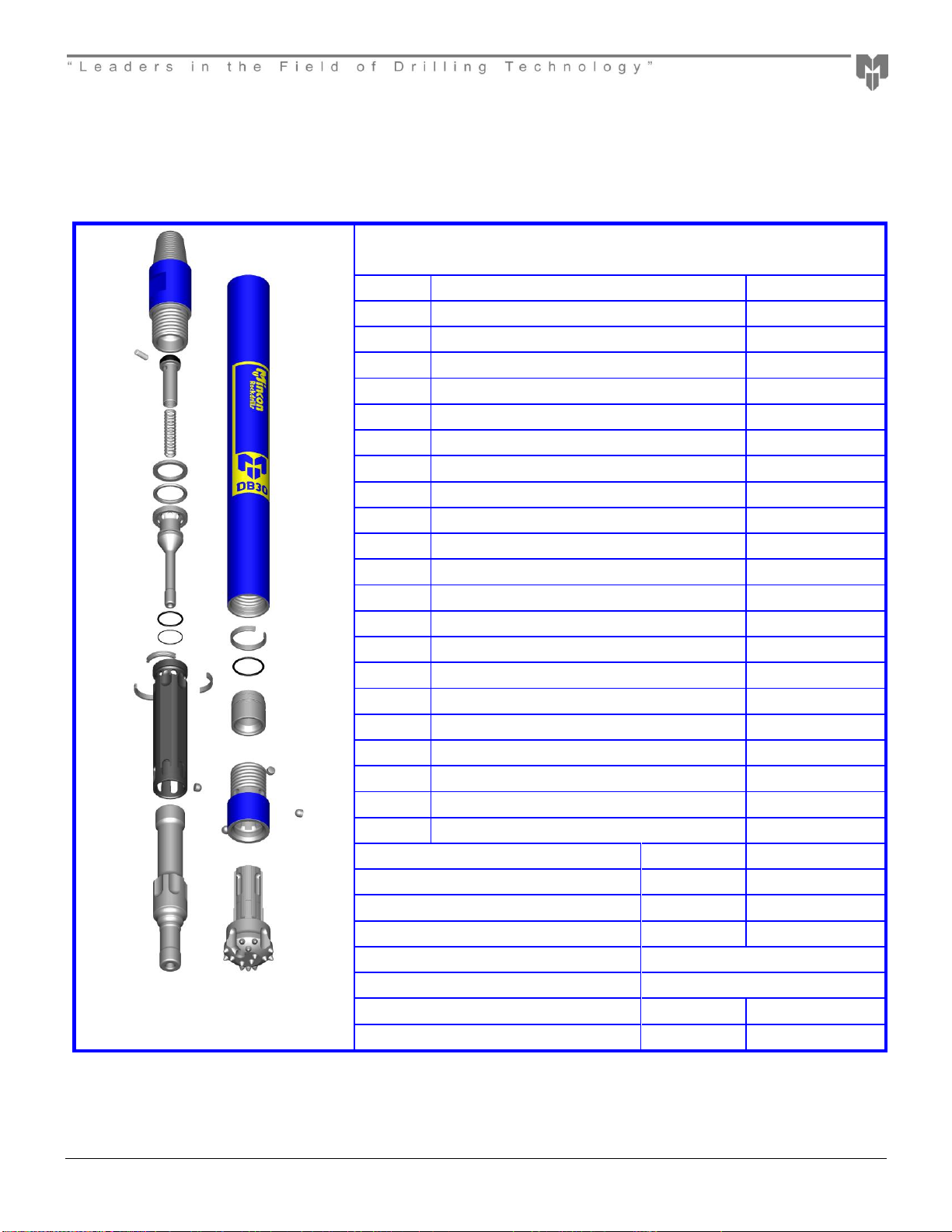
Breakout the Chuck and Backhead as described previously. Unscrew chuck and remove bit and bit retaining pieces. Turn the
hammer upright so the backhead end is uppermost. Unscrew the backhead and check to see if the check valve and spring are
operating correctly, and then remove them. Mark one end to identify either the chuck or backhead end for reassembly latter as the
hammer is not reversible.
Stand hammer up with the chuck end uppermost. Using a mild steel bar, tap the strike face of the piston to remove the air
distributor and inner cylinder. The steel make-up ring and lock ring should fall out during this process, if so remove them and
continue until the top of the air distributor is at the top of the wear sleeve. The hammer can now be placed flat on the ground or put
up onto a suitable vice, and using the mild steel bar, hit the piston strike face from the chuck end, to completely remove the air
distributor, inner cylinder and piston.
Stand the wear sleeve up with the chuck end on the ground. Reverse the piston and drop into hammer so the non strike face end is
against the aligner. Take care to ensure that fingers do not get caught between the piston and wear sleeve. Using a mild steel bar,
tap the strike face of the piston to remove the aligner.
Again stand the hammer up with the backhead end uppermost, and tap the piston retaining ring on the section opposite the gap in
the ring. This will release the ring along the taper and can then be pulled out.
2.3.5 Inspection
Prior to inspection, thoroughly clean all parts using a suitable cleaning agent. Diesel is not recommended for cleaning as it can
cause erosion to components, and damage to health.
All parts should be visually inspected for any signs of damage, wear or cracking. The inner cylinder, wear sleeve and lock rings can
be checked for unseen cracking by suspending them and lightly tapping with a screw driver. If they emit a ringing tone then they
should be sound. However, a dull flat tone if emitted may indicate cracking, and the part should be replaced.
Take particular care to check the internal bore of the wearsleeve for pick-up marks and galling. If these are present, the barrel of
the wear sleeve should be honed out, using a hand hone to remove them.
Inspect surface of the piston for pick-up marks and galling (usually caused through poor lubrication or the presence of
contaminants) and smooth out with emery paper or a hand held grit stone. Where galling of the piston has occurred, substantial
heat has been generated and quite often, micro cracking has occurred on the piston. In these cases, the piston should be replaced
if there is evidence of such cracking. Check the strike face of the piston for cracking or damage.
www.CrowderSupply.com • Toll Free: 888-883-5144
Crowder Supply Co., Inc. • 8495 Roslyn St., Commerce City, CO 80022 • Toll Free: 888-883-5144 • www.CrowderSupply.com