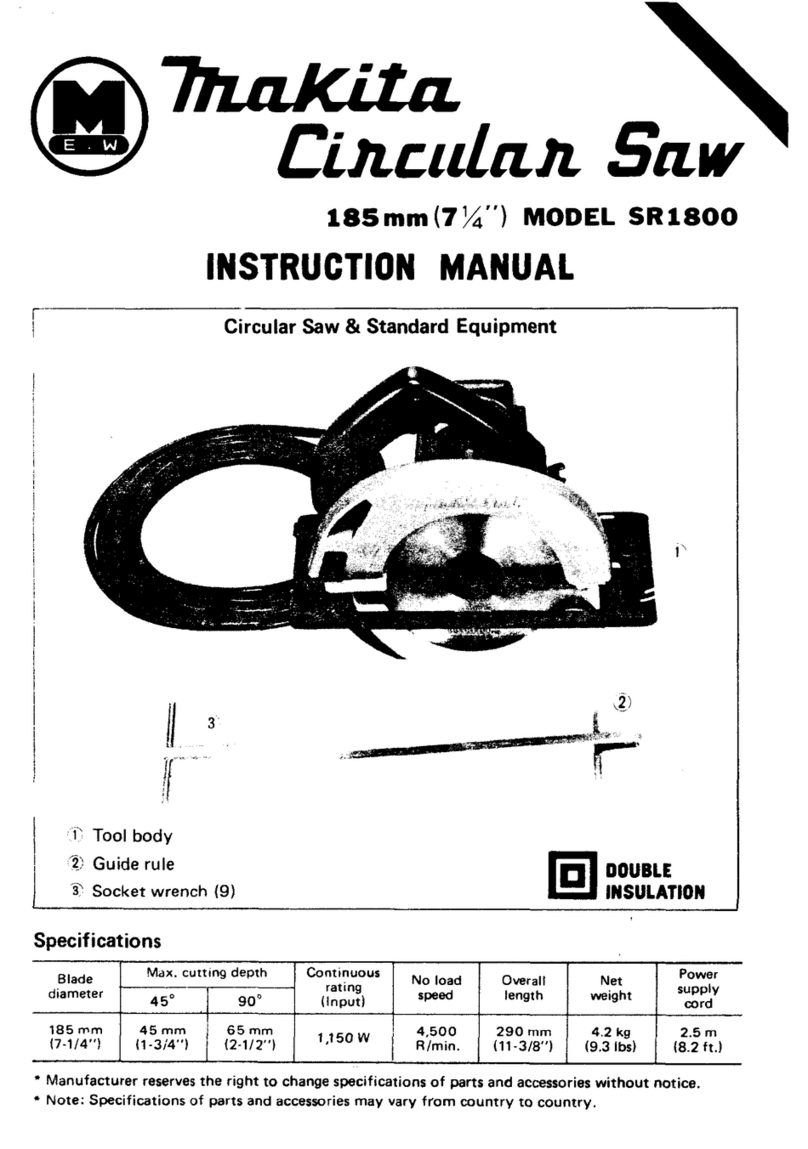
Makita LS1040 User manual

LS1040
LS1040S
LS1040F
LS1040FS
EN Compound Miter Saw INSTRUCTION MANUAL 8
UK Комбінована торцювальна
пила ІНСТРУКЦІЯ З
ЕКСПЛУАТАЦІЇ 17
PL Ukośnica INSTRUKCJA OBSŁUGI 27
RO Ferăstrău pentru tăieri oblice
combinate MANUAL DE INSTRUCŢIUNI 38
DE Kapp-und Gehrungssäge BEDIENUNGSANLEITUNG 48
HU Kombinált gérvágó HASZNÁLATI KÉZIKÖNYV 59
SK Zložená píla na zrezávanie NÁVOD NA OBSLUHU 69
CS Pokosová pila NÁVOD K OBSLUZE 79

1
2
3
12
34
1
ɸ9x 2
185 mm 219 mm
11
1
1
12
Fig.1
Fig.2
Fig.3
Fig.4
Fig.5
Fig.6
Fig.7
Fig.8
2

1
2
2
1
3
1
2
3
4
1
1
23
231
1
1
2
Fig.9
Fig.10
Fig.11
Fig.12
Fig.13
Fig.14
Fig.15
Fig.16
3

1
3
4
2
1
2
21 43
1
23
4
5
6
Fig.21
1
2
3
12
1
Fig.17
Fig.18
Fig.19
Fig.20
Fig.22
Fig.23
Fig.24
4

1
1
2
3
6
4
57
12
3
4
12
2
1
1
2
3
4
5
Fig.25
Fig.26
Fig.27
Fig.28
Fig.29
Fig.30
Fig.31
Fig.32
5

1
2
3
1
1
3
1
2
2
3
1
1
2
3
12
3
4
Fig.33
Fig.34
Fig.35
Fig.36
Fig.37
Fig.38
Fig.39
Fig.40
6

1
23
4
1
2
34
1
5
1
12
Fig.41
Fig.42
Fig.43
Fig.44
7

8ENGLISH
ENGLISH (Original instructions)
SPECIFICATIONS
Model LS1040 / LS1040S LS1040F / LS1040FS
Blade diameter 255 mm - 260 mm
Hole diameter For all countries other than
European countries
25.4 mm, 25 mm or 30 mm (Country specic)
For European countries 30 mm
Max. kerf thickness of the saw blade 3.2 mm
Max. Miter angle Left 45°, Right 52°
Max. Bevel angle Left 45°
No load speed 5,100 min-1
Dimensions (L x W x H) 530 mm x 476 mm x 532 mm
Net weight 11.8 kg 12.0 kg
Safety class /II
• Due to our continuing program of research and development, the specications herein are subject to change
without notice.
• Specications may differ from country to country.
• Weight according to EPTA-Procedure 01/2014
Max. Cutting capacities (H x W) with blade 260 mm in diameter
Bevel angle Miter angle
0° 45° (left and right)
0° 93 mm x 95 mm 93 mm x 67 mm
69 mm x 135 mm 69 mm x 95 mm
45° (left) 53 mm x 95 mm 49 mm x 67 mm
35 mm x 135 mm 35 mm x 94 mm
Symbols
The following show the symbols used for the equip-
ment. Be sure that you understand their meaning before
use.
Read instruction manual.
DOUBLE INSULATION
To avoid injury from ying debris, keep
holding the saw head down, after making
cuts, until the blade has come to a com-
plete stop.
Do not place hand or ngers close to the
blade.
For your safety, remove the chips, small
pieces, etc. from the table top before
operation.
Always set SUB-FENCE to left position
when performing left bevel cuts. Failure to
do so may cause serious injury to operator.
To loosen the bolt, turn it clockwise.
Only for EU countries
Do not dispose of electric equipment
together with household waste material!
In observance of the European Directive,
on Waste Electric and Electronic
Equipment and its implementation in
accordance with national law, electric
equipment that have reached the end of
their life must be collected separately and
returned to an environmentally compatible
recycling facility.
Intended use
The tool is intended for accurate straight and miter
cutting in wood. With appropriate saw blades, aluminum
can also be sawed.
Power supply
The tool should be connected only to a power supply of
the same voltage as indicated on the nameplate, and
can only be operated on single-phase AC supply. They
are double-insulated and can, therefore, also be used
from sockets without earth wire.

9ENGLISH
For public low-voltage distribution
systems of between 220 V and 250 V
For Model LS1040
Switching operations of electric apparatus cause voltage
uctuations. The operation of this device under unfavor-
able mains conditions can have adverse effects to the
operation of other equipment. With a mains impedance
equal or less than 0.29 Ohms it can be presumed that
there will be no negative effects. The mains socket used
for this device must be protected with a fuse or protective
circuit breaker having slow tripping characteristics.
For Model LS1040F
Switching operations of electric apparatus cause voltage
uctuations. The operation of this device under unfavor-
able mains conditions can have adverse effects to the
operation of other equipment. With a mains impedance
equal or less than 0.34 Ohms it can be presumed that
there will be no negative effects. The mains socket used
for this device must be protected with a fuse or protec-
tive circuit breaker having slow tripping characteristics.
Noise
The typical A-weighted noise level determined accord-
ing to EN62841-3-9:
Sound pressure level (LpA) : 91 dB(A)
Sound power level (LWA) : 101 dB (A)
Uncertainty (K) : 3 dB(A)
NOTE:
The declared noise emission value(s) has been
measured in accordance with a standard test method
and may be used for comparing one tool with another.
NOTE:
The declared noise emission value(s) may
also be used in a preliminary assessment of exposure.
WARNING: Wear ear protection.
WARNING: The noise emission during actual
use of the power tool can differ from the declared
value(s) depending on the ways in which the
tool is used especially what kind of workpiece is
processed.
WARNING: Be sure to identify safety mea-
sures to protect the operator that are based on an
estimation of exposure in the actual conditions of
use (taking account of all parts of the operating
cycle such as the times when the tool is switched
off and when it is running idle in addition to the
trigger time).
Vibration
The vibration total value (tri-axial vector sum) deter-
mined according to EN62841-3-9:
Vibration emission (ah) : 2.5 m/s2or less
Uncertainty (K) : 1.5 m/s2
NOTE: The declared vibration total value(s) has been
measured in accordance with a standard test method
and may be used for comparing one tool with another.
NOTE: The declared vibration total value(s) may also
be used in a preliminary assessment of exposure.
WARNING: The vibration emission during
actual use of the power tool can differ from the
declared value(s) depending on the ways in which
the tool is used especially what kind of workpiece
is processed.
WARNING: Be sure to identify safety mea-
sures to protect the operator that are based on an
estimation of exposure in the actual conditions of
use (taking account of all parts of the operating
cycle such as the times when the tool is switched
off and when it is running idle in addition to the
trigger time).
EC Declaration of Conformity
For European countries only
The EC declaration of conformity is included as Annex A
to this instruction manual.
General power tool safety warnings
WARNING: Read all safety warnings, instruc-
tions, illustrations and specications provided
with this power tool. Failure to follow all instructions
listed below may result in electric shock, re and/or
serious injury.
Save all warnings and instruc-
tions for future reference.
The term "power tool" in the warnings refers to your
mains-operated (corded) power tool or battery-operated
(cordless) power tool.
Safety instructions for mitre saws
1. Mitre saws are intended to cut wood or wood-
like products, they cannot be used with abra-
sive cut-off wheels for cutting ferrous material
such as bars, rods, studs, etc. Abrasive dust
causes moving parts such as the lower guard to
jam. Sparks from abrasive cutting will burn the
lower guard, the kerf insert and other plastic parts.
2. Use clamps to support the workpiece when-
ever possible. If supporting the workpiece
by hand, you must always keep your hand at
least 100 mm from either side of the saw blade.
Do not use this saw to cut pieces that are too
small to be securely clamped or held by hand.
If your hand is placed too close to the saw blade,
there is an increased risk of injury from blade
contact.
3. The workpiece must be stationary and
clamped or held against both the fence and the
table. Do not feed the workpiece into the blade
or cut "freehand" in any way. Unrestrained
or moving workpieces could be thrown at high
speeds, causing injury.
4. Never cross your hand over the intended line
of cutting either in front or behind the saw
blade. Supporting the workpiece "cross handed"
i.e. holding the workpiece to the right of the saw
blade with your left hand or vice versa is very
dangerous.

10 ENGLISH
► Fig.1
5. Do not reach behind the fence with either hand
closer than 100 mm from either side of the saw
blade, to remove wood scraps, or for any other
reason while the blade is spinning. The proxim-
ity of the spinning saw blade to your hand may not
be obvious and you may be seriously injured.
6. Inspect your workpiece before cutting. If the
workpiece is bowed or warped, clamp it with
the outside bowed face toward the fence.
Always make certain that there is no gap
between the workpiece, fence and table along
the line of the cut. Bent or warped workpieces
can twist or shift and may cause binding on the
spinning saw blade while cutting. There should be
no nails or foreign objects in the workpiece.
7.
Do not use the saw until the table is clear of all tools,
wood scraps, etc., except for the workpiece. Small
debris or loose pieces of wood or other objects that con-
tact the revolving blade can be thrown with high speed.
8.
Cut only one workpiece at a time. Stacked multiple
workpieces cannot be adequately clamped or braced
and may bind on the blade or shift during cutting.
9.
Ensure the mitre saw is mounted or placed on a level,
rm work surface before use. A level and rm work sur-
face reduces the risk of the mitre saw becoming unstable.
10.
Plan your work. Every time you change the bevel
or mitre angle setting, make sure the adjustable
fence is set correctly to support the workpiece
and will not interfere with the blade or the guard-
ing system. Without turning the tool "ON" and with
no workpiece on the table, move the saw blade
through a complete simulated cut to assure there will
be no interference or danger of cutting the fence.
11. Provide adequate support such as table exten-
sions, saw horses, etc. for a workpiece that is
wider or longer than the table top. Workpieces
longer or wider than the mitre saw table can tip
if not securely supported. If the cut-off piece or
workpiece tips, it can lift the lower guard or be
thrown by the spinning blade.
12.
Do not use another person as a substitute for a
table extension or as additional support. Unstable
support for the workpiece can cause the blade to bind
or the workpiece to shift during the cutting operation
pulling you and the helper into the spinning blade.
13.
The cut-off piece must not be jammed or pressed
by any means against the spinning saw blade. If
conned, i.e. using length stops, the cut-off piece could
get wedged against the blade and thrown violently.
14. Always use a clamp or a xture designed to
properly support round material such as rods
or tubing. Rods have a tendency to roll while
being cut, causing the blade to "bite" and pull the
work with your hand into the blade.
15. Let the blade reach full speed before contact-
ing the workpiece. This will reduce the risk of the
workpiece being thrown.
16. If the workpiece or blade becomes jammed,
turn the mitre saw off. Wait for all moving
parts to stop and disconnect the plug from
the power source and/or remove the battery
pack. Then work to free the jammed material.
Continued sawing with a jammed workpiece could
cause loss of control or damage to the mitre saw.
17. After nishing the cut, release the switch,
hold the saw head down and wait for the blade
to stop before removing the cut-off piece.
Reaching with your hand near the coasting blade
is dangerous.
18. Hold the handle rmly when making an incom-
plete cut or when releasing the switch before
the saw head is completely in the down posi-
tion. The braking action of the saw may cause
the saw head to be suddenly pulled downward,
causing a risk of injury.
19. Only use the saw blade with the diameter that
is marked on the tool or specied in the man-
ual. Use of an incorrectly sized blade may affect
the proper guarding of the blade or guard opera-
tion which could result in serious personal injury.
20. Only use the saw blades that are marked with
a speed equal or higher than the speed marked
on the tool.
21. Do not use the saw to cut other than wood,
aluminum or similar materials.
22. (For European countries only)
Always use the blade which conforms to
EN847-1.
Additional instructions
1. Make workshop kid proof with padlocks.
2. Never stand on the tool. Serious injury could
occur if the tool is tipped or if the cutting tool is
unintentionally contacted.
3. Never leave the tool running unattended. Turn
the power off. Do not leave tool until it comes
to a complete stop.
4. Do not operate saw without guards in place.
Check blade guard for proper closing before
each use. Do not operate saw if blade guard
does not move freely and close instantly.
Never clamp or tie the blade guard into the
open position.
5. Keep hands out of path of saw blade. Avoid
contact with any coasting blade. It can still
cause severe injury.
6. Always secure all moving portions before
carrying the tool.
7. Stopper pin which locks the cutter head down
is for carrying and storage purposes only and
not for any cutting operations.
8. Check the blade carefully for cracks or dam-
age before operation. Replace cracked or dam-
aged blade immediately. Gum and wood pitch
hardened on blades slows saw and increases
potential for kickback. Keep blade clean by
rst removing it from tool, then cleaning it with
gum and pitch remover, hot water or kerosene.
Never use gasoline to clean blade.
9. Use only anges specied for this tool.
10. Be careful not to damage the arbor, anges
(especially the installing surface) or bolt.
Damage to these parts could result in blade
breakage.
11. Make sure that the turn base is properly
secured so it will not move during operation.
Use the holes in the base to fasten the saw to a
stable work platform or bench. NEVER use tool
where operator positioning would be awkward.
Other manuals for LS1040
20
This manual suits for next models
3
Table of contents
Languages:
Other Makita Saw manuals

Makita
Makita JR140D User manual

Makita
Makita SP001G User manual

Makita
Makita 2704 User manual

Makita
Makita 5104 User manual

Makita
Makita 5604R User manual

Makita
Makita LS1016 User manual

Makita
Makita 5143R User manual

Makita
Makita LS1212 User manual

Makita
Makita JR3000V User manual

Makita
Makita EA3200S User manual

Makita
Makita DPB181 User manual

Makita
Makita DLW140 User manual

Makita
Makita BJR181 Manual

Makita
Makita LS1040 User manual

Makita
Makita LS1040F User manual

Makita
Makita JR3060T User manual

Makita
Makita DLS212 User manual

Makita
Makita 5036DWB Quick start guide

Makita
Makita LS0810 User manual

Makita
Makita BPB180 User manual