
Makita DMC300 User manual

DMC300
EN Cordless Compact Cut O INSTRUCTION MANUAL 8
PL Akumulatorowa Przecinarka
Kątowa INSTRUKCJA OBSŁUGI 17
HU Akkumulátoros kompakt
gyorsdaraboló HASZNÁLATI KÉZIKÖNYV 27
SK Akumulátorová kompaktná
rozbrusovačka NÁVOD NA OBSLUHU 37
CS Akumulátorová kompaktní
řezačka NÁVOD K OBSLUZE 46
UK Бездротова компактна
відрізна пила ІНСТРУКЦІЯ З
ЕКСПЛУАТАЦІЇ 55
RO Mașină de debitat compactă
fără cablu MANUAL DE INSTRUCŢIUNI 65
DE Akku-Winkelschleifer BETRIEBSANLEITUNG 75

2
1
2
3
Fig.1
1
2
Fig.2
1
2
Fig.3
1
Fig.4
1
2
1
2
1
Fig.5
1
2
1
1
2
Fig.6
1
2
Fig.7

3
1
2
Fig.8
1
Fig.9
1
Fig.10
1
3
2
Fig.11
1
3
2
3
Fig.12
4
1
2
3
4
Fig.13
1
Fig.14
1
2
3
4
5
Fig.15
1
2
3
4
5
Fig.16
1
2
3
Fig.17
1
Fig.18

5
12
3
4
Fig.19
1
2
Fig.20
2
1
Fig.21
1
2
3
Fig.22
1
2
3
4
5
Fig.23
1
2
Fig.24

6
1
2
Fig.25
Fig.26
Fig.27
Fig.28
Fig.29
7
12
Fig.30
1
2
Fig.31
8ENGLISH
ENGLISH (Original instructions)
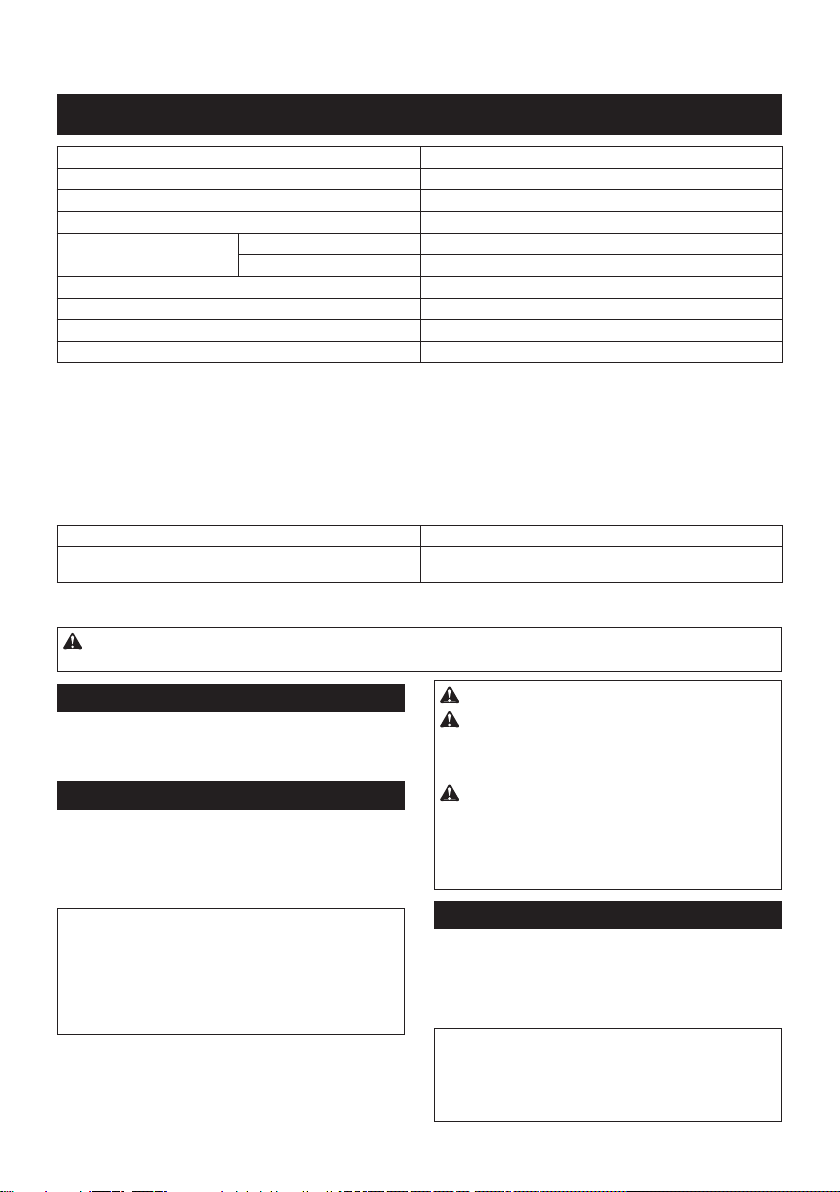
SPECIFICATIONS
Model: DMC300
Wheel outer diameter 76 mm
Wheel inner (arbor) diameter 10.0 mm / 9.5 mm (3/8″) (country specic)
Max. wheel thickness 1.0 mm
Max. cutting capacities With dust collect cover 13.5 mm
Without dust collect cover 16.0 mm
Rated speed (n) / No load speed (n0)20,000 min-1
Overall length 271 mm *1
Rated voltage D.C. 18 V
Net weight 1.2 - 1.7 kg
*1. With battery cartridge (BL1860B) / Without dust collection cover
• Due to our continuing program of research and development, the specications herein are subject to change
without notice.
• Specications and battery cartridge may dier from country to country.
• The weight may dier depending on the attachment(s), including the battery cartridge. The lightest and heavi-
est combinations, according to EPTA-Procedure 01/2014, are shown in the table.
Applicable battery cartridge and charger
Battery cartridge BL1815N / BL1820B / BL1830B / BL1840B / BL1850B / BL1860B
Charger DC18RC / DC18RD / DC18RE / DC18SD / DC18SE / DC18SF /
DC18SH / DC18WC
• Some of the battery cartridges and chargers listed above may not be available depending on your region of
residence.
WARNING: Only use the battery cartridges and chargers listed above. Use of any other battery cartridges
and chargers may cause injury and/or re.
Intended use
The tool is intended for cutting a sheet, tting, pipe, tile
or wall in metal, plastic, ceramic, plaster and similar
composite materials without use of water.
Noise
The typical A-weighted noise level determined accord-
ing to EN60745-2-22:
Sound pressure level (LpA) : 88 dB (A)
Sound power level (LWA) : 99 dB (A)
Uncertainty (K) : 3 dB (A)
NOTE: The declared noise emission value(s) has
been measured in accordance with a standard test
method and may be used for comparing one tool with
another.
NOTE: The declared noise emission value(s)
may also be used in a preliminary assessment of
exposure.
WARNING: Wear ear protection.
WARNING:
The noise emission during actual
use of the power tool can dier from the declared
value(s) depending on the ways in which the tool is
used especially what kind of workpiece is processed.
WARNING:
Be sure to identify safety measures
to protect the operator that are based on an estima-
tion of exposure in the actual conditions of use (tak-
ing account of all parts of the operating cycle such
as the times when the tool is switched o and when
it is running idle in addition to the trigger time).
Vibration
The vibration total value (tri-axial vector sum) deter-
mined according to EN60745-2-22:
Work mode: concrete cutting (thickness 5 mm)
Vibration emission (ah) : 3.0 m/s2
Uncertainty (K) : 1.5 m/s2
NOTE: The declared vibration total value(s) has been
measured in accordance with a standard test method
and may be used for comparing one tool with another.
NOTE: The declared vibration total value(s) may also
be used in a preliminary assessment of exposure.

9ENGLISH
WARNING: The vibration emission during
actual use of the power tool can dier from the
declared value(s) depending on the ways in which
the tool is used especially what kind of workpiece
is processed.
WARNING: Be sure to identify safety mea-
sures to protect the operator that are based on an
estimation of exposure in the actual conditions of
use (taking account of all parts of the operating
cycle such as the times when the tool is switched
o and when it is running idle in addition to the
trigger time).
Declarations of Conformity
For European countries only
The Declarations of conformity are included in Annex A
to this instruction manual.
SAFETY WARNINGS
General power tool safety warnings
WARNING Read all safety warnings, instruc-
tions, illustrations and specications provided with
this power tool. Failure to follow all instructions listed
below may result in electric shock, re and/or serious
injury.
Save all warnings and instruc-
tions for future reference.
The term "power tool" in the warnings refers to your
mains-operated (corded) power tool or battery-operated
(cordless) power tool.
Compact cut o safety warnings
1. The guard provided with the tool must be
securely attached to the power tool and
positioned for maximum safety, so the least
amount of wheel is exposed towards the oper-
ator. Position yourself and bystanders away
from the plane of the rotating wheel. The guard
helps to protect operator from broken wheel frag-
ments and accidental contact with wheel.
2. Use only bonded reinforced or diamond cut-o
wheels for your power tool. Just because an
accessory can be attached to your power tool, it
does not assure safe operation.
3. The rated speed of the accessory must be at
least equal to the maximum speed marked on
the power tool. Accessories running faster than
their rated speed can break and y apart.
4. Wheels must be used only for recommended
applications. For example: do not grind with
the side of cut-o wheel. Abrasive cut-o wheels
are intended for peripheral grinding, side forces
applied to these wheels may cause them to
shatter.
5. Always use undamaged wheel anges that are
of correct diameter for your selected wheel.
Proper wheel anges support the wheel thus
reducing the possibility of wheel breakage.
6. Do not use worn down reinforced wheels from
larger power tools. Wheels intended for a larger
power tool are not suitable for the higher speed of
a smaller tool and may burst.
7. The outside diameter and the thickness of your
accessory must be within the capacity rating
of your power tool. Incorrectly sized accessories
cannot be adequately guarded or controlled.
8. The arbour size of wheels and anges must
properly t the spindle of the power tool.
Wheels and anges with arbour holes that do not
match the mounting hardware of the power tool
will run out of balance, vibrate excessively and
may cause loss of control.
9. Do not use damaged wheels. Before each
use, inspect the wheels for chips and cracks.
If power tool or wheel is dropped, inspect for
damage or install an undamaged wheel. After
inspecting and installing the wheel, position
yourself and bystanders away from the plane
of the rotating wheel and run the power tool
at maximum no load speed for one minute.
Damaged wheels will normally break apart during
this test time.
10. Wear personal protective equipment. Always
wear hearing protection. Depending on
application, use face shield, safety goggles
or safety glasses. As appropriate, wear dust
mask, gloves and shop apron capable of stop-
ping small abrasive or workpiece fragments.
The eye protection must be capable of stopping
ying debris generated by various operations.
The dust mask or respirator must be capable of
ltrating particles generated by your operation.
Prolonged exposure to high intensity noise may
cause hearing loss.
11. Keep bystanders a safe distance away from
work area. Anyone entering the work area
must wear personal protective equipment.
Fragments of workpiece or of a broken wheel may
y away and cause injury beyond immediate area
of operation.
12. Hold the power tool by insulated gripping
surfaces only, when performing an operation
where the cutting accessory may contact hid-
den wiring. Cutting accessory contacting a “live”
wire may make exposed metal parts of the power
tool “live” and could give the operator an electric
shock.
13. Never lay the power tool down until the acces-
sory has come to a complete stop. The spinning
wheel may grab the surface and pull the power
tool out of your control.
14. Do not run the power tool while carrying it at
your side. Accidental contact with the spinning
accessory could snag your clothing, pulling the
accessory into your body.
15. Regularly clean the power tool’s air vents. The
motorʼs fan will draw the dust inside the housing
and excessive accumulation of powdered metal
may cause electrical hazards.

10 ENGLISH
16. Do not operate the power tool near ammable
materials. Sparks could ignite these materials.
17. Do not use accessories that require liquid
coolants. Using water or other liquid coolants
may result in electrocution or shock.
Kickback and related warnings
Kickback is a sudden reaction to a pinched or snagged
rotating wheel. Pinching or snagging causes rapid
stalling of the rotating wheel which in turn causes the
uncontrolled power tool to be forced in the direction
opposite of the wheel’s rotation at the point of the
binding.
For example, if an abrasive wheel is snagged or
pinched by the workpiece, the edge of the wheel that is
entering into the pinch point can dig into the surface of
the material causing the wheel to climb out or kick out.
The wheel may either jump toward or away from the
operator, depending on direction of the wheel’s move-
ment at the point of pinching. Abrasive wheels may also
break under these conditions.
Kickback is the result of power tool misuse and/or
incorrect operating procedures or conditions and can be
avoided by taking proper precautions as given below.
1. Maintain a rm grip on the power tool and
position your body and arm to allow you to
resist kickback forces. Always use auxiliary
handle, if provided, for maximum control over
kickback or torque reaction during start-up.
The operator can control torque reactions or kick-
back forces, if proper precautions are taken.
2. Never place your hand near the rotating acces-
sory. Accessory may kickback over your hand.
3. Do not position your body in line with the
rotating wheel. Kickback will propel the tool in
direction opposite to the wheel’s movement at the
point of snagging.
4. Use special care when working corners, sharp
edges etc. Avoid bouncing and snagging the
accessory. Corners, sharp edges or bouncing
have a tendency to snag the rotating accessory
and cause loss of control or kickback.
5. Do not attach a saw chain, woodcarving blade,
segmented diamond wheel with a peripheral
gap greater than 10 mm or toothed saw blade.
Such blades create frequent kickback and loss of
control.
6. Do not “jam” the wheel or apply excessive
pressure. Do not attempt to make an excessive
depth of cut. Overstressing the wheel increases
the loading and susceptibility to twisting or binding
of the wheel in the cut and the possibility of kick-
back or wheel breakage.
7. When wheel is binding or when interrupting
a cut for any reason, switch o the power
tool and hold the power tool motionless until
the wheel comes to a complete stop. Never
attempt to remove the wheel from the cut while
the wheel is in motion otherwise kickback may
occur. Investigate and take corrective action to
eliminate the cause of wheel binding.
8. Do not restart the cutting operation in the
workpiece. Let the wheel reach full speed and
carefully re-enter the cut. The wheel may bind,
walk up or kickback if the power tool is restarted in
the workpiece.
9. Support panels or any oversized workpiece to
minimize the risk of wheel pinching and kick-
back. Large workpieces tend to sag under their
own weight. Supports must be placed under the
workpiece near the line of cut and near the edge
of the workpiece on both sides of the wheel.
10. Use extra caution when making a “pocket cut”
into existing walls or other blind areas. The
protruding wheel may cut gas or water pipes, elec-
trical wiring or objects that can cause kickback.
11. Before using a segmented diamond wheel,
make sure that the diamond wheel has the
peripheral gap between segments of 10 mm or
less, only with a negative rake angle.
Additional Safety Warnings:
1. Never attempt to cut with the tool held upside
down in a vise. This can lead to serious acci-
dents, because it is extremely dangerous.
2. Check that the workpiece is properly
supported.
3. Some material contains chemicals which may
be toxic. Take caution to prevent dust inhala-
tion and skin contact. Follow material supplier
safety data.
4. Store wheels as per manufacturer recom-
mendations. Improper storage may damage the
wheels.
SAVE THESE INSTRUCTIONS.
WARNING: DO NOT let comfort or familiarity
with product (gained from repeated use) replace
strict adherence to safety rules for the subject
product. MISUSE or failure to follow the safety
rules stated in this instruction manual may cause
serious personal injury.
Important safety instructions for
battery cartridge
1. Before using battery cartridge, read all instruc-
tions and cautionary markings on (1) battery
charger, (2) battery, and (3) product using
battery.
2. Do not disassemble or tamper with the battery
cartridge. It may result in a re, excessive heat,
or explosion.
3. If operating time has become excessively
shorter, stop operating immediately. It may
result in a risk of overheating, possible burns
and even an explosion.
4. If electrolyte gets into your eyes, rinse them
out with clear water and seek medical atten-
tion right away. It may result in loss of your
eyesight.
5. Do not short the battery cartridge:
(1) Do not touch the terminals with any con-
ductive material.
(2) Avoid storing battery cartridge in a con-
tainer with other metal objects such as
nails, coins, etc.
(3) Do not expose battery cartridge to water
or rain.
Other manuals for DMC300
7
Table of contents
Languages:
Other Makita Cordless Saw manuals

Makita
Makita JV143D User manual

Makita
Makita DPB184 User manual

Makita
Makita UC007G User manual

Makita
Makita JV102D User manual

Makita
Makita BJR240 User manual

Makita
Makita 4331D User manual

Makita
Makita DHS660RTJ User manual

Makita
Makita M4301 User manual

Makita
Makita DSS610RMJ User manual

Makita
Makita JR103D User manual

Makita
Makita BLS712 User manual

Makita
Makita DHS711 User manual

Makita
Makita XRJ05 User manual

Makita
Makita JR3000V User manual

Makita
Makita 4300D User manual

Makita
Makita DJR188ZJ User manual

Makita
Makita DHS782 User manual

Makita
Makita DHS661 User manual

Makita
Makita DJV140 User manual

Makita
Makita DHS680 User manual


