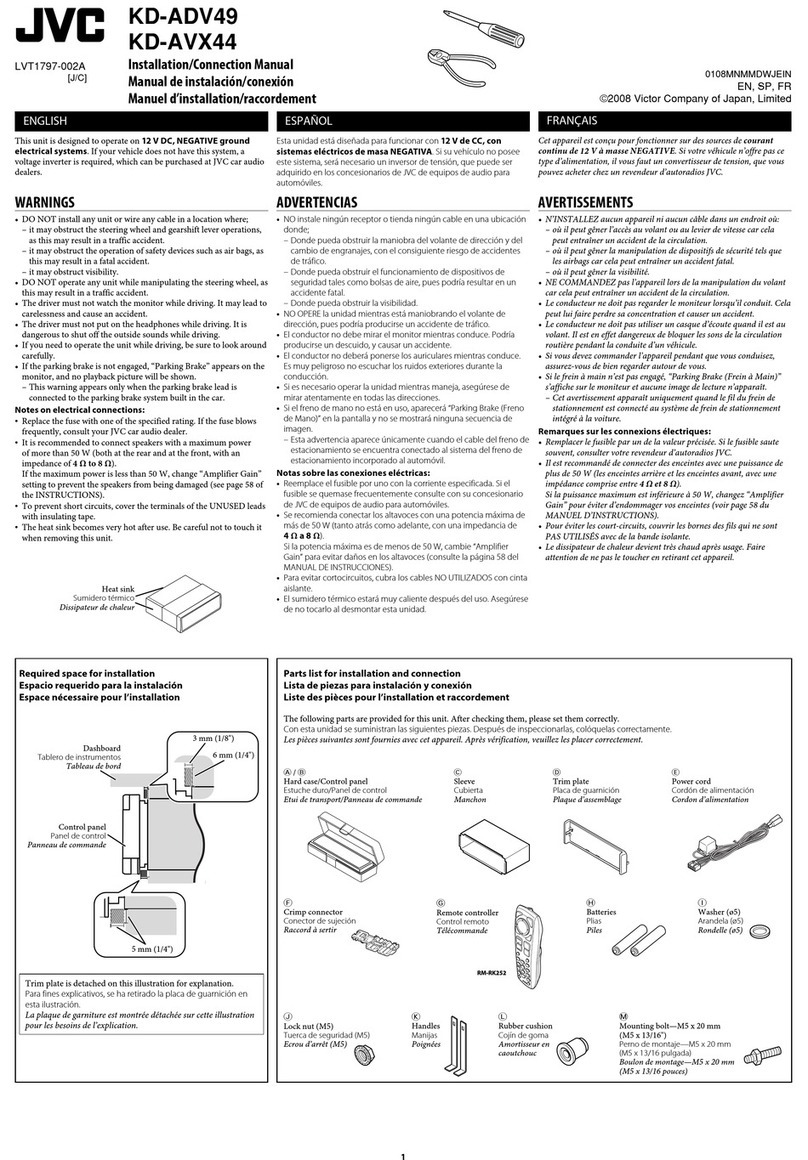
JVC KD-SV3000 User manual

SERVICE MANUAL
COPYRIGHT © 2003 VICTOR COMPANY OF JAPAN, LIMITED No.49837
2003/6
VCD/CD RECEIVER
4983720036KD-SV3000
TABLE OF CONTENTS
1 Precautions . . . . . . . . . . . . . . . . . . . . . . . . . . . . . . . . . . . . . . . . . . . . . . . . . . . . . . . . . . . . . . . . . . . . . . . . . . 1-3
2 Disassembly method . . . . . . . . . . . . . . . . . . . . . . . . . . . . . . . . . . . . . . . . . . . . . . . . . . . . . . . . . . . . . . . . . . 1-5
3 Adjustment. . . . . . . . . . . . . . . . . . . . . . . . . . . . . . . . . . . . . . . . . . . . . . . . . . . . . . . . . . . . . . . . . . . . . . . . . . 1-24
4 Description of major ICs. . . . . . . . . . . . . . . . . . . . . . . . . . . . . . . . . . . . . . . . . . . . . . . . . . . . . . . . . . . . . . . 1-27
Area Suffix
U --------------------- Other Areas
VIDEO CD
P
BC
E
N
T
E
R
C
D
E
Q
F
M
/
A
M
V
O
L
DOWN
UP
ATT
O
S
D
A
UD
I
O
123
456
78
0
9
R
E
T
URN

1-2 (No.49837)
SPECIFICATION
Design and specifications are subject to change without notice.
AUDIO AMPLIFIER
SECTION Maximum Power
Output Front 50 W per channel
Rear 50 W per channel
Continuous Power
Output (RMS): Front 19 W per channel into 4 Ω40 Hz to 20 000 Hz
at no more than 0.8% total harmonic distortion.
Rear 19 W per channel into 4 Ω40 Hz to 20 000 Hz
at no more than 0.8% total harmonic distortion.
Load Impedance 4 Ω(4 Ωto 8 Ωallowance)
Tone Control Rang Bass ±10 dB at 100 Hz
Treble ±10 dB at 10 kHz
Frequency Response 40 Hz to 20 000 Hz
Signal-to-Noise Ratio 70 dB
Line-Out Level/Impedance 2.0 V/20 kΩload (full scale)
Output Impedance 1 kΩ
VIDEO SECTION Color system PAL/NTSC
Video output (composite) 1Vp-p/75Ω
TUNER SECTION Frequency Range FM 87.5 MHz to 108 MHz
AM 531 kHz to 1 602 kHz
[FM Tuner] Usable Sensitivity 11.3 dBf (1.0 µV/75 Ω)
50 dB Quieting Sensitivity 16.3 dBf (1.8 µV/75 Ω)
Alternate Channel Selectivity (400 kHz) 65 dB
Frequency Response 40 Hz to 15 000 Hz
Stereo Separation 35 dB
Capture Ratio 1.5 dB
[AM Tuner] Sensitivity 20 µV
Selectivity 35 dB
CD PLAYER SECTION Type Compact disc player
Signal Detection System Non-contact optical pickup (semiconductor la-
ser)
Number of channels 2 channels (stereo)
Frequency Response 5 Hz to 20 000 Hz
Dynamic Range 88 dB
Signal-to-Noise Ratio 90 dB
Wow and Flutter Less than measurable limit
MP3 decoding format MPEG1 Audio Layer 3
Max. Bit Rate 320 Kbps
GENERAL Power Requirement Operating Voltage: DC 14.4 V (11 V to 16 V al-
lowance)
Grounding System Negative ground
Allowable Operating Temperature 0ºC to +40ºC
Dimensions
(W ×H ×D) Installation Size (approx.) 182 mm ×52 mm ×150 mm
Panel Size (approx.) 188 mm ×58 mm ×11 mm
Mass (approx.) 1.3 kg (excluding accessories)

(No.49837)1-3
SECTION 1
Precautions
1.1 Safety Precautions
!Burrs formed during molding may be left over on some parts of the chassis. Therefore,
pay attention to such burrs in the case of preforming repair of this system.
!Please use enough caution not to see the beam directly or touch it in case of an
adjustment or operation check.

1-4 (No.49837)
1.2 Preventing static electricity
Electrostatic discharge (ESD), which occurs when static electricity stored in the body, fabric, etc. is discharged, can destroy the laser
diode in the traverse unit (optical pickup). Take care to prevent this when performing repairs.
1.2.1 Grounding to prevent damage by static electricity
Static electricity in the work area can destroy the optical pickup (laser diode) in devices such as CD players.
Be careful to use proper grounding in the area where repairs are being performed.
(1) Ground the workbench
Ground the workbench by laying conductive material (such as a conductive sheet) or an iron plate over it before placing the
traverse unit (optical pickup) on it.
(2) Ground yourself
Use an anti-static wrist strap to release any static electricity built up in your body.
(3) Handling the optical pickup
• In order to maintain quality during transport and before installation, both sides of the laser diode on the replacement optical
pickup are shorted. After replacement, return the shorted parts to their original condition.
(Refer to the text.)
• Do not use a tester to check the condition of the laser diode in the optical pickup. The tester's internal power source can easily
destroy the laser diode.
1.3 Handling the traverse unit (optical pickup)
(1) Do not subject the traverse unit (optical pickup) to strong shocks, as it is a sensitive, complex unit.
(2) Cut off the shorted part of the flexible cable using nippers, etc. after replacing the optical pickup. For specific details, refer to the
replacement procedure in the text. Remove the anti-static pin when replacing the traverse unit. Be careful not to take too long a
time when attaching it to the connector.
(3) Handle the flexible cable carefully as it may break when subjected to strong force.
(4) It is not possible to adjust the semi-fixed resistor that adjusts the laser power. Do not turn it.
1.4 Attention when traverse unit is decomposed
*Please refer to "Disassembly method" in the text for the CD pickup unit.
• Apply solder to the short land before the flexible wire is disconnected from the connector on the CD pickup unit.
(If the flexible wire is disconnected without applying solder, the CD pickup may be destroyed by static electricity.)
• In the assembly, be sure to remove solder from the short land after connecting the flexible wire.
1M
(caption)
Anti-static wrist strap
Conductive material
(conductive sheet) or iron plate
Pickup
Short-circuit point
(Soldering)
Flexible wire
Pickup
Short-circuit point

(No.49837)1-5
SECTION 2
Disassembly method
2.1 Main body
2.1.1 Removing the front panel assembly
(See Fig.1)
(1) Push the release button in the lower right part of the front
panel assembly and remove the front panel assembly.
Fig.1
2.1.2 Removing the bottom cover
(See Fig.2)
(1) Turn the main body up side down.
(2) Insert a screwdriver under the joints to release the two
joints aon the left side, two joints bon the right side and
joint con the back side of the main body, then remove the
bottom cover from the main body.
CAUTION:
When releasing the joints using a screwdriver, do not damage
the main board.
Fig.2
2.1.3 Removing the front chassis assembly
(See Fig.3)
• Prior to performing the following procedures, remove the front
panel assembly and bottom cover.
(1) Remove the screw Aon the both sides of the main body.
(2) Release the two joints dand two joints eon the both sides
of the main body, then remove the front chassis assembly
toward the front.
Fig.3
Front panel assembly
Release button
Bottom cover
Joint b
Joint b
Joint c
Joint a
Joint a
Joint d
Front chassis
A
Joint e
Joint dJoint e

1-6 (No.49837)
2.1.4 Removing the heat sink
(See Fig.4)
• Prior to performing the following procedure, remove the front
panel assembly as required.
(1) Remove the two screws Band two screws Cattaching the
heat sink on the left side of the main body, and remove the
heat sink.
Fig.4
2.1.5 Removing the rear bracket
(See Fig.5)
• Prior to performing the following procedure, remove the bottom
cover.
(1) Remove the three screws D, screw Eand six screws Fat-
taching the rear bracket on the back side of the main body.
(2) Remove the rear bracket.
Reference:
During reassembly, before fixing the rear bracket onto the
main body, insert the video out cable into the slot.
Fig.5
2.1.6 Removing the main board
(See Fig.6)
• Prior to performing the following procedure, remove the front
panel assembly, front chassis assembly, heat sink, bottom
cover and rear bracket.
(1) Remove the two screws Gattaching the main board.
(2) Disconnect the connector CN501 and remove the main
board.
Fig.6
Heat sink
CBC
FF
DD
E
Rear bracket F
Insert the video out cable
into the slot.
Main board assembly
G
G
CN501

(No.49837)1-7
2.1.7 Removing the VCD/CD mechanism board
(See Fig. 7)
• Prior to performing the following procedure, remove the front
panel assembly, front chassis assembly, heat sink, bottom
cover, rear bracket and main board.
(1) Remove the five screws Hattaching the VCD/CD mecha-
nism board.
(2) Disconnect the card wire from the connector CN601 on the
VCD/CD mechanism board.
(3) Move the VCD/CD mechanism board in the direction of the
arrow to release it from the joint f.
Fig.7
2.1.8 Removing the CD mechanism assembly
(See Fig. 8)
• Prior to performing the following procedure, remove the front
panel assembly, front chassis assembly, heat sink, bottom
cover, rear bracket, main board and VCD/CD mechanism
board.
(1) Remove the three screws Jattaching the top chassis.
(2) Take out the CD mechanism assembly.
Fig.8
H
H
VCD/CD mechanism board
CN601
Card wire
Top chassis
Joint f
J
J
CD mechanism assembly Top chassis

1-8 (No.49837)
2.1.9 Removing the front board
(See Figs.9 to 11)
• Prior to performing the following procedure, remove the front
panel assembly.
(1) Remove the four screws Kon the back side of the front
panel assembly. (See Fig.9.)
(2) Release the thirteen joints g. (See Fig.10.)
(3) Release the joint hand take out the front board. (See
Fig.11.)
Fig.9
Fig.10
Fig.11
K
K
K
Joints g
Joints gJoints g
Joints g
Joints g
Joints g
Front board Joint hFront panel assembly

(No.49837)1-9
2.2 CD Mechanism section
2.2.1 Removing the top cover
(See Figs.1 and 2)
(1) Remove the four screws Aon the both side of the body.
(2) Lift the front side of the top cover and move the top cover
backward to release the two joints a.
Fig.1
Fig.2
A
A
A
Joints a
Top cover
Joints a
Top cover

1-10 (No.49837)
2.2.2 Removing the connector board
(See Figs.3 to 5)
CAUTION:
Before disconnecting the flexible wire from the pickup, solder
the short-circuit point on the pickup. No observance of this in-
struction may cause damage of the pickup.
(1) Remove the screw Bfixing the connector board.
(2) Solder the short-circuit point on the pickup.
(3) Disconnect the flexible wire from the pickup.
(4) Move the connector board in the direction of the arrow to
release the two joints b.
(5) Unsolder the wires on the connector board if necessary.
CAUTION:
Unsolder the short-circuit point after reassembling.
Fig.3
Fig.4
Fig.5
B
Connector board
Pickup
Short-circuit point
Joints b
Wires
Pickup
Short-circuit point
(Soldering)
Flexible wire
B
Flexible wire
Connector board
Frame
Other manuals for KD-SV3000
2
Table of contents
Other JVC Car Receiver manuals