HEYER Modular
Rev. 1.1 – 07/07 HEYER Modular, Operator’s manual 9 / 50
3.1.3 Compliance compensation
The administered tidal volume is corrected to
the target value set by the user with the aid of
the compliance compensation. The system
compliance of each ventilation system i.e. the
compliance of patient hoses and the patient
module itself always leads to losses in the
administered tidal volume. In the case of the
HEYER Modular, a control loop can correct
this volume loss as an automatic
compensation function. For this purpose
several ventilation cycles are required. The
drive gas flow is then increased to just above
the normal values, i.e. values to achieve the
set ventilation volume. The correct tidal volume
is, however, administered to the patient, while
the slightly higher volume is absorbed by the
system compliance due to the effective
compliance compensation.
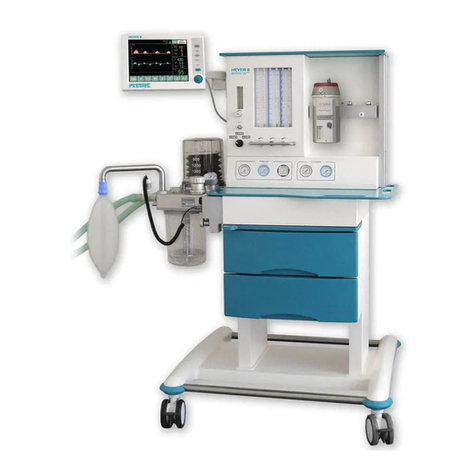
3.1.4 Bag-in-Bottle System
The so-called Bag-In-Bottle system is part of
the patient section or circuit system. The gas-
conducting sections are divided from the
ventilator into a primary (ventilator) and a
secondary circuit (patient). The gas volume
provided by the drive is not directly
administered to the patient but instead
compresses a bellows inside a pressure dome.
As a result the ventilation gas contained in the
bellows is administered to the patient. The
larger the drive volume flowing into the
pressure dome, the greater the tidal volume
will be. Once the drive gas flow has finished
the pressure compensation between the
primary and secondary circuit is also ended. A
distinctive plateau in the ventilation pressure
curve is formed if the system does not switch
over to the expiration directly after the end of
the inspiratory gas flow. For this purpose the
drive volume contained ion the pressure dome
us maintained at a steady level for some time.
The bellows are suitable for adults and
children. An exchange of the bellows for
different patient groups is not necessary.
3.2 Fresh gas dosing
The adjustment of the amounts of gas
delivered to the patient is handled at the
measuring tube block. It contains flow
measurement tubes, also described as
rotameters. These measuring tubes consist of
a vertically aligned glass tube with a floating
element inside. Since the glass tube widens
toward the top, a certain flow of gas will lift the
floating element to a corresponding height.
Adjusting the gas flow is handled by valve
spindles inside the respective measuring
tubes.
The choice between a setting of gas types
O2/AIR and/or O2/N2O is made via a change-
over switch, which opens the respective gas
line to the measuring tube block.
The fresh gas cannot be set with a mixture of
AIR and N2O as in this case a decrease of the
oxygen content to below 21% could not be
avoided.
Reducing the oxygen content to less than 21%
is theoretically also possible when dosing the
O2 and N2O gases. Such unfavorable settings
are prevented by a pneumatic safety system.
This mechanism, also described as the “Ratio
system”, ensures a steadily present minimum
content of 25% O2along with the N2O in the
gas mix dosage. When raising the flow of N2O,
the required flow of O2is also raised
automatically. The fresh gas thus adjusted will
be fed to the vaporizer automatically and
mixed with the anesthetic there.
3.3 Vaporizer mounting device and
vaporizer
The appliance contains a Selectatec®
compatible vaporizer mounting device
(standard configuration) for two vaporizers.
The vaporizer has a chamber, which contains
the anesthetic in liquid form in its lower part. A
wick made of metal mesh enriches the upper
part of the chamber with saturated vapors of
the anesthetic. The concentration of the
saturated vapor at room temperature is much
higher than is clinically justifiable. A suitable
mixing ratio of the gas with anesthetic with a
flow of gas passing by this chamber can lead
to the desired concentration. This is handled
by the adjusting wheel. This adjusts the ratio of
the streams of carrier gas via a bypass
channel and through the vaporizer chamber in
such a way that the desired concentration is
attained at the vaporizer outlet. In the zero
position of the vaporizer this bypass channel
remains open, while the vaporizer chamber is
completely closed off to the flow of gas.
The anesthetic vapor concentration in the
vaporizer chamber may be saturated, but the
absolute content of anesthetic is still
dependent on temperature. This is why there is
a temperature compensation valve in the
bypass channel, which in the case of vapor
pressure changes caused by temperature
fluctuations changes the set dilution ratio in
such a way that a temperature-independent
concentration output of the anesthetic is
warranted.
For additional indications see:
Operating instructions of the anesthetic
vaporizer used.