Häfele HH-VR302M Operation manual

EN INSTRUCTIONS FOR USE AND INSTALLATION
TH
LIB30618
REV00-100915
HH-VR302M
HH-VR604M
คู่มือการใช้งาน และ การติดตัง

2

3
EN
Dear customer! The built-in ceramic-glass cooktop is intended for household use only. Materials
used for packaging are nature friendly and may be recycled, deposited or destroyed
without any threats to the environment. In order to recognize these features, all
packing materials are marked with relevant symbols.
Once your appliance has become obsolete and you do not intend to use it any
longer, take adequate care not to litter the environment. Deposit your old appliance
with the authorized depot dealing with used household appliances.
Instruction for use Instructions for use have been prepared for the user, anddescribe the particulars
and handling of the appliance. These instructions apply to different models from the
same family of appliances, therefore you may find information and descriptions that
may not apply to your particular appliance.
Installation instruction The appliance should be connected to the power supply in accordance with the
instructions from the chapter “Electrical connections” and in line with the standing
regulations and standards. The connections should be carried out by a qualified
personnel only.
Rating plate The rating plate with basic information is located underneath the appliance.
Fire hazard protection Appliances are allowed to be mounted on one side next to a high kitchen cabinet,
the height of which may exceed that of the appliance. On the opposite side however,
only a kitchen cabinet of equal height as the appliance is allowed.
The Manufacturer strives for continuous improvements. For this reason,
the text and illustrations in this book are subject to change without notice.
Important warnings 4
Installation 5
Connection to the power supply 6
Tecnical information 7
Operation 9
Cleaning and maintenance 10
4
IMPORTANT
WARNINGS
• The appliance may be built-in and connected to the power supply only by a
qualified technician.
• The appliance and its accessible parts become hot during use. Care should be
taken to avoid touching heating elements. Children less than 8 years of age shall
be kept away unless continuously supervised.
Prevent the children to hang around the appliance and warn them properly
against the danger of burns.
• This appliance can be used by children aged from 8 years and above and persons
with reduced physical, sensory or mental capabilities or lack of experience and
knowledge if they have been given supervision or instruction concerning use of the
appliance in a safe way and understand the hazards involved. Children shall not
play with the appliance. Cleaning and user maintenance shall not be made by
children without supervision.
•WARNING: Unattended cooking on a hob with fat or oil can be dangerous and
may result in fire.Be sure have the preparation of such food (fries) under constant
control. Never try to extinguish a fire with water, but switch off the appliance and
then cover flame e.g. with a lid or a fire blanket.
•WARNING: Danger of fire: do not store items on the cooking surfaces.
•WARNING: If the surface is cracked, switch off the appliance to avoid the
possibility of electric shock.
• Do not use high-pressure steam cleaner or hot steam to clean the appliance.
• Never place any metal objects upon the induction hotplate, such as knives, forks,
spoons, pot lids, and the like, as they may get very hot.
• The hob can not be activated by external timers or remote controls systems.
• Hotplates may not be left in operation empty, without any dishes on top.
•Never use the appliance for heating the ambience.
• Never use the induction cooktop as a working surface. Sharp objects may damage
the cooktop surface.
• Preparation of food in aluminium or plastic cookware is not allowed. Never place
any plastic objects or aluminium foil upon the cooktop surface.
• In case any other appliances are plugged in the electric mains close to the
cooktop, prevent the contact of the plug cable with the hot cooking zones.
• Never keep any flammable or temperature sensitive objects, like cleaning agents,
sprays, detergents, etc., below the appliance.
• In case of any malfunctions, disconnect the appliance from the power supply and
call service department.
• The appliance is manufactured in compliance with the relevant effective safety
standards.
• Be careful not to drop objects or crockery on the ceramic glass's surface. Even
light objects (e.g. a salt shaker) can crack or damage the ceramic plate.
• If the appliance is built in over an oven with a pyrolytic system, it should not be
operated while the pyrolytic process is in progress because it can trigger the
overheating protection of the cooktop.
• Don't connect the hob to the power supply with an extension cable or multiple
sockets, because they don't assure a sufficient safety (e.g. overheating risk of
multiple sockets).
• After using the cooktop, disconnect it from the user’s interface. Do not trust the pot
detector.
• Connect the equipment to a permanent connection.
The symbol on the product or on its packaging indicates that this product may
not be treated as household waste. Instead it shall be handed over to the
applicable collection point for the recycling of electrical and electronic
equipment. By ensuring this product is disposed of correctly, you will help
prevent potential negative consequences for the environment and human
health, which could otherwise be caused by inappropriate waste handling of
this product. For more detailed information about recycling of this product,
please contact your local city office, your household waste disposal service or
the shop where you purchased the product.
5
INSTALLATION
• To avoid any possible hazard, the appliance may be installed by qualifi ed personnel only.
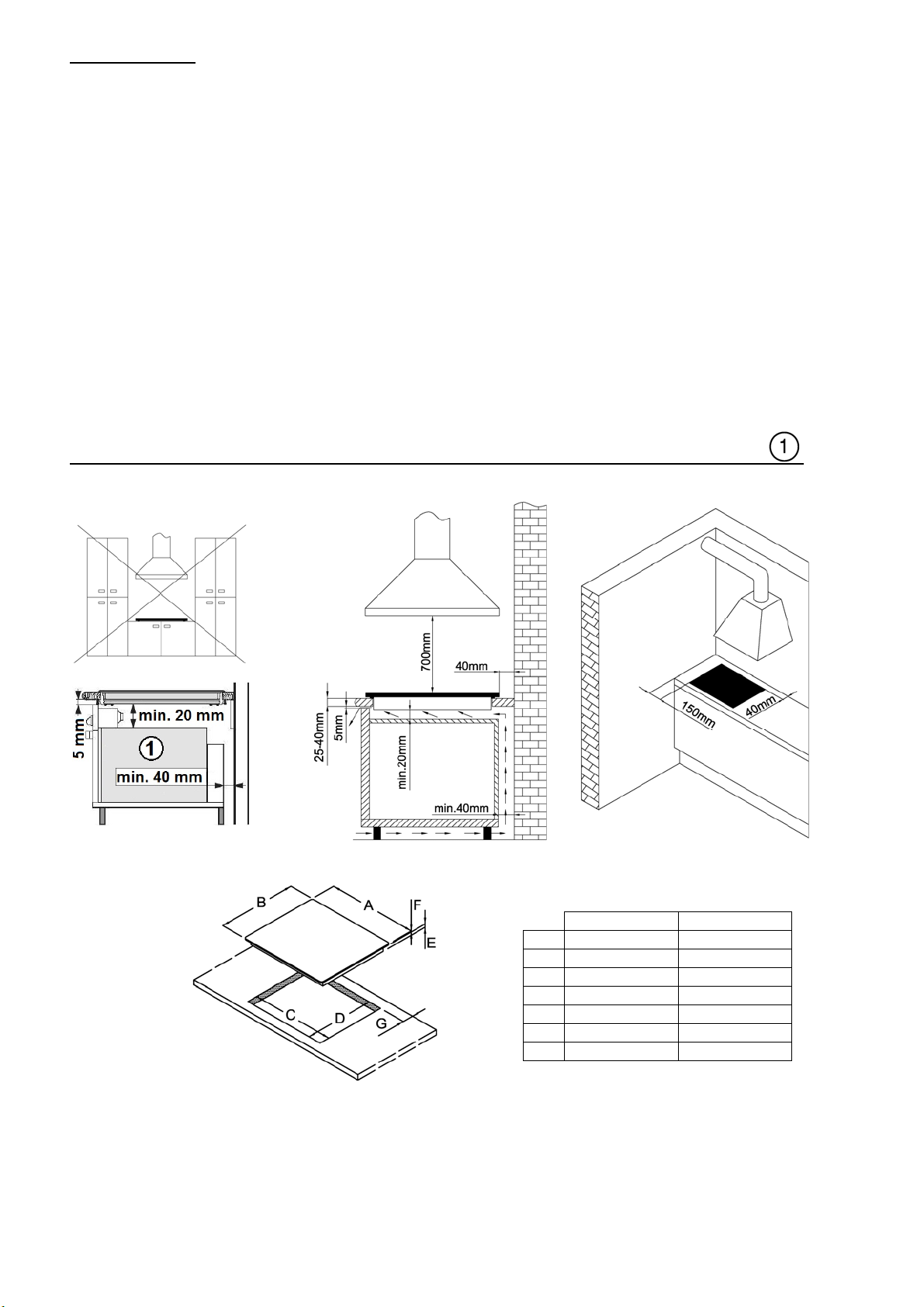
• Panels and furniture lining of the kitchen cabinet receiving the hob must be treated with temperature resistant
adhesives 100°C (otherwise they might be discoloured or deformed because of inadequate temperature
resistance).
• The cooking hob is intended for building into the worktop above the kitchen element of 600 mm width or more.
• After the installation of built-in hob make sure that there is free access to the two fixing elements in front.
• Suspended kitchen elements above the cooktop must be installed at such distance to provide enough room for
comfortable working process.
• The distance between the worktop and the hood must be at least such as indicated in the instructions for
installation of the kitchen hood, but in no case it may be less than 700 mm.
• The use of hard wood decorative borders around the worktop behind the appliance is allowed, in case the
minimum distance remains as indicated on the installation illustrations.
• Minimum distance between the built-in cooktop and rear wall is indicated at the illustration for the installation of
the built-in cooktop.
• Ceramic hob may be built into the 25 to 40 mm thick worktops.
• Bottom kitchen element must not have a drawer. It must be fitted with a horizontal plate 20 mm away from the
worktop bottom surface. Space between the plate and the hob must be empty and no objects may be stored or
kept there.
• Rear side of the kitchen element must also have a 50 mm high opening along the entire width of the element,
and the front part must have an opening of no less than 5 mm.
• Incorporation of the oven under the hob is permissible for ovens equipped with a cooling fan .
Prior inserting the oven, it is necessary to remove the rear kitchen element panel in the area of the oven opening.
Equally, the front part of the element must have an opening of no less than 5 mm.
HH-VR302M HH-VR604M
A 288 mm 580 mm
B 510 mm 510 mm
C 270 mm 560 mm
D 490 mm 490 mm
E 40 mm 40 mm
F 5 mm 5 mm
G 50 mm 50 mm
6
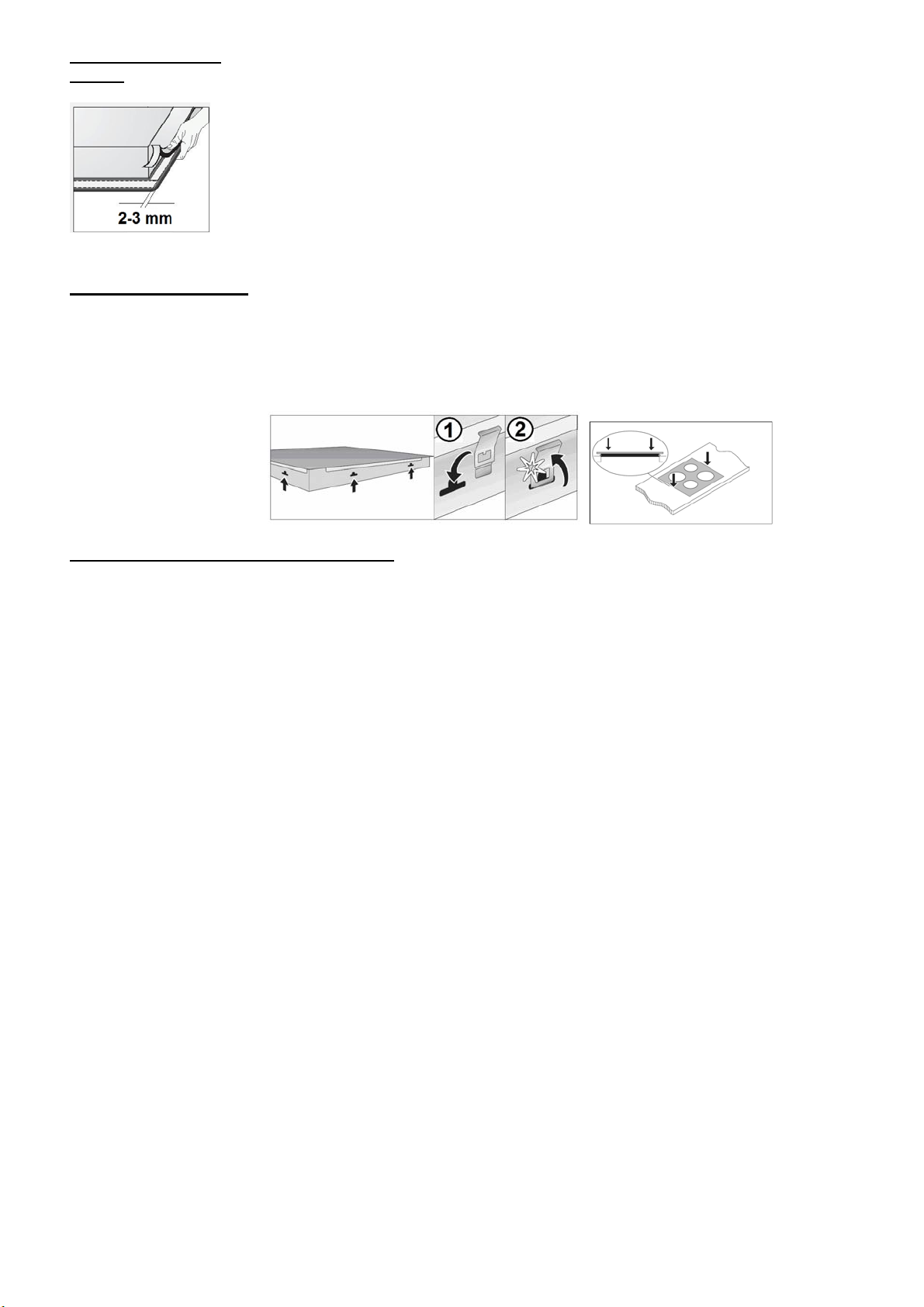
Installing the foam
gasket
Before inserting the appliance into the opening in the kitchen worktop, the supplied
foam gasket must be attached to the lower side of the glass ceramic (glass) cooking
hob.
Do not install the appliance without the foam gasket!
The gasket should be attached to the appliance in the following way:
▪Remove the protective film from the gasket.
▪Then, attach the gasket to the lower side of the glass, approximately 2-3
millimetres from the edge.
▪The gasket must be attached along the entire length of the glass edge and should
not overlap at the corners.
▪When installing the gasket, make sure that the glass does not come into contact
with any sharp objects.
Installation procedure • Worktop must be placed absolutely horizontal.
• Suitably protect the edges of the cut aperture.
• Connect the cooking hob to the mains power supply (see instructions for the
connection of the cooking hob to mains power supply).
• Put the supplied springs in their places.
•Insert the hob into the cut aperture.
•Press the hob firmly towards the worktop from above.
CONNECTION TO THE POWER SUPPLY
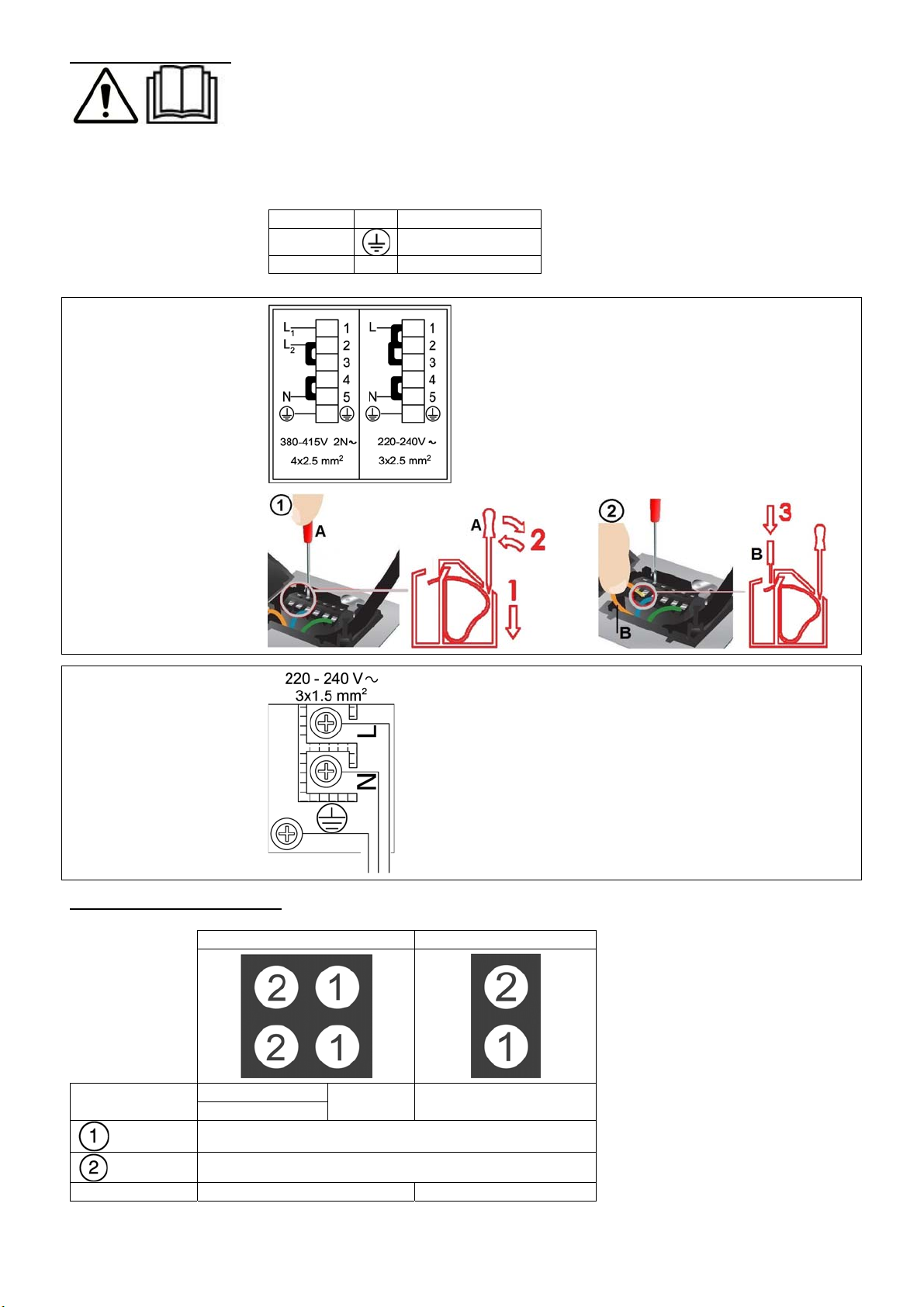
• Connections may be carried out by a qualified technician only. The earthing
protection must comply with the standing regulations.
• Connection terminals are revealed when the connection box cover is removed.
•Prior any attempted connection check that the voltage indicated on the rating plate
is in line with your home power supply.
• The rating plate is located underneath the appliance.
• The appliance is manufactured for use with the power supply voltage
220-240 V ~.
• In order to make a fixed connection to the mains, insert an all-pole circuit breaker
between the appliance and the mains. This device shall have a contact separation in
all poles, providing full disconnection under overvoltage category III conditions.
• Such appliances are allowed to be mounted on one side next to a high kitchen
cabinet, the height of which may exceed that of the appliance. On the opposite side
however, only a kitchen cabinet of equal height as the appliance is allowed.
• Upon the completion of installation, live wires and isolated cables must be
adequately protected against accidental touching.
ATTENTION !
Before attempting any repairs on the appliance, disconnect the power supply. In
accordance with the mains voltage the appliance should be connected in line with the
attached diagram.
The earthing wire (PE) must be connected to the terminal marked with the earthing
symbol .
The connection cable must lead through the relief safety device, protecting it from
accidental pulling out. Upon the completion of installation switch all the hotplates on
for about 3 minutes to check the proper functioning.
7
Installation diagram • Incorrect connection may destroy parts of the appliance, making the warranty void.
• Before connecting the appliance, make sure the voltage indicated on the rating
plate is consistent with the voltage in your home network. Connection voltage should
be checked by a qualified technician using a corresponding measuring device!
• Connection cable on the back of the appliance should be led in such way that it
does not touch the appliance back wall, as this part will get very hot during operation.
The following cables must be used for connection:
H05GG-F
LIVE L BROWN
EARTH GREEN / YELLOW
NEUTRAL N BLUE
HH-VR604M
HH-VR302M
TECNICAL INFORMATION
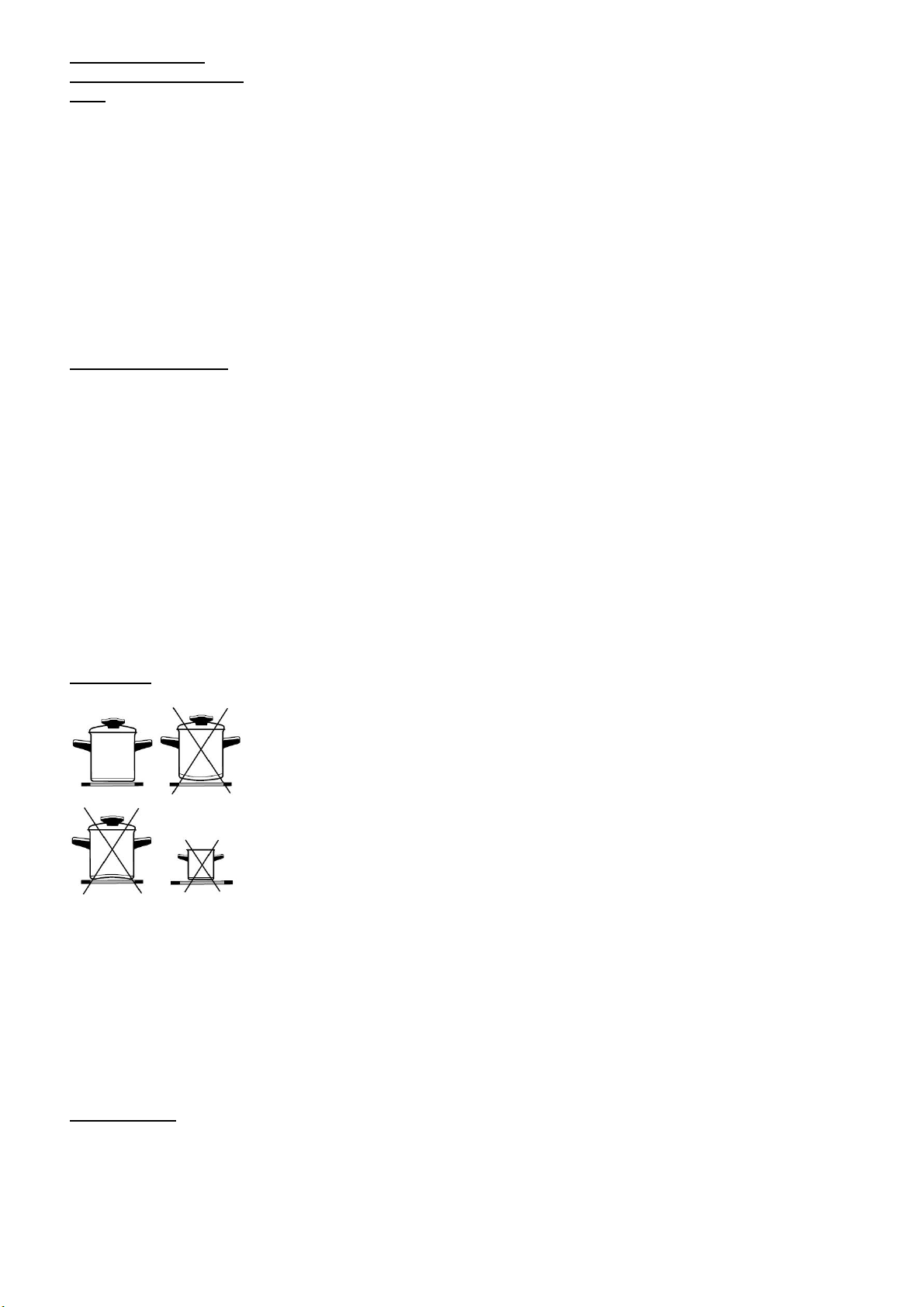
HH-VR604M HH-VR302M
Rated voltage 220-240 V~ 50/60 Hz 220-240 V~ ; 50/60 Hz
380-415 V 2N~
Ø 14 cm / 1,2 kW
Ø 18 cm / 1,8 kW
PnTOT 6000 W 3000 W
8
Before using the
appliance for the first
time
Clean the glass-ceramic surface with a damp cloth and some manual dishwashing
detergent. Do not use aggressive detergents such as abrasive cleaners that can
scratch the surface, abrasive dishwashing sponges, or stain removers.
• Do not turn on a cooking zone without a pan over it, and never use the cooking hob
for room heating!
• Make sure the cooking zones and pan bottom are clean and dry, and that sufficient
heat transmission is enabled between them, in order to prevent any damage to the
heating surface.
• Any fat or oil left on the cooking ones may ignite. Therefore, be careful when using
fat and oil to prepare food (e.g. French fries) and control the cooking process at all
times.
• Do not place a damp pan or a steam-covered lid on the cooking zones, as moisture
is detrimental to them.
• Do not leave a hot pan to cool down on the cooking zones, because moisture will
be generated under it, causing corrosion.
• The hob can not be activated by external timers or remote controls systems.
Important warnings Important warnings regarding the glass ceramic hob
• Cooking zone reaches the selected power level or temperature very quickly;
however, the area surrounding the cooking zones remains relatively cool.
• The hob is resistant to temperature changes.
• The hob is also impact-resistant. The pans may be placed onto the hob roughly
without damaging the hob.
• Glass ceramic hobs should not be used as a worktop. Sharp objects can cause
scratches.
• Preparing food in thin aluminum of plastic containers on hot cooking zones is not
allowed. Do not place any plastic objects or aluminum foil on the glass ceramic hob.
• Never use a glass-ceramic hob that is cracked or broken.
If an object falls on the hob with a sharp edge downwards, this could cause the hob /
glass ceramic panel to break. The consequences are visible immediately, or only
after a while. If any visible crack should appear, immediately disconnect the
appliance from the power supply.
• If sugar is spilt on a hot glass ceramic hob, or a sugar-laden food, immediately
wipe the hob.
Cookware Tips on using the cookware
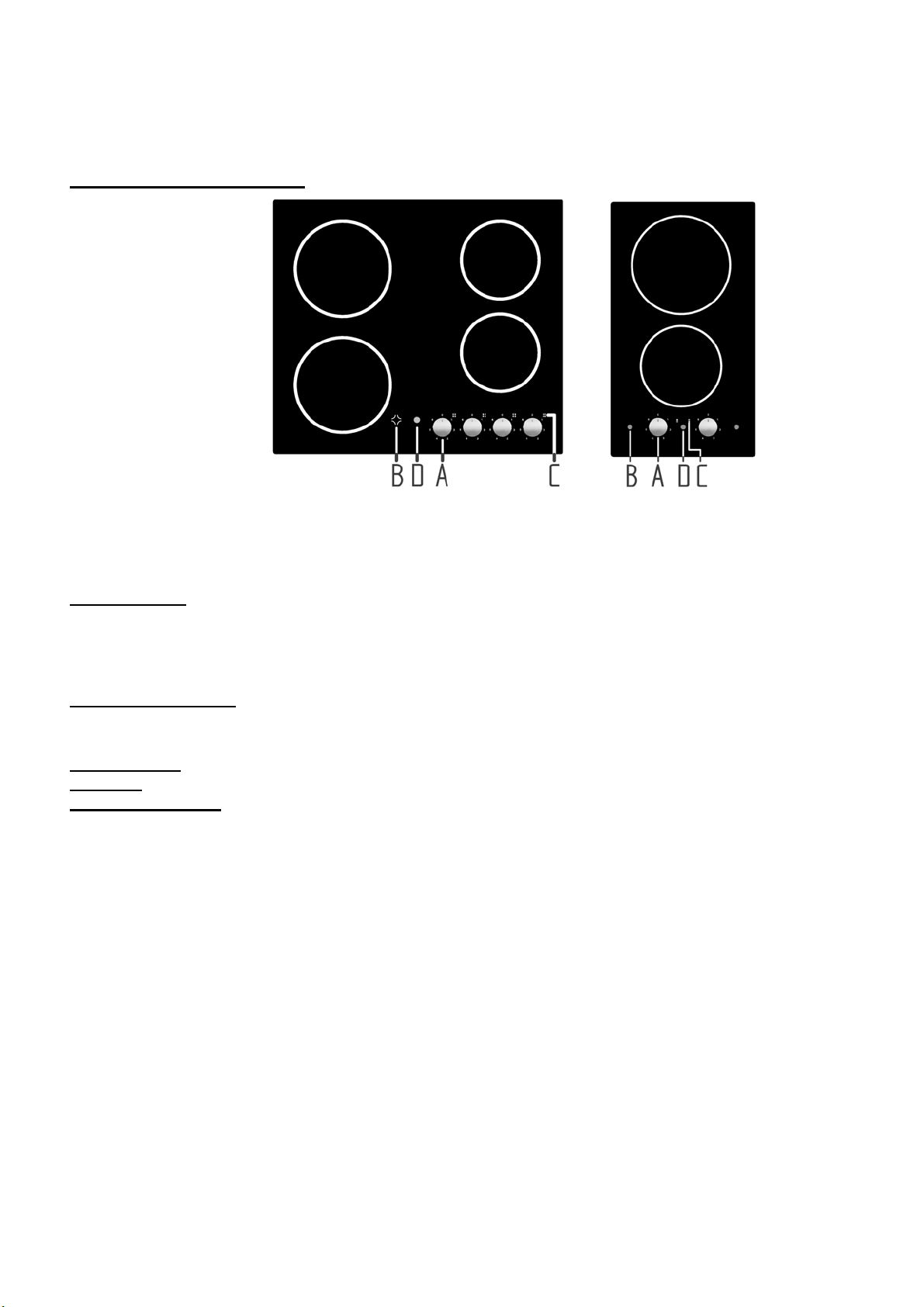
Use high-quality cookware with a flat and stable bottom.
• Transmission of heat is best when the pan bottom and the cooking zone are of the
same diameter, and the pan is placed on the middle of the cooking zone.
• When using a tempered glass (Pyrex) or porcelain cookware, please follow the
cookware manufacturer’s instructions.
• When using a pressure cooker, do not leave it unattended until the desired
pressure is reached. The cooking zone should initially be set to the maximum power
level; as the pressure rises, use the sensors to decrease the power level according
to the pressure cooker manufacturer’s instructions.
• Make sure there is always enough water, either in a pressure cooker or in any
other piece of cookware, as using an empty pan on the cooking hob will result in
overheating which will damage both the pan and the cooking zone.
• Tempered glass (Pyrex) cookware with a specially brushed bottom is suitable for
use on cooking hobs if it fits the diameter of the cooking zone. Cookware with larger
diameter may break due to thermal stress.
• When using any special or unconventional cookware, follow the cookware
manufacturer’s instructions.
• When a highly reflective pan (bright metal surface) or a pan with a thick bottom is
used for cooking on a glass-ceramic hob, cooking time can be extended by several
minutes (up to 10 minutes). If you wish to boil a larger quantity of food, it is
recommended to use a container with a flat dark bottom.
• Do not use clay cookware, because it may leave scratches on the glass-ceramic
hob.
Energy saving • Pan bottom diameters should match the diameter of the cooking zone. If the pan is
too small, some heat is wasted; furthermore, using a too small pan can damage the
cooking zone.
• Whenever possible given the cooking process, use a lid.
•The pan should be appropriately sized given the quantity of food prepared.
Preparing a small quantity of food in a large pan will cause a waste of energy.
9
• Dishes that take a long time to cook should be prepared in a pressure cooker.
• Various vegetables, potatoes, etc., can be cooked in a small quantity of water;
however, the lid should be closed tightly. When the water is brought to boil, reduce
the power level to a setting that maintains a temperature just above boiling point.
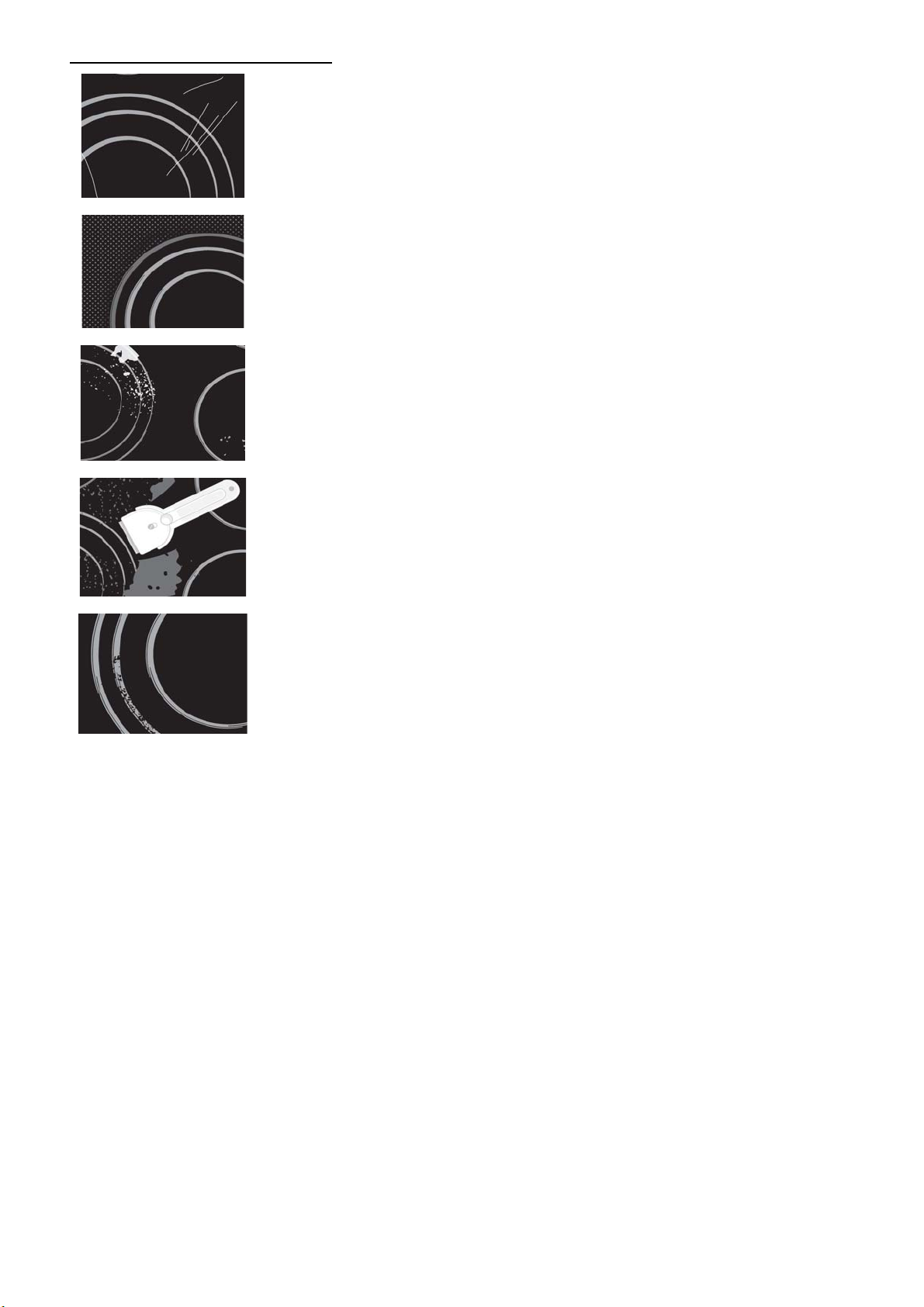
CERAMIC-GLASS COOKTOP
A.Control knob
B.Residual heat indicator
C.Cooking zone identification
D.Mains indicator light
Control knobs Cooking zones are controlled by knobs connected to an energy regulator numbers 1 to 6
are used to indicate cooking settings, turning clockwise where 1 is the minimum setting
and 6 the maximum setting. number 0 signifies the off position.
The zone controlled by each knob is identified by the adjacent cooking zone
identification.
Mains indicator light The mains indicator light is switched on when one or more of the heating elements
are operating.
Residual heat
indicator
(hot hob indicator)
Each heating element has a corresponding residual heat indicator light. This
switches on automatically once the corresponding cooking zone has reached a
temperature of 50°c and above. Once a cooking zone has been turned off, the
corresponding light will stay on for a period of time necessary for the zone to cool
down to 50°C.
10
CLEANING AND MAINTENANCE
Ceramic glass hob should be cleaned only when completely cooled down, preferably
after each use, otherwise even the slightest stains remaining after cooking may burn
into the hob surface with each following use.
For regular maintenance of ceramic-glass hob use special cleansing agents,
produced in such way to create protective film upon the surface.
Before each use, wipe the dust and other particles from the hob, they may scratch
the surface (Fig. 1).
Caution: use of steel wool, abrasive cleaning sponges, and abrasive detergents can
scratch the surface of the hob. The surface may also be damaged by the use of
aggressive sprays and inappropriate liquid chemicals (Fig.1 and 2).
Pattern marks can be erased by the use of aggressive cleansing agents or rough
and damaged cookware bottoms (Fig. 2).
Minor stains are removed with moist soft cloth; after that the surface should be
wiped dry (Fig. 3).
Water stains are removed with gentle vinegar solution, but you must not wipe the
frame with it (certain models only), since it may lose its glow. Never use any
aggressive sprays or limestone removers (Fig. 3).
Major stains are removed with special ceramic-glass cleansers.
Follow strictly the manufacturer’s instructions.
Be careful to remove any remains of cleansing agent from the hob surface,
otherwise they will be heated during the next use and can damage the hob (Fig. 3).
Stubborn and burnt stains are removed with special ceramic-glass scraper. Be
careful, however, not to touch the hotplate surface with the scraper handle (Fig. 4).
Handle the scraper with utmost care to avoid injuries!
Sugar and sugar containing food may permanently damage the ceramic-glass hob
surface (Fig. 5), so the remains of sugar and sugar containing food must be scraped
off from the hob surface immediately, when the hotplates are still hot (Fig. 4).
Discoloring of ceramic-glass hob has no effect whatsoever on its operation and
stability. In most cases, it appears as the consequence of burnt in food remains, or
as a result of dragging pots and pans (especially aluminium or copper bottom
cookware) across the surface, and such discoloring is rather hard to remove.
Note: All described faults are mostly esthetical and do not affect directly the
operation of the appliance. Remedy of such faults is not covered by warranty.
Fig.1
Fig.2
Fig.3
Fig.4
Fig.5
HÄFELE (Thailand) Limited
57 Soi Sukhumvit 64, Sukhumvit Rd.,
Bangchak, Phrakanong,
Bangkok 10260
Tel.: (+66) 02 741-7171
Fax.: (+66) 02 741-7272
E-mail: [email protected]
This manual suits for next models
1
Table of contents
Languages:
Other Häfele Cooktop manuals