
Garmin Fusion Apollo MS-AP41200 User manual
Fusion®Apollo™Multichannel Amplifiers Installation Instructions
Important Safety Information
WARNING
See the Important Safety and Product Information guide in the product box for product warnings and other
important information.
This device must be installed according to these instructions.
Disconnect the vessel's power supply before beginning to install this device.
CAUTION
Continuous exposure to sound pressure levels over 100 dBA may cause permanent hearing loss. The volume is
typically too loud if you cannot hear people speaking around you. Limit the amount of time you listen at high
volume. If you experience ringing in your ears or muffled speech, stop listening and have your hearing checked.
To avoid possible personal injury, always wear safety goggles, ear protection, and a dust mask when drilling,
cutting, or sanding.
NOTICE
YOU MUST NOT USE THIS AMPLIFIER WITH ANY THIRD-PARTY MARINE AUDIO SYSTEMS. This amplifier is
compatible only with Fusion DSP-enabled marine audio equipment and may cause damage to third-party
speakers due to the amplifier power output.
When drilling or cutting, always check what is on the opposite side of the surface to avoid damaging the vessel.
It is strongly recommended that you have your audio system installed by a professional installer to ensure
optimum performance.
You must read all installation instructions before beginning the installation. If you experience difficulty during
the installation, go to support.garmin.com for product support.
After installing an audio system, you should run the connected speakers and subwoofers at low to medium
volumes for the first few hours of use. This helps to improve the overall sound by gradually loosening up the
moving components of new speakers and subwoofers, such as the cone, spider, and surround. See the
installation instructions provided with your speakers, because there may be more details about the
recommended time for each model.
NOTE: After installing the amplifier, you must set up your connected stereo using the Fusion-Link™ app to select
and activate the correct DSP profile.
GUID-12BC9614-2882-4A6F-A581-2894A8B33AAD v3September 2021

Tools Needed
• Drill and 3 mm (1/8 in.) drill bit (or a drill bit appropriate for your provided mounting hardware and mounting-
surface material).
• Screwdrivers:
◦5 mm (7/32 in.) flat (slotted)
◦4 mm (5/32 in.) flat (slotted)
◦3 mm (1/8 in.) flat (slotted)
◦#2 Phillips
◦#0 Phillips
• Wire cutter
• Wire stripper
• Wires and cables:
◦4 AWG (21 through 25 mm2) marine-grade, fully-tinned copper wire for power and ground
NOTE: You may need larger-diameter (smaller gauge number) wire for longer runs to account for voltage
drop (Connecting to Power, page 9)
◦16 AWG (1.3 through 1.5 mm2) marine-grade, fully-tinned copper wire for standard speakers
You can purchase this wire from your Fusion or Garmin® dealer:
◦010-12899-00: 7.62 m (25 ft.)
◦010-12899-10: 15.24 m (50 ft.)
◦12 AWG (3 through 4 mm2) marine-grade, fully-tinned copper wire for full-range speakers or subwoofers
using the high power adapter
You can purchase this wire from your Fusion or Garmin dealer:
◦010-12898-00: 7.62 m (25 ft.)
◦010-12898-10: 15.24 m (50 ft.)
NOTE: You may need larger-diameter (smaller gauge number) wire for longer runs of speaker or
subwoofer wire.
◦20 AWG (0.5 through 0.75 mm2) marine-grade, fully-tinned copper wire for the remote-on signal
◦2-channel RCA cable (1 per stereo channel pair) (Signal and Speaker Connection Considerations,
page 11)
◦1-channel RCA cable (1 per mono channel) (Signal and Speaker Connection Considerations, page 11)
You can purchase a suitable length of RCA cable at garmin.com/apollo_amplifier_accessories or from
your Fusion or Garmin dealer.
• Cable ties (optional)
2 Fusion Apollo Multichannel Amplifiers Installation Instructions Installation Instructions

Mounting Considerations
CAUTION
In high ambient temperatures and after extended use, the device enclosure may reach temperatures deemed
dangerous to touch. To avoid possible personal injury, the device must be installed in a location where it will
not be touched during operation.
NOTICE
This device should be mounted in a well-ventilated location that is not exposed to extreme temperatures or
conditions. The temperature range for this device is listed in the product specifications. Extended exposure to
temperatures exceeding the specified temperature range, in storage or operating conditions, may cause device
failure. Extreme-temperature-induced damage and related consequences are not covered by the warranty.
If you are mounting the device on fiberglass, when drilling the pilot holes, use a countersink bit to drill a
clearance counterbore through only the top gel-coat layer. This will help to avoid cracking in the gel-coat layer
when the screws are tightened.
This device is designed for installation only in a dry location. Installing this device in a location where it may
come in contact with more than occasional dripping water or become submerged may result in damage. Water
damage is not covered by the warranty.
You can mount this device using one of two methods:
• You can use the included bracket and pan head screws to mount the device (Installing the Mounting Bracket,
page 4).
◦Mounting the device using the bracket allows you to quickly attach and detach the device from the
mounting surface.
◦Mounting the device using the bracket requires clear space above the mounting location to allow for
connecting the device to the bracket and installing the locking wedge.
• You can use the included flat-head, countersunk screws to mount the device directly to the mounting surface
(Mounting the Device Directly to the Surface, page 7).
◦Mounting the device directly to the surface does not allow you to quickly detach the device.
◦Mounting the device directly to the surface does not require as much clear space above the mounting
location, so it may be a more suitable choice for installing in a smaller space.
When selecting a mounting location, observe these considerations:
• You must mount the device in a location that does not interfere with the fuel tank or electrical wiring.
• You must mount the device in a location where it is not exposed to water.
• You must mount the device in a location where it is not exposed to fuel or fuel vapor.
• You must mount the device in a location with adequate ventilation where it is not exposed to extreme
temperatures.
• If you mount device in an enclosed space, you should install a cooling fan with appropriate ducts to aid in
airflow.
• You should mount the device so that the cables can be connected easily.
• To avoid interference with a magnetic compass, you should mount the device the specified distance away
from a compass. This distance is listed in the specifications section.
• You must not mount the device in close proximity to other navigation-critical equipment, antennas, or radio-
communication equipment on the vessel.
Fusion Apollo Multichannel Amplifiers Installation Instructions Installation Instructions 3
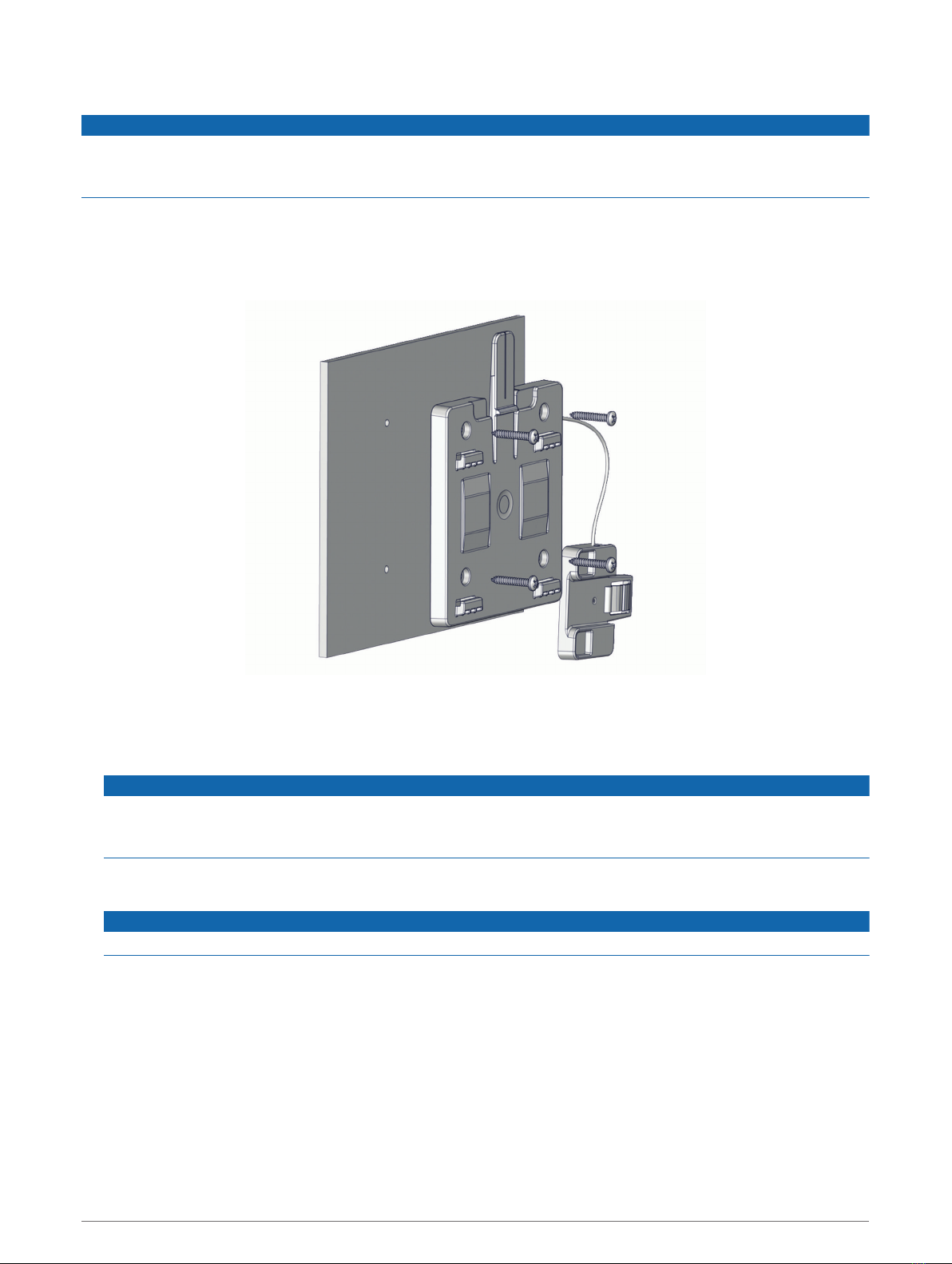
Installing the Mounting Bracket
NOTICE
Pan-head screws are included, but they may not be suitable for the mounting surface. If you provide different
mounting hardware, you must not use fasteners with a countersunk head. Hardware with a countersunk head
will damage the mounting bracket.
Before you install the mounting bracket, you must select a mounting location and determine what screws and
other mounting hardware are needed for the surface.
Mounting the device using the mounting bracket allows you to quickly attach and remove the device as needed.
1Use the included template to verify that the mounting location has sufficient clearance to install the device.
NOTE: You must install the bracket with the release tab pointing up to properly secure the amplifier in the
bracket.
2Using a 3 mm (1/8 in.) bit or a bit appropriate for your provided hardware and mounting-surface material, drill
the pilot holes marked on the template.
NOTICE
If you are mounting the device on fiberglass, when drilling the pilot holes, use a countersink bit to drill a
clearance counterbore through only the top gel-coat layer. This will help to avoid cracking in the gel-coat
layer when the screws are tightened.
3Using the included pan-head screws or other pan-head mounting hardware, secure the bracket to the
mounting surface.
NOTICE
You must use pan-head screws, because countersunk screws will damage the bracket.
4 Fusion Apollo Multichannel Amplifiers Installation Instructions Installation Instructions
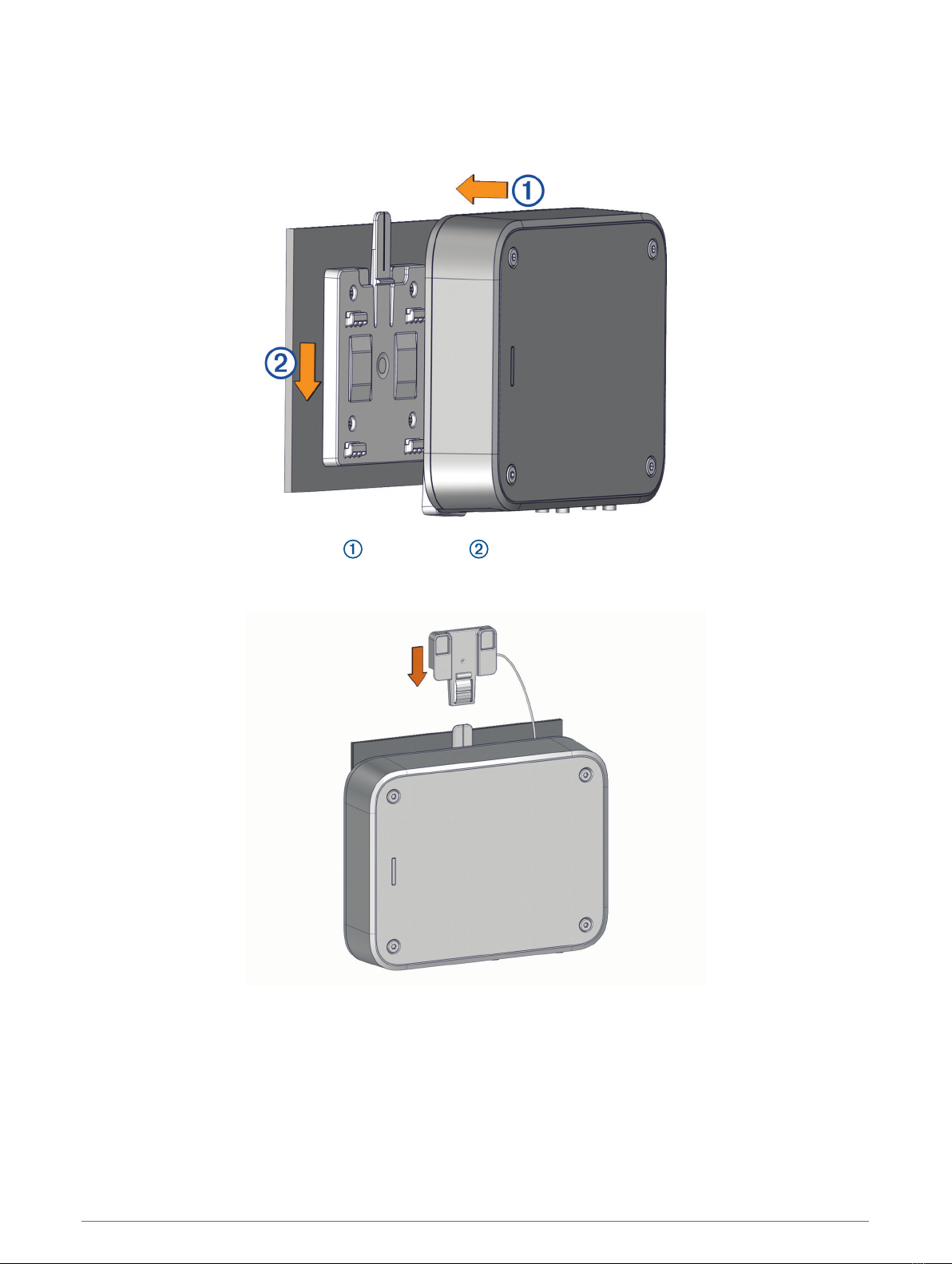
Connecting the Device to the Mounting Bracket
You must secure the mounting bracket to the surface before you can connect the device.
1Hold the device over and slightly above the mounting bracket.
2Place the device onto the bracket and pull down until the tab audibly clicks.
3Insert the wedge over the tab on the top of the mounting bracket it and push down to lock the device in the
bracket.
4Install the included screw covers in the four holes on the top of the amplifier (optional).
Fusion Apollo Multichannel Amplifiers Installation Instructions Installation Instructions 5
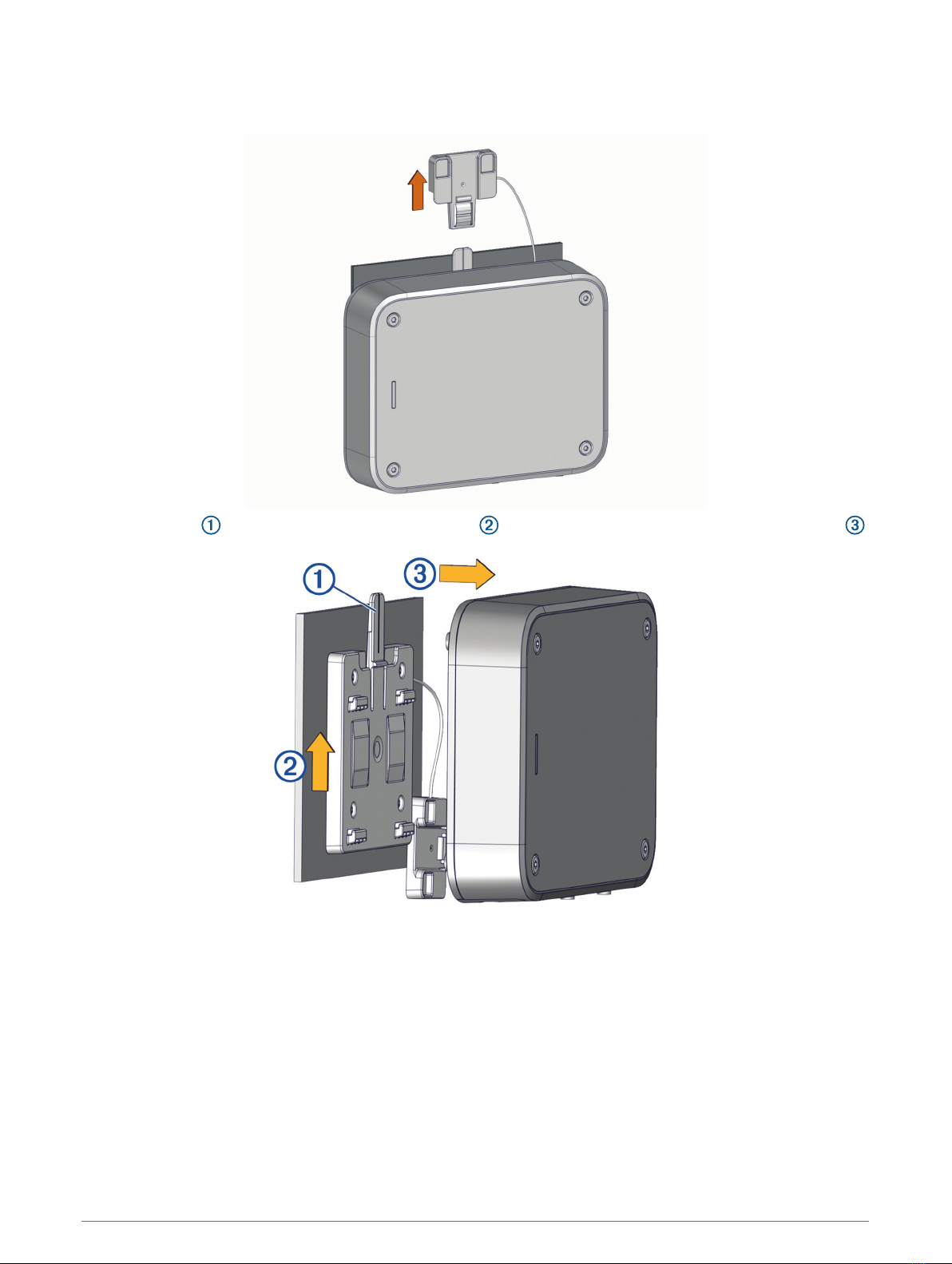
Removing the Device from the Mounting Bracket
1Lift up to remove the wedge, which unlocks the tab on the mounting bracket.
2Press the tab on the mounting bracket, and lift up on the amplifier to disconnect it from the mount .
6 Fusion Apollo Multichannel Amplifiers Installation Instructions Installation Instructions

Mounting the Device Directly to the Surface
If you are installing the device in a location with limited space, or you do not want to use the bracket, you can
mount the device directly to the surface.
NOTE: Countersunk screws are provided to mount the device directly to the surface. If you choose to use your
own hardware to mount the device directly to the surface, countersunk heads are recommended.
1Using the provided template, mark the pilot hole locations for the four mounting holes on the device,
observing these considerations:
• Because you are not using the bracket, you do not need to observe the upper clearance line on the
template.
• You must observe the lower clearance line on the template so that you have the space needed to make
the cable connections.
2Using a 3 mm (1/8 in.) bit or a bit appropriate for your provided hardware and mounting-surface material, drill
the pilot holes.
NOTICE
If you are mounting the device on fiberglass, when drilling the pilot holes, use a countersink bit to drill a
clearance counterbore through only the top gel-coat layer. This will help to avoid cracking in the gel-coat
layer when the screws are tightened.
3Using the provided countersunk screws, secure the device to the mounting surface.
4Install the included screw covers in the four holes on the top of the amplifier (optional).
Connection Considerations
NOTICE
You should turn off the audio system before making any connections to the amplifier. Failure to turn off the
audio system may result in damage to the audio system.
All terminals and connections must be protected from contact with the vessel chassis and with each other.
Improper terminal or wire contact may result in damage to the audio system.
NOTE: You must connect the amplifier to the AMPLIFIER ON wire from the stereo for the amplifier to turn on
and off with the stereo.
Fusion Apollo Multichannel Amplifiers Installation Instructions Installation Instructions 7
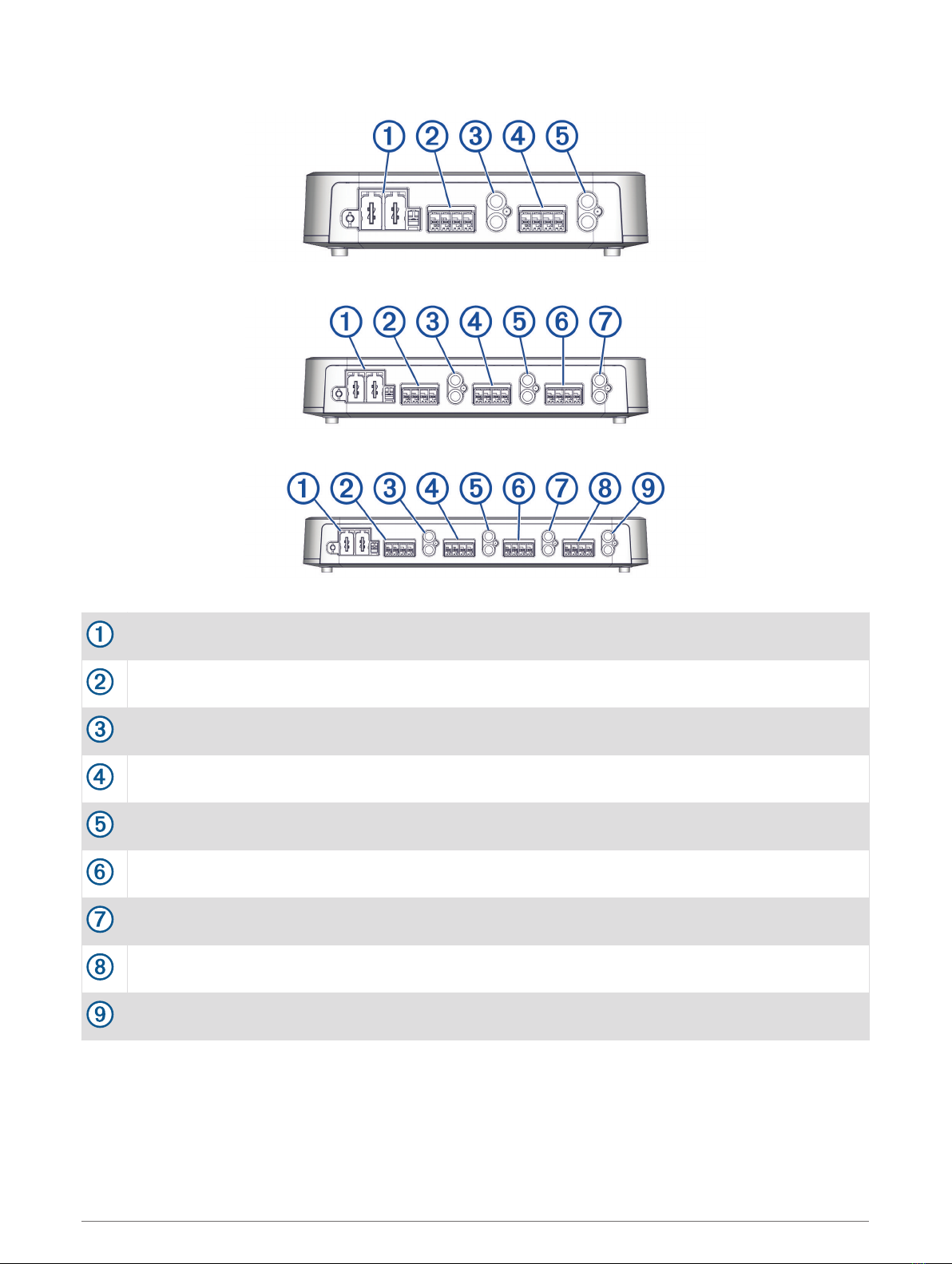
Port Identification
MS-AP41200 4-Channel Amplifier
MS-AP61800 6-Channel Amplifier
MS-AP82400 8-Channel Amplifier
Power block port (Connecting to Power, page 9)
Zone 1 speaker block port (Signal and Speaker Connection Considerations, page 11)
Zone 1 RCA input
Zone 2 speaker block port
Zone 2 RCA input
Zone 3 speaker block port
Zone 3 RCA input
Zone 4 speaker block port
Zone 4 RCA input
8 Fusion Apollo Multichannel Amplifiers Installation Instructions Installation Instructions
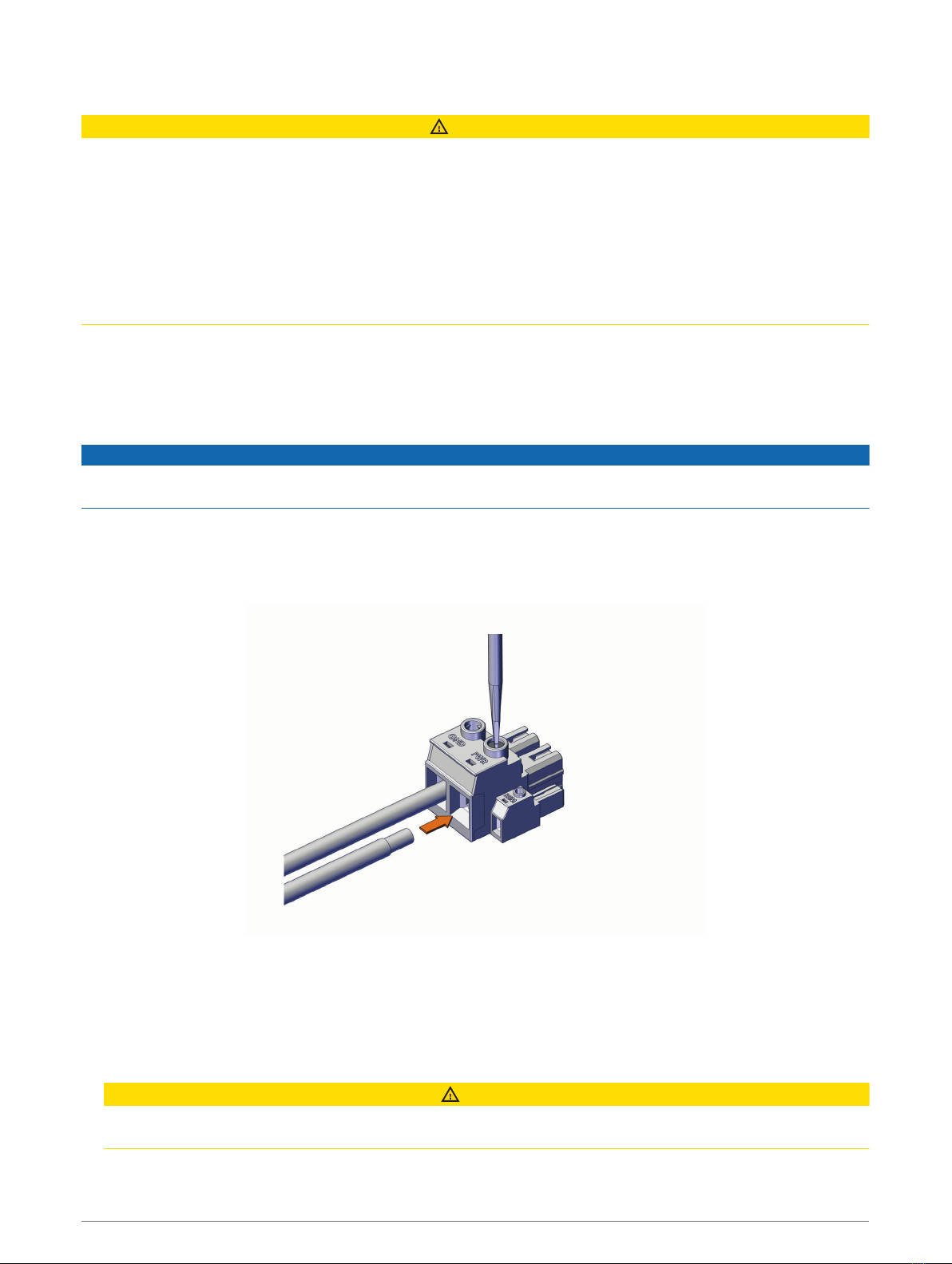
Connecting to Power
CAUTION
The wiring (not included) from the power source to the amplifier must run through an inline fuse or circuit
breaker (not included) as close to the power source as possible. You must connect the positive wire to the fuse
or circuit breaker. Connecting the amplifier to power without an inline fuse or circuit breaker may result in a fire
if there is a short in the cable.
If the amplifier is powered by a battery, use a breaker or fuse rated to protect a cable of the gauge used to
connect the amplifier to the battery. See the American Boat & Yacht Council (ABYC) standards for the required
fuse or breaker rating.
If the amplifier is powered by a source other than a battery, use a breaker or fuse rated no higher than the max
current of the power source.
You should use 4 AWG (21 through 25 mm2) marine-grade, fully-tinned copper wire (not included) to connect
the amplifier to power and ground for most installations. For long power-cable runs, you should consider using
larger-diameter (smaller gauge number) wire to minimize power loss.
You must connect the REM terminal on the amplifier block to either the AMPLIFIER ON wire from the connected
stereo or to a constant 12 Vdc power source using a switch.
NOTICE
Connecting to the AMPLIFIER ON wire is recommended to avoid damaging your speakers when the stereo
turns on or off.
1Route 4 AWG (21 through 25 mm2) marine-grade, fully-tinned copper ground wire (not included) to the
amplifier and to a ground location on the boat.
2Using a 5 mm (7/32 in.) flat (slotted) screwdriver, connect the ground wire to the GND terminal on the power
connection block.
3Connect the other end of the ground wire to the ground location.
4Route 4 AWG (21 through 25 mm2) marine-grade, fully-tinned copper power wire (not included) to the
amplifier and to the power source, and select an option:
• Install a properly rated in-line fuse on the power wire as close to the power source as possible.
• Identify or install a circuit breaker, as close to the power source as possible, for use with the amplifier
power wire.
CAUTION
Connecting the amplifier to power without the proper inline fuse or circuit breaker as described above and in
the specifications section may result in a fire if there is a short in the cable.
Fusion Apollo Multichannel Amplifiers Installation Instructions Installation Instructions 9

5Using a 5 mm (7/32 in.) flat (slotted) screwdriver, connect the power (+) wire to the PWR terminal on the
power connection block.
6Route a 20 AWG (0.5 through 0.75 mm2) marine-grade, fully-tinned copper remote-on wire (not included)
from the amplifier to the AMPLIFIER ON wire on the stereo.
NOTE: The amplifier and the stereo must connect to a common ground location for the AMPLIFIER ON
signal to function properly.
7Using a 4 mm (5/32 in.) flat (slotted) screwdriver, connect the remote-on wire to the REM terminal on the
power connection block.
NOTICE
You should wait to connect the power terminal block to the amplifier. Make all of the other connections to the
stereo and speakers before completing the connection to power (Completing the Connections, page 15).
10 Fusion Apollo Multichannel Amplifiers Installation Instructions Installation Instructions
This manual suits for next models
2
Table of contents
Other Garmin Amplifier manuals

Garmin
Garmin SIGNATURE Series User manual

Garmin
Garmin Fusion Apollo Series User manual

Garmin
Garmin FUSION SIGNATURE Series User manual

Garmin
Garmin Fusion Apollo MS-AP12000 User manual

Garmin
Garmin Fusion Apollo MS-AP12000 User manual

Garmin
Garmin Fusion Apollo MS-AP12000 User manual

Garmin
Garmin Fusion Apollo AP-DA214 User manual


