Executone Systems MEDLEY Use and care manual


© 1997 EXECUTONE Information Systems, Inc.
All rights reserved. No part of this document may be reproduced,
distributed, or transmitted in any form, or by any means (graphic, electronic, or mechanical,
including photocopying, taping, or information storage and retrieval systems now known or as
may be hereafter developed) without written permission of EXECUTONE Information Sys-
tems.
Medley™ is a trademark of EXECUTONE Information Systems, Inc.
EXECUTONE®is a registered trademark of EXECUTONE Information Systems, Inc.
THE INFORMATION CONTAINED HEREIN IS SUBJECT TO CHANGE
WITHOUT NOTICE AS PROGRESS AND ENHANCEMENTS ARE MADE.
Printed in USA

1997 i
Table of Contents
1. Introduction..................................................................................................................1
1.1 Hardware.............................................................................................................. 1
1.2 System Design ..................................................................................................... 2
1.3 Call Processing Features...................................................................................... 5
1.4 Administrative Duties.......................................................................................... 8
2. System Programming Functions.................................................................................. 9
3. General Programming Procedures ............................................................................. 10
3.1 Entering Programming Mode ............................................................................ 10
3.2 Exiting Programming Mode .............................................................................. 10
3.3 Programming Keys ............................................................................................ 11
3.4 Inputting Alphabetic and Numeric Characters .................................................. 12
3.5 System Numbering Plan .................................................................................... 12
3.6 Accessing a User Station from that Station....................................................... 13
4. Specific Programming Procedures ............................................................................ 14
4.1 Function 1 System Parameters .......................................................................... 14
Function 13 Administrator Password ........................................................... 14
Function 14 Set Time.................................................................................... 14
Function 17 System Speed Dial.................................................................... 14
4.2 Function 3 Extension Programming .................................................................. 15
Function 32 Extension Feature Authorization .............................................. 15
4.3 Function 5 Voice Mail Programming................................................................ 16
Function 53 Guest / Information Mailboxes................................................. 16
Function 54 Group Mailboxes (including Broadcast) .................................. 17
Function 56 Cascade Paging Mailboxes....................................................... 18
4.4 Function 6 Recording ........................................................................................ 19
Function 61 Record System Prompts ........................................................... 19
Function 62 Record Directory Names .......................................................... 21
Function 63 Message On Hold Programming .............................................. 21

1997
ii
4.5 Function 7 Reports............................................................................................. 23
Function 72 Line / Auto Attendant Report ................................................... 23
Function 73 Extension / Department Report ................................................ 23
Function 74 Voice Mail Statistics Report..................................................... 23
Function 75 System Speed Dial Report........................................................ 23
5. Programming Tutorial................................................................................................ 24
Function 32 Extension Feature Authorization.............................................. 24
Function 53 Information Only Mailbox ....................................................... 25
Function 53 Guest Mailbox .......................................................................... 25
Function 54 Group Mailbox for One Owner ................................................ 26
Function 54 Group Mailbox for Multiple Owners ....................................... 26
Function 56 Cascade Paging Notification .................................................... 27

1997 1
1. INTRODUCTION
Medley™ is an advanced small business telephone system with built-in voice
processing, automated attendant and voice-mail capability. The system’s
combined functions are controlled by a single processor and by a single set of
proprietary operating system software. Its features and functions include the
following:
• A 16 x 34 digital telephone system
• 10 voice mail ports
• Automated attendant
• Automatic call distribution (ACD)
• Message on hold
• Caller ID
• Call traffic and call activity reports
Medley is a single system that performs both telephone and voice mail func-
tions using a single processor, storage medium, and voice processing DSP.
With no boundaries between these once separate tasks, Medley delivers the
greatest possible efficiency and cost effectiveness.
1.1 Hardware
Hardware consists of the system cabinet and power source, the optional expan-
sion cabinet, and up to 32 M64 phones.
System Cabinet and Power Source
The compact, wall-mounted cabinet houses the processor, memory, and station
interfaces. It is powered by a small external wall-mount transformer. The base
unit is capable of supporting up to eight CO lines, 16 feature phones, and two
analog ports.
Expansion Cabinet (Optional)
A piggyback expansion cabinet can be added for an additional 8 x 16 configu-
ration without increasing the system’s “footprint.”
M64 Phones
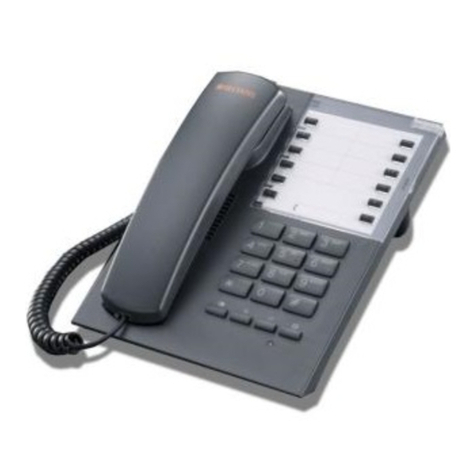
The M64 phones provide advanced call handling features, an LCD display, and
built-in speaker phone capability.

1997
2
1.2 System Design
The system includes the following design features:
Voice prompts and Voice prompts and the LCD display guide users
64-character LCD through programming and operation. The LCD
display display also shows such information as how
many new and old messages waiting in voice
mail, caller ID (if active), and how many calls
are holding for ACD agents.
Help The HELP key provides voice and LCD expla-
nations of programming and all commonly used
phone features.
Private line Lines are programmed to ring directly to a
preset station, department or mailbox.
Programmable keys These 15 lighted, programmable keys provide
one-touch transfer to stations, mailboxes, or
departments; direct line keys; speed dial; or
other feature access.
Line groups Each outbound line is assigned to a group. Icons
on a user’s LCD display shows how many lines
exist, whether or not each line is in use.
Guest extensions Guest extensions are voice mailboxes for
employees who work outside the office. A guest
extension makes it appear as if an off-site
employee has a live station in the office. People
calling the office phone system can be trans-
ferred to the extension.
Common audible One of the system’s analog ports can be desig-
nated to provide common audible (e.g. bell,
chime, etc.) ringing to provide simplified line
pickup from any station during the night mode.
Paging There are three built-in paging zones and one
all-page via a fixed feature key.

1997 3
External paging A CO line connection or one of two preassigned
interface analog ports can be used for simplified connec-
tion to external overhead paging equipment.
FAX transfer If a FAX tone is detected upon answer by the
auto attendant, the call will automatically be
transferred to the analog port set as a FAX
extension.
Remote system System updates are accomplished via a built-in
software updates 14.4 Kb modem. System software or built-in
voice prompts are factory updated through dial-
up rather than by costly and time-consuming
EPROM replacement. Dealers can also use the
modem port for remote real-time monitoring of
system activity and for debugging.
911 alert This feature provides immediate line access if
any station dials 911 to report an emergency. A
warning message will sound at extension 100
and the LCD display will show “911 CALL
FROM X102 JOHN JAMES”.
Call statistics Medley tracks call activity by line, extension,
and department. Medley also tracks voice mail
activity. The system administrator can print
reports.

1997
4
Voice mail The VM key provides one-stroke, immediate
connection to voice mail features, including the
following:
Automatic Mailbox Creation
From the moment a Medley system is up-and-
running, mailboxes are automatically created
with generic greeting and forwarding default
values for all users. If they want, users can then
create their own custom greetings.
Message Waiting Indication
The unit will automatically activate the phone’s
message light and provide a real time display on
LCD of type and number of messages.
Duration Display
As a message is played, the LCD display shows
its duration from the beginning of playback and
counts down to message completion.
Call Screening
A user can monitor incoming calls in the same
way as is done on a home answering machine. If
the user activates monitor mode, then when a
caller begins leaving a message, his or her voice
is output to the user’s speaker, giving the user
the option of intercepting the call or allowing
the message to be completed.
Personal Greeting Reminder
A user can activate this feature to automatically
play his or her personal greeting the first time
the phone is used after an absence, ensuring
removal of an outdated greeting. The user can
then keep or change the greeting.
Voice Groups
A user can leave a single message in several
user’s mailboxes by pressing the VM key and
then the desired station keys.

1997 5
1.3 Call Processing Features
Medley provides seamless operation and call processing. No hookflash or call
progress monitoring is required, resulting in the fastest call processing avail-
able.
Record conversations During any conversation, a user can press the
REC key and record the conversation for later
retrieval. Users can record personal reminders
by lifting the handset and pressing the REC key
on the phone.
Service observing Stations designated to observe can be allowed to
monitor conversations on specified stations.
Toll restriction You can limit user access to toll calls.
Day and night operation You can program both a day and a night main
greeting and day and night call processing for
automatic operation. The operator can manually
change between day, night, holiday, and auto-
matic modes with the press of a key.
Delayed ringing Delayed ringing options allow flexibility in
answering incoming calls. For example, an
incoming call intended for a sales person or
department can be sent to an administrator, and
ultimately to a chime for any available person to
answer. The feature is programmed on a line-by-
line basis.
Hold recall You can set the amount of time that elapses
between placing a call on park or hold and when
that party is recalled.
Auto attendant Auto attendant gives branch options for callers,
who press keys according to the information,
person, or department they want. Auto attendant
can have as many as eight options, down to six
levels deep.

1997
6
Message on hold Message on hold (MOH) allows for traditional
announcements or music to be played to callers
who are on hold. Three generic hold messages
are stored on disk. Up to five custom recordings
can be downloaded.
On-hold dialing If the MOH source is being generated by the
system, DTMF receivers continuously monitor
the line, allowing callers on hold or in ACD
queue to dial other options such as extensions or
the operator.
ACD Calls are presented to the longest idle ACD
agent or, if all agents are busy, callers are held
in queue and presented as agents become
available. Possibilities include up to 10 agent
groups with up to 32 agents in a group.
Caller ID With caller ID service activated, the name and
number of the calling party is displayed on
incoming calls and during call waiting. Addi-
tionally, the caller ID can be used for automatic
callback. Some limitation based on the service
provider and the local dialing patterns may exist.
Call waiting A second call to a station is indicated by an
audible tone and a display message.
Call pickup A user can answer another ringing station or a
common bell.
Call transferring You can perform both supervised and blind
transfers.
Call forwarding A call can be forwarded to another extension or
mailbox when the intended extension is busy or
not answered.
Conference calling Up to 12 parties can be in conferences at the
same time; up to four parties in a single confer-
ence. The originating extension must remain in
the conference.
Do not disturb A user can activate the feature with the single
press of the DND key while the phone is idle.
Table of contents