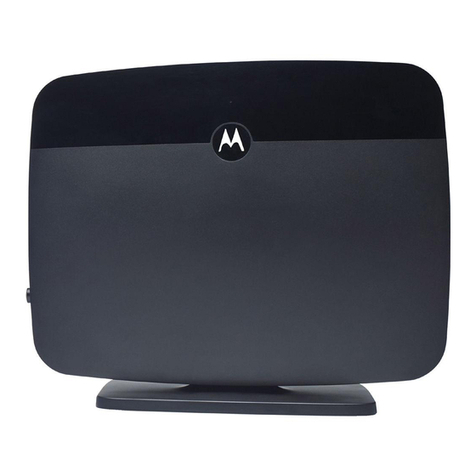
Ericsson HN294DP/DI User manual

ADSL Wireless Router
HN294dp/di
User Guide

ADSL Wireless Router
HN294dp/di
User Guide
.
ii EN/LZT 108 6377 R4 – September 2003
Copyright
Ericsson AB – 2003 All Rights Reserved
Disclaimer
The contents of this document are subject to revision without notice due to
continued progress in methodology, design, and manufacturing. Ericsson shall
have no liability for any error or damages of any kind resulting from the use of
this document.
Abstract
This User Guide provides general information about the installation of the
Ericsson ADSL Wireless Router HN294d, as well as information about
configuration possibilities.
Trademark List
Windows Windows is a registered trademark of Microsoft
Corporation
Enclosure List

Contents
EN/LZT 108 3377 R4 – September 2003 iii
Contents
1Introduction 1
1.1 About this User Guide 1
1.2 About the ADSL Wireless Router HN294d 1
1.2.1 Ease of Use 2
1.2.2 Wireless Features 2
1.2.3 Security 3
1.2.4 Advanced Possibilities 4
2Hardware Description and Installation 5
2.1 Before You Start 5
2.1.1 Package Contents 5
2.1.2 Subscription for ADSL Service 6
2.2 Physical Appearance 6
2.2.1 Front Panel and LED Indicators 6
2.2.2 Back Panel and Connectors 7
2.3 Choose a Place for the Router 8
2.4 Connect the HN294d 9
2.4.1 Connect Wireless Computer(s) 9
2.4.2 Connect Computer(s) via Cables 10
2.5 Configure Client PCs 14
2.5.1 Use DHCP 14
2.5.2 Use Static IP Addresses 15
3Initial Configuration 17
3.1 Introduction 17
3.2 Access the Configuration Wizard 18
3.3 Access the Internet 19
4ADSL-mode – RFC1483 Bridge 20
4.1 Description 20

Contents
iv EN/LZT 108 6377 R4 - September 2003
4.2 IP Addresses Assigned by PPPoE 20
4.3 IP Addresses Assigned by DHCP 21
4.4 Static IP Addresses 21
5ADSL-mode – RFC1483 Router 22
5.1 Description 22
5.2 IP Addresses Assigned by DHCP 22
5.3 Static IP Addresses 23
6ADSL-mode – RFC1483 MER Router 24
6.1 Description 24
6.2 IP Addresses Assigned by DHCP 25
7ADSL-mode – PPPoE Router 26
7.1 Description 26
7.2 PPPoE Termination and PPPoE Passthrough 27
7.3 IP Addresses Assigned by DHCP 27
8ADSL-mode – PPPoA Router 28
8.1 Description 28
8.2 IP Addresses Assigned by DHCP 29
9Advanced Configuration 30
9.1 Introduction 30
9.2 Access the Web Manager 30
9.2.1 Outline of the Web Manager 31
9.3 Overview 32
9.3.1 Connect/Disconnect to ISP 32
9.4 System 34
9.4.1 Device Information 34
9.4.2 Administration 34
9.4.3 Backup Configuration 36
9.4.4 Save Configuration 38
9.4.5 Upgrade Firmware 38

Contents
EN/LZT 108 6377 R4 - September 2003 v
9.4.6 Reset Router 39
9.5 Status 41
9.5.1 DSL Connection 41
9.5.2 WAN Connection 42
9.5.3 Traffic Counter 43
9.5.4 Routing Table 44
9.5.5 DHCP Table 44
9.5.6 Wireless Client 44
9.6 Configuration 46
9.6.1 DSL Configuration 46
9.6.2 LAN Configuration 46
9.6.3 WLAN Configuration 51
9.6.4 WAN Configuration 56
9.6.5 IP Route 59
9.6.6 DNS 61
9.6.7 Security 64
9.6.8 Virtual Server 70
9.6.9 IGMP Proxy 73
9.6.10 UPnP 74
10 Troubleshooting 75
10.1 Basic Functions 75
10.2 LAN Connection 75
10.2.1 How to use WINIPCFG 76
10.2.2 How to use IPCONFIG 76
10.3 WAN Connection 77
10.4 WLAN Connection 77
10.5 Reset the HN294d 78
10.6 Safety Mode 78
11 Important Information 80
11.1 Product Care and Maintenance 80
11.2 License Agreement 81

Contents
vi EN/LZT 108 6377 R4 - September 2003
11.2.1 License 81
11.2.2 Term 81
11.2.3 Limited Warranty 81
11.2.4 Intended Use 82
11.2.5 Limitation of Liability 82
11.2.6 Governing Law 82
11.3 Regulatory Information 83
11.3.1 EU Directives 83
11.3.2 Safety Approvals 83
11.3.3 EMC Approvals 84
11.3.4 Telecom Approval 85
11.3.5 Access Point Frequency Band 87
11.3.6 Caution 87
11.3.7 Power Supply 87
11.3.8 Environmental Information 87
11.3.9 Intended Use 87
Glossary 88

Introduction
EN/LZT 108 6377 R4 - September 2003 1
1 Introduction
1.1 About this User Guide
This User Guide provides general information about the installation of the
Ericsson ADSL Wireless Router HN294d, as well as information about
configuration possibilities.
The following chapters are included in this guide:
Chapter 1 – “Introduction” - provides information about the ADSL
Wireless Router HN294d.
Chapter 2 – “Hardware Description and Installation” – provides a
hardware description of the product and detailed instructions about
how to install the HN294d in a PC/Windows environment
Chapter 3 – “Initial Configuration” – describes how to access the
built-in Configuration tool and run the Configuration Wizard in order
to perform the initial configuration.
Chapter 4, 5, 6, 7 and 8 – “ADSL-mode – xxx” – give a description
of each of the five pre-defined ADSL-modes included in the
Configuration Wizard.
Chapter 9 – “Advanced Configuration” - provides detailed
information about the built-in Web Manager and how to perform
advanced configuration.
Chapter 10 – “Troubleshooting” - provides tips and solution for
resolving some of the problems that might occur when installing and
using the HN294d.
Chapter 11 – “Important Information” – provides information about
License Agreement and Regulatory Information.
The Glossary includes abbreviations and explanations to technical
terms used in this guide.
1.2 About the ADSL Wireless Router HN294d
Thank you for choosing the Ericsson ADSL (Asymmetric Digital Subscriber
Line) Wireless Router HN294d. Already by the name you can see that the

Introduction
2 EN/LZT 108 6377 R4 - September 2003
HN294d is a powerful addition to your home; HN294d stands for Ericsson
quality, Wireless (WLAN) stands for freedom from cables, ADSL stands for
high-speed access to the Internet, Router stands for security/convenience
and they altogether stands for the future.
The HN294d is available in two versions: HN294dp and HN294di. Both
products offer the same features, but they rely on different types of
telephone line in order to provide the ADSL service. HN294dp offers ADSL
service over POTS (Plain Old Telephone System) lines, while HN294di
uses ISDN (Integrated Services Digital Network) lines to provide the ADSL
service.
Based on the IEEE 802.1d wireless standard the HN294d will let you
experience the freedom from cables, this means "no more annoying
cables"! With up to 11 Mbit/s in wireless speed you will have access to your
broadband network from wherever you are in your home.
With the fast and powerful HN294d you can spend less time waiting and
more time doing the things you want to do and you can do it anytime
anywhere. You can even talk on the telephone simultaneously as you surf
the Internet using your existing phone line. Using this wireless router will
give you lots of advantages over only using a simple ADSL modem (simple
ADSL modems are often referred to as "bridged" modems). With a router
you can connect multiple PCs together to use a single Internet connection
using wireless, Ethernet- or USB devices (the HN294d can handle all three
simultaneously) and you will be protected by state-of-the-art firewall
technology. But, perhaps the best thing about the HN294d is that you don’t
have to be a computer expert to use it, simple plug it in and you are done.
No complex configuration with a lot of questions you don’t know how to
answer, Ericsson has already answered them for you.
1.2.1 Ease of Use
For standard Internet access (surfing websites, playing network games,
downloading files, using peer-to-peer programs etc) all you have to do is
select an appropriate ADSL-mode in the web-based Configuration Wizard
and the technical details is set-up and managed automatically. The
HN294d comes pre-programmed with different ADSL-modes to suit
different end-users.
1.2.2 Wireless Features
It is very easy to have a wireless network up and running when using the
HN294d. As the HN294d is preconfigured, all you have to do is to install
and configure a wireless card to your computer (wireless PCMCIA-card,
wireless PCI-card or wireless USB adapter) and when your computer is
correctly setup just turn on your HN294d. Your computer will automatically

Introduction
EN/LZT 108 6377 R4 - September 2003 3
find the HN294d and assign your computer an IP address. Now, you are
ready to surf and use the Internet anywhere in your home.
Since a wireless network is more vulnerable to attacks than a traditional
wired network it is recommended to make some configuration that will
make it impossible for another user than you to access the wireless
network. The HN294d has several configuration possibilities to help you
improve the security in your wireless LAN.
In a wireless configuration the HN294d is designed to reach 50-100 meters
indoors (up to 300 meters outdoors), but when choosing a location for your
router keep in mind that this length is affected by a number of rules, such
as:
The more walls the signal has to pass, the shorter will the signal
reach.
The thicker the wall is, the shorter will the signal reach.
Keep the HN294d away from equipment that might disturb the
signal (such as Bluetooth devices, microwave ovens and 2.4 GHz
cordless phones).
1.2.3 Security
You can connect more than 250 PCs to the HN294d, all sharing the same
public IP address. This is made possible by NAT (Network Address
Translation) technology. NAT also hides your PCs from the Internet, which
serves as security protection, making it impossible to directly target your
PCs from the outside. All traffic is addressed to the HN294d, which, with its
powerful firewall, inspects all incoming and outgoing traffic and removes
malicious or dangerous packets. The firewall is a full stateful packet
inspection firewall, which means that it will not only inspect packets (like
simple firewalls) but also will remember and investigate traffic flows and
patterns to detect and prevent advanced attacks. To keep it simple, all that
you need to do is select the desired level of security.
Even though your PCs are invisible and protected from the Internet you can
still access the Internet as before, and all your Internet programs (games,
applications, peer-to-peer programs, communications applications etc) will
still work. This is handled by built-in mechanisms that recognize your
programs and allow them to access the Internet directly. Everything is
handled automatically and requires no user configuration.
The HN294 also supports pass-through of common VPN (Virtual Private
Network) implementations making it possible for the user to create secure
connections. A VPN is used to create secure connections where
confidential information needs to be sent. The VPN can be compared to a

Introduction
4 EN/LZT 108 6377 R4 - September 2003
tunnel where the information inside the tunnel is encrypted so that only the
intended target at the end of the tunnel can read the information.
1.2.4 Advanced Possibilities
The HN294d also offers sophisticated router functionality making it possible
for advanced users to create customized network scenarios as desired.
This includes the ability to set up static routes, multiple subnets, a DMZ,
etc. The Virtual server function enables you to create your own servers
behind the HN294d firewall, giving both the servers and the PCs, on which
they run, full protection. Several servers are already pre-defined, making it
easy to enable secure access to the server.
With its dual benefits of advanced functionality and ease of use, the
HN294d provides an ideal Internet access solution for a corporate
environment, a small office, and even for home users.
This manual suits for next models
2
Table of contents
Other Ericsson Network Router manuals

Ericsson
Ericsson W20 User manual

Ericsson
Ericsson ECN330 User manual

Ericsson
Ericsson EDA User manual

Ericsson
Ericsson W21 User manual

Ericsson
Ericsson W30 User manual

Ericsson
Ericsson W3x Series User manual

Ericsson
Ericsson ECN330 User manual

Ericsson
Ericsson W20 User manual

Ericsson
Ericsson W20 User manual

Ericsson
Ericsson SmartEdge 600 Installation instructions