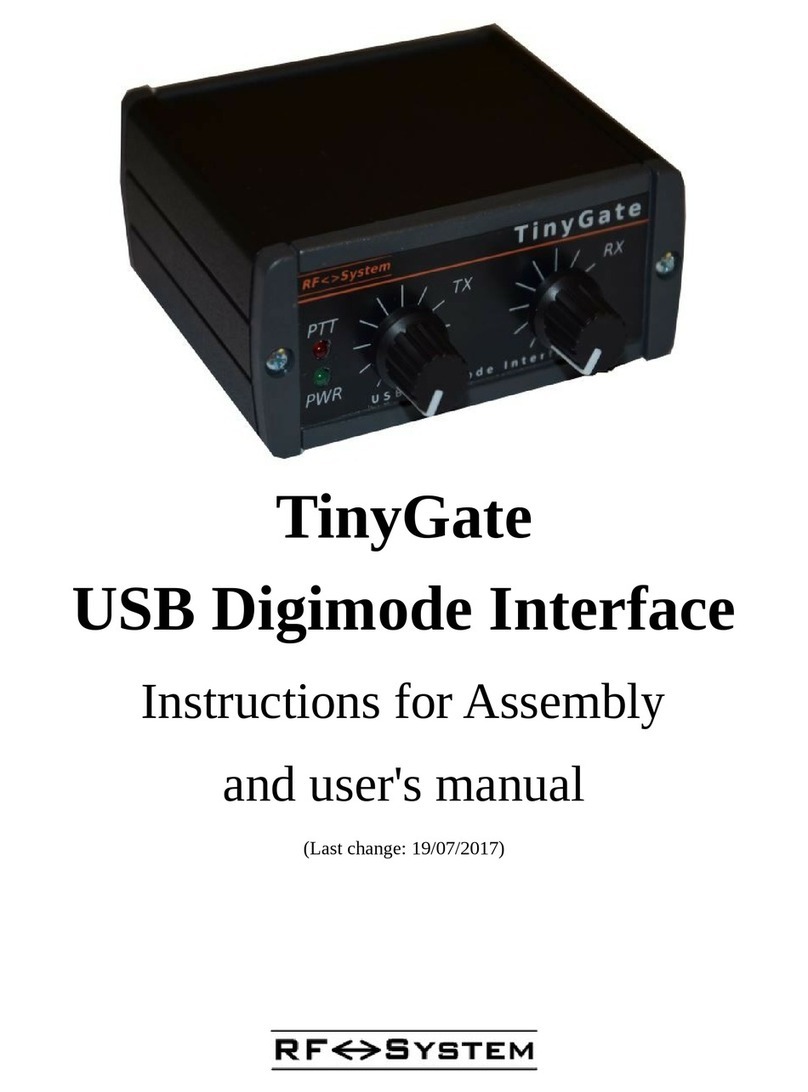
dualo du-touch User manual

dualo du-touch
user guide

Welcome to the dualo community. You are among the rst-ever players of the
dualo, and we congratulate you on your choice.
The du-touch is still under development, as is its user guide. As such, we welcome
any comments you may have on how the du-touch works, which you can submit
via the page dualo.org/en/support. We regularly produce updates. So, before
anything else, make sure that the sofware version of your du-touch corresponds to
the version of this user guide, also available from dualo.org/en/support.
The du-touch is a musical instrument, and as such no user guide teaches you
how to play it. The purpose of this guide is to answer questions you may have,
but it does not constitute a method. You'll be able to nd du-lessons on the dualo
YouTube channel and on the dualo.org/en/media page, with a series of tutorials
for learning how to handle the du-touch.
Have a great time getting down with your du-touch.
from the du-team
dualo du-touch
user guide Version 01 - 0021
© Dualo, december 2014
A word from the instrument maker

3
Contents of the pack
USB cable + international AC adaptator
quickstart paper
du-touch
cotton protective cover

4
The musical instrument
The du-touch is a new musical instrument with its own special way of being
played. It’s a complete instrument, in the sense that it’s a controller, a synthe-
sizer and a sequencer all at the same time. So, in order to understand how
it works, here are ve elements which, when combined, make it possible to
play and share music:
play: it's the du-touch as a machine which captures the gestures
of the musician. (Don't look for the button, this is the du-touch itself)
sound: everything involving the timbre in the broad sense, choos-
ing a sound, adding effects, etc.
music: in the sense of musical text, recording or playing a piece of
music, tracks, or anything that might be found in music notation.
settings: for adjusting the various parameters of the rst three
elements.
connection: everything to do with links and sharing with the out-
side world, other machines or other members of the community
and, of course, the du-station software.

5
play
The du-touch
The du-touch is a controller, in other words a machine that
captures the gestures of the musician to transmit them to the
internal synthesizer or to a MIDI interface. It does not have
speakers, so you need to connect it to an amp or a headset, or
use it as a MIDI controller.

6

7

8
Connecting to a headset or an amp
Plug in your headset or headphones to the headset mini-jack socket.
If you are using an amp, plug your jack into the audio line-out. Make your
connections before turning the equipment on.The du-touch produces bass
sounds, so you're advised to use a bass or keyboard amp, or even better a
sound system, rather than a guitar amp.
The du-touch is stereo but works very well in mono. Take care however not
to use a stereo jack on a balanced mono input. If in doubt, use a mono jack.
Turning the du-touch on or off
Briey press the standby button beneath the du-
touch to turn it on.The music button and screen
light up after several seconds, and the instrument
is ready to play.
Press the same standby button to turn the du-
touch off.

9
Adjusting the general volume
Adjust the volume by stroking the touch
strip on the front of the du-touch. The vol-
ume value appears on the screen.
Touch the bottom of the strip to turn the
volume to zero (mute). Touch the top of
the strip to return the volume to what it
was before being zeroed (unmute).
There are other volumes for sounds, pieces
of music, loops and metronome.
Positioning the instru-
ment
Place your du-touch on your lap and
let it rest against your midriff. It stays
in place without needing to be held.
Your hands (including your thumbs)
are over the keyboards, for maximum
freedom of movement. For greater
stability we recommend the use of
the du-belt*, the Dualo carry strap.
* available as an option from dualo.
org
touch strip

10
Playing notes
To play notes, hit the keys with your ngertips. Simply pressing isn't effective,
you need to move your ngers rapidly. The harder you hit, the louder the
sound. It is possible to adjust the sensitivity of the keys, display a scale on the
keyboard or display the names of the notes on the screen..
Holding a note
For playing a sustained note without keeping the key depressed, play and
hold the music or sound button before releasing the note or chord.To re-
lease the sustained note, play the same notes again or double-click the sound
button.
Layout of the notes
On the Dualo, as one goes away from the head, the notes jump up in thirds,
both major thirds (inward) and minor thirds (outward). So two hands must
co-operate to play all the notes needed: one hand must play the rst (root),
third, fth and seventh, etc. notes, while the other hand plays the second,
forth, sixth, eighth (octave), etc. notes. To play a chord you just need to play
three successive keys. See the dualo principle, to nd out more.
It is possible to display the notes on the screen.
Table of contents