
Daymak SASQUATCH JR User manual
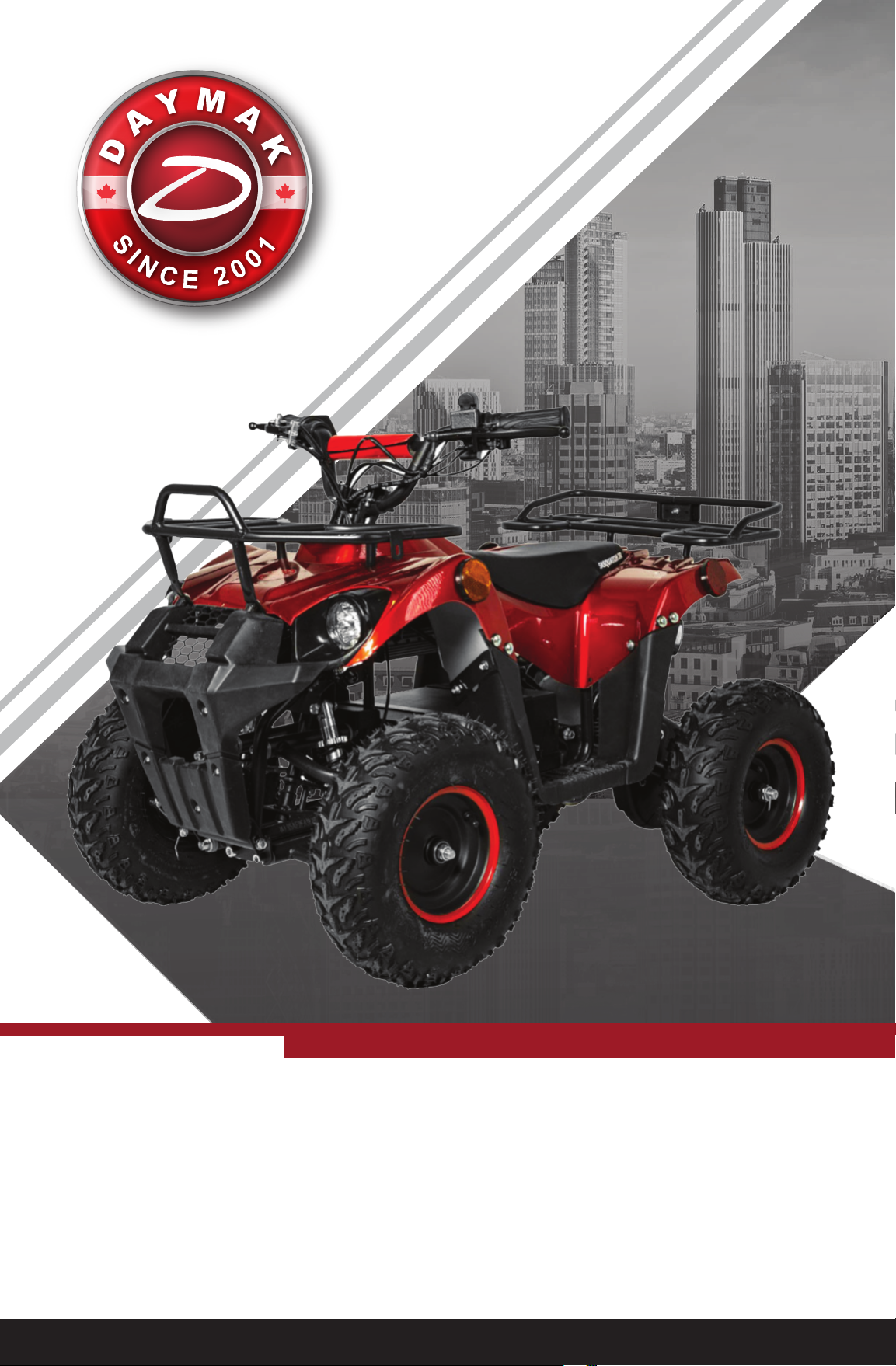
sasquatch jr.
User Manual
2
Safety
When operang the Sasquatch Jr. please make sure you adhere to the following:
• Always wear a helmet when riding the Sasquatch Jr.
• Have a parent or guardian assemble the unit to ensure security.
• Do not operate without parental supervision
• Always ride in open areas free of obstrucon
• Make sure that your baery power is sucient before you go out to ride.
• Do not exceed weight limits of the unit
• To start, make sure unit is in slowest speed to prevent accidents.
• Periodically charge the unit when not in use for long periods of me
• Do not over charge the baery by leaving the charger in the charging port. Once
the baery is fully charged remove the charger immediately.
• Do not try to operate the unit while charging.
• Do not make sharp / abrupt turns at high speeds to avoid pping.
• Do not operate under the inuence of any use of drugs or alcohol
• Do not completely submerge the unit in water
• Do not operate in harsh weather condions.
For any quesons or concerns please call
1-800-649-9320 or visit www.daymak.com
3
About Daymak
Daymak is one of Canada’s largest Alternave Vehicle providers. We design, engineer,
manufacture, import and repair everything from recreaonal dirt bikes, go-karts and
electric golf cars to alternave transportaon soluons such as atv electric scooters.
Our electric bicycles represent an energy-ecient and eco-friendly alternave for
people who need to get around the city. They greatly increase the praccality of bicycle
transportaon in urban centres. Cosng only a few cents to charge, an atv can make city
life more convenient and much less expensive.
While there are many new Green technologies that are sll in their infancy, electric
bicycles have been developing over the last 40 years or more. Atv technology has been
dramacally rened since the introducon of the rst custom-conversion bicycles. Today,
electric bicycles are a supremely reliable and aordable means of transportaon.
Daymak is constantly developing new eco-friendly alternave transportaon strategies,
led by its own Research and Development department in Toronto, Canada. We are always
improving our products. Our innovave in-house engineering and quality tesng provide
customers with many new kinds of reliable, eco-friendly vehicles, designed to help change
the lives of our customers and the world.
Daymak warranes, services, and stocks parts for everything it sells. We support our
products. Please feel free to visit our website. You’ll nd the latest in cool transportaon
soluons, support for the products you’ve purchased and contact informaon.
4
Introduction
Liability
Daymak does not assume any liability for damages, loss of prots, or claims from third
pares due to improper use of this product. Daymak does not assume any liability for
damages due to problems with the product resulng from service by a third party that is
not cered by Daymak.
The informaon in this guide may be subject to change without noce. For the latest
informaon available, please contact your local Daymak dealer or visit our website.
We have taken all possible measures to ensure the accuracy and completeness of the
informaon in this guide. However, if you do nd anything missing, incomplete or wrong,
do not hesitate to contact us.
5
Table of Contents
• SAFETY 2
• ABOUT DAYMAK 3
• INTRODUCTION 4
• PART DIAGRAMS 6
• RIDING INSTRUCTIONS 7
• ASSEMBLY 7
• FUSE 11
• THE BATTERY 12
• CHARGING YOUR ATV 13
• CHARGING THE SASQUATCH JR. 14
• OPERATION 16
• TECHNICAL DATA 20
• VEHICLE IDENTIFICATION NUMBER (VIN) 21
• MAINTENANCE AND TROUBLESHOOTING 22
• MAINTENANCE 24
• THANK YOU FOR CHOOSING DAYMAK 28
6
Part Diagrams
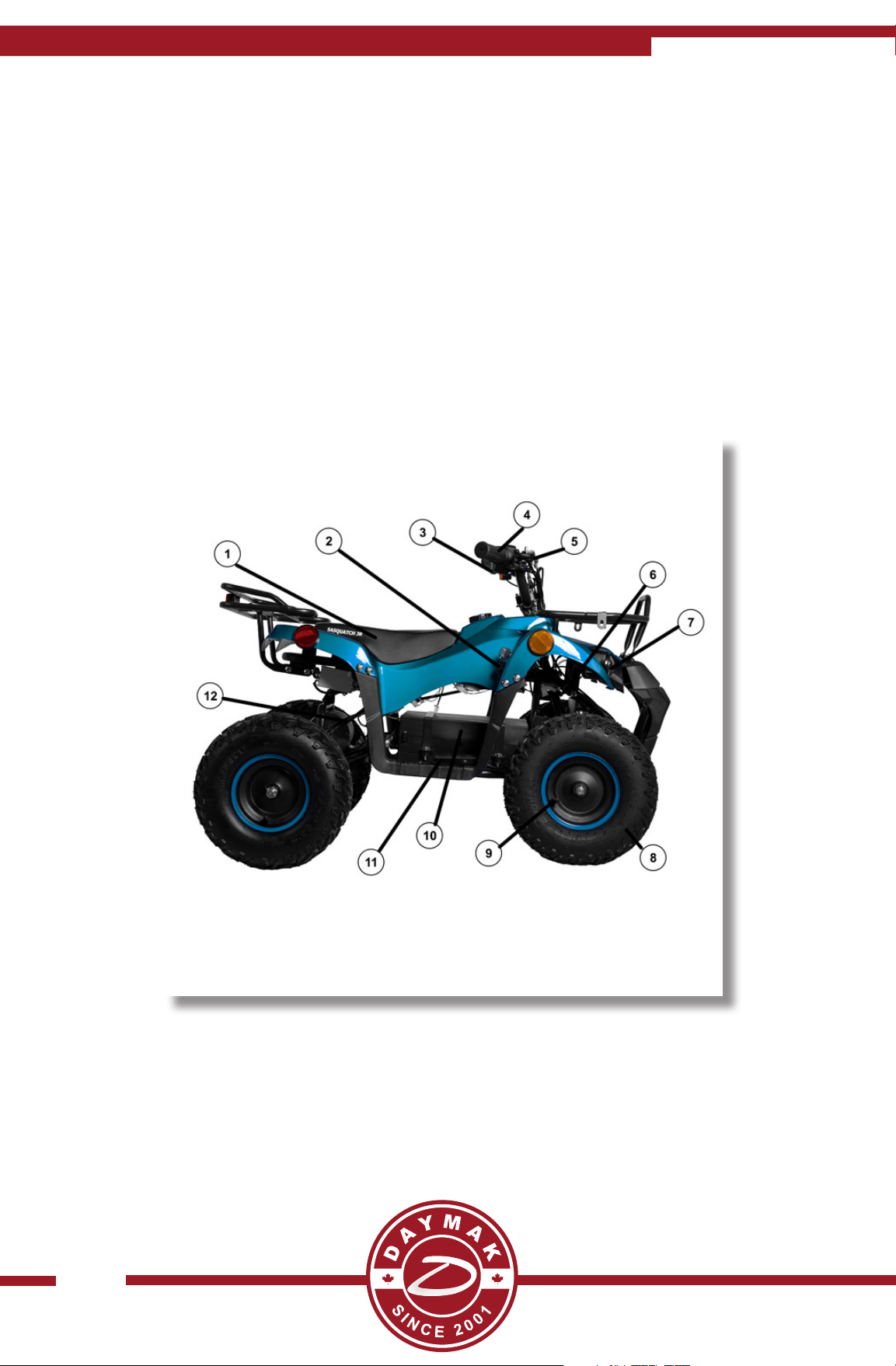
Diagram 1: Sasquatch Jr.
This diagram illustrates the various parts of your unit. Please note that many of these
parts are not user-serviceable and should be repaired only by trained professionals. This
is especially true of the electrical systems and the mechanical components.
1. Seat
2. Ignion
3. MP3 / Radio Switch
4. Throle
5. Brakes
6. Charge Port
7. Headlights
8. Tires
9. Tire Pump Valve
10. Baery
11. Safety Foot Pedal
12. Motor
7
Riding Instructions
This guide assumes that you already know how to ride a standard bicycle. Before you try
to ride an electric dirt bike, you should be very familiar with controlling and balancing a
normal bicycle.
Cauon
If you do not have riding experience, an atv is too dangerous to ride. Do not begin learning
to ride a bicycle using an atv.
Important Notes
• ATVS are Fast! Atv are capable of traveling at higher speeds than many bicycle
riders are accustomed to. Use cauon at all mes, especially when travelling in mixed
trac. Always take into account driving and traveling condions.
• Obey the Law. Be sure to follow all provincial and city trac
laws. This includes obeying stop signs, checking carefully when
turning, and riding defensively. An atv is a motorized vehicle. You must
follow the law.
• Stay Sober. Never ride your ATV while intoxicated. An atv is capable of traveling
faster than a normal bicycle, and you should always be in control of it.
• Share the Road. Be careful in mixed trac. Let vehicles that are faster than you
Overtake you and give ample room for vehicles travelling slower.
AsSEMBLY
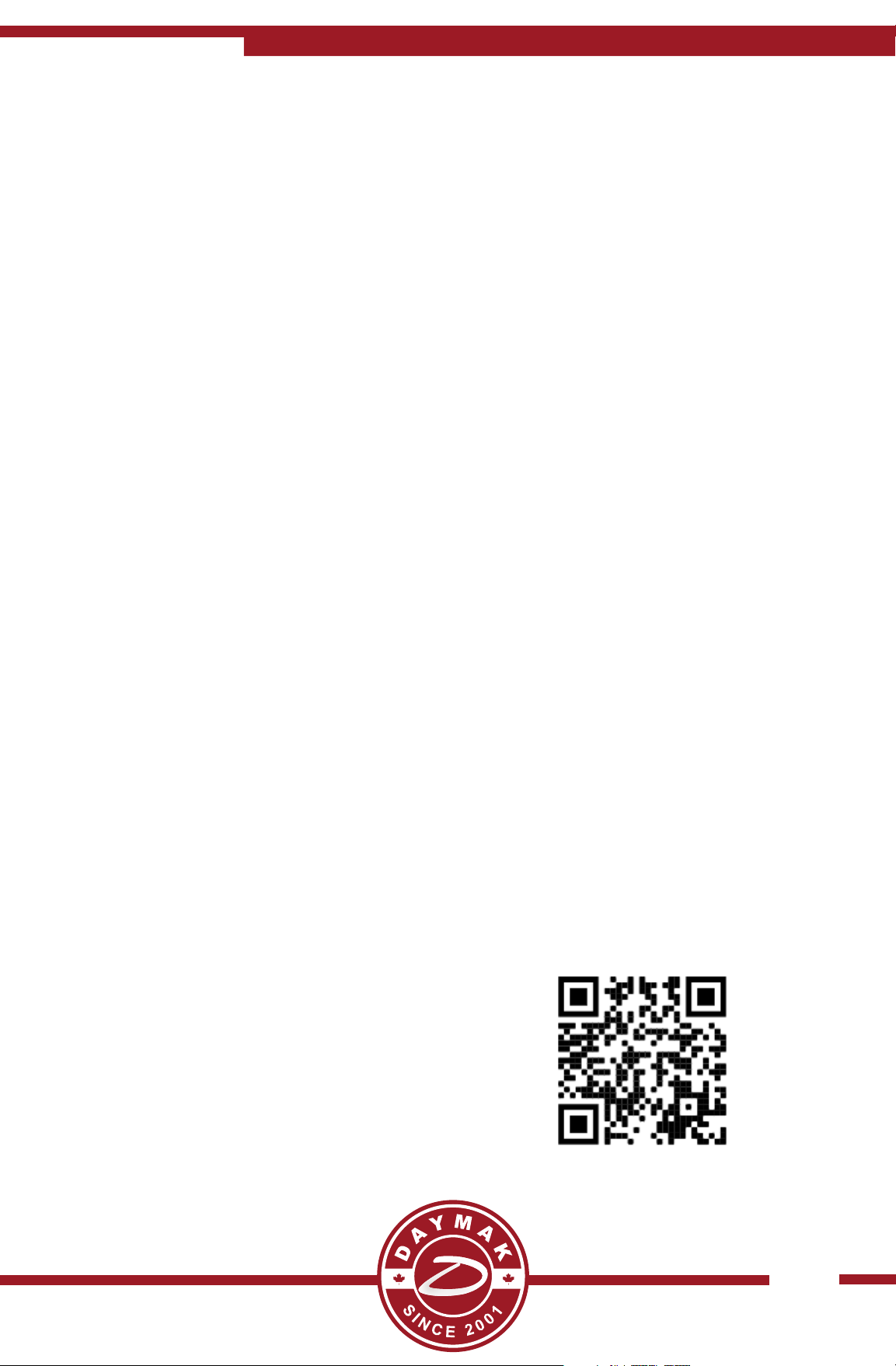
For a full guide on how to assemble the Sasquatch Jr.
please go the following url or scan the QR Code:
hps://daymak.com/assembly/sasquatch-jr
8
Items to Carry with the Electric Bike
It is a good idea to carry the following items with you at all mes when you ride your atv.
• The charger, to charge the bike in case the baery power runs out.
• 30 Amp Fuse, spares for the baeries, in case the fuses blow (if applicable).
• A lock, to secure your atv when you park it.
• A helmet, and protecve riding gear.
Inspecting your ATV
Always inspect your atv before you ride it, to make sure its safety features are operang
properly. Many accidents can be avoided with roune inspecons. Once you are
comfortable with your atv, you will be able to detect small changes in the way it feels. If
anything changes between uses, make sure to have it properly examined. Also, be sure
to listen for changes in the sounds your atv makes over me. Any mechanical or power
issues may have eects on the sounds the bicycle makes.
Holding the Handlebars
As with a normal bicycle, place your ngers over the brake levers, using the palms of your
hand and your thumbs to wrap around and under the handlegrips. Doing this allows you
to acvate the brakes easily, by squeezing your hand, in case you have to stop quickly. This
is the safe way to control your atv.
Turning your Atv On and Off
To turn on your atv, insert the key into the “ignion”, located just below the dash board,
and turn the key to the right. When your atv is acvated, the power indicator will light and
the baery charge indicator will jump, showing you how much power your atv has. To turn
o the atv, simply turn the key to the le, and remove the key.
9
Warning
When you acvate the atv, the electrical system becomes live. Do not try to aect changes
to the Atv (such as removing the baery or repairing electrical components) while the Atv
is acvated. Turn the Atv o and remove the key before you aempt to access any of the
electrical components. Also, the baery carries a signicant electric charge and can injure
people if not treated properly and with respect.
Accelerating and Decelerating
The throle is found on the right-side hand grip on the handlebars. Turn rotate the grip
counterclockwise (towards you) to accelerate. To decelerate, release the grip (turn it
away from you). Don’t over-rotate the accelerator, as this could damage the baery and
electrical components.
Warning
Do not acvate the accelerator unl you are seated on the atv and are ready to accelerate.
The atv can easily escape from your control, possibly injuring you or others, and the atv
may be damaged by being dropped.
Stopping
Your atv has two sets of brakes, at the front and at the rear. The levers aached to the
handlebars, on the le and right, acvate the brakes. Pull the levers toward you to acvate
the brakes.
You can use both brakes to come to a stop more quickly, or you can use one of the brakes
to come to a gentle stop, depending on your riding needs at the moment. When the
brakes are acvated, the power to the engine is automacally turned o, unl you release
the brakes. This allows you to stop safely.
Safety Tips
• When you are traveling in wet weather, water may cause your brakes to funcon
less eciently because it reduces fricon between the brake pads and the wheels.
• Take care to slow down and give yourself more room to stop or slow if necessary.
• It is a good idea to have your brakes and brake pads checked regularly. The brake
pads will eventually wear down through fricon, and aer signicant use will have to
be replaced.
• Engage the rear brakes rst before the front brakes to avoid ipping the unit.
10
Riding in Wet Weather
Your atv is designed to funcon in wet condions, such as when it is raining. However,
because the motor is on the rear wheel, it is easy to slip when moving at high speeds. If
it is very wet, be sure to avoid high speeds. When you are traveling in wet weather, water
may cause your brakes to funcon less eecvely because it reduces fricon between the
brake pads and the wheels. Take care to slow down and give yourself more room to stop
or slow if necessary.
The Motor and Water
Your atv is not designed to be immersed in water. Always ensure that the water level does
not go above the middle of the re, to prevent water from geng inside the motor. Water
in the motor can cause short-circuits and may damage the electrical systems in your atv.
Riding in Cold Weather
Your atv is designed to operate year-round. However, in very cold condions or when there
is a lot of snow or slush on the ground, it is possible for the motor in the atv to get wet
or for the brakes to funcon less eecvely, just as it can happen in wet weather. Below
10 degrees Celsius, the baery will not work as well as it would in warmer temperatures.
While Lithium-Ion baeries perform beer than Lead-Acid baeries in temperature
extremes, both will experience reduced performance in cold temperatures.
Also, riding the atv in cold temperatures may require you to replace the baery sooner
rather than later.
Maximum Load
Do not exceed the maximum load capabilies of your atv. You can nd the exact loading
capacity listed in the technical specicaons in this guide.
If you exceed the maximum load, the performance of the atv will suer.
Exceeding the maximum load of your atv could cause damage to the shocks, to the
mechanism and, ulmately, even to the frame. It could also cause your motor to work too
aggressively, and may cause it to burn out.
Table of contents
Other Daymak Offroad Vehicle manuals


