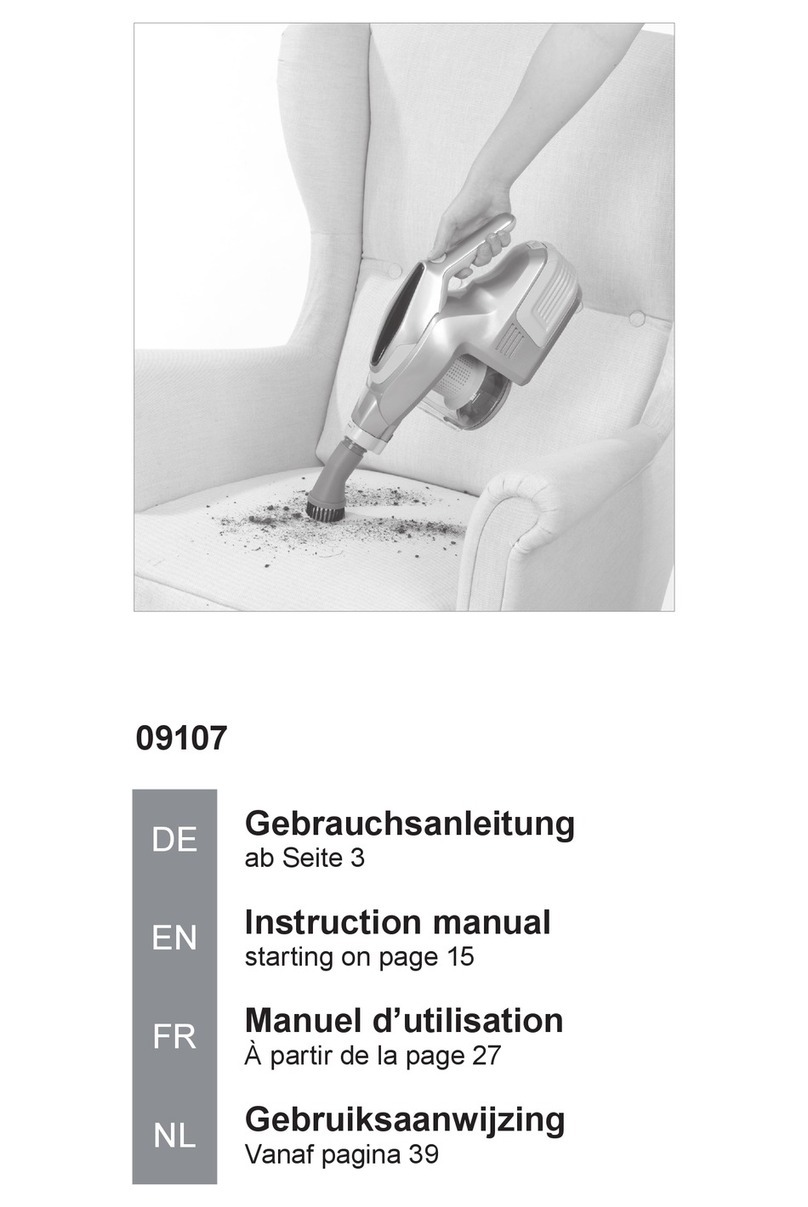
Daewoo DCVC100 User manual

DCVC100
Window Vacuum Cleaner
EN
NL
DE
FR
USER MANUAL
GEBRUIKERSHANDLEIDING
GEBRAUCHSANWEISUNG
MODE D’EMPLOI
2
11
20
29

EN
2
TECHNICAL SPECIFICATIONS
Warning!
Risk of electric shock and for potential risk of death and/or
serious irreversible injury!
Safety Warning!
It requires special attention to read and follow the instructions,
otherwise a potential hazard, injury, death or serious condition
may happen.
Class II
For equipment where protection against electric shock does
not solely rely on basic insulation, but where additional safety
precautions like double insulation or reinforced insulation are
taken, and there is no protective earthing or reliance upon
installation conditions.
CE marking
Indicates that the product sold in Europe has been assessed to
meet high safety, health, and environmental protection require-
ments.
Wheelie Bin (WEEE)
Instructions for protecting the environment (Waste Electrical &
Electronic Equipment directive)

EN
3
Read the instructions for use carefully and keep them safe. If
you give this device to other people, please also pass on this
manual.
SAFETY INFORMATION:
When using any electrical appliance, basic safety precautions should always
be considered to reduce the risk of re, electrical shock, leaking batteries of
personal injury, including the followings:
• Never immerse unit or charger in water or other liquid
• Do not insert objects into the air vents.
• This appliance can be used by children aged from 14 years and above
and persons with reduced physical, sensory, or mental capabilities or
lack of experience and knowledge if they have been given supervision or
instruction concerning use of the appliance in a safe way and understand
the hazards involved. Children shall not play with appliance. Cleaning
and user maintenance shall not be made by children without supervision.
• This appliance is powered by safety low voltage corresponding to the
marking on the appliance.
• Before using the appliance and after any impact, check for any sign of
wear or damage.
• Do not use the appliance if any parts is damaged or defective.
• Only use the charger supplied with the product. Do not attempt to use
any chargers from other products to charge the appliance.
• Using a charger from different product may cause re and or electrical
shocks.
• Before use, check the charger cord for signs of damage or ageing.
• Do not attempt to charge a damaged battery.
• The appliance must be disconnected from main supply when removing
the battery.
• Always unplug the appliance before cleaning and/or maintenance.
• Always unplug the charger from the main supply if it is not used for
charging.
• Keep the charger cord away from hot surfaces and sharp edges.
• Do not handle the charger with wet hands.
• Do not store or charge the unit at outdoor.

EN
4
STORAGE
• Store in an upright position
• Store in a dry place
• Store out of reach of children
• Ensure the appliance is not plugged-in during storage
INTENDED USE
• Use only as instructed in this manual. The use of any accessory or opera-
tion with this appliance other than those recommended in this instruction
manual may have the risk of personal injury.
• Use this battery-operated appliance only for cleaning moist, smooth
surfaces such as windows, mirrors, or tiles.
• It is not recommended to use the appliance on surfaces that can be
easily scratched such as wood, steel, varnished and high glossy surfaces,
otherwise it will damage the rubber lips.
• Only use this appliance with conventional window cleaner (no spirit, no
foam), otherwise leakage may happen from air vents. If this happens,
stop the appliance immediately.
START UP
• Before you start, unpack the product, remove all protective cartons, and
make sure no accessories are missing and none of the package have
been damaged (Fig. 1).
• Attach the suction nozzle to the main unit until it snaps in place (Fig. 2).
• Assemble the sprayer and wipe bre and add detergent/window cleaner,
water into sprayer tank (Fig. 3, 4 and 5).
• Charge the battery of appliance for 3 hours before use (Fig. 6).
• After fully charging the appliance, the operating time of the appliance is
about 30 minutes.
INSTRUCTIONS
• Apply detergent/window cleaner on the windows surface evenly (Fig.
7-2).
• Rub and loosen the dirt on window using the wipe bre (Fig. 7-3)
• Prior to use, make sure the squeegees are clean.
• Turn the appliance on and move the appliance from top to bottom of
window (Fig. 8) and vacuum up the detergent/window cleaner.
• Hard to reach areas can be vacuumed vertically or horizontally.

EN
5
• If battery level is low, the charging/power indicator starts ashing
slowly. If this happens, charge up the battery as soon as possible.
• The appliance can be switched off (Fig. 9) while the spray bottle
is in use. This will save battery power and extend operating time.
• Switch off the appliance and set it in upright position if there is a need
for an interrupt during the cleaning process.
CLEANING THE APPLIANCE
Emptying water tank
• Once the max. level (150ml mark) of the water tank is reached, dirt water
inside the water tank has to be discarded, otherwise water may get into
the suction system.
• If the appliance is being used with its handle facing down (e.g., cleaning
rooight), it is recommended to empty the water tank after cleaning each
window.
• Turn off the appliance and pull out the cover lock (Fig. 10) of the water
tank.
• Drain out the water from water from water outlet hole (Fig. 11).
• Only open the water tank when cleaning is necessary.
Cleaning water tank
• For hygienic reason, it is recommended to empty and clean the water
tank after several uses.
• Push down the release button of water tank and take it out from the main
unit (Fig. 13).
• To open the water tank, apply force to pull the top half and bottom half
of water tank apart (Fig. 14).
• Each time to open the water tank, be cautious for the inner assembled
parts.
• Remove the tube separator by pulling it out of the main unit and clean it
and the inside of water tank under running water, or with a cloth.
• Components of the window vacuum cleaner are NOT dishwasher safe!
• Connect the tube separator back to water tank bottom half unit.
• Connect the water tank top and bottom half units back in place.
• Put the water tank back to the main unit by pushing the top part into the
main unit until it snaps in place.

EN
6
Cleaning main unit
• Turn off the appliance.
• The main unit as well as the squeegee can be cleaned or wiped with a
damp cloth.
• Squeegee can be detached from the main unit by releasing the lock in
the middle (Fig. 12).
• Do not use solvents or polishes to clean the outside of the unit.
• The appliance contains electrical components, never immerse the
unit in water.
• Do not clean it in a dishwasher, washing machine, or under running
water.
• Store the appliance in a dry place with put the appliance in an upright
position.
BATTERY CHARGING
• Charge the battery for 3 hours before use for the rst time.
• Turn off the appliance before charging.
• Connect the charging plug of charger to the charging socket located
below the power button of apparatus.
• Plug the charger to a suitable electrical socket.
• The light indicator will be ashing in blue colour during charging.
• After charging is completed, the light indicator will remain blue.
• Unplug the charger from main socket. Do not pull the charger cord.
• Disconnect the charging plug from the apparatus.
• It takes about 3 hours to fully recharge the battery if the apparatus is
automatically stopped due to low battery power.
• If the appliance is connected to the charger while it is on, the motor will
stop immediately, and it will start charging.
• To maintain the good performance of the battery, it is recom-
mended the unit to be fully discharged and completely recharged at
least once a month.

EN
7
LIGHT INDICATOR
TROUBLESHOOTING
Machine does not start
Check the light indicator
• Light is off/slow blinking: charge the apparatus.
• With a rapidly blinking signal with charged battery: inform your dealer of
after-sales service
Streaks while cleaning
• Clean the pull-off lip.
• Reverse the used pull-off lip: Pull the silicon squeegee to the side. Wet
the squeegee in the curved area with water or detergent. Slide the sili-
con squeegee back in the holder of reverse order.
• Replace the pull-off lip if necessary: If both edges are worn after turning
the silicon squeegee around, a new silicon squeegee is required. Re-
place silicon squeegee as described above.
• Adjust the dosing of cleaning solution.
Water is leaking from the air louvers
Empty the water tank (max. 150ml capacity)

EN
8
INSTRUCTIONS FOR PROTECTING THE ENVIRONMENT
(WEEE, the waste electrical and electronic equipment directive)
Your product has been manufactured using high quality material and com-
ponents which can be recycled and used again. At the end of its life, this
product cannot be disposed in normal domestic waste, but must be taken
to a special collection point for recycling electrical and electronic equip-
ment. This is indicated in the user manual and in the packaging by the waste
container marked with cross symbol. Used raw materials are suitable for
recycling.
By recycling used appliance or raw materials, you are playing an important
role in protecting our environment. You can ask your local council about the
location of your nearest collection point.
Do not dispose batteries in your household waste. Dispose of batteries by
taking them to your local recycling station. Contact your local government
ofce for details.

EN
9

EN
10
EU DECLARATION OF CONFORMITY
We,
Elmarc B.V.
Kolenbranderstraat 28, 2984 At Ridderkerk,
The Netherlands
Declare under our sole responsibility that the product:
• Product Brand: Daewoo
• Product Model No: DCVC100
• Product Description: Window Vacuum Cleaner
• Product Rating: 3.7V , 20W, IPX4
• Charger Input: 100 - 240 V~, 50/60 Hz, 0.2A, Class II, IPX0
• Charger Output: 5V , 800mA
Following the provisions of the Directives:
• Electromagnetic Compatibility (EMC) Directive: 2014/30/EU
• Low Voltage Directive (LVD): 2014/35/EU
• Energy Related Products (ERP) Directive: 2009/125/EC
• Restriction of the use of certain Hazardous Substances in Electrical and Electronic
Equipment Directive (RoHS): 2015/863amending 2011/65/EU
And standards to which Conformity is declared:
EMC (Window Vacuum Cleaner & Charger):
• EN 55014-1:2017
• EN 55014-2:2015
• EN 61000-3-2:2014
• EN 61000-3-3:2013
LVD (Window Vacuum Cleaner):
• EN 60335-2-2:2010/A1:2013
• EN 60335-1:2012/A13:20117
• EN 62233:2008
LVD (Charger):
• EN 60335-2-29:2004+A2:2010+A11:2018
• EN 60335-1:2012+A11:2014+A13:2017+A1:2019+A2:2019+A14:2019
• EN 62233:2008
ERP (Charger):
• EU 2019/1782
Place: The Netherlands
Date of issue: 20 April 2022
Table of contents
Languages:
Other Daewoo Vacuum Cleaner manuals

Daewoo
Daewoo Tornado Lyte User manual

Daewoo
Daewoo RCC-120R-1 User manual

Daewoo
Daewoo RC-300 User manual

Daewoo
Daewoo RC-700M User manual

Daewoo
Daewoo DAVC150 User manual

Daewoo
Daewoo RC-350 User manual

Daewoo
Daewoo RC-150R User manual

Daewoo
Daewoo RCC-153 User manual

Daewoo
Daewoo RC-230R User manual

Daewoo
Daewoo RC-701M User manual

Daewoo
Daewoo RC-3714F User manual

Daewoo
Daewoo RC-550 User manual

Daewoo
Daewoo TORNADO PET User manual

Daewoo
Daewoo DAVC 90-20L User manual

Daewoo
Daewoo RC-4085BLBA User manual

Daewoo
Daewoo RC-220 User manual

Daewoo
Daewoo Cyclone Digi-Flex User manual

Daewoo
Daewoo RC-6003F User manual

Daewoo
Daewoo RC-6005B User manual

Daewoo
Daewoo RCC11CY User manual