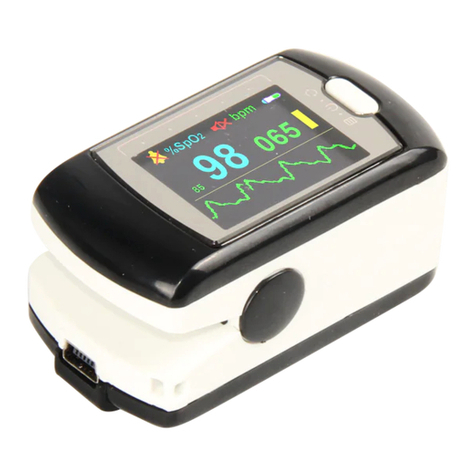
Contec CMS-50D Plus User manual

I
Instructions to User
Dear users, thank you very much for purchasing the Pulse
Oximeter.
This Manual is written and compiled in accordance with the
council directive MDD93/42/EEC for medical devices and
harmonized standards. In case of modifications and
software upgrades, the information contained in this
document is subject to change without notice.
The Manual describes, in accordance with the Pulse
Oximeter’s features and requirements, main structure,
functions, specifications, correct methods for transportation,
installation, usage, operation, repair, maintenance and
storage, etc. as well as the safety procedures to protect both
the user and equipment. Refer to the respective chapters for
details.
Please read the User Manual carefully before using this
product. The User Manual which describes the operating
procedures should be followed strictly. Failure to follow the
User Manual may cause measuring abnormality, equipment
damage and human injury. The manufacturer is NOT
responsible for the safety, reliability and performance issues
and any monitoring abnormality, human injury and
equipment damage due to users' negligence of the operation
instructions. The manufacturer’s warranty service does not
cover such faults.
Owing to the forthcoming renovation, the specific products
you received may not be totally in accordance with the

II
description of this User Manual. We would sincerely regret
for that.
This product is medical device, which can be used
repeatedly.
WARNING:
Uncomfortable or painful feeling may appear if
using the device ceaselessly, especially for the
microcirculation barrier patients. It is
recommended that the sensor should not be applied
to the same finger for over 2 hours.
For the special patients, there should be a more
prudent inspecting in the placing process. The
device can not be clipped on the edema and tender
tissue.
The light (the infrared is invisible) emitted from the
device is harmful to the eyes, so the user and the
maintenance man should not stare at the light.
Testee can not use enamel or other makeup.
Testee’s fingernail can not be too long.
Please refer to the correlative literature about the
clinical restrictions and caution.
This device is not intended for treatment.
The User Manual is published by our company. All rights
reserved.

III
CONTENTS
1 SAFETY.....................................................................1
1.1 INSTRUCTIONS FOR SAFE OPERATIONS...............1
1.2 WARNING ...........................................................1
1.3 ATTENTION.........................................................3
2 OVERVIEW ..............................................................6
2.1 CLASSIFICATION:................................................6
2.2 FEATURES...........................................................7
2.3 MAJOR APPLICATIONS AND SCOPE OF
APPLICATION..............................................................7
2.4 ENVIRONMENT REQUIREMENTS .........................7
3 PRINCIPLE...............................................................9
4 TECHNICAL SPECIFICATIONS..........................10
4.1 MAIN PERFORMANCE .......................................10
4.2 MAIN PARAMETERS..........................................10
5 INSTALLATION.....................................................12
5.1 VIEW OF THE FRONT PANEL..............................12
5.2 BATTERY INSTALLATION...................................12
5.3 ACCESSORIES ...................................................13
6 OPERATING GUIDE..............................................14
6.1 APPLICATION METHOD.....................................14
6.2 ATTENTION FOR OPERATION.............................22
6.3 CLINICAL RESTRICTIONS..................................23
7 MAINTAIN, TRANSPORTATION AND STORAGE25

IV
7.1 CLEANING AND DISINFECTING .........................25
7.2 MAINTAIN.........................................................25
7.3 TRANSPORTATION AND STORAGE .....................25
8 TROUBLESHOOTING ..........................................26
9 KEY OF SYMBOLS................................................28
10 FUNCTION SPECIFICATION ............................31

1
1 Safety
1.1 Instructions for Safe Operations
Check the main unit and all accessories periodically to
make sure that there is no visible damage that may affect
patient’s safety and monitoring performance about cables
and transducers. It is recommended that the device should
be inspected once a week at least. When there is obvious
damage, stop using the device. In addition ,the overall
check of monitor, including the safety check such as the
leakage current ,should be performed only by qualified
personnel once every 12 months.
Necessary maintenance must be performed by
qualified service engineers ONLY. There are no user
serviceable parts and users are not permitted to
maintain it by themselves.
The oximeter cannot be used together with devices not
specified in User’s Manual.Only the accessory that
appointed or recommendatory by manufacture can be
used with this device.
This product is calibrated before leaving factory.
1.2 Warning
Explosive hazard—DO NOT use the oximeter in
environment with inflammable gas such as some
ignitable anesthetic agents.

2
Ensure that the environment in which the device is
operated is not subject to any sources of strong
electromagnetic interference, such as radio transmitters,
mobile telephones, etc. Keep them far away High level
electromagnetic radiation emitted from such devices
may greatly affect the monitor performance.
DO NOT use the oximeter while the testee measured
by MRI and CT.
Be careful with the use of the lanyard cord. Improper
use of the lanyard cord will cause device damage not
covered under the manufacturer’s warranty. Swinging
the device by the lanyard cord will void the warranty.
Please do not use lanyard cord if allergic to lanyard
cord.
The person who is allergic to rubber can not use this
device.
The disposal of scrap instrument and its accessories
and packings(including battery, plastic bags, foams and
paper boxes) should follow the local laws and
regulations.
Please check the packing before use to make sure the
device and accessories are totally in accordance with
the packing list, or else the device may have the
possibility of working abnormally.

3
Please choose the accessories and probe which are
approved or manufactured by the manufacturer, or else
it may damage the device.
Please don't measure this device with functional tester
for the device's related information.
When uploading, do keep the patient form touching the
USB port. The computer used when uploading must be
in accordance with EN60950. In addition, when the
data line connected to a computer, the medical
electrical systems should be in accordance with
IEC60601-1-1.
1.3 Attention
Keep the oximeter away from dust, vibration, corrosive
substances, explosive materials, high temperature and
moisture.
If the oximeter gets wet, please stop operating it.
When it is carried from cold environment to warm or
humid environment, please do not use it immediately.
DO NOT operate keys on front panel with sharp
materials.
High temperature or high pressure steam disinfection
of the oximeter is not permitted. Refer to User Manual
in the relative chapter (7.1)for instructions of cleaning
and disinfection.

4
Do not have the oximeter immerged in liquid. When it
needs cleaning, please wipe its surface with medical
alcohol by soft material. Do not spray any liquid on the
device directly.
When cleaning the device with water, the temperature
should be lower than 60 ℃.
As to the fingers which are too thin or too cold, it
would probably affect the normal measure of the
patients' SpO2and pulse rate, please clip the thick
finger such as thumb and middle finger deeply enough
into the probe.
The update period of data is less than 5 seconds, which
is changeable according to different individual pulse
rate.
The waveform is normalized. Please read the measured
value when the waveform on screen is equably and
steady-going. Here this measured value is optimal
value, and the waveform at the moment is the standard
one.
If some abnormal conditions appear on the screen
during test process, pull out the finger and reinsert to
restore normal use.
The device has normal useful life for three years since
the first electrified use.

5
The hanging rope attached to the device is made from
Non- allergy material, if particular group are sensitive
to the hanging rope, stop using it. In addition, pay
attention to the use of the hanging rope , do not wear it
around the neck on the purpose of avoiding harm to the
patient.
This device has the function of alarming, users can
check on this function according to chapter 6.2 as a
reference.
The device has the function of limits alarming, when
the measured data is beyond the highest or lowest limit,
the device would start alarming automatically on the
premise of the alarming function is on.
The device has the function of alarming, this function
can either be paused, or closed (default setting) for
good. This function could be turned on through menu
operation if you need.Please check the chapter 6.2 as a
reference.
The device may not work for all patients. If you are
unable to achieve stable readings, discontinue use.
A flexible circuit connects the two parts of the device.
Do not twist or pull on the connection.

6
2 Overview
The pulse oxygen saturation is the percentage of HbO2in the
total Hb in the blood, so-called the O2concentration in the
blood. It is an important bio-parameter for the respiration. A
number of diseases relating to respiratory system may cause
the decrease of SpO2in the blood, furthermore, some other
causes such as the malfunction of human body's
self-adjustment, damages during surgery, and the injuries
caused by some medical checkup would also lead to the
difficulty of oxygen supply in human body, and the
corresponding symptoms would appear as a consequence,
such as vertigo, impotence, vomit etc. Serious symptoms
might bring danger to human's life. Therefore, prompt
information of patients' SpO2is of great help for the doctor
to discover the potential danger, and is of great importance
in the clinical medical field.
The Pulse Oximeter features in small volume, low power
consumption, convenient operation and being portable.It is
only necessary for patients to put one of his fingers into a
probe for diagnosis, and a display screen will directly show
the measured value of pulse oxygen saturation with the high
veracity and repetition.
2.1 Classification:
Class II b(MDD93/42/EEC IX Rule 10)
Other manuals for CMS-50D Plus
1
Table of contents
Other Contec Medical Equipment manuals

Contec
Contec ESA0008 User manual

Contec
Contec CMS50D User manual

Contec
Contec CMS-50E User manual

Contec
Contec CMS80A Instruction Manual

Contec
Contec CMS60C User manual

Contec
Contec CMS-50E User manual

Contec
Contec SP10W User manual

Contec
Contec CMS50DL User manual

Contec
Contec PM-60A User manual

Contec
Contec CMS50DA User manual

Contec
Contec CMS50QB Instruction Manual

Contec
Contec MDD93EEC Instruction Manual

Contec
Contec CMS50DL User manual

Contec
Contec CMS60C User manual

Contec
Contec CMS 50IW User manual

Contec
Contec CMS60C User manual

Contec
Contec CMS50M User manual

Contec
Contec CMS50D User manual

Contec
Contec CMS-50f User manual

Contec
Contec CMS50D User manual