8
Operate in compliance with safety regulations in force.
For detailed information (dimensions, weight, technical
characteristics etc.) please refer to the TECHNICAL
INFORMATION section.
Use single protection devices : gloves, glasses ecc.
During positioning consider these elements :
• technical spaces required for the machine and system
• place where the machine will be installed
• electrical connections
• water connections
• air / aeraulic ducts
Do not considerer these elements could decrease
performances and operational life of the unit.
3.1 PRELIMINARY INFORMATION Protect the unit with an appropriate fencing to avoid the
access to a not authorized personnel (babies, vandals etc.)
A correct circulation of the air is indispensible to guarantee the
good working order of the machine.
Avoid therefore:
• obstacles to the airflow;
• exchange difficulties;
• leaves or other foreign bodies that can obstruct the
exchange batteries;
• winds that hinder or favour the airflow;
• heat or pollution sources close to the unit (chimneys,
extractors etc);
• stratification (cold air that stagnates at the bottom);
• recirculation (expelled air that is sucked in again);
• positioning below the level of the threshold, close to very
high walls, attics or in angles that could give rise to
stratification or recirculation phenomenons.
Ignoring the previous indications could:
• energy efficiency decrease;
• blocks due to HIGH PRESSURE (in summer) or LOW
PRESSURE (in winter).
3.2 FUNCTIONAL SPACES
3.3 POSITIONING
Functional spaces are designed to:
• guarantee good unit operation
• carry out maintenance operations
• protect authorized operators and exposed people
Respect all functional spaces indicated in the TECHNICAL
INFORMATION section.
Double all functional spaces if two or more unit are aligned.
Units are designed to be installed:
• EXTERNAL
• in fixed positions
Limit vibration transmission:
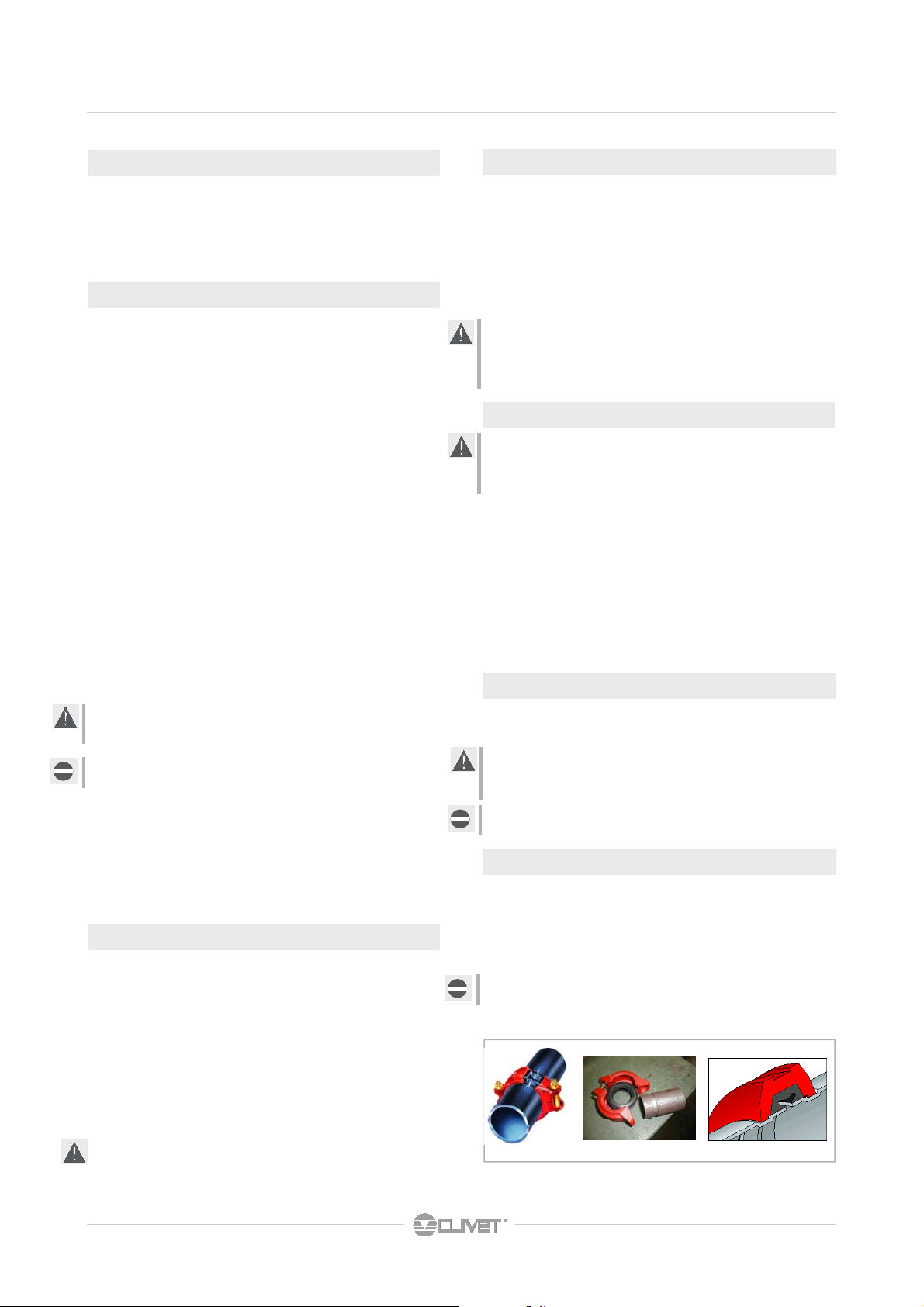
• use antivibration devices on unit bearing points
• install flexible joints on the hydraulic connections
Choose the installation place according to the following
criteria:
• Customer approval
• safe accessible position
• technical spaces requested by the unit
• spaces for the air intake/exhaust
• avoid flood-prone places
• verify unit weight and bearing point capacity
• verify that all bearing points are aligned and leveled
• install the unit raised from the ground
• max. distance allowed by the electrical connections
Prefer places where the unit doesn’t disturb the neighbours.
Avoid installations next to bedrooms or windows.
Avoid snow accumulations on batteries.
3 - POSITIONING
3.4 CONDENSATE WATER
When a heat pump is running it produces a considerable
amount of water due to the defrosting cycles of the external
coil.
The condensation must be eliminated in a manner to avoid
wetting pedestrian areas.
With extensive very cold outdoor temperatures, condensation
could freeze and block the flow, causing a slow build-up of
ice; therefore special attention must be paid to eliminating
condensation, raising the unit off the ground and evaluating
whether antifreeze elements should be installed
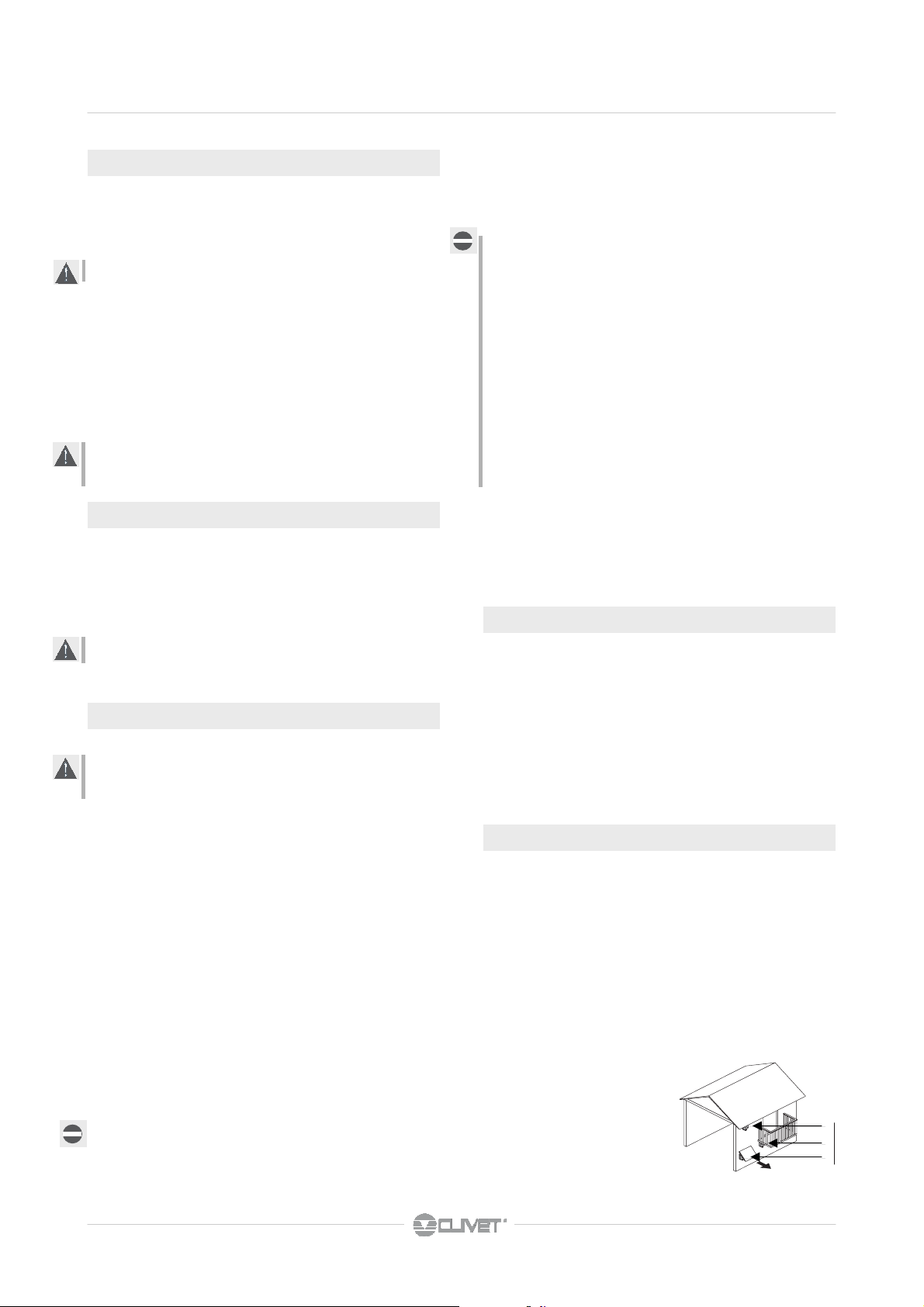
3.5 FRESH AIR PROBE - OPTIONAL
A
B
C
NORD
The external probe allows to automatically change the unit set
point according to the external enthalpy (temperature +
humidity).
It is then possible to optimize the unit energy efficiency.
POSITIONING
The sensor should not be influenced by factors that can
distort the reading (eg direct sunlight, air exhausted from the
fan or other sources, contact with the unit structure or other
heat sources, accumulations of snow / ice).
Examples to position the external probe :
• A roof
• B under a terrace
• C if at free wall provide a
small roofing